Showing posts with label Sementeyo/Cemeteries. Show all posts

Wednesday, May 21, 2025

WHY THEY CRIED AT TIGUAK CEMETERY


Tiguak, usually spelled Tiguac, is Guam's one and only public cemetery. It's also perhaps Guam's most pitiful cemetery.

Recently, in the news, it's been announced that the cemetery has only 8 burial plots left. A bill has been introduced to give the cemetery more land adjacent to the present cemetery. But some community leaders are saying more land is not the only issue; properly maintaining the cemetery that already exists is just as important an issue, and that the Government has done a poor job of it.

Many might be surprised to know this is not a new problem. People were decrying the condition of Tiguak Cemetery right from the beginning.

The Guam Code authorized the Government of Guam to establish a public cemetery, but nothing was done to put this into effect in the 1950s. In 1961, Governor Flores designated nearly 20 acres in Talofofo to be used for a public cemetery, but it was never done.

Then in 1964, the need for a public cemetery was brought up in the Guam Legislature. Up to that time, your options for burial on Guam were just with the Catholic and Protestant cemeteries, and, much more rarely, the US Naval Cemetery in East Agaña. But these cemeteries were filling up fast. The Catholic cemeteries ordinarily buried only Catholics, and even Protestants who were not Baptists or Seventh Day Adventists depended on the good graces of those two churches to bury them. Then there would come the time when people with no religion, or non-Christian people, would need a final resting place.

The days of relying on the churches to bury everybody were fast coming to an end. Both Catholic and Protestant church leaders urged the Government to move on a public cemetery. In late 1965, Governor Manuel Guerrero chose Tiguak as the site of Guam's first and only public cemetery, but funding would have to come from the Guam Legislature.


EL PATIO FIRE IN 1957


Interestingly, the site Guerrero put aside for a cemetery had been the location of a popular nightclub called El Patio which had burned down! Perhaps that should have been an indication that the area was under a cloud of some sort.

By January of 1967, the news reported that Public Works was building a road leading into the cemetery. That February, a documented burial took place at the cemetery.

But it seems that building a road to Tiguak, and removing tall grass and trees, was all the Government did. The rest was up to the family of the deceased. No structures of any sort were built. No hall, no restroom, no parking. A grave was dug and the coffin lowered into it. It was the family's decision what marker was to be placed. 

Part of the challenge was the terrain. A lot of Tiguak is not level, but slopes down into gullies. The landscape makes it very hard to even the ground.


ALREADY COMPLAINTS IN 1968

"Pathetic, disgusting and shameful" were just some of the words used as early as 1968 to describe the situation at Tiguak.

Joe Murphy wrote about it in his column for the Guam Daily News, after receiving phone calls and personal visits from people who had attended a burial at Tiguak and found the condition of the cemetery intolerable. 

Since the cemetery was not maintained, reaching a burial plot meant walking through overgrown weeds, with sticker burrs all over your pants and socks. Pall bearers had to carefully step over loose boards lying all around. 

"No one cried until they saw the cemetery," one person said, who had attended the funeral at Tiguak. Guam was no place to die, they said, unless you could get buried at one of the religious cemeteries.


DECADES OF MINIMAL MANAGEMENT


THE FAMOUS HORSE GRAVESTONE AT TIGUAK


The only thing, apparently, that has changed at Tiguak since the first complaints in 1968 has been the increase of burials.

Because it is Guam's most affordable burial place, Tiguak has filled to over 4000 burials. Pigo Cemetery, Guam's largest Catholic cemetery, is still the most populated on Guam, with over 8000 burials. Guam Memorial Park in Leyang, a private business, is fast approaching with over 7000 burials.

Due to the large number of burials, graves are often very close to each other. Families freely augment the graves anyway they feel like it, recently creating controversy when a life-sized white horse was built on a grave. Weeds and debris are everywhere, and there are no paved roads nor parking lots inside the cemetery. The cemetery has also been a favorite dumping ground for illegal dumping.

Responsibility for the cemetery, considered a headache to handle by many, shifted from Public Health to Public Works to Parks and Recreation.

In the 1980s, the cemetery was named the Vicente A. Limtiaco Memorial Park, in honor of the long-time Commissioner (Mayor) of Piti.

Already in 1988, former Senator Ben Ada was saying that the problem wasn't the need for more cemetery land, but the need to fund and properly maintain the cemetery.


Wednesday, March 26, 2025

CAPITOL HILL CEMETERY


CAPITOL HILL "WIRELESS RIDGE" CEMETERY


In some countries where, in the past, almost everybody was Catholic, there are Non-Catholic Cemeteries set up to accommodate non-Catholics, usually people who are not native to the place. Rome has a famous Cimitero Acattolico, which literally means "Non-Catholic Cemetery," where some famous people like John Keats and Percy Bysshe Shelley, English poets, are buried. There are so many British and Protestant people buried there that the cemetery is often called the English Cemetery or the Protestant Cemetery, but Non-Catholic Cemetery is more accurate as there are a good number of Russians, Germans and many other nationalities, even Italians, buried here. And not just Protestants but Orthodox as well.

Keats and Shelley were Protestant, not Catholic, and, in those days, non-Catholics and even Catholics who committed suicide or who otherwise lived in public sin could not be buried in the Catholic cemetery proper, but only outside it, where the ground was not consecrated.

Saipan was a place where everybody, at one time, was Catholic, at least among its native population. In the 1950s, 60s and 70s it had no other cemeteries but the ones for Catholics.

So what was someone to do if one died in Saipan but was not Catholic?

This was Mike Marcus' situation in 1975. Marcus, a Chuukese Protestant and Saipan's safety officer at the time, was trying to bury his infant daughter on Saipan, and could only do so "outside the fence" at the Catholic cemetery. He did so, but began prompting government officials to look for a site in Saipan suitable for a public cemetery where anybody could be buried, regardless of religious affiliation.


WIRELESS RIDGE


The area selected was a far, isolated spot north of Capitol Hill called Wireless Ridge by the Americans after the war.

There are just a little over 100 graves at Wireless Cemetery today. If Marcus' daughter was buried there, either the grave can't be found anymore or her remains were moved. The oldest death we can tell from the grave stones was in 1975; someone named Kim An Montenero.

As can be expected, the cemetery has a good number of Koreans, Chinese and Micronesians from various parts of that region. There are fewer numbers of Statesiders and Filipinos. There are Protestant Christians and non-Christian Buddhists and at least one Jew.


DIFFERENT ETHNIC BACKGROUNDS AND RELIGIONS


There is at least one Chamorro we know of buried here, which is unusual given that most Chamorros are Catholic, but we're not sure why she is buried here. There could be a few other Chamorros buried here, but I'm not totally sure yet if they are Chamorro. If the surname is Spanish, the deceased could be some other race. It's also possible the deceased with a Chamorro name had been married to one but is not Chamorro herself.

Due to the fact that many of those buried here have few, and some no family at all, on Saipan, many of the graves are not cared for. Mother Nature has taken over a lot of the cemetery, with the grass so tall that it hides many of the graves. Many of the grave stones are no longer legible or lack signage completely. A few graves are reduced to just a small percentage of the cement that used to be there, and one cement grave is partially open.

Hillside fires, sometimes due to the heat of the dry season and sometimes due to deer hunters setting fires to scare the deer, typhoons and just the passing of time exposed to sun and rain have taken their toll on many of the graves. It's certain that some graves are now completely unseen. 


When you first drive into the cemetery, it appears to be rather small, but that's only because the tall grass and some of the tall trees obscure your vision. The cemetery is actually a good size, and goes all the way to the edge of the cliff. It has a great view of Mañagaha Island.

There was talk of closing this cemetery so that a larger, better-located public cemetery for Saipan can be opened, and the graves at Wireless transferred to the new one. But the new one has yet to be built, so Wireless continues till this day.

Tuesday, June 28, 2022

CHAMORRO GRAVE IN ANGAUR


CECILIA CAMACHO CABRERA
1922 to 1923


Angaur is one of the Palau islands, situated at the very southern part of the island chain.

When the Germans got control of the Caroline Islands in 1899, they got control over Palau. Around 1909, the Germans started to mine Angaur for phosphate, which makes excellent fertilizer in the production of plants. It can also be turned into phosphoric acid which is used for many things, from cosmetics to animal feed. Money could be made selling phosphorus, and the Germans wanted to make money.

But they needed workers. Angaur had a small population, so workers from all over those parts of the  Pacific where the Germans were in control were recruited to work in Angaur. Workers came from the other Caroline islands under the Germans, from China (the Germans controlled the port city of Tsingtao) and the Northern Marianas, also under the Germans.


ANGAUR PHOSPHATE MINES


When the Japanese took over all the German territory in Micronesia in 1914, they continued the mining of phosphorus in Angaur and the recruitment of workers from other areas.

So, Chamorros from Saipan, and a few from Luta, moved to Angaur.

One of them was Ramón Taisague Cabrera and his wife Consolación Campos Camacho. Ramón was born in Guam but moved to Saipan when he was a child when his parents, Antonio Garrido Cabrera and Agapita San Nicolás Taisague, moved to Saipan in the 1880s. One of their children, María, was born in Angaur in 1917 so the Cabreras were in Angaur at least by 1917.

If Cecilia, the deceased infant buried in Angaur, is indeed the child of Ramón and Consolación, as I suspect she was, then she, too, was born in Angaur but died in her first year of life. The Cabreras may have had other children born in Angaur who died there in infancy.


THE CHAMORRO LÁPIDA IS IN SPANISH

Some of the writing on the gravestone or lápida is no longer legible, but most of it can still be read and it's in Spanish. The Spanish had left Micronesia for twenty years already, but the Spanish language was still being used by older Chamorros who had been raised under Spain and by the Spanish missionaries. In 1923, when Cecilia died, all the Catholic missionaries in Micronesia (except for Kiribati and Nauru), including Guam, were Spanish.


After World War II, almost all the Chamorros on Palau went back to the Marianas, except for some Palauans who had Chamorro blood, the children of Chamorro men who had married Palauan women.


VERSIÓN ESPAÑOLA
(traducida por Manuel Rodríguez)

LÁPIDA CHAMORRA EN ANGAUR

Angaur es una de las Islas Palaos, situada en la parte más meridional de la cadena insular.

Cuando en 1899, los alemanes obtuvieron de los españoles el control de las Islas Carolinas, se hicieron también con el control de Palaos. Alrededor de 1909, los alemanes comenzaron a extraer fosfato de Angaur, que es un excelente fertilizante para la producción de plantas. También se puede convertir en ácido fosfórico que se usa para muchas cosas, desde cosméticos hasta alimento para animales. Se podía ganar dinero vendiendo fósforo, y los alemanes querían ganar dinero.

Pero necesitaban trabajadores. Angaur tenía una población pequeña, por lo que se reclutaron trabajadores de otras partes del Pacífico donde los alemanes tenían el control. Los trabajadores llegaron de las otras Islas Carolinas bajo el poder de los alemanes, de China (los alemanes controlaban la ciudad portuaria de Tsingtao) y de las Islas Marianas del Norte, también bajo soberanía germana.

Cuando en 1914, los japoneses se apoderaron de todo el territorio alemán en Micronesia, continuaron con la extracción de fósforo en Angaur y la contratación de trabajadores de otras áreas del Pacífico.

Entonces, los chamorros de Saipán y algunos de Rota se mudaron a Angaur.

Uno de ellos fue Ramón Taisague Cabrera y su esposa Consolación Campos Camacho. Ramón nació en Guam pero se había mudado a Saipán cuando era un niño, cuando sus padres, Antonio Garrido Cabrera y Agapita San Nicolás Taisague, se mudaran a Saipán en la década de 1880. Uno de sus hijos, María, nació en Angaur en 1917 por lo que los Cabrera residían en Angaur al menos desde esa fecha.

Si Cecilia, la bebé fallecida y enterrada en Angaur, es efectivamente hija de Ramón y Consolación, como sospecho que lo era, entonces ella también nació en Angaur pero murió en su primer año de vida. Los Cabrera podrían haber tenido otros hijos nacidos en Angaur que murieron allí durante su infancia.

LÁPIDA CHAMORRA EN ESPAÑOL

Parte de la escritura de la lápida ya no es legible, pero la mayor parte todavía se puede leer y está en español. Los españoles ya habían dejado Micronesia desde hacía unos veinte años, pero el idioma español todavía lo usaban los chamorros mayores que se habían criado bajo la soberanía y los misioneros españoles. En 1923, cuando falleció Cecilia, todos los misioneros católicos en Micronesia (excepto Kiribati y Nauru), incluido Guam, eran españoles.

Después de la Segunda Guerra Mundial, casi todos los chamorros de Palaos regresaron a las Marianas, excepto algunos palauanos que tenían sangre chamorra, hijos de hombres chamorros que se habían casado con mujeres palauanas.


Monday, July 27, 2020

LÅPIDA GI FINO' ESPAÑOT


LÅPIDA (HEADSTONE) IN PREWAR PIGO' CEMETERY


Pigo' (later Holy Cross) Cemetery was the main cemetery of Hagåtña before the war, as it is now. There were private cemeteries, a Baptist cemetery and a Navy cemetery as well. But Pigo' was the main graveyard and owned by the Church.

It went back to the 1870s and so there were graves in Pigo' since Spanish times, their lápida or headstones written in Spanish. Here are two of them, but I will focus on the one on the right.

Although blocked in large part by the wooden fence, so that we cannot identify whose grave it is, we see enough to know it is written in Spanish.


The top of the lápida has the initials D.O.M.

These stands for the Latin expression "Deo Optimo Maximo," which means "To God the Best and the Greatest."

Next we can see the Spanish "Aquí yacen los restos mortales de..." which means "Here lie the mortal remains of..."

The name of the deceased should follow and it looks like it says "María" and then what looks like "Borja." The BOR is clear, which means it can only either be Borja or Bordallo, and there was no María Bordallo before the war.

One thing we can learn from this is that no one would have written a lápida in Spanish if there were no one able to read and understand it. This is not the grave of a Spaniard, nor of an elite Chamorro from the highest level of society. And so we can learn from this that, at least at one time, a good number of ordinary Chamorros, perhaps those more exposed to Spanish language and manners, but not necessarily just of the elite class, had a good knowledge of at least some Spanish.


VERSIÓN ESPAÑOLA
(traducida por Manuel Rodríguez)

LÁPIDA EN ESPAÑOL

El cementerio Pigo (luego “Santa Cruz” o “Holy Cross”) fue el cementerio principal de Agaña antes de la guerra, como lo es también hoy en día. 

Hubo en Guam cementerios privados, un cementerio bautista y un cementerio de la Marina. Pero Pigo era el cementerio principal y era propiedad de la Iglesia Católica.

Se remonta a la década de 1870, por lo que había tumbas en Pigo desde la época española, con lápidas escritas en español. Aquí hay dos de ellas, pero me centraré en la de la derecha.

Aunque tapada en gran parte por la valla de madera, de modo que no podemos identificar de quién es la tumba, vemos lo suficiente como para saber que está escrita en español.

La parte superior de la lápida dice D.O.M.

Es la expresión latina "Deo Optimo Maximo", que significa "A Dios el mejor y el más grande".

A continuación podemos ver en español "Aquí yacen los restos mortales de ...."

El nombre del difunto debe estar a continuación y parece que dice "María" y luego parece que dice "Borja". El BOR es claro, lo que significa que solo puede ser Borja o Bordallo, y no hubo nadie con el nombre de María Bordallo antes de la guerra.

Una cosa que podemos aprender de esto es que nadie habría escrito en español si no hubiera gente capaz de leerlo y entenderlo. Ésta no es la tumba de un español, ni de un chamorro de élite del más alto nivel de la sociedad. Y así podemos entender que, al menos en un momento, un buen número de chamorros, tal vez aquellos más expuestos al idioma y al estilo de vida españoles, pero no necesariamente de la aristocracia, tenían un buen conocimiento de al menos algo de español .


Tuesday, May 2, 2017

HUMÅTAK'S HIDDEN CEMETERY


Humåtak's Hidden Protestant Cemetery
located in West Ginahit, Humåtak


As far as most people are concerned, Humåtak has but one, solitary cemetery. You make a right turn immediately after the big, towered bridge, leaving Route 1 and entering the West Ginahit area and take the road all the way in and there you will find the Catholic cemetery at the dead end. No pun intended.

And most people would not be surprised that Humåtak (so it seems) has but one cemetery. The village is one of Guam's smallest, so one cemetery should suffice. And, no surprise, it's the parish or Catholic cemetery, since everyone in Humåtak is Catholic. Right?

Wrong.

Today, of course, many Chamorros are no longer Catholic but even in the 1930s, not everyone in Humåtak was Catholic.

There was one Baptist family there.

The head of the family was Juan Aguon Quinata, the son of Faustino Mendiola Quinata and Clara Infaña Aguon. He was born in Humåtak in 1883 and then married a Sumay woman, Elocracia Guzmán Dueñas. Her first name has been spelled in a variety of ways! Her headstone spells it Elocracia. One census spells it Elogracia. And the oldest census she is in, the 1897 one, renders her name Lucrecia. She was the daughter of José Quintanilla Dueñas and María Santos Guzmán.

The couple became Baptist. Till his death, Juan read a Spanish Bible every day and lead family prayers at night.

As Baptists, none of them could be buried in the Catholic cemetery in Humåtak, the only one existing in the 1930s. So when Juan's daughter Guadalupe died in 1934, land for a non-Catholic cemetery had to be found. I am not sure how this piece of land became the Protestant (or, at least, non-Catholic) cemetery. I'd have to research at Land Management who is the owner and who were the owners in the past. I wouldn't be surprised if this land was Juan's to begin with, but that's just a guess.

Either by design or by coincidence, the Protestant Cemetery is just a few yards away from the Catholic one. It is so small; the headstones so darkened with the passage of time and the effects of the weather, that it is easy to miss when driving by.


Guadalupe's grave

Of the headstones that still exist, the oldest belongs to Juan's daughter Guadalupe, who was born on the feast of Our Lady of Guadalupe, December 12th in 1909. I have a suspicion, then, that Juan was still Catholic in 1909 since he named his daughter after the saint on whose feast the daughter was born. Our Lady of Guadalupe also happens to be the patroness of Sumay, the village where Elocracia came from.

Guadalupe had married Francisco T. Manalisay, a school teacher, but unfortunately she died a young woman, being only 24 years old at the time of death.

Sadly, just the following year, Juan's wife Elocracia also died, at the relatively young age of 55. Hers is the second oldest headstone in the cemetery.


Elocracia's weather-beaten headstone.
You can just barely make out the writing.

After the war, many of Juan's family became Seventh Day Adventists, but Juan remained a Baptist and played the organ at the Talofofo General Baptist Church. When he died in 1958 he was buried in this small cemetery along with his wife and daughter.


Juan's headstone is in better condition.

There is, finally, the grave of a stateside woman, Mary Violet Cathey (maiden name Bridges), born in Missouri. She died in Guam in 1966 and is buried in Humåtak. I do not know her story, nor her connection to the Quinatas, if any in fact exists.


For all we know, there may other graves in this cemetery, but the headstones are missing.


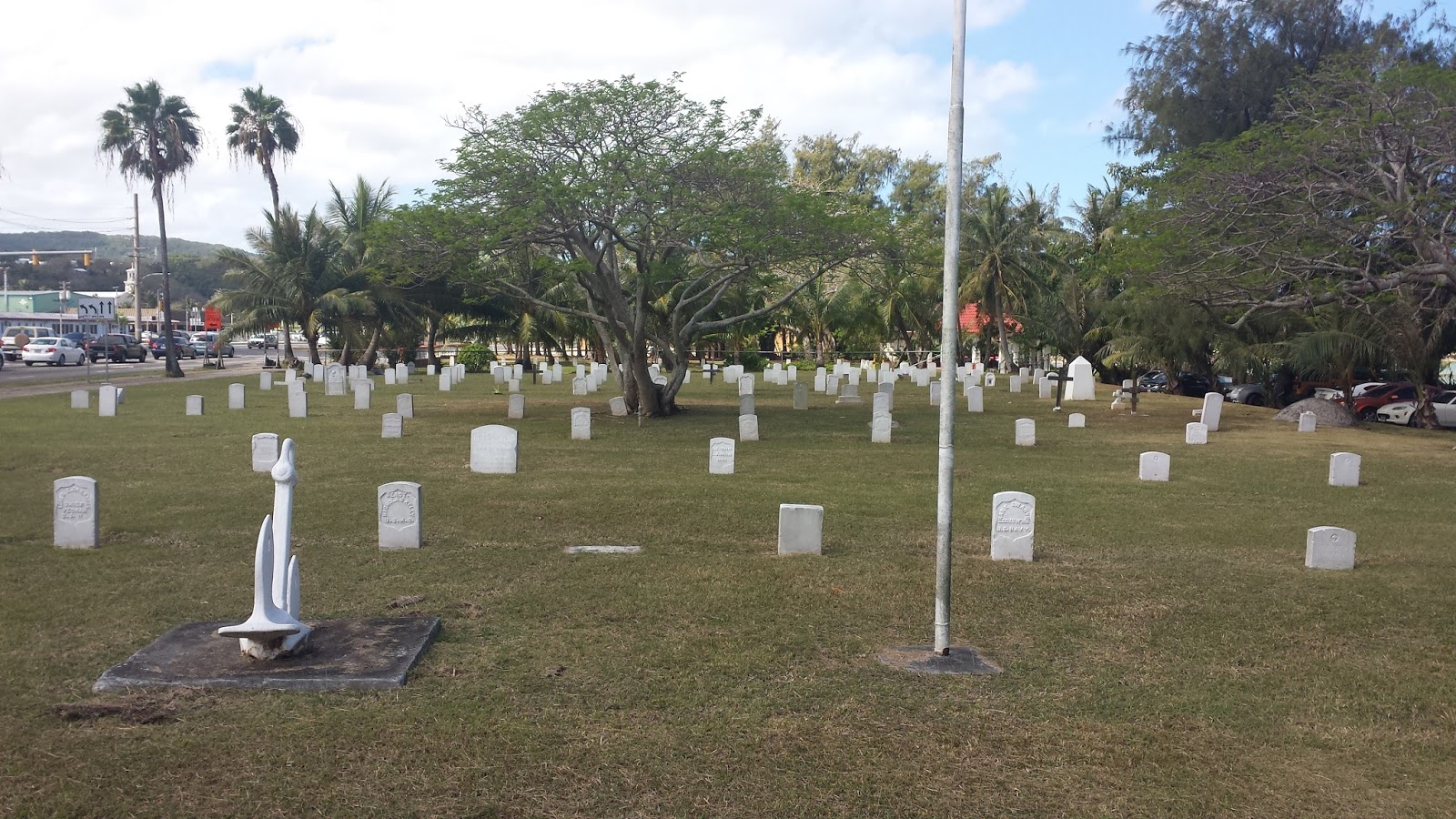
Friday, February 5, 2016

THE NAVAL CEMETERY : A FIRST


FIRST NON-CATHOLIC CEMETERY IN GUAM

Or in the Marianas, for that matter. And since westernization, to be precise. Prior to 1668, our ancestors were not Christian and were obviously buried in our islands.

But ever since Catholic Spain began to run things, only Catholic cemeteries were allowed in the Marianas, under the supervision of the local priest.

So, if you were not Catholic (and the islands always had non-Catholic residents, at least in the 1800s), where was your body laid to rest if you died in the Marianas?

The fact is that Catholic cemeteries had provisions for that possibility.

Catholic cemeteries were consecrated and a fence or a wall marked the area that was consecrated. Right outside that fence or wall was the space provided for non-Catholics, unbaptized babies, suicides and "public sinners," meaning Catholics who lived in a public way in contradiction to the religion who died without reconciling with the Church. Catholics who died unrepentant of living with a partner outside of marriage, or Catholics who joined the Freemasons, for example, would be buried here. Many of these prohibitions concerning burial in a Catholic cemetery are no longer in force, but I remember the days visiting a relative's grave which was outside the fence.

It is documented that, during Spanish times, Protestants and others were buried at Pigo but in the unconsecrated portion of the cemetery.

GOVERNOR SCHROEDER

There may be documentation stored somewhere in the US among Navy records detailing the opening of this cemetery but they aren't readily accessible, if they exist at all. Still, the first burial we know of dates back to 1902, during the tenure of the second American Naval Governor of Guam, Seaton Schroeder.

Seeing the need for a burial space for their own personnel and for the increasing number of non-Catholics on American Guam, the Naval Government chose this site for a military cemetery. At the time, this area of Hagåtña, called San Antonio, as yet had a small population. This area would have been at the outer edge of the barrio or district. But it wouldn't be long before the population grew and new houses would be built to the east of the cemetery. The beach and the road in front served as the northern and southern borders.

NOT JUST FOR AMERICAN NAVY MEN

The oldest grave is that of an American Marine private, Elwood Hopkins. But more than just active stateside military personnel are buried here. There are some spouses, children and retired military men, too. And there are also some Chamorro military men, both active and retired.


Jesus L. Guerrero, Chamorro, was in the Navy and died during World War II in 1944


Ah Shun Chang was Chinese and a member of the Auxiliary Services of the US Navy, which probably meant he was a cook or other domestic worker in the Navy.


Francisco Unpingco Rivera was a Chamorro Navy man who died in the attack at Pearl Harbor on December 7, 1941. His body was later buried on Guam.


Alessandro Veneziano was Greek Orthodox. He came to Guam as a musician in the Navy and married a Chamorro lady. His children eventually moved to the US mainland.


Gertrud Costenoble was a civilian and a German. Her husband had first moved to Saipan when it was under the Germans but he then moved to Guam.


Another German buried here was a civil servant in the Saipan government! For whatever reason (maybe medical?) he was on Guam in early 1903 and passed away.


THE CORMORAN GRAVES

On April 7, 1917, when the U.S. declared war on Germany, a German ship, the SMS Cormoran, peacefully lay in Apra Harbor. Rather than let the ship fall into American hands, the Germans on board blew up their own ship. Seven crew members died and are buried in this cemetery.


The Cormoran marker, with the German Iron Cross and inscription in the German language.


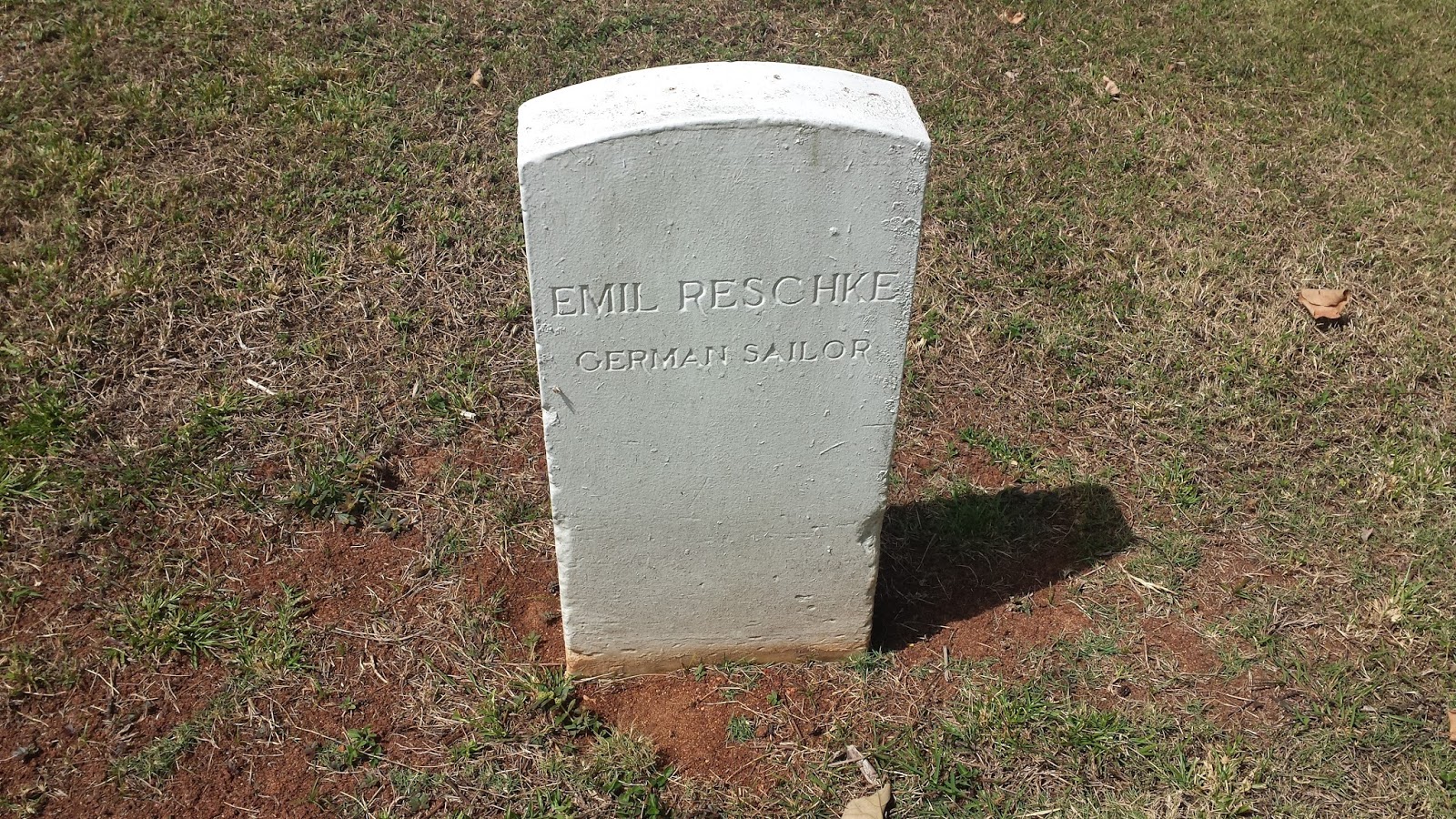
Poor Emil Reschke of the German Navy didn't make it alive after the explosion.


One of the Cormoran deceased was not German at all but from German-controlled New Guinea. His name was Boomerum (or Bumerum).


MAY THEY ALL REST IN PEACE

Thursday, June 25, 2015

PRE-WAR TAKANO MAUSOLEUM?

MARC collection

In a pre-war photo of Pigo Catholic Cemetery stands a large mausoleum.

The mausoleum itself is prominent, dwarfing the small lápida (grave stones) around it. But what also catches the eye on closer inspection are the Chinese characters written above the entrance of the mausoleum.

Japanese names are written in Chinese characters (kanji). The mausoleum shows that the owners had some money, and that they were Catholic, which usually meant a Japanese male married to a Chamorro female.

So I asked some people to take a look at the kanji. They said it meant No ("field") and Daka or Taka from takai ("high").

This only made me more mystified because there was no Japanese-Chamorro families names Nodaka.

But there was (is) a Japanese-Chamorro family named Takano, and they ran a store.

If you invert No and Daka/Taka, you get Takano.

Perhaps this was the Takano family mausoleum.

The family patriarch was a Japanese who settled Guam and who received the Christian name Vicente when he married Dolores Dydasco San Nicolas.


Tuesday, August 20, 2013

ANOTHER SPANISH LÁPIDA


Even up to the 1920s, Chamorros were writing some things in Spanish, including cemetery headstones.  This one is in Saipan.

Aquí yacen los restos mortales de Rodrigo de Castro que falleció 18 de enero de 1913 a los 62 años de edad.  Su desconsolada esposa y familia dedican este recuerdo como prueba del acendrado cariño y amor que le profesan.  RIP

"Here lies the mortal remains of Rodrigo de Castro who passed on the 18th of January in 1913 at the age of 62 years.  His inconsolable wife and family dedicate this memorial as a sign of their sincere affection and love which they have for him.  Rest in peace."

Saturday, March 9, 2013

GUAM'S SMALLEST CEMETERY?

 
Four graves.  That's it.

I know of individual graves, and also graves of two, perhaps three, individuals buried right next to a private residence.  But I wouldn't consider those cemeteries but rather private graves, instead.

But this site, not connected to any private residence, could be the smallest cemetery in all the Marianas.  Four graves.

It's found in Humåtak, just outside the large Catholic cemetery.  These four graves belong to four Baptists in Humåtak, who could not be buried in the Catholic cemetery for obvious reasons.


Juan Aguon Quinata, born in 1883, was baptized a Catholic, as they all were during Spanish times.  Later, during American times, he became a Baptist.  He died in 1953.  Two other graves are of people who died in 1925 and 1934.  So this small area was designated for the Humåtak Baptists in the 1920s.

I have to investigate further, but I think the Baptist connection came about through marriage with one of the Hagåtña Baptists.  These graves are basically of people within one family.

The gravestones all include at the bottom the opening lines of one of the most famous English Protestant hymns :  Rock of Ages, cleft for me, let me hide myself in thee!

It's amazing what you find hidden in some of the small villages and isolated locations in our islands - if you just look hard enough.

Monday, October 1, 2012

LÅPIDAN SUMAY


Gravestone of a Chamorro in Sumay
In Spanish

This lápida has cracked in two, and some parts are missing from the very top.  But, from what we can read, it says :

Concepcion Perez que
falleció el 10 de agos-
to de 1913 a los 9 añ-
os de edad.

(Concepcion Perez who
passed away the 10th of
August of 1913 at 9
years of age.)

In the bottom half :

(Su) Padre y Madre le de-
dican este recuerdo.
Rogar a Dios por su e-
terno descanso.
R.I.P.

(Her father and mother
dedicate to her this memorial.
Pray to God for her eternal rest.
Rest In Peace.)


NOTES

  • We can only assume the little girl's name was Concepcion Perez.  But since part of the låpida is missing, there is a remote chance Concepcion was her middle name and her first name is in the missing piece.  But I doubt it.

  • R.I.P. stands for Requiescat In Pace, which is Latin for "Rest In Peace."

Tuesday, August 21, 2012

GERMAN REMAINS


Memorial Marker to the German Dead
Navy Cemetery, Hagåtña


This German visitor, after seeing what is left of the buildings and structures built by the Spanish (Malesso' konbento), pre-war Americans (Merlyn G. Cook School) and even Japanese (some pillbox gun placements), asked me if there were any German remains on Guam.

I said, "Yes, come with me."

I think he was expecting a building, but instead I took him to the Navy cemetery in Hagåtña where the skeletal remains of German sailors are buried - sailors who died in the scuttling of the HMS Cormoran ship in Apra Harbor when America declared war on Germany in 1917.

I don't think he was aware that Guam was never part of the German colonies.  Saipan and Rota were, but not Guam.

Sunday, July 1, 2012

CHAMORRO LÅPIDA


CELINA Q. CASTRO

ma'agang para i inet
non i man Angeles
gi anae 13 meses edadña
gi 29 Sep 1964.
AMDG

Or

CELINA Q. CASTRO
ma ågang para i inetnon
i man Ångheles
gi annai 13 meses edåt-ña
gi 29 Septiembre 1964.
AMDG

Or

CELINA Q. CASTRO
called to be with the company of Angels
when she was 13 months old
on September 29, 1964.

AMDG are the initials of a Latin phrase : Ad Maiorem Dei Gloriam.  For the Greater Glory of God.

Repåra.  Notice.

  • Because the dear child was incapable of personal sin, being too young, she was assured of heaven when she passed from this life.  Thus, she was "called to be with the company of Angels."
  • Thus, there is no expression "Rest in Peace" on the gravestone.  She is most certainly in heaven; no prayers or best wishes are needed for her.  She is where the best is to be found - heaven.  In God's glory.  Thus, the concluding sentiment is "Ad Maiorem Dei Gloriam," "For the Greater Glory of God."  God called her when still innocent and sinless to be one with Him in His glory, to adore and glorify Him.
  • The date is expressed 29 September, not September 29.  This follows the Spanish (and other European) form of stating the day first, then the month.

Friday, June 8, 2012

LÅPIDAN SUMAY


Gravestone of a Chamorro in Sumay Cemetery
In Spanish

At the top of this lápida are the initials R.I.P. for the Latin Requiescat In Pace, which means "Rest In Peace."

Then it reads :

Aquí yacen los restos
mortales de D. Juan
de la Cruz que falleció
el día 28 de Marzo
del año 1910.

(Here rest the mortal
remains of Don Juan
de la Cruz who passed away
on the 28th day of March
in the year 1910.)

At the bottom, barely legible, is written :

Su hijo D. Ygnacio
le dedica este cari-
ñoso recuerdo.

(His son Don Ygnacio
dedicates to him this
loving memorial.)


NOTES

  • I am almost sure this is the grave of Tun Ignacion Tuan's grandfather.  Tun Ignacio was Ignacio Alcantara Cruz, son of Ignacio Mendiola Cruz, whose father was Juan Cruz.  Tuan was his "better-known-as." If this is the case, then this is the great-grandfather of Dr. Olivia Cruz and her siblings.

  • In Spanish, I and Y have the same sound as vowels.  So Ignacio was sometimes spelled Ygnacio; the same with Ysabel-Isabel and Ysidro-Isidro.  We Chamorros have inherited this in cases such as Ypao-Ipao, Ylig-Ilig and Ysengsong-Isengsong.  If I'm not mistaken, our license plates say "Tano Y Chamorro," again a throwback to Spanish times when Y and I sounded the same, and they still do in Spain and, I guess, apparently, to us.  Though I prefer to stick with the I and use the Y as a consonant as in Yigo or Yu'us.  Otherwise one could write, "Y Yy'os-ta."  "Our God."  Doesn't "I Yi'os-ta" look clearer? 

  • All Cruzes started out as "de la Cruz," then dropped the "de la" for convenience.   A small number have kept the "de la."

Sunday, May 27, 2012

LÅPIDAN SUMAY


Gravestone of a Chamorro in Sumay Cemetery
In Chamorro

It reads :

LUIS C. SABLAN

Mafañago gi

Sept. 23, 1886

Matai

gi

Oct. 23, 1936

It is the grave of Luis C. Sablan, born in 1886 and deceased in 1936.

Monday, May 7, 2012

LÅPIDAN SUMAY


Gravestone of a Chamorro in Sumay Cemetery
In Spanish

Starting from the very top, to the right of the angel, it reads :

Rogad por él.
Sus desconsolados
esposa e hijos
dedican este recuerdo!

(Pray for him.
His inconsolable
wife and children
dedicate this memorial!)

Then the abbreviation : E.P.D. which stands for :

En Paz Descanse
(Rest in Peace)

At the bottom :

Aquí yacen los restos mortales de
D. Pedro Borja Pangelinan
+25 Abril 1929
a la edad de 45 años

(Here lie the mortal remains of
Don Pedro Borja Pangelinan
Died 25 April 1929
at the age of 45 years.)


NOTES

  • Spanish was still in vogue with some people even in 1929, 30 years after American colonization began.  Spanish was still prestigious, and associated with church matters, with all the priests being Spanish at the time

  • In 1920, the American Governor obliged the Chamorros to follow the American order when using surnames; the maternal in the middle and the paternal last.  Prior to that, Chamorros followed the Spanish system which was the reverse.  Under Spain, the deceased would have been Don Pedro Pangelinan Borja.  Everyone would have known that Pangelinan was his last name.

  • Because he had "Don" added to his name, Pedro was some kind of municipal leader at some point in his life.

  • This man is an ancestor of the Kotla clan of Pangelinans.

  • The lápida is pretty high-grade.  Made in Manila?

Monday, April 30, 2012

SEMENTEYON SUMAY


The village of Sumay is gone.

But not its cemetery.

Most of the lápida (gravestones) are now nameless slabs of stone.  But a few remain, in Spanish, Chamorro and English, to the extent that we can come up with a list of the people buried here :


This list is long, but some names are missing, such as Concepcion Perez, whose Spanish lápida I saw for myself, lying on the ground in this cemetery.

The Sumay baptismal records survived the war, so even if the cemetery did not survive, or even if it survived but most lápida are unidentifiable at this time, those baptismal records provide us much valuable family information.

For us Hagåtña people, we lost both the baptismal records and our cemetery (Pigo') to American bombardment.  Ai ke lástima!

Monday, May 30, 2011

OLD CEMETERY IN HÅGAT


I guess you can tell I like cemeteries.  I do.  I have to visit them when I see them, even in foreign countries.

The old cemetery in Hågat is easy to miss if you're not looking for it.  It is located in what was the original site of the pre-war village.  After the war, the population moved south to its present location.  I am old enough (ugh) to remember seeing Hågat called "New Agat."  At the time, I only knew of one Agat.  Where was the old one?  The answer is seen in the photo above.

The church in old Agat was where the 76 gas station is now.


I didn't find too many graves at the old cemetery, and many of them are not attended to and are missing identification.  Not many were very old (pre-war) so I imagine the place got pretty messed up by the pre-liberation bombardment.  Many of the names are easily recognizable as Sumay people, so I assume both neighboring villages shared this cemetery.

But there were a good number of graves from just after liberation.  It is said that some of the victims of the FENA MASSACRE (July, 1944) are buried here in this cemetery.

http://www.airdaleamericanhistory.com/WWII--Agat-SantaRita02.html

Thursday, May 19, 2011

NAVAL CEMETERY, HAGÅTÑA


I noticed they took down the fence at the Naval Cemetery in Hagåtña.  The cemetery was opened by the newly-arrived American Naval Government quite early, as the oldest grave is dated 1902.

One of the most historical features of this cemetery are the graves of several German sailors who lost their lives in the scuttling of German ship the SMS Cormoran in 1917.  To read up on the story, go to http://en.wikipedia.org/wiki/Scuttling_of_SMS_Cormoran.


Emil Reschke was one such unfortunate German seaman.


Several more individual graves exist, but a monument to all the Cormoran dead is also on site at the cemetery.   The marker reads, "Den Toten von SMS Cormoran.  7 IV 1917"
"The dead of the SMS Cormoran.  April 7, 1917."


Besides the German sailors, there is the grave of a civilian German, Gertrud Blum Costenoble, the wife of Hermann Costenoble.  She and her husband moved to Saipan in 1902 when it was a German colony, but then moved to American Guam in 1904 where they engaged in business.  Of her 9 children, one was born on Saipan and the youngest was born on Guam.  Gertrude died on Guam in 1915.  The Costenobles moved back and forth between Guam and Manila, and most eventually settled in the U.S.  But while on Guam, besides running businesses, they were a prominent part of the social scene.

Finally, there are many graves of both American and Chamorro service men in this cemetery.

Friday, April 8, 2011

A HIDDEN GEM IN HAGÅTÑA


Precious little in Hagåtña survived the massive American bombardment of the city in 1944.  But tucked away in the back streets of town, near the cliff line, is a private, family cemetery that did survive the war.  It was owned by the Torres-Leon Guerrero family, with connections to Padre Palomo (who was a Torres, and whose sister married a Leon Guerrero) and to the Martinez family (María LG Torres married Pedro Pangelinan Martínez).

The remains of Padre Palomo, the first Chamorro Catholic priest, are interred here.  Don Pedro and Tan María Martínez rest here as well, and many of their children. 

How old is this cemetery?  I'll have to ask family members, but there is a headstone (called lápida in Spanish/Chamorro) kept here that dates to 1910.  It seems to be the headstone of one Caridad Leon Guerrero, who was married to a Suarez.  Here is the headstone, written in Spanish back when Spanish was still the language of the educated and upper classes of the Marianas :


It reads, in Spanish, "Aquí yaces Caridad / pues la parca te segó / mas tu espíritu voló / al seno de la Deidad."

It means, "Here you lie Caridad / for death has felled you / but your spirit flew / to the bosom of the divinity."

This was poetic, not elementary, Spanish and indicates the high level of Spanish spoken by some on Guam at the time.

The stone is dated March 18, 1910.

The D.O.M. at the top is the abbreviation for "Deo Optimo Maximo," a Latin phrase meaning "to God, the Best and the Greatest."  It was the custom to write this abbreviation on many public buildings and monuments all over Catholic Europe.