Showing posts with label Tinian. Show all posts

Friday, August 7, 2020

A SURVIVOR REMEMBERS THE MARIANAS 1848


TINIAN


A man read the newspaper one day that the US had just taken Guam away from Spain.

Guam! He had been there fifty years before, in 1848. He had been, in fact, on Tinian and Luta as well. Memories came flooding back, and he went looking for some notes he wrote about his experience to refresh his memory. He read them again, and shared his memories with newspapers at the time.


SHIPWRECKED ON TINIAN


THE CANTON

Charles Miles was just sixteen years old in 1848. Somehow he became an apprentice crew member of a British ship, the Canton. The Canton was used for many things but one of them was transporting convicts to Australia, a penal colony of England at the time. But the ship also engaged in commerce and that day in 1848 it was bound for Hong Kong from Sydney with goods to sell. Finding itself in a storm, the ship lost its way and ended up crashing into Tinian. It was October. Typhoon season.

Twenty out of the twenty-five men on board perished. The wreck was so bad that even the mainmast came crashing down, but Miles and William Foxal managed to get into a lifeboat that they had lowered. Then they rescued from the water Thomas Avent, then William Thompson, and then a fifth man whose name wasn't recorded. Five survivors only.

For ten hours they drifted in the lifeboat till they managed to climb on shore, on the eastern side of Tinian which is almost all cliffs; not very high but which go straight down into the ocean. They survived on some fruits from trees found near the shore and on shellfish, probably small crabs, which they caught scurrying on the coral rocks.


Hard to land on most places in Tinian


FOUND BY CHAMORRO WORKERS

Unlike other shipwreck survivors who ended up on Tinian, the five survivors of the Canton found people on Tinian. That didn't always happen before.

Tinian, since the early 1700s, had no permanent population. The Spaniards had taken all the Tinian people down to Guam where they mixed with the Guam Chamorros. That left Tinian completely empty of people.

But the island was recognized as an excellent place to raise cattle. It was flat and grassy. Everything was owned by the Spanish government. Chamorro workers from Guam, numbering twenty or so, would go up to Tinian for temporary work, butchering cattle and pork and salting the meat, and sending down to Guam the meat and island produce to be sold by the government. The income was meant to support Guam's "lepers" and other indigents.

When other castaways on Tinian found no one, it just so happened they got there when the Guam workers were not there. But had the survivors stayed longer, it was only a matter of time before a boat of Guam workers would come up. Or the Spaniards would get word of a shipwreck in Tinian or Saipan, and the government would send up soldiers to check things out.

That day when the Canton was shipwrecked was a time when Guam workers were on Tinian. It was only a question when, not if, the five survivors would be found by those Chamorros farm laborers. The first indication that the survivors were not alone on Tinian was when they heard an unseen human voice cry out, "KOO EEE! KOO EEE!" Even though they had no idea if the calling was by friend or foe, the desperate survivors yelled back. Now even more unseen voices yelled out "KOO EEE," followed by the sound of barking dogs.

First appeared the dogs, then five island men, their teeth stained black and red from betel nut, most if not all we can assume were Chamorro, appeared, carrying musket guns and spears. The island men made friendly gestures and restrained the dogs, so the five survivors felt at ease. The Chamorro men offered the castaways local tobacco and then took out corn on the cob from woven baskets, which the survivors eagerly ate. Miles and his companions were escorted to the western side of Tinian, where the settlement was.

MEETING THE ALCALDE

Eventually, the alcalde (mayor) of Tinian came on the scene. Don Diego was dressed somewhat more fancy than the workers, who wore just the bare essentials, but the alcalde was barefoot. He had a long, dangling sword that got in the way of his legs. The alcalde explained that workers on the island had found wreckage washed ashore, plus the life boat and a box of stick candles, probably from the Canton. The candles the alcalde had burned before the image of San Antonio (Saint Anthony), who was obviously responsible for the survivors being found, the alcalde said. Saint Anthony is the patron saint of lost things.

LIFE IN TINIAN IN 1848

There were fifteen workers on Tinian at the time, the alcalde and his family and one convict, Manuel. Manuel was a Spanish political prisoner, having participated in a failed uprising in Madrid. Due to Tinian's isolation, Manuel was not confined to a cell; the whole island was his prison. The survivors ate well on Tinian and tried tuba for the first time. Though not a strong liquor, Miles noticed some of the men becoming rowdy after drinking it.

Every full moon, Carolinians in their canoes came to transport the dried meat and other products to Guam. It was one such Carolinian canoe that brought the survivors to Luta, their next stop before going to Guam.


CANOES OF SATAWAL
Many of the Carolinians in the Marianas were from Satawal


LUTA FOR A WHILE

Miles said that Luta rose out of the ocean like a "green gem." Luta was much higher than flat Tinian, and its coast not as rugged. There also seemed to be much more farming in Luta. Of course, what Miles may not have known is that Luta always had a permanent population since prehistoric times, never having been depopulated by the Spanish. Thus, while Tinian may have had 15 to 20 temporary workers, Luta always had 200 to 400 lifelong inhabitants. There, the alcalde, Don Joaquín, received the five Englishmen courteously, having read a letter handed over by Miles, written by the Tinian alcalde explaining who the survivors were.

On Luta, Miles found four Spanish convicts, all political prisoners, but this time they were chained, unlike Manuel who was not chained in Tinian. But, it was explained, the alcalde chained the Spaniards only when visitors came to Luta, for fear that the convicts might convince the visitors to take them off the island. Once visitors left, the prisoners were let loose again.

DOWN TO GUAM

The Carolinian canoe brought the survivors down to Guam and, being a canoe and not a ship, went straight for Hagåtña which a canoe could reach through the small channel. Hagåtña, with 5000 residents, presented of course a scene altogether different from Tinian and Luta. Here were many houses, stone buildings, a large stone church, a fort on the hill and the Governor's palace. Chanorro spectators looked on without smiles, not knowing if the five white men were pirates or unfortunate castaways. A large group of soldiers took the five to the Governor, who read the letter from the alcalde of Luta. All was well after that, and the Governor treated them very nicely.

The five men of the Canton stayed only a week on Guam. In 1848, many ships were coming to Gum and a French vessel happened to be leaving Guam for Manila. Miles eventually moved to the United States and it was there that he read the news about Guam coming under American rule and prompted him to publicize his time in the Marianas in 1848.

Two things about Guam made a big impression on Charles Miles.


ELEPHANTIASIS


A man from Guam with elephantiasis

Elephantiasis is a disease caused by parasitic worms which lodge in the body, blocking the flow of lymph which is part of our immune system. This results in the swelling of arms, legs and other parts of the body. The worms are carried by mosquitoes who pass the worms into the body when they bite.

The condition was common in the Marianas during the Spanish era. Apparently, it didn't always cause pain in those afflicted.


COCKFIGHTING


Cockfighting was all the rage on Guam on Sundays after Mass. Huge crowds, mostly men, gathered at the gayera held in an open field in front of the Hagåtña church. Men would walk to the pit with their roosters under their arms. The cocks fought with spurs, the crowd hissing and clapping and screaming bets. Dozens of birds died, but as soon as one match was over, a new one began. When the church bell rang, everyone knelt down and said prayers and got back up and the game continued.


MY OWN OBSERVATION : ENGLISH NOT UNKNOWN

It was only 1848, but quite a few Chamorros and Spaniards Miles met knew at least a few words in English.

This was certainly due to the large presence of British and American whalers who visited the Marianas starting around the 1820s. Many young Chamorro men joined the whaling ships and picked up basic English, but most never came back. If someone on Guam or Luta could say a few words in English, even swear words, it was because there were always Anglo whalers hanging around Guam, mixing with the people.

The very first English words Miles heard on Tinian outside his group of companions was from a dark-skinned woman nursing a baby at the small encampment on the western side. "Alright, alright," she said as she patted Miles' head to comfort him. That was the full extent of her English.

The alcalde of Tinian knew some English, but he did greet the English sailors "Good morning" when the sun was setting, so obviously his English was rough. But he did tell Miles, the 16-year-old, "Poor boy." I have a feeling Miles was not just young but also short at the time such that everyone was calling him "boy" and treating him like one.

The alcalde of Luta also knew some English. But when he received from the survivors the letter from the alcalde of Tinian, instead of saying "Thank you" he said "You're welcome." One of the guards on Luta said, "How do, Jack? We speak English very much." There was also a Carlos living on Luta who spoke English, whom the alcalde tasked to show the survivors around the island.

Miles said the Spanish Governor he met, who would have been Pablo Pérez, spoke very good English, telling them how glad he was that they were safe and sound and would be on the next ship possible sailing to Manila.

The point of all this is not to ascribe any value to our people's English-speaking abilities at the time. It is to point out the historical evidence that the British and American whalers were making an impact on a handful of Chamorros of the 1800s in terms of spreading familiarity with English. Long before the US took over Guam in 1898, many of our people were familiar with Americans, American ways and the English language.


ADVERTISEMENT FOR THE ILL-FATED VOYAGE
August 21, 1848
Sydney, Australia newspaper


VERSIÓN ESPAÑOLA
(traducida por Manuel Rodríguez)

EL SUPERVIVIENTE DE UN NAUFRAGIO RECUERDA LAS ISLAS MARIANAS DE 1848

Un día leyendo el periódico, un hombre se enteró de que Estados Unidos acababa de arrebatar Guam a España.

Guam. Había estado allí cincuenta años antes, en 1848. De hecho, también había estado en las islas de Tinián y Rota. Los recuerdos regresaron a raudales y fue a buscar algunas notas que había escrito sobre su experiencia para refrescar la memoria. Los volvió a leer y compartió sus recuerdos con los periódicos de ese momento.

Charles Miles tenía solo dieciséis años en 1848. De alguna manera se convirtió en aprendiz de tripulante de un barco británico, el Canton. El Canton era utilizado para diferentes finalidades, pero una de ellas era transportar presos a Australia, una colonia penal de Inglaterra durante aquellos años. Pero el barco también se dedicaba al comercio y ese día de 1848 se dirigía a Hong Kong desde Sydney con mercancías para vender. Al encontrarse en medio de una tormenta, el barco se perdió y terminó chocando contra las costas de Tinián en Marianas. Era octubre, temporada de tifones.

Veinte de los veinticinco hombres a bordo perecieron. El naufragio fue tan terrible que incluso el palo mayor se derrumbó, pero Charles Miles y William Foxal lograron entrar en un bote salvavidas que habían bajado. Luego rescataron del agua a Thomas Avent, luego a William Thompson y por último a un quinto hombre cuyo nombre no se registró. Solo cinco supervivientes.

Durante diez horas estuvieron a la deriva en el bote salvavidas hasta que lograron trepar a la orilla, en el lado este de Tinián, que es casi todo acantilado; no muy alto pero sus rocas descienden directamente al océano. Sobrevivieron alimentándose de algunas frutas de los árboles que se encuentran cerca de la costa y a los mariscos, probablemente pequeños cangrejos, que capturaron en las rocas de coral.

A diferencia de otros supervivientes de naufragios que ocurrieron en Tinián, los cinco supervivientes del Canton se encontraron con gente en la isla. Eso no siempre sucedía.

Tinián, desde principios del siglo XVIII, no tenía población permanente. Los españoles habían llevado a todo el pueblo tiniano a Guam, donde se entremezclaron con los chamorros guameños. Eso dejó a Tinián completamente vacía de gente.

Pero la isla fue reconocida como un excelente lugar para la cría de ganado. Era llana y cubierta de hierba. Todo era propiedad del gobierno español. Los trabajadores chamorros de Guam, unos veinte, subían a Tinián para realizar trabajos temporales, sacrificaban el ganado, salaban la carne y enviaban a Guam los productos de Tinián para que los vendiera el gobierno. Los ingresos iban destinados a mantener a los "leprosos" de Guam y otros indigentes.

Cuando en otros naufragios en Tinián, los supervivientes no encontraron a nadie, esto fue debido a que cuando llegaron allí, los trabajadores de Guam no estaban. Pero si los supervivientes se hubieran quedado más tiempo, era solo cuestión de que llegara un barco de trabajadores de Guam. O los españoles se enterarían de un naufragio en Tinián o Saipán, y el gobierno enviaría soldados desde Guam.

Ese día en que el Canton naufragó fue un tiempo en que los trabajadores de Guam estaban en Tinián. La duda estaba en cuándo los cinco supervivientes serían encontrados por esos trabajadores chamorros. La primera indicación de que los supervivientes no estaban solos en Tinián fue cuando escucharon una voz humana invisible que gritaba: "¡KOO EEE! KOO EE!" Aunque no tenían idea de si la llamada era de un amigo o de un enemigo, los desesperados supervivientes respondieron a gritos. Ahora incluso más voces invisibles gritaron "KOO EEE", seguido por el sonido de perros ladrando.

Primero aparecieron los perros, luego cinco hombres de la isla, con los dientes teñidos de negro y rojo por la nuez de betel, la mayoría, si no todos, que podemos asumir que eran chamorros, aparecieron portando fusiles de mosquete y lanzas. Los hombres de la isla hicieron gestos amistosos y sujetaron a los perros, por lo que los cinco supervivientes se sintieron a gusto. Los chamorros ofrecieron tabaco local a los náufragos y luego sacaron mazorcas de maíz de cestas tejidas, que los supervivientes comieron con entusiasmo. Charles Miles y sus compañeros fueron escoltados al lado occidental de Tinián, donde se encontraba el poblado.

Finalmente, el alcalde de Tinián entró en escena. Don Diego vestía algo más elegante que los trabajadores, que vestían solo lo esencial, pero el alcalde estaba descalzo. Tenía una espada larga colgante que se interponía en sus piernas. El alcalde explicó que los trabajadores de la isla habían encontrado en la orilla, además del bote salvavidas, una caja de velas y otros restos, probablemente del Canton. Las velas fueron encendidas ante la imagen de San Antonio, quien obviamente había sido el responsable de que los supervivientes fueran encontrados, aseguró el alcalde. San Antonio es el santo patrón de los objetos perdidos.

En ese momento había quince trabajadores en Tinián, el alcalde y su familia y un preso, Manuel. Manuel era un preso político español, habiendo participado en un fallido levantamiento en Madrid. Debido al aislamiento de Tinián, Manuel no fue confinado en una celda; toda la isla era su prisión. Los supervivientes se alimentaron bien en Tinián y probaron la tuba por primera vez. Aunque no es un licor fuerte, Charles Miles notó que algunos de los hombres se volvían ruidosos después de beberlo.

Cada luna llena, los carolinos en sus canoas venían a Guam para traer la carne seca y otros productos. Fue una de esas canoas carolinas la que llevó a los supervivientes a Rota, su siguiente parada antes de llegar a Guam.

Charles Miles dijo que Rota se levantaba del océano como una "gema verde". Rota era mucho más elevada que la llana Tinián, y su costa no era tan accidentada. También parecía haber mucha más agricultura en Rota. Por supuesto, lo que Charles Miles puede que no supiera es que Rota siempre tuvo una población permanente desde la prehistoria, y que nunca fue despoblada por los españoles. Por lo tanto, mientras que Tinián pudo haber tenido entre 15 y 20 trabajadores temporales, Rota siempre tuvo entre 200 y 400 habitantes. Allí, el alcalde, Don Joaquín, recibió a los cinco ingleses con cortesía, después de haber leído una carta entregada por Charles Miles, escrita por el alcalde de Tinián explicando quiénes eran los supervivientes.

En Rota, Charles Miles encontró a cuatro presos españoles, todos presos políticos, pero esta vez estaban encarcelados, a diferencia de Manuel, que no estaba encadenado en Tinián. Pero se explicó el alcalde diciendo que habían encadenado a los españoles solo cuando los visitantes habían llegado a Rota, por temor a que los convictos pudieran convencer a los visitantes de sacarlos de la isla. Una vez que los visitantes se fueron, los prisioneros fueron liberados nuevamente.

La canoa carolina llevó a los supervivientes a Guam y, como era una canoa y no un barco, se dirigió directamente hacia Agaña, que una canoa podía alcanzar sin problema a través del pequeño canal. Agaña, con 5000 residentes, presentaba, por supuesto, una escena completamente diferente de Tinián y Rota. Aquí había muchas casas, edificios de piedra, una iglesia de piedra, un fuerte militar en la colina y el Palacio del Gobernador. Los chamorros los miraban sin sonreír, sin saber si los cinco hombres blancos eran piratas o desafortunados náufragos. Un gran grupo de soldados llevó a los cinco al Gobernador, quien leyó la carta del alcalde de Rota. Todo estuvo bien después de eso, y el Gobernador los trató de maravilla.

Los cinco hombres del Canton se quedaron solo una semana en Guam. En 1848, muchos barcos llegaban a Guam y un barco francés salía de la isla hacia Manila. Charles Miles finalmente se mudó a los Estados Unidos y fue allí donde leyó las noticias sobre que Guam estaba bajo el dominio estadounidense y lo impulsó a publicitar su estancia en las Marianas en 1848.

Dos cosas sobre Guam causaron una gran impresión en Charles Miles.

1) La elefantiasis, una enfermedad causada por gusanos parásitos que se alojan en el cuerpo humano y bloquean el flujo de la linfa que forma parte de nuestro sistema inmunológico. Esto da como resultado la hinchazón de brazos, piernas y otras partes del cuerpo. Los gusanos son transportados por mosquitos que pasan los gusanos al cuerpo cuando pican.

Esta condición era común en las Marianas durante la época española. Aparentemente, no siempre causaba dolor a los afectados.

2) Las peleas de gallos estaban de moda en Guam los domingos después de la misa. Grandes multitudes, en su mayoría hombres, se reunían en la “gayera” celebrada en un campo abierto frente a la iglesia de Agaña. Los hombres caminaban hasta el pozo con los gallos debajo del brazo. Los gallos peleaban con espuelas, la multitud silbaba, aplaudía y apostaba. Decenas de gallos morían, pero tan pronto como terminaba una partida, comenzaba otra nueva. Cuando sonaba la campana de la iglesia, todos se arrodillaban y rezaban, se levantaban y el juego continuaba.

Era solo el año 1848, pero algunos chamorros y españoles que conocieron a Charles Miles sabían al menos algunas palabras en inglés.

Sin duda, esto se debió a la gran presencia de balleneros británicos y estadounidenses que visitaron las Marianas a partir de la década de 1820. Muchos jóvenes chamorros se unieron a los barcos balleneros y aprendieron un inglés básico, pero la mayoría nunca regresó. Si alguien en Guam o Rota podía decir algunas palabras en inglés, incluso palabrotas, era porque siempre había balleneros anglosajones merodeando Guam, entremezclándose con la gente.

Las primeras palabras en inglés que Charles Miles escuchó en Tinián, fuera de su grupo de compañeros, fueron las de una mujer de piel oscura que amamantaba a un bebé en el pequeño poblado del lado oeste. "Alright, alright (Está bien, está bien)", dijo mientras acariciaba la cabeza de Charles Miles para consolarlo. Ésa era la extensión completa de su inglés.

El alcalde de Tinián sabía algo de inglés, pero saludó a los marineros ingleses con un "Good morning (Buenos días)" cuando el sol se estaba poniendo, así que obviamente su inglés era flojo. Pero le dijo a Charles Miles, el chico de 16 años, "Poor boy (Pobre chico)". Tengo la sensación de que Charles Miles no solo era joven, sino también bajito en ese momento, de modo que todos lo llamaban "niño" y lo trataban como tal.

El alcalde de Rota también sabía algo de inglés. Pero cuando recibió de los supervivientes la carta del alcalde de Tinián, en lugar de decir "Thank you (Gracias)", dijo "You’re welcome (De nada)". Uno de los guardias de Rota dijo: "How do, Jack? We speak English very much (¿Cómo estás, Jack? Hablamos mucho inglés)". También había un Carlos que vivía en Rota y hablaba inglés, a quien el alcalde le encargó que mostrara la isla a los supervivientes.

Charles Miles dijo que el gobernador español que conoció, que habría sido Pablo Pérez, hablaba muy bien inglés y les dijo lo contento que estaba de que estuvieran sanos y salvos y que subirían al próximo barco que zarparía desde Guam para Manila.

El objetivo de todo esto no es atribuir ningún valor a las habilidades de habla inglesa de nuestra gente en esa época. Es para señalar la evidencia histórica de que los balleneros británicos y estadounidenses estaban teniendo un impacto en un puñado de chamorros del siglo XIX en términos de difundir la familiaridad con el inglés. Mucho antes de que Estados Unidos se apoderara de Guam en 1898, alguna de nuestra gente estaba familiarizada con los estadounidenses, las costumbres estadounidenses y el idioma inglés.


Wednesday, August 21, 2019

ANSON'S ANCHOR


Commodore George Anson of the British Royal Navy visited Tinian in 1742, and lost two anchors.

Apparently, according to news accounts, one of the two was found around 1829 by a whaling vessel stopping at Tinian. When the whaling ship lowered its anchor, it touched Anson's old anchor resting at the bottom. The anchor was taken down to Guam, rusty but in usable condition, where it was banged by Chamorro workers into bars and bolts, since someone was building a ship and needed those parts.

Well, if this makes you sad, hold on.

History-minded persons in Saipan took advantage of a Scripps Institute research team doing some exploration in the very area offshore in Tinian where Anson's ship was anchored. They asked the researchers to keep an eye out for anchors, and they did in fact find two. In 2017, these two anchors were brought up. They very well could be Anson's two anchors, but the jury is still out on that until we can be more sure.

Thursday, June 20, 2019

TINIAN RANCH LIFE IN 1835


View of Tinian from Anson's ship in 1742


Hopefully it is by now well-known by my readers that Tinian was used, during the major part of the Spanish period, for cattle raising and a few other animals.

The island is, in the main, quite flat and suitable for animal grazing.

Under Spain, Tinian was also depopulated, so the entire island could be dedicated to agriculture and animal husbandry. The sale of Tinian beef, pork and other farm produce helped fund the Spanish government and the care of lepers and other needy people in Guam.

Since Tinian itself had no population, the Spanish government employed Chamorro workers from Guam, often single men who could work on Tinian for a couple of years then return to Guam, replaced by a new batch of workers repeating the cycle. Towards the end of the 1800s, Carolinian workers were brought in, but that didn't last long.

Thanks to an English shipwreck survivor, we have a bit of a description of life in Tinian in 1835, lived by these Chamorro workers from Guam.

The survivor, whose name was William Reney, sailed in a boat with five other shipmates after his ship had crashed in the Kiribati (Gilbert) Islands, some two thousand miles away. When they spotted Tinian a month later, they had depleted their meager store of food and water. They were overjoyed to find land!

They arrived at night so it wasn't until dawn's light that they met human beings on Tinian. The men described themselves as being "exiles" from Guam. I'm not sure what was exactly meant by the term. Were they found guilty of some crime on Guam and sentenced to work the Tinian farms as punishment? Or was the term "exile" misapplied or misunderstood by either party? In any case, Reney met men from Guam. He doesn't say how many men he met, but the impression given is not too many; certainly not in the hundreds. From other documents, we can estimate some thirty or forty men, more or less.

These workers are under the command of a sergeant, sent from Guam as well. He had the power to punish any man by flogging. The men lived in little huts. There is water from a well, and the water, though brackish, is drunk. As an alternative, the men make and drink their own tuba (coconut toddy).


Today's Tinian Cattle

Tinian was abundant with fruit. Coconuts, oranges, breadfruit, sweet potatoes and more. The workers raised cattle, all milky white, and pigs, and many of these ran wild. Well-trained dogs were employed to hunt down wild pigs. Sometimes twenty to thirty pigs were caught in a day. They were cut open and emptied of the inner organs then hung up over a fire to burn off the hair.

One man was in charge of making salt from sea water. Then the others would salt the meat. Three times a year, a vessel from Guam would come up to collect the dried, salted meat to take back to Guam, and to supply the Tinian workers with whatever supplies might be needed.

Though no priest regularly lived on Tinian, the Chamorro men got up every morning at the sound of a horn, and gathered as one body to say their morning prayers. Around 9PM at night, they gathered for prayer one more time, then went to sleep.

Reney's report makes no mention of women. Unless each man was able to bring his own wife and children to Tinian, it would be dangerous, if experience is any teacher, to have a small number of women on an island inhabited by that many men. No wonder, then, that the men from Guam served in Tinian only for a few years then went home, either to find a wife or return to the one they already had.

Friday, March 29, 2019

THE RAZING OF TINIAN


THE HOUSE OF TAGA IN 1818
Around eight years before this incident
Sketch by Arago


Ever since the Spaniards depopulated Tinian in the early 1700s, the island never had a stable human community living there until the late 1800s.

For those hundred years or so, the Spaniards on Guam used Tinian for agriculture, especially cattle raising. The meat from those cows was sold and helped finance various things, including the government's care of Guam's lepers and other patients.

In order to raise that cattle, Chamorro men from Guam were employed, usually for a couple of years, to live on Tinian and take care of the government herd. Since wives and children couldn't normally live on Tinian at the time, these male workers did their time in Tinian and returned to Guam, replaced by a new set of workers. At times, no one was physically in Tinian now and then.

It was on one such occasion in 1826 that a British whaling ship, the George the Fourth, commanded by a Captain Buckley, stopped by Tinian and found no one there.

Buckley took advantage of whatever he found in Tinian for the benefit of his ship and crew but, being English and knowing that Tinian was a Spanish possession, Buckley decided to destroy whatever he could on Tinian before he left, and put the Spaniards at a disadvantage.

He burned down the homes used by the cattle workers. He even cut down breadfruit and coconut trees, and did various acts of devastation. One only wonders what he might have done to the cattle, besides letting them loose, after butchering some, I suppose, for the ship's needs.

The reason why we know of Buckley's razing of Tinian is because two of his crew deserted and remained behind on Tinian when the ship left. When the Spanish Governor on Guam, José Ganga Herrero (ancestor of Guam's Herrero family), sent a few soldiers to inspect Tinian some time later, they found the two deserters and learned the facts from them.

Vermont Journal, January 27, 1827

Monday, May 1, 2017

EARLY AMERICAN SHIP IN TINIAN


In October of 1799, the whaling ship Barclay set out from New Bedford, Massachusetts in search of seal skins. Griffin Barney was in command of the ship. After many months of travel and seal catching in various places in the Atlantic, they headed up the Pacific to Hawaii and from there to China.

But on the way to China the Barclay made a stop at Tinian in the fall of 1800. Perhaps the first visit to Tinian, and indeed perhaps the entire Marianas, by an American ship. The American ship the Lydia would not come to Guam until 1802.

The reports of the Barclay about Tinian state that the island was uninhabited, except by "immense droves of white cattle." The men of the ship helped themselves to abundant supplies of lemons and red peppers.

Interestingly, nothing is said about the House of Taga. Perhaps the men didn't find it or, perhaps finding it, didn't know what it was, there being no one on Tinian at the time to tell them. But I tend to think that, had they seen those tall pillars, they would have simply reported seeing them, even without knowing what they were.


The House of Taga did not make it in the story but Tinian cattle did.

Wednesday, July 27, 2016

TINIAN'S LAST STRAGGLER


JESUS "KUMOI" GUERRERO, PEDRO ATTAO 
AND MANUEL "KIYU" VILLAGÓMEZ
escorting a captured Japanese


The changing tides of history.

In the photo above, Saipan Chamorro guards have custody over a Japanese. Six years prior to this, a Japanese would have had the power over the Chamorros.

On February 16, 1953, more than eight years after Tinian's capture by the United States, a Japanese straggler was discovered on that island.

Susumu Murata was not a soldier but rather a civilian employee for the NKK, the largest sugar company in the Marianas. Murata was a long-time resident of the Marianas, having worked for the NKK first on Rota in 1934. But it was on Tinian where Murata found himself running for his life during the American invasion.

Even though he knew from pamphlets dropped by the Americans that the war was over, Murata decided to hide. He built a well-hidden shack near Tinian's lake or hagoi in Chamorro. It is not the best of fresh water but it is potable. Murata was quite resourceful. Besides fishing and bird hunting, he would take from American supplies under the cover of darkness.

Murata's downfall was the vegetable patch he grew not far from his shack. When the little garden was discovered, it was enough to raise suspicions and a security detachment, including Cristino Sablan de la Cruz, went out to investigate. They followed a barely visible trail that lead them to the shack.

De la Cruz yelled for whoever was in the shack to come out with his hands up. It took a few tries but Murata eventually came out. When asked by de la Cruz if anyone else was in the shack, Muarat said no. Still, de la Cruz opened fire and shot up the shack. Murata started to cry. De la Cruz asked why. Murata said that de la Cruz had just shot up his only supply of soy sauce. De la Cruz told him he would find more soy sauce in Saipan.


CRISTINO SABLAN DE LA CRUZ
He captured Murata

Friday, June 24, 2016

UNAI CHULU


People lived on this beach perhaps 3500 years ago!

Despite the fact that this beach was the scene of a large American invasion in 1944, greatly disturbing the physical environment, archaeologists were able to dig and search and find evidence of human settlement going as far back as 3500 years.

Unai Chulu is a beach in the northwest corner of Tinian.


The signs of human habitation at this beach, going so far back in time, show that our ancestors lived almost anywhere along the coast where dwellings could be built, even if the beach was a small one and the reef close to shore.

Tinian is a rather flat island. This beach area would have been more exposed to the elements as there are no caves and no high cliffs in this area. The people may have have depended more heavily on the sea for food than in other places in the Marianas where land resources would have been more plentiful.

Chulu is not far from a fresh water lake, which is more like marsh land, called Hagoi, which is the Chamorro word for "lake." But the water, at least now, is brackish, though ancient people could have probably strained or boiled it for drinking purposes. Otherwise, people would have collected rain water as a main source of drinking water.


This pottery sherd was found at the House of Taga, south of Chulu. But a unique and more decorated one was found at Chulu.

A unique find at Chulu was a pottery sherd which was decorated on both sides, including the inner part of the bowl or pot. On both inside and outside walls of the pot, a line of impressed circles filled with lime (åfok) can be seen. These decorated sherds are from the earliest period of human settlement in the Marianas.

Cow bones buried in the soil at Chulu point to the cattle ranches that the Spanish government maintained at Tinian in the 1800s for the benefit of Guam.


This map of the US invasion of Tinian in 1944 shows just how vulnerable Chulu Beach was at that time (White Beach 2).

As the US military always has its eye on northern Tinian for military exercises to this day, let's hope our ancestral cultural treasures do not suffer destruction any more!

Wednesday, August 20, 2014

CHAMORRO PETROGLYPHS ON TINIAN

Father Marcian at Fr Marcian Cave
A recent article in the Marianas Variety reminds us of the existence of ancient Chamorro petroglyphs in Tinian, and the American Capuchin missionary who helped bring them to light.


Archaeologists are working at the moment to photograph and catalog a wide range of cultural treasures unearthed in Tinian for many years.  Tinian had, at one time, a thriving and prominent Chamorro population. The latte stones at the House of Taga, though all but one are toppled, are the tallest in the Marianas, at least that we know about.

In the 1950s, Father Marcian Pellett, a Capuchin priest who came to Guam in 1940 before WW2, was the one and only missionary on Tinian. Among the many things he did, he looked all over Tinian for historic sites and artifacts. He discovered ancient pictures marked on the walls of a cave.  They are very similar to other Chamorro petroglyphs found on Guam and Saipan.

That cave is still called "Father Marcian Cave." He also found, there and in other sites, pottery remains, shell pendants, beads, sinkers and stones possibly used as adzes or knives. Together with archaeologist Alexander Spoehr of the Bishop Museum in Honolulu, he wrote an article about these findings that was published in a scholarly journal in 1961.


A page from Fr Marcian's article detailing some of his findings


FR. MARCIAN PELLETT, OFM Cap
(1909-1996)

Pastor of Tinian (1949-1958; 1968-1970)
Amateur archaeologist and artist

Thursday, August 14, 2014

BRITISH SHIPWRECK AT TINIAN


October 4, 1848

The British ship Canton sailed peacefully out of Sydney, Australia in September, with China as her destination.

All was well till the early morning hours of October 4th when it was caught in a terrible storm.  Under these circumstances, the ship could not avoid hitting the reef off of Tinian. It is not known why the ship would have been in the Marianas in the first place, if they were indeed heading for China.

The ship lost 20 men, buried in the waters off Tinian.  Its 507 tons of cargo were also lost, including over a dozen horses.

Five members managed to get into a lifeboat and escape before the ship went down : William Foxal, Thomas Avent, William Thompson, and two unnamed others, a seaman and a boy.

These five survivors were well-received by the small group of Chamorro laborers living on Tinian at the time. These laborers, all from Guam, worked on Tinian's cattle ranches for two or three years at a time, providing beef for Guam. Sometimes Filipino convicts also lived on Tinian for brief periods, doing the same work. Carolinians would sail their boats up and down the Marianas sent on errands by the Spanish government.

After nine days on Tinian, the five survivors were sent to Guam. After some time there, they were sent to Manila where eventually they found passage to their homelands.

Tuesday, April 22, 2014

JAPANESE TINIAN


On Tinian, sugar was king in the 1920s and 30s

One of the neatest things about Tinian is the abundance of Japanese-era remnants that exist there to this day.

Tinian was an entirely Japanese (and Okinawan and Korean) island in the 1920s and 30s.  The Japanese, who took over the Northern Marianas in 1914, found no permanent and rooted Chamorro community on the island.  Since the Spaniards deported the people to Guam in the 1700s, Tinian was inhabited only by seasonal Chamorro workers, and then later by a Carolinian community eventually relocated to Tanapag (Saipan), who tended the herds of cattle for the government and sometimes private entrepreneurs.  By 1914, all this had more or less been shut down and the island depopulated again, except for sporadic visits by Chamorros on Saipan to get beef or benefit somehow from the land.


Sugar Mill of the Nanyo Kohatsu Kaisha (NKK)

Taking advantage of Tinian's flat terrain, suitable soil and lack of a native population that owned land, much less used it themselves, the NKK sugar company expanded the sugar industry from Saipan to Tinian.  Eventually Tinian would be producing twice the amount of sugar Saipan was.


Though the fires burn, thanks to the battle, Tinian's sugar cane fields are still clearly visible


Tinian was mainly populated by Japanese, Okinawans and Koreans.  Chamorros amounted to a dozen or so males from Saipan and Rota doing temporary work on Tinian.  There wasn't even a Catholic priest assigned to Tinian during the Japanese period.
 
JAPANESE REMNANTS


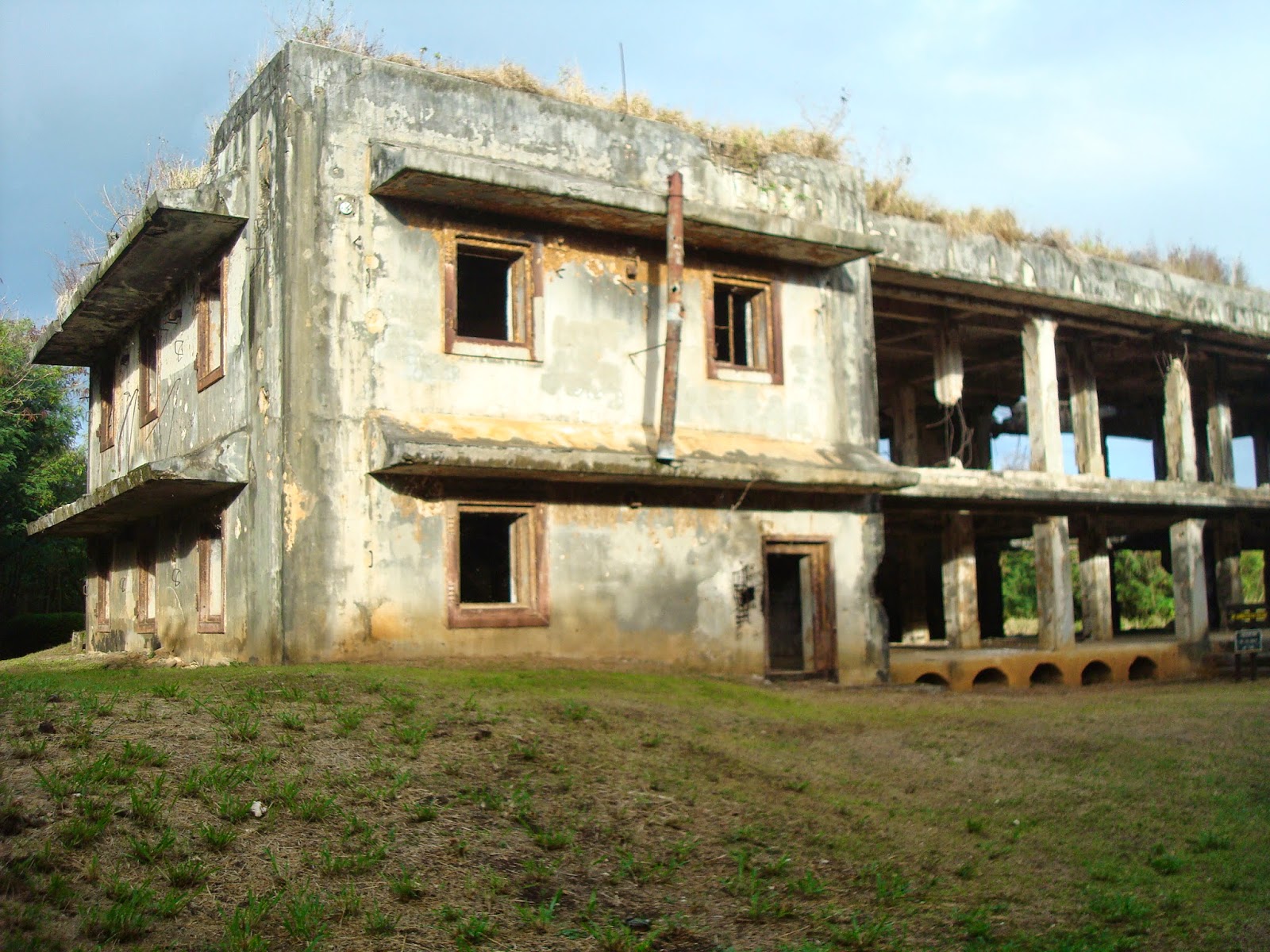
Japanese Communications Center
now surrounded by cattle farms


The torii (gate) of the NKK Shinto Shrine

 
Japanese Air Administration building near the now-abandoned airstrips


Japanese Air Operations building in the area of the old airstrips

 
An office building of the NKK


The railroad tracks went through here, transporting sugar cane to the mill.

 
Tanks for raising unagi or fresh water eels.

 
The Sumiyoshi Shrine sits atop a hill thickly covered by vegetation.

 
The Shrine is still in good condition.

 
Another Shrine, on Mt Lasso, is not in as good a condition as Sumiyoshi.


Japanese Coastal Defenses, Chulu Beach

 
Japanese water pumps and tanks dot the island


What's left of the Japanese crematorium


Sunday, June 17, 2012

CHAMORRON YAP


Chamorro Family in Yap
Early 1900s

In honor of the Chamorro community that lived in Yap from the 1880s until 1948, which was the theme for this year's Homecoming Festival in Yap this past weekend, here are some photos of the grave sites of some of these Yap Chamorros who later moved to and died in Tinian.


HOFSCHNEIDER


FLEMING


ADRIANO

SANCHEZ


Chamorro and Yapese Boys in front of the Catholic Church

The Chamorro boys in shirts and pants

Monday, May 28, 2012

AN GUMUPU I....BATKONAIRE


Let me take you on a virtual flight from Tinian to Saipan, from the safety of your desk, chair or bed.

Air travel between Tinian and Saipan is regular and frequent....but unpredictable.

The small planes wait till there are enough passengers to justify using up the gas.  In my case, I waited and waited, and when it looked like I was the only passenger at least for a while, they put me on the plane as the sole passenger.  But they can always make money from cargo.

I used to sit next to the pilot at times back in the 90s when I was a priest in Saipan and would fly to Tinian.  He'd ask me to open and close the window on take -off.  I thought I should've gotten at least a few dollars off the fare for helping fly the plane.

Totally unrelated story.  Years ago I was helping cover a parish in Hawaii and a parishioner's boyfriend was a pilot who flew a small plane as this one in the video, taking small cargo to the small islands of Lanai and Molokai.  For the price of helping him carry cargo on and off the plane, he said I could go with him.  And that is how I saw two islands I probably never would have been to; Lanai and Molokai.

Back to Tinian.  In the 90s, I had a Healing Mass every Monday for the sick and I recognized an elderly man would always come for the blessing after Mass.  This elderly man was usually the pilot on these quick flights to Tinian and back.  I mentioned to him after Mass one time, "I really pray for you a lot when you come for the blessing."  "Why?" he asked me.  I said, "You know you're usually the one flying me to Tinian, right?"  "Yes," he said.  "Well, don't forget, there's no co-pilot!"

Monday, April 9, 2012

BEST BEACH IN MARIANAS?


TÅGA' BEACH
Tinian

What's not to like?

Sand --- not sharp rocks and coral.

Warm, clean water that gradually deepens so you can actually swim, dive or float, and not just get your legs wet.


The beach is situated at an idyllic cove, free of pollution.  And the best thing - this is Tinian!  Which means - you can spend hours here and be the only person.  Your own personal beach.

Like these two Tinian boys roughing it up in that clean, clean water.

Monday, November 28, 2011

MAN MA DISPENSA

philcrowther.com


TINIAN DOCKS IN 1945

These announcements by Father Lee in Tinian in the early 1960s reflect the pace of life in that small and quiet community.  The people depending on many goods coming from the supply ship, so when it came, whenever it came, that was the priority.  So on this occasion, Father Lee dispensed the men working to unload the supplies from Sunday Mass obligation when the ship came on a Sunday.  Others, probably mainly the women, would cook to feed the loading crews.  The community also depended heavily on sports to fill in the hours of TV-less nights and weekends.


Hu dispepensa todo i taotao "loading ship" på'go na oga'an ginen i obligasion Sånta Misa, kon todo i taotao kusina yanggen mañåtsaga siha.  Yanggen siña, debe de u fan hosme Misa durånte i semåna.  Malago' yo' hu sangåne i taotao MDC sen dangkulo Si Yu'us Ma'åse' pot i che'cho'-miyo nigap gi plåsan basketball.  Debåtde ha' todo i che'cho'-ñiha, sa' para i Gima'yu'us yan i famagu'on-ta.


I am dispensing all the "loading ship" people this morning from the obligation (of attending) Holy Mass, including the kitchen crew if they are unable (to attend Mass).  If they can, they must attend Mass during the week.  I would like to tell the MDC people thanks very much for your work yesterday on the basketball court.  All their work is free, because it's for the Church and our children.