Showing posts with label Kareta/Cars. Show all posts

Wednesday, January 16, 2013

AUTOMOTIVE CHAMORRO


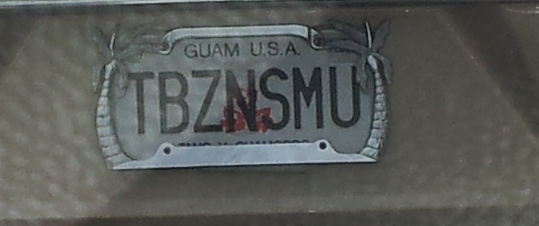
TBZNSMU

Ti bisnes-mu.

It's not your business.

OK, but I would never have paid attention to your license plate had you simply stuck with the ordinary one issued to you by Rev & Tax!
 
NO PIC, BUT HERE'S ANOTHER WINNER....

TKK2

Ti keketu!

Keto or kieto, from the Spanish quieto, meaning "still, motionless."

Quieto (Spanish) and kieto (Chamorro) has more the meaning of physical stillness, which usually means the person or environment is also silent, but if one wanted to say silent, silencio (Spanish) or silensio (Chamorro) would be used.

*Si Yu'us ma'åse', Lucinda, pot i un na' tungo' yo' pot este na ehemplo!

So, "ti keketo" or "ti keketu" means "always on the run."

Friday, August 17, 2012

AUTOMOTIVE CHAMORRO


I recently found out the background of this Chamorro decal that is seen on a few cars on Guam.

The word må'gas means "superior, great."

Notice that the A's are designed to resemble latte stones.

The crowned lion is carrying the flag of the Northern Marianas.

The lion is the mascot here because the designer, so I am told, is a de Leon Guerrero from Saipan.

"Leon Guerrero" is Spanish for "lion warrior."

Tuesday, July 10, 2012

AUTOMOTIVE CHAMORRO


Have you figured it out?

Ti bisnes-mu.  Not your business.

But the owner hears the Z in "business."

Whereas the traditional pronunciation would be bisnes, not biznes.

Bisnes, of course, is borrowed from the English.  But what would be the older Chamorro word for "business?"

Asunto.  That is borrowed from the Spanish.


Maila' ya ta kuentos pot este na asunto.  Let's talk about this business (issue, topic).

"Business" as in "making money" is kometsio or negosio, again both borrowed from the Spanish.

Fama' salåppe' is "to make money."

Saturday, February 4, 2012

AUTOMATIVE CHAMORRO


MAPUS.  Gone.  Departed.

An alternate spelling is må'pos.

Not sure who left, though.  It seems the driver is telling us he left, but if we can read it, how far, then, could he have possibly have gone?

Monday, August 29, 2011

AUTOMOTIVE CHAMORRO


This car owner reveals to us his or her family nickname.

The Kadi family is a branch of the Manibusan clan.

Monday, August 1, 2011

THE BEST KNOWN AUTOMOTIVE CHAMORRO


FÅKKAI

Everyone has seen this Chamorro word on many a car driving on Guam, the Marianas and abroad.  Not many people know the original meaning of this word which has taken on a new connotation in modern times.

The original word in Chamorro means "to distribute, to divide."  Simple as that.

A hundred years ago, our people used this word quite freely, and nobody giggled.  Its meaning was simply to distribute or divide something.

When fishermen caught fish, they would distribute the fish among the community.  The boat owner, the net owner, the fishermen and the whole community, especially the poor and the sick, got their shares of the catch.  Man ma fåkkai i taotao siha ni guihan.  Fish was distributed among the people.

Ti siña ma fåkkai.  It cannot be divided, or distributed.  The Three Persons of the Holy Trinity are separate persons but one God, not three.  Ti siña ma fåkkai. In terms of their divinity, they cannot be divided.

Na' gai fakkai yo'.  Give me a share of the distribution.  They're passing out free titles to surplus military land.  "Na' gai fakkai yo' pot fabot!"

Fast forward to today, hundreds of years after the word was originally used by our mañaina.

The modern meaning is "to beat up."  One modern dictionary defines it so.

Like many words that became slang, the origin of the modern usage remains a mystery.  Slang often begins with one, anonymous originator.  It catches on, becomes widespread, and the explanation of the word's origin takes on the nature of an urban myth.

The company that uses a stylized spelling of the word has also come up with their own definition of the word, as can be seen in one of their logos : exhaust the body, proceed the mind, cultivate the spirit.  My how far we've come.
Friday, June 24, 2011

AUTOMOTIVE CHAMORRO


KATON I TANO'

The Cat of the Land
Land Cat


Hmmmmm.....?????  Or, as we say here, "Haaaaaa......?????"

Not sure where this is going.  Is there a "Familian Kato" I've never heard of before?

Is the owner purr-ty much into cats?  Paw-ssibly.

Any which way, another example of Automotive Chamorro.

Sunday, June 12, 2011

AUTOMOTIVE CHAMORRO


The owner of this car provides us both the family name (Gumataotao) and the family nickname (Cherick).

The spelling of "Cherick" shows American influence.  Others would spell it "Chirik."

I know of a few Chirik Gumataotaos in Chalan Pago.

Saturday, April 16, 2011

AUTOMOTIVE CHAMORRO


It's good to see our young people using their language (in a clean way) as they personalize their cars and trucks.  I like this one in particular because "ke ya hafa" is particularly Chamorro in attitude.  "Taffo'" means "brash, tactless, bold in a rude way."  Someone who stops by the house too much or at inconvenient hours is "taffo'."  Someone who breaks social norms or who does not observe etiquette is "taffo'."

Maybe the owner had this in mind when he put "taffo'" on his car.  Or perhaps he meant it to mean "bold" in a general way, though the better word for that is "matatnga."  "Taffo'" has a note of impropriety to it.

Now "ke ya håfa" is a wonderfully flexible phrase.  It comes from the Spanish word "que" which means "what" or "which," and even sometimes "who" or "whom."

"Ke ya håfa?" Literally, "What/which/that and what?"  But it can be best translated "And so what?"  Or, "And what of it?" Depending on the tone, it can carry different meanings.

Jose : You're late, Mary.
Mary : Ke ya håfa? (as in, "It's not the end of the world, Jose.  Chill.")
Mary : Ke ya håfa? (as in, "Leave me alone!  I've had a bad day!")