Showing posts with label Nengkano'/Food. Show all posts

Tuesday, December 22, 2020

BEFORE THERE WAS MAPLE SYRUP


In case you haven't noticed, there are no maple trees in the Marianas.

So why do we eat buñelos dågo at Christmas time with maple syrup?

The dågo has been around since before the Spaniards. The buñuelos was taught to our people by either the Spaniards, or by Mexican or Filipino soldiers who came with them.

But maple syrup only came around after World War II, at least for the majority of people.

Well, long before Western maple syrup graced our store shelves, we had our own syrup called ATNIBAT.


It was made with something we grew right here in our islands - either SUGARCANE (TUPU) or COCONUT SAP (TUBA).

The juice of the sugarcane was boiled until it became a syrup. That was the FIRST METHOD.

The SECOND METHOD was to use the brown sugar made from the juices and, when boiled with water, the sugar made a perfectly fine syrup.

The THIRD METHOD of making syrup was to boil sweet tuba, made from coconut sap.

The Spanish word for it is ALMÍBAR, but we pronounce it ATNIBAT.


You may think it's OK, we'll always have maple syrup. But, you may need syrup right away with no time to run to the store. Or, God forbid, some worldwide situation delays cargo ships from bringing manufactured goods to the island.

As long as you have brown sugar, you can make your own atnibat or syrup, just like we did 100 years ago. 

Here's how easy it is to do :


VERSIÓN ESPAÑOLA
(traducida por Manuel Rodríguez)

ANTES DE QUE EN GUAM EXISTIERA EL SIROPE DE MAPLE

En caso de que no nos hayamos dado cuenta, no hay maple en las Islas Marianas.

Entonces, ¿por qué tomamos “buñuelos dågo” en Navidad acompañados de sirope de maple?

El “dågo” en Guam es un producto originario pre-hispánico. La preparación de “buñuelos” fue enseñada a nuestro pueblo por los españoles, o por los soldados mexicanos o filipinos que los acompañaban.

Pero el sirope de maple solo apareció en Guam después de la Segunda Guerra Mundial, al menos para la mayoría de la gente.

Pues bien, mucho antes de que el sirope de maple adornara los estantes de nuestras tiendas, elaborábamos nuestro propio sirope llamado “ATNIBAT”.

Se hacía con algo que cultivamos aquí en nuestras islas, ya fuese caña de azúcar (TUPU) o savia de coco (TUBA).

Se hervía el jugo de la caña de azúcar hasta que se convertía en almíbar. Ése era el primer método.

El segundo método era utilizar el azúcar moreno. Cuando se hervía con agua, el azúcar moreno formaba un almíbar perfectamente fino.

El tercer método de hacer almíbar era hervir tuba dulce, hecha de savia de coco.

La palabra en español es “ALMÍBAR”, pero la pronunciamos en chamorro, “ATNIBAT”.

Podemos pensar que siempre tendremos sirope de maple en las tiendas. Pero es posible que en alguna ocasión necesitemos sirope de inmediato sin tiempo para ir a comprarlo. O, Dios no lo quiera, alguna situación mundial retrase a los buques de carga de traer productos manufacturados a la isla.

Siempre que tengamos azúcar moreno, podemos hacer nuestro propio “atnibat” o sirope, tal como lo hacíamos hace 100 años.

Así de fácil es prepararlo:

Antes de que el comercio moderno llevara el sirope de maple a las Marianas, nuestra gente hacía su propio sirope usando azúcar moreno de caña o savia de coco, ambos cultivados aquí en casa. Este sirope se llama ATNIBAT. A continuación, os indicamos cómo prepararlo con azúcar moreno.

Usemos dos medidas iguales de agua y azúcar. Para una persona, 1/4 de una taza es suficiente. Llevar a ebullición y revolver. Esperemos hasta que tenga la consistencia que se desea, luego retiremos del fuego y aguardemos a que enfríe.

Me gusta el almíbar no demasiado espeso, todavía un poco líquido, ya que los “buñuelos” lo absorberán mejor y resultarán más empapados.

A veces el almíbar se pega a los lados de la taza, pero está lo suficientemente líquido como para que los “buñuelos” lo absorban completamente. 

FELIZ PASCUA DE NOCHEBUENA.


Monday, March 5, 2018

CHORISOS CHAMORRO


Perhaps you've tried Katson's chorisos Chamorro.

Crumbly, red, spicy. At one time it was such a best seller that the family went into business making and selling it, with USDA approval!

Nowadays it is no longer sold commercially but different people make their own chorisos Chamorro for domestic use.

How did the Katsons start it all up?

Vicente Calvo Aflague, of the Katson branch of Aflagues, was actually a jeweler by trade and profession. His work adorned the ears, necks, wrists and fingers of many a lady on Guam, as well as men.

But he also raised pigs at his ranch in Dededo. With all that pork available, Vicente wondered how to make good use of the meat. He and his wife, the former Ruth Lujan Tydingco, decided to make sausage, or chorisos, with the pork. At first, these sausages were not encased like link sausages. They were loose and crumbly. Everybody fell in love with it.

Vicente and Ruth used parts of the pork best suited for sausage. The butt, belly and thighs. In Chamorro, the posuelo (the front chest area) and the pietna (legs or thighs) were used. To give it some fat, the skin (lassas) was added to the mixture in due proportion. This was all ground in a molino (grinder), hand-driven at first and then they switched to an electric one when the business took off.

Essential to the recipe are garlic (in generous amounts), white vinegar, achiote (the seeds, not the powder from a package), paprika, salt, black pepper and as much, or as little, chili pepper (the donne' såli kind) to suit one's taste. Chicken can also be used to make chorisos Chamorro.

When the family was still running the business, they supplied Payless and other local stores with it, and even the military commissaries, both Navy and Air Force. Casings were ordered from the US and some of the sausages were made into links. Many people, however, still preferred the loose kind which was pan fried, cooked with vegetables or eggs, or added to fried rice. It could also be found on the menus of some local restaurants.

You can find on the internet a few recipes for chorisos Chamorro and some people do make their own. But it all started after the war with Ton Vicente'n Katson and his wife Ruth.


Katson's Chicken Chorisos Chamorro

Monday, January 15, 2018

CHORISOS ESPAÑOT


What do many Chamorros living in the mainland ask us to send them? Chorisos Españot.

Strongly-flavored and fatty, chorisos españot can be really addicting.

And, for Chamorros, there is only one kind of chorisos españot. It has to be the "El Rey" brand, in its distinctive olive green can (or plastic bag, nowadays) and gold lettering.

Where does it come from?

Well, we call them chorisos españot which literally means "Spanish sausages."

But notice that the can (or package) does NOT call them chorisos españot. It doesn't even say Chorizos Españoles, which would be the way to say it in Spanish. In fact, there is no ONE thing in Spain known as "chorizos españoles" because there are dozens and dozens of different kinds of Spanish sausages.

The green can or package doesn't call these chorizos by a certain name. But the original manufacturer of the El Rey variety of chorizos called them chorizo Bilbao (or chorizos de Bilbao) after the Spanish city of Bilbao. There may be chorizos made in Bilbao, but it's not exactly what you find inside the El Rey can of chorizo.

The original manufacturer, named Genato, enjoyed much success with his brand of chorizo and chorizo Bilbao became well-loved in many a Filipino kitchen. It was Genato who thought up the brand name, the design of the can and the tweaking of the flavor, which includes generous portions of paprika.

I wonder if our Genato of the Chorizo is the same Vicente Genato of the Genato Commercial Corporation in Manila which produced Royal brand foods. The Royal brand of chorizo bears striking similarities with the El Rey brand. The Royal brand chorizos were encased in lard (manteca) inside the can. Vicente Genato had a store on the Escolta, a premier shopping street in the Binondo district of old Manila.


At some point, Genato's El Rey brand of chorizos were being manufactured in the U.S. Several different American companies have manufactured the El Rey brand.


Chorisos Españot being sold in Hawaii for $5.29 a can in 1960.


But I believe Guam didn't need to wait for chorisos to be made in the US in order to enjoy them. Guam merchants always did business in Manila before the war, and I wouldn't be surprised if they imported El Rey chorisos españot since then. Someone on Guam called them "Spanish sausages," or "chorisos españot," maybe because the cans had Spanish writing on them.


They come in plastic bags now


FRIED RICE WITH CHORISOS ESPAÑOT


annieschamorrokitchen.com


THE BIG QUESTION

So, if chorisos españot is made in the US, why do our stateside friends and relatives ask us on Guam to send it to them there?

I suppose because it is easier and faster for us to find El Rey chorisos españot at Payless down the street than for them to hunt high and low in Orange County. They may be made in the US but they aren't sold down the street everywhere in the US.

This is one of the few quirks of life where people on Guam need to send to the mainland something made in the mainland.

Tuesday, October 17, 2017

ROSKETE


All over the Hispanic world, there are different kinds of rosquete.

The root word is rosco.  A rosco can mean a bread roll, a biscuit, a cookie....and many other similar things.

In the Spanish city of Cádiz, in the south of that country, they make a rosquete that looks like our own Chamorro version, but it is made with some ingredients not found in our own.


A kind of Spanish rosquete


So when Spaniards or Latin Americans brought the basic idea for rosquete to the Marianas, our people had to use ingredients that were available to them.

The Chamorro roskete is made of : flour, corn starch (a lot of it), sugar, butter, eggs and salt. Modern recipes add baking powder and vanilla extract (some use lemon extract), which I am pretty sure were not available in the Marianas 200 years ago. Even butter may not have been quite readily available in our islands 100 years ago or more. Some other shortening must have been used.

The Chamorro roskete is dry and crumbly. That is due to the large amounts of corn starch in the recipe. Because they are so dry and crumbly, mailing roskete to your loved ones off-island is an exercise in hope or optimism. They often become pulverized in the mail. Your loved ones in the States will receive roskete powder by the time it gets to them.

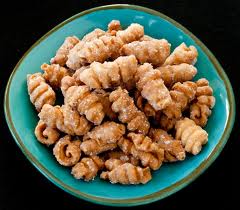
The traditional form of the roskete is to form loops with the rolled out dough. Many people today simply make medallions of the dough. Less work.

Personally, I prefer the "figure eight" traditional form of roskete. Because they are so dry, it is better to eat in smaller doses.

When a roskete is excellent, it has flavor. Am not sure if it is the vanilla extract or the eggs that impart that flavor. I know a lady who makes excellent roskete and claims it's because of her "secret ingredient." I have a suspicion it's Crisco.

But then there is roskete that has little to no flavor. It can become a mouthful of dry, sweet cookie crumbles in the mouth, best dissolved by a gulp of hot coffee.

Here's a video (in two parts, actually) showing how to make roskete according to one person's recipe :


And a link to another recipe for roskete :

http://www.annieschamorrokitchen.com/rosketti/


Friday, March 10, 2017

ESKABECHE


Chamorro Eskabeche

I must admit that, when I was a kid, eskabeche was not one of my favorites and I think most kids feel the same. But, as I grew older, I began to appreciate it more, especially for the veggies.

Chamorro Eskabeche is made from ingredients that can be found locally. Our mañaina were making it long before Payless was opened after World War II.

But some of the ingredients, such as the biringhenas (eggplant) and friholes (beans) and even the repoyo (cabbage) had been brought to Guam by the outside settlers, either from Mexico or the Philippines or both. Thus they all have foreign names and eskabeche, as well, is a foreign name.


THE ORIGINAL ESCABECHE

Escabeche started in the Mediterranean countries of Europe where they cooked the protein (fish, fowl, pork and even rabbit) in some acid, usually vinegar, and saffron, which gives it the yellow color.

Spaniards brought this recipe wherever they went, but ingredients had to change, depending on the resources of the country.

Apparently, the Moors who ruled over most of Spain from the year 711AD, gradually beaten back by the Spaniards until 1492, brought the recipe to the Spaniards. The original name was al-sikbaj, which morphed into escabeche when said by Spaniards.


VINEGAR

Wherever the escabeche recipe changed, one thing stayed the same : there was always some vinegar included in the recipe.

In fact, in Spain, one can get a kind of escabeche in a jar, made up entirely of pickled vegetables. Below is an American brand of vegetable escabeche .


And here are examples of escabeche in other countries :


There are many Chamorro recipe resources on the internet. Here's one that cooks eskabeche in a somewhat different way :

http://www.annieschamorrokitchen.com/escabeche/

Enjoy! Especially for Lent!

Wednesday, November 16, 2016

TINAKTAK


If you want an example of our changing Chamorro culture that you can sink your teeth into, one of them is tinaktak.

For the traditionalist, tinaktak is a dish made of beef, coconut milk, green beans, cherry tomatoes, onions, garlic, salt and pepper. That's the bottom line, though some add a little this or that, like eggplant or lemon juice.

None of those "bottom line" things except the coconut milk and salt would have been available to our ancestors who lived before the Spaniards came. Even the Chamorro words we have for the remaining ingredients are taken from the Spanish : kåtnen guaka, friholes, tomåtes, seboyas, åhos and pimienta.

But, safe to say, tinaktak has been around for a long time and part of our culinary culture for a couple hundred years or more.

The theory is that the name of this dish comes from the sound made when the beef was pounded on by a knife. Tak tak tak!

But there is a word taktak, and another form of it, talaktak, which means the sound of a bang or clap, as when something falls to the floor. That would correspond to the sound of a knife hitting a piece of beef lying on a cutting board or table.

So, tak tak tak went the cook until the meat was broken down into crumbly bits, like the ground beef you buy to make burgers or meat loaf.

Since our people didn't slaughter cattle a whole lot but rather for special occasions, tinaktak would not be a frequent meal served on a weekly basis.


THE EVER-CHANGING RECIPE

Nowadays, you can have tinaktak without the taktak.

There are cooks who do not pound the beef but slice it instead. Everything else in the recipe remains the same, but you bite into beef strips instead of ground beef.

Some people also use ground chicken or ground turkey. Salmon. Tofu. Octopus. Fake beef (vegan). I can't wait to see what else they will make tinaktak with.


www.marga.org

Tofu Tinaktak
with Sriracha sauce by the way


You don't even need to eat tinaktak with rice anymore. You can now have a Tinaktak Burger.


www.theboyandthebaker.com

People will be experimenting with new and creative ways to make tinaktak.

So, with all these changes, can you call anything tinaktak? How much change is needed so that it's no longer tinaktak? How does tinaktak remain tinaktak?

I suppose most people would agree that as long as the protein source is (1) ground or at least in small, bit-sized pieces, and (2) it is cooked in coconut milk, it qualifies as some version of tinaktak.

Even with the Tinaktak Burger, the meat is cooked in coconut milk but the liquid is cooked down till nearly gone.


Saturday, October 22, 2016

BISKUCHON PÅNGLAO


No Chamorro home was ever without biskuchon pånglao.

It was so-called because of the crab (pånglao) that appeared on the wrapping or on the tin can that stored bulk quantities of the biscuit.

Different families ate it in different ways, but nearly every family had them in the cupboard.

Some families ate biskucho every day, while some ate it only rarely.

Some had it for breakfast, especially with coffee. Some would dip the biscuit into the coffee and others would break the biscuit into little pieces and soak them in the coffee. Still others could butter up the biscuit and eat with coffee like one does with toast.

Especially for kids, the biskucho would be broken up and soaked in milk (especially condensed milk;  Carnation) and sugar. Many people call this kåddun biskucho.

Other families would have biskucho mainly for merienda, the late afternoon snack, sometimes with cheese.


After a typhoon....

Finally, some families ate it only after a typhoon. This is where the biskucho came in very handy. It didn't need refrigeration. It could last for years in perfectly fine condition in your pantry, as long as it stayed dry. It was ready to eat. No cooking was needed. It was thus perfect for after a typhoon, when the electricity could be out for weeks, if not months.

The durability of this kind of biscuit made it ideal food for sailors when ships lacked refrigeration. Thus they were called sea biscuits, ship biscuits, Navy biscuits, as well as many other names.

Those tin cans...


A common trait among our people was never to throw things out that can be used later. Such happened with the tin cans of biskucho . Many elders saved them because they were perfect for storage of many things, food or otherwise. I remember them making excellent containers for pån tosta (toasted bread rolls).

Japanese....

It only takes a few seconds' glance to see that the biskucho eat in the Marianas is Japanese, made by the Kaniya Company of Kofu, Japan.

Guam merchants (many of them Japanese themselves) were importing Japanese goods to Guam since the early part of the 1900s. Up in Saipan, the entire island was run by the Japanese, who transformed the island into an outpost of Japanese culture. The same can be said for Tinian and Luta.

So it is very possible that Japanese biskucho was being sold in our islands since the beginning of the 1900s. In Japan, however, biskucho (known as kanpan in Japanese), did not become well-known until 1937 when Japan's war with China forced the government to promote the sale of kanpan among the people, since the nation had to conserve food for the fighting soldiers. That's when the sale of kanpan hit the roof in Japan, and it became associated with the war effort and the people's participation in it.

Since then, kanpan has become Japan's disaster food. Whenever there is a bad typhoon or earthquake and normal food supplies are strained, relief efforts pass out huge quantities of kanpan to the people.

It was also distributed by the Americans to island people in need for food after the war. That's another way the biskucho became widespread among Pacific islanders.

Disappearing?

The news from Japan, though, is that Kaniya's kanpan, or biskucho, may be a vanishing piece of food history. The tastes of younger Japanese are changing. People in Japan are switching to a new kind of biscuit which started in the 1980s called CalorieMate. Why? It is softer than kanpan. Kaniya is still baking biskucho and we're still buying them in the Marianas, but if sales of Kaniya's hard biscuits fall, the company may stop making them.


Even if every Chamorro in the world continued to buy Kaniya'a biskucho, and I doubt that would ever happen since even many younger Chamorros think that biskucho is man åmko' food (just for the elderly), would that be enough to save the biscuit from extinction?

The good news is that, even if the biscuit is no longer made, the ones already baked, as long as they stay dry, can last longer than you or I can!

VIDEO

How biskucho is made in Japan.


Tuesday, February 23, 2016

BUCHI BUCHI AND PÅSTET


Buchi buchi? Or påstet?

I suppose the best answer is "both."

But what is the question?

For some people, the question is which is which? The general answer I receive from most people is, "If it's fried, it's buchi buchi. If it's baked, it's påstet." And my sources come from Saipan, as well as Guam.

Then there are the hold-outs who say that both words apply to either. I suppose, then, one could ask for fried påstet or baked påstet. Fried buchi buchi, or baked buchi buchi. I can just see the traditionalists cringe. For them, påstet is always baked and buchi buchi is always fried. Personally, I go along with this distinction of fried-vs-baked. It makes it easier to know which of the two you want.

The filling does not make a difference in the name. The traditional filling on Guam is pumpkin (kalamasa), though at times I also see on Guam papaya fillings for påstet. This is the typical filling for Saipan påstet - papaya.

The next endless and, perhaps useless, debate is which of the two is better? While I tend to favor the fried buchi buchi, there are times when I prefer påstet but only when the shell is exquisitely flaky and the filling perfectly flavored.

These foods were introduced to the Marianas in Spanish times as we had no wheat flour, nor pumpkin nor papaya until then.

Påstet is surely the Chamorro rendering of the Spanish word pastel. The word pastel in Spanish can mean many things, all of them a kind of food, of course. In Spain, pastel usually means "cake." But in other Spanish-speaking countries it can mean a filled pastry as we have it, although the filling can include meat. So the idea came from Latin America, I believe, and we simply used the ingredients available to us locally.

Buchi, in Chamorro, can mean a swelling on the body or a bubble on a tire. Perhaps the air pockets formed in the shell of the buchi buchi when it is fried lead to this food's name. Who really knows? The Filipinos have a treat called buchi, but it's a sweet rice ball with a mung bean filling and sesame seeds added to the exterior. I believe that's inspired by the Chinese and the name might be Chinese in origin, as well.

As someone said to me, "Call it what you want. We don't eat the name, we eat the thing itself."

Wednesday, January 13, 2016

FINO' GUAM FINO' SAIPAN


Our people, in general, like their food spicy hot.

And nature has given us the very thing to achieve that - the donne' pepper, of which there are many kinds.

When the donne' pepper is prepared (the Chamorro word fa', or "to make"), it becomes fina'denne'. Donne' that is prepared.

Usually, fina'denne' is donne'' swimming in soy sauce, or vinegar or lemon juice, often with onion slices added. People then dip their food into this sauce or spoon it over the food.

In Guam, when the donne'' is mashed (ma gulek) into a paste, usually with salt and maybe some vinegar added for flavor and preservation, it is called donne' dinanche. Dinanche means "correct."

I suppose the name came about because people had the idea that donne'' that is prepared this way is donne' that is prepared "just right" or "correctly," meaning "most pleasing to the palate."

It should be remembered that the Chamorro verb danche can also mean "to hit a target" or "hit the mark." So, donne' dinanche is to "get it just right."

Purists will say that donne' dinanche is just the donne' paste with some salt and vinegar. But many others add a wide variety of extra ingredients which differ from home to home. Some add string beans, onions, garlic, coconut crab meat, imitation crab meat, coconut milk, lemon juice, finely chopped pumpkin tips and even mayonnaise. I think the variations will continue to evolve into the future.

In the Northern Marianas, which has more Japanese influence, some add miso paste.

But the purists will say that such donne' dinanche is not dinanche!

In Saipan, no one called it donne' dinanche. Recently, a few in Saipan have started to call it so, because of Guam's influence.

Otherwise, the Chamorros of Saipan just called it donne' or fina'denne'.

But in Saipan there is another name for it : donne' chosen.

Chosen (some pronounce it Chosing) is an old Japanese way of naming Koreans. Koreans do not appreciate the name and it should not be used among them.

Guam Chamorros are unfamiliar with the term Chosen because we on Guam did not have a Korean community on our island before the war, unlike the thousands of Korean workers brought into the Saipan in the 1920s and 30s by the Japanese. Japan ruled Korea before World War II.

The Saipan Chamorros, observing the Koreans (or Chosen) and their love for the chili pepper in their food, started to call donne' paste after the Koreans.

I asked someone from Saipan what he thought of the Guam term donne' dinanche.

He chuckled and said, "Todo donne' dinanche."

"All donne' is correct."


Thursday, January 7, 2016

KONSETBA


Our islands abound in papaya. They grow wild all over the place.

But we don't see this Chamorro sweet treat much. It's called konsetba, and in English we might call it "candied papaya."


WHAT IS IT?

Konsetba are papaya slices that are :

BRINED and then COOKED IN SUGAR

The result is sweet, gummy papaya slices with some stiffness.

BRINING means soaking the papaya slices in water and åfok, which is lime (not the fruit) made from baking coral or clam shells. Brining stiffens the papaya slices so that they can survive cooking and not fall apart, and it also helps preserve the papaya. Konsetba does not have to be refrigerated, though it can be, especially if you want to take time finishing your supply.

Then sugar and some water are added to a pan and allowed to caramelize. Then the papaya slices are added and cooked in the caramel. Once done, it is now konsetba and the slices are cooled and allowed to drip any excess.

Here is a link to a recipe for konsetbaKONSETBA RECIPE


DOES KONSETBA MEAN "CONSERVE"

Why is it called  konsetba? To some, it sounds close to the English word "conserve." Is there a connection?

There is a Spanish word conservar. Indeed, it can mean "to conserve," as in, "to keep something from being lost." A synonym would be "preserve."

And foods en conserva in Spanish means preserved foods, such as canned or potted foods.

Because the brining of the candied papaya makes it harder for bacteria to breed and spoil the papaya, it was rightly called konsetba, from the Spanish en conserva.....preserved papaya.

But don't think konsetba can also be used to mean, in Chamorro, "to conserve or preserve." Konsetba, in Chamorro, only means candied papaya.


CHAMORRO WORD FOR "CONSERVE" OR "PRESERVE"


Today, and for a couple of centuries already, we have been using the Spanish word mantiene to express the idea of holding on to something, not allowing something to be lost, weakened, deteriorated and so on.

"Preserve our culture." "Mantiene i kutturå-ta."

To "conserve" as in "not to waste," there is the Chamorro term chomma', which means to reduce usage or abstain (as well as "to block, forbid, prevent").

But in the 1865 Spanish-Chamorro dictionary by Father Ibáñez, nå'na' is another word for "conserve."

This comes as a surprise to people fluent in Chamorro, because nå'na' means "to hide." But it makes sense. If you want to preserve or conserve something, you often need to hide it, or at least store it away.

Påle' Román's 1932 dictionary confirms that nå'na' did indeed mean "to save, keep, safeguard" because one often hides what one keeps safe for the future.

But since our generation has lost the other meanings of nå'na', if we said "Nå'na' i kutturå-ta" hoping to mean "Preserve our culture," fluent speakers of the modern age would interpret the statement to mean "hide our culture."

So, ironically, the indigenous term "to preserve" has not been preserved up to our times. We would generally use the word we borrowed from Spanish, "mantiene."


Thursday, May 7, 2015

LATIYA? OR NATIYA?


A popular dessert dish among Chamorros is latiya.

Or is it natiya?

The short answer is : both.

To make you more confused, some also say latiyas or natiyas. And in Saipan, they call it lantiyas.

What's the deal here?

The name is borrowed from the Spanish, who call it natillas or natilla, again depending on the country. It's simply the difference between saying, in English, "custard" or "custards."

The root word is nata, which means milk cream. The condensed milk forms the custard, along with the other ingredients : sugar, eggs, water, vanilla extract, cinnamon and corn starch for thickening.


From Spain, the custard dish recipe went all over the Spanish-speaking world, becoming modified here and there depending on the country and the resources they had.

Words in a language also change, here and there, depending on the sounds preferred by the speakers.

First of all, no Chamorro would ever pronounce Spanish LL as English Y. It becomes Chamorro Y, which sounds like English J. Quintanilla. Acfalle. So natilla became natiya.

But then, many Chamorros in the past liked to changed initial N in a Spanish word to L. This is what happened to natilla. For some Chamorros, natiya became latiya.

Up in Saipan, time away from Guam as Guam Chamorros moved up there since the 1850s, allowed changes in pronunciation to develop on their own. Latiya became lantiyas.


CHAMORRO VERSION


One thing that stands out about the Chamorro version, whether it's from Guam, Saipan or the other islands in the Marianas, is that the custard is only one-half of the dish. It isn't latiya (or natiya, or lantiyas) unless the custard goes on top of sponge cake, broas or even pound cake, as the recipe undergoes more recent tweaking.


In my own version, I add canned peaches. People love it. I also add a secret syrupy ingredient to soak a bit of the bottom of the cake. Secret.

When I first lived on Saipan, back when I did not have a strict diet, they found out I loved lantiyas. Although they called it by a slightly different name, it was the same dish and it went into the same stomach where latiya used to go!

Monday, March 9, 2015

KELAGUEN/KILAWIN


Visitors to the Marianas don't always like all of our food.

But the one dish that seems to be a hit with almost all visitors is kelaguen, especially kelaguen månnok.

Where did this dish originate?

I wish I knew. Three hundred years ago, only Europeans were writing down things about Chamorro culture and none of them talk about kelaguen.

But coincidences between us and others sometimes leads us to some pretty good guesses. And, between us and the Filipinos, there are two coincidences dealing with kelaguen.

The first coincidence is the dish itself. Both the Filipino and Chamorro versions of kelaguen deal with marinating mainly raw foods in some kind of acid. Chamorros exclusively use lemon (or lime) juice, while the Filipino version is open to vinegar and other fruit juices as well as lemon/lime.

The second coincidence is the name. Chamorros call it kelaguen; in the Philippines it is kilawin, although regional variations on the word exist. The root word seems to be hilaw, or "raw."

Since lemons and limes did not grow in our islands before the Spaniards came, it's more than likely that the basic recipe for kelaguen came from Filipino settlers in the Marianas, although the Latin American settlers could have also had a hand in it, since they have a similar dish called ceviche.

But the word kelaguen is so close to kilawin that I would guess that we borrowed kilawin and pronounced it our way. Remember that Chamorro does not have an independent W souind. The W sound exists in Chamorro when combined with G, for example, as in guiya, guennao, pugua'.

In fact, when foreign names starting with a W came to us, Chamorros pronounced the W in other ways, as in Bisle for Wesley and Guait for White.


Chamorro Kelaguen Uhang (Shrimp)


It's not kelaguen unless it has lemon juice, salt and onions. Green onions will also do.

Purists will say kelaguen also has to have chili peppers (donne') but some people forego that because some people can't stand the heat.

Some kelaguen includes grated coconut, and some do not. Some will not add coconut when the dish will be out on the table a long time, for fear of quick spoilage. Others just don't think grated coconut goes well with raw meat, such as benådo (deer), beef or fish. Some seafood kelaguen, however, will add a bit of coconut milk into the mix.

In a few kelaguen recipes, sliced cherry tomatoes will be added.


KILAWIN


The Filipinos, however, are a lot more permissive with what they add to their kilawin. Ginger, garlic, black pepper, sugar and a longer list of veggies than ours can be found in different types of kilawin.

In terms of style, the Chamorros will mash up more what the Filipinos will allow as whole or larger-cut pieces. In the picture above, the Filipinos serve their shrimp whole while the Chamorro recipe would mince the shrimp into a kind of mash.

Also :

www.guampedia.com/kelaguen-meat-chicken-or-seafood-with-lemon

Wednesday, July 3, 2013

MAN E'EYAK MAMA'TINAS NA' CHAMORRO


"Flirtacious Kitchen"

A Chamorro language class at UOG turned to the fun and practical; cooking Chamorro food.


The class divided into teams and demonstrated how to cook specific Chamorro recipes.  The Chamorro language was used as much as possible in the menus, recipes and conversation.

 
Lumpian Aga'
(Banana Rolls)


Cutting up the dough for the Buñuelos Månglo'
 
Buñuelos Månglo' are simple flour donuts and literally mean "wind fritters."  It could be so-called because they are so light, but there's also the belief that they were named after the typhoons, which blow a lot of wind.  Apparently, when the electricity was out because of the typhoons, women fried up these buñuelos.


Frying the donuts.


Gollai Åppan Kamute

Sweet potatoes were imported to Guam from Mexico.  Many Mexican soldiers and lay catechists were brought to Guam by the Spaniards.  In Gollai Åppan style, the starch is cooked in coconut milk.

In Saipan, they don't use the term Gollai Åppan.  They say Saibok.


Thickening the custard to top the sponge cake (broas) to make latiya.

Latiya comes from the Spanish natilla, or "custard."  The root of that word is nata, or "cream."  In Saipan, they pronounce it lantiyas.


The recipe for Buñuelos Månglo' written in both Chamorro and English.

Sunday, March 3, 2013

I TIBA


Before the Europeans settled the Marianas, the Chamorros didn't get drunk.

Why?  No tuba.  Or any intoxicating beverages for that matter.

It was the Filipinos who introduced tuba to the Chamorros.  Tuba even made its way from the Philippines to Mexico, an example of reverse cultural influence.  Usually it was the other way around; Mexico influencing the Philippines.

Collected from the sap that seeps from the cut flower of the coconut tree into a bamboo cylinder hung around the flower stump.  When the first cut heals and the sap no longer flows, the stump is sliced again and the stump bleeds more sap.  The sap is most productive at night, and tuba makers collect the sap in the morning and before sunset.


When the sap is first collected, it is very sweet and can be converted right away into a form of syrup or sugar by boiling.  If left alone for four hours, it has fermented enough to become intoxicating, but still sweet.

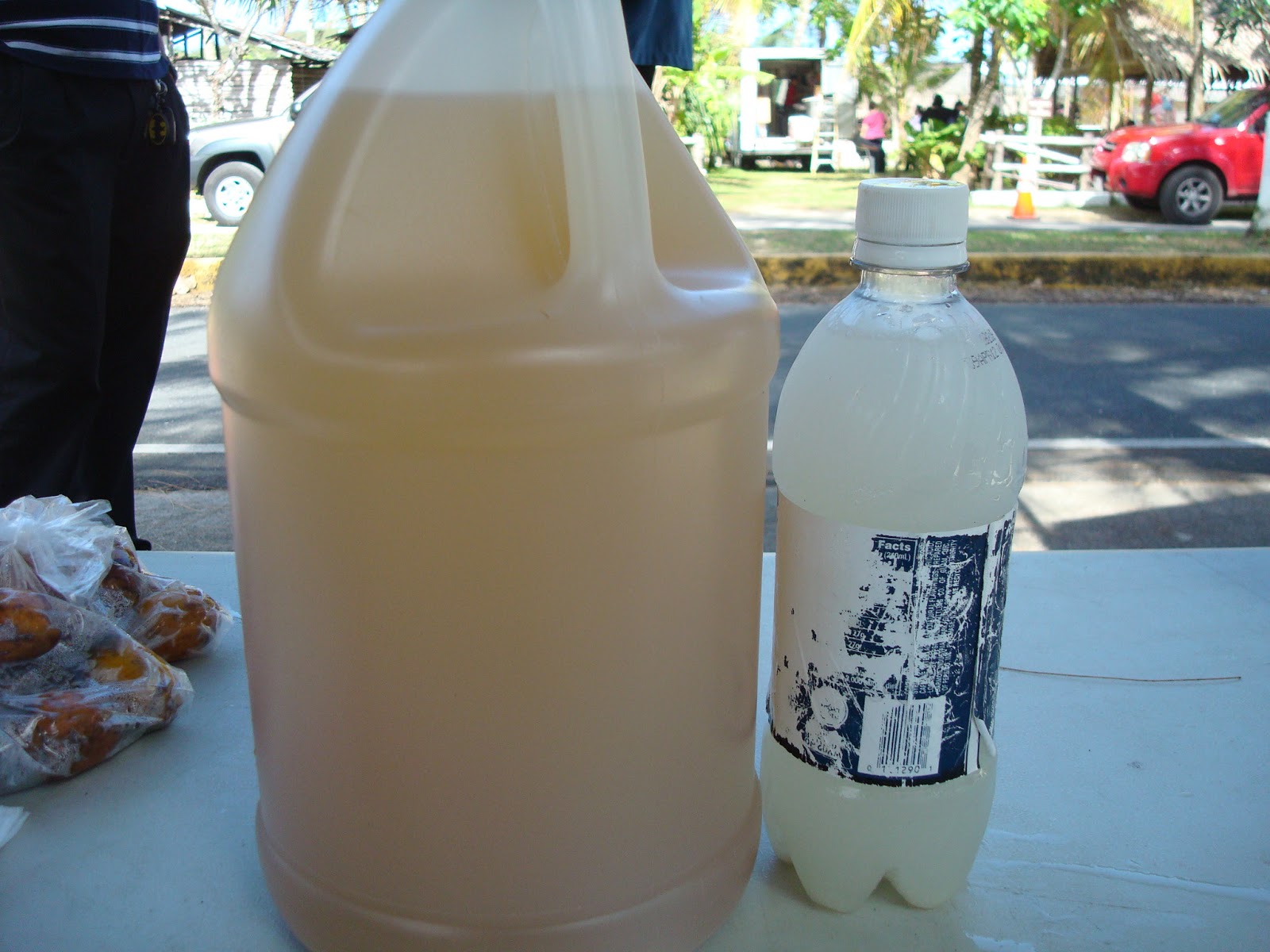
Unless it is refrigerated after this point, the tuba will ferment quickly and become an excellent vinegar, binaklen tuba.  In the two bottles above, the sweet, cold and clear tuba is to the right; the room temperature, darker vinegar is to the left.

In the old days before Payless supermarkets, Chamorros would use tuba as a leavening agent, like yeast, in breads.  One can always tell, for example, when tuba was used in making poto (rice cakes).

But there's nothing like drinking ice cold, sweet tuba on a warm day....


Ilek-ña i Amerikåno, "Ei na minannge'"

A statesider tries tuba for the first time - and likes it.

Wednesday, September 19, 2012

FINO' GUAM, FINO' SAIPAN

paulaq.blogspot.com

What do you call this in Chamorro?
 
It depends, nai.

On Guam, we say latiya

On Saipan, they say lantiyas.

They're both Chamorro modifications of the Spanish word natillas.


NATILLAS

First of all, remember that LL in Spanish is pronounced Y.  In old, old Spanish, it could also be pronounced LY.  Which is why we say Madeleine BordaLYO.

But Chamorro does not have the Y sound.  It becomes a DZ.  Think of Yoña and Yigo.

And also why Quintanilla is Kintanidza.  And Tajalle is Tahadze.  And old-time Chamorros would say Madeleine Botdadzo.

Now the Spanish word nata means "cream."  Nata de coco means "coconut milk" because coconut milk is so high in fat it's like a cream.

Natillas is literally "small creams" but it means "custard."

Simple as that.

Latiya or lantiyas is the Chamorro pronunciation for the Spanish word for custard - natillas.


BUT WHY THE SWITCH FROM N TO L?

Just how different languages prefer different letters, and the sounds they make.

For example, naranja is Spanish for orange.  Naranjita is "small orange."

But Chamorros changed it to lalanghita.  We prefer starting off L words with an N.

And we don't like R; we prefer L.  Guitarra becomes gitåla.


BUT WHY DO THE SAIPANESE ADD AN N?  LANTIYAS?

Because someone started pronouncing it that way and it caught on.

Just observe the world around you today.

Where do we get new slang words?  Someone thinks it up and it catches on.  Before you know it, the whole island is saying it.  No???


THE MOST IMPORTANT QUESTION ABOUT LATIYA.....
 
How do you make it?

http://guampedia.com/latiya-recipe/


Just to confuse you more...


I have heard some Chamorron Guam say natiya, latiyas, natiyas.  But lantiyas is a dead giveaway that you're from Saipan.
 
 
AND PLEASE.....IN THE NAME OF ALL THAT IS SACRED
 
Never, never, never spell it
 
LATIJA

Monday, June 25, 2012

GUYURIA WITH A TWIST...OR A ROLL?


Guyuria is a food we adopted from abroad.  We made it local by adding coconut milk and shaping it the way we do and cooking it till hard as a rock.

This young man makes the characteristic grooves on the guyuria using, of all things, a Japanese sushi roller!

flickr.com
CHAMORRO GUYURIA

sjcervo.multiply.com

FILIPINO GOLLORIA
No coconut milk


folklore.panamatipico.com

PANAMANIAN GOLLORIA
Made with bananas!  Cooked in sugarcane syrup.


The original Spanish word is

GOLLERIA

which means : exquisite food, delicacies

Thursday, June 21, 2012

EAT AN ALLIGATOR


ALAGETA

The mangoes have been so plentiful this year, people are paying you to take them.  It seems we also have more than enough avocados to go around this year as well.  We've been getting bags and bags of them.

The Chamorro word for avocado is alageta.  I have often wondered about that because we know it is native to Central America and so it had to have been brought to the Marianas.  There was no indigenous name for it.  But in Spanish it is called aguacate.  The Filipinos call it abukado.  But alageta? Where did we come up with that?

For years it did strike me that alageta sounds like a Chamorro pronunciation of alligator.  Sure enough, "alligator pear" is another English name for avocado.

Then I checked Safford, an American Naval officer who was secretary to the Governor in the very first years of the U.S. occupation of Guam.  Safford was interested in everything; language, plants, history, you name it.  And he wrote a lot of it down.

According to Safford, he introduced avocados to Guam.  So there we have it.  No wonder we don't even call avocados by their Spanish name, as we often do with fruits and vegetables introduced by the Spaniards.  This was brought in by an American, and another English name for avocado is "alligator pear," or, as we would pronounce it with our accent - alageta!

huntbot.andrew.cmu.edu
William E. Safford

Next time you eat a local alageta, you have him to thank for it