Showing posts with label Familia/Family. Show all posts

Wednesday, September 17, 2025

FAMILIA : CELIS


The center of the CELIS family is Saipan, but there is a small branch on Guam.

It all began with a man named AGATÓN CELIS from the Philippines. Records are not consistent in telling us where in the Philippines he was from. Some records say he was from Malate, a district of Manila. Other records say he was from Camarines Norte, a province in the Bicol region. It's possible he was born in Camarines Norte then later moved to Malate, Manila.


Agatón was a soldier under the Spaniards in the Philippines but, in 1843, he was found guilty of some crime, it seems likely a military rebellion, and exiled to Guam. He was on good terms with Governor Santa María of Guam, who employed him in the Government in Hagåtña. It seems he was engaged in clerical work, as he talks about using his pen.

Later he was assigned to Tinian, when that island only had a temporary community of a dozen men who did some animal husbandry for the Guam market, the income being spent on the care of lepers.

Then he was assigned to Saipan as a teacher for the Carolinians, and assisted in teaching what they needed to know to become Catholics. In 1856, he petitioned to have his case pardoned and to receive a salary for his teaching. It was a petition supported by the Chamorro mayor of Saipan and the Spanish priest of Saipan, as well as the Spanish Governor of the Marianas based on Guam.

While in Saipan he married a Carolinian woman in 1857 by the name of Enriqueta Antonia (Aurora). Records about her origins are also not consistent, some saying Eauripik and others saying Lamotrek. Her Christian names are also not always consistent. Sometimes Aurora is added to her names. She would have also had a Carolinian name from birth. Lasiguerag is mentioned as her Carolinian personal name.

Agatón was such an early settler in Saipan that a stream, spring and valley in the Tanapag area are called Sadog As Agatón, Bo'bo' As Agatón and Kannat As Agatón respectively. Sometimes people skip saying the "As."

It's possible that these areas were named after Agatón Celis because he owned land here.


The As Agaton area just south of Tanapag was used as a village or camp for Samoans exiled by the Germans to Saipan in 1909 until the Japanese sent them back to Samoa.

Agatón and Enriqueta had at least these three children that I know of :

IGNACIA, born in Saipan in 1858. She had a son Felipe, born in 1892 with no father stated in his birth record. Felipe married Ana Díaz Castro, daughter of Rodrigo and Luciana. Ana was born in Guam but moved with her parents to Saipan as a child. From them came Celis descendants.

Ignacia had a daughter María who had children out of wedlock, some of whom carried forward the Celis surname.

CARMEN, born in Saipan in 1860, married Simeón Muña Camacho, son of Juan Camacho and Francisca Muña, two of the earliest settlers of Saipan from Guam.

JUAN, born in Saipan in 1865, married María Garrido Iriarte of Guam. It seems Juan lived on Guam at times because a son, José Iriarte Celis, seems to have been born in Guam sometime in the late 1880s. Another son, Joaquín, seems to have been born on Guam around 1891. Joaquín never married. Neither Juan, nor his sons José and Joaquín, appear in the 1897 Guam Census, leading me to believe that they moved back to Saipan, perhaps because María had died, since Juan married (again) in 1896 in Saipan with a Carolinian woman named Nicolasa Huarong. No children seem to have come from this second marriage.

José and Joaquín reappear in the Guam records after 1900 so they must have left Saipan for Guam and settled on Guam for good, with José eventually marrying Nieves Namauleg Tuncap, the daughter of Jaun de Ocampo Tuncap, a Filipino, and Escolástica Angoco Namauleg from Aniguak. Their descendants spell the name CELES, but in the past spelling was inconsistent and both Celis and Celes were used across the board. So the Guam family spells it Celes, but they are of the same clan as the Saipan Celis.


A small, village street in Tanapag, Saipan is named after the founder of the Celis family, Agatón Celis.

Sometimes the Celis family is known as familian Agatón, even though there is only one Celis clan in all the Marianas.

Wednesday, June 4, 2025

FAMILIAN ANONAS


A branch of the Guerrero family on Guam is called the familian ANONAS.

The anonas is a tropical fruit, related to the åtes and laguaná, or custard apple and sour sop. There are literally dozens of different kinds of anonas in the tropics. They originated in Mexico, Central America and the Caribbean and were brought to the Marianas and the Philippines by the Spaniards. The name anonas comes from the Native American Taino word for the fruit. The Tainos were from Hispaniola, the island on which Haiti and the Dominican Republic in the Caribbean are located.

"Anonas" is also said in a number of Philippine languages.


Here's an early artistic portrayal of the anonas as found on Guam:


According to Safford, the Chamorros did not eat much of the anonas, preferring the åtes most of all, and then the laguaná. But the fanihi (fruit bats) relished the anonas and they grew wild in the jungle, so the bats had their fill of them.


DOMINGO BAE GUERRERO

The branch of the Guerreros known as the familian Anonas seem to be the descendants of Domingo Bae Guerrero who was born around 1849 or so. He was still alive, age 71 years, in the 1920 Guam Census. But he does not appear in subsequent censuses, so he must have passed away in or prior to 1930.

It is believed he was the son of Ignacio Guerrero and Andrea Quintanilla Bae.


DOMINGO'S SIGNATURE IN 1906
It was common to abbreviate Guerrero as Grro


Domingo married Ana Blas and they had five children.

SOLEDAD was the only daughter. She married José Garrido Álvarez but they had no children.

DOMINGO, a son, never married.

JOSÉ, another son, left Guam during Spanish times joining the crew of a ship.


JOSÉ BLAS GUERRERO

José was already out of Guam by 1897 as he is absent from the Guam Census taken that year. He may have gotten to the US during Spanish times, then. At any rate, he was married in California in the year 1900 to a Hispanic woman named Augustina Rodriguez, whose father was born in California and whose mother was born in Mexico. Originally living in San Francisco, the couple moved to Stockton by 1910. They had many children, so the Anonas family has had a branch in the United States for over 100 years.

NICOLÁS, another son, married María San Nicolás Luján, the daughter of Silvestre and Nieves.

They had a daughter María and a son Silvestre.

Nicolás married a second time, with Josefa Dueñas Crisóstomo, the daughter of José Tagaña Crisóstomo and María Camacho Dueñas.

Their children were Manuela, Rafael, Ana, Maria, Domingo and José.

Nicolás' children kept the Anonas clan continuing and spreading on Guam.

FRANCISCO, also a son, is listed in the 1950 Guam Census as the husband of Josefa Dueñas Crisóstomo. So it seems that, after his brother Nicolás died, he married his widowed sister-in-law Josefa. But both were too old by then to have children.

Domingo, the patriarch of the family, apparently married a woman named Nieves, perhaps after his first wife died. But by then he and his new wife were too old to have children.

I have not come across any information as to why Domingo's branch of Guerreros are nicknamed Anonas.


BAE

Domingo's middle name, Bae, which was his mother's maiden name, was a family here on Guam in the 1800s that has since vanished due to lack of male descendants. There are only 5 people with the surbame Bae in the 1897 Guam Census, and they are all women.

The Bae family goes back even further in time, and the name was sometimes spelled BAHE which means it was pronounced BA - E, since the Spanish H is silent and is used at times to separate tow vowels.

Tuesday, February 4, 2025

FAMILIA : CARBULLIDO

THE FOUR CARBULLIDO SONS
Clockwise starting at top left : LUÍS, JOSÉ, SEBASTIÁN, JESÚS

The Carbullido family on Guam is a well-documented one. It is so well-documented that many in the family have a very good family tree worked out. But this blog post adds a few details which family researchers may not have access to.

From the Agat sacramental records, which cannot be open to the general public in order to respect the privacy of individuals and families, we know that the first Carbullido on Guam was a man named


ANDRÉS RODRÍGUEZ CARBULLIDO

He was Filipino and born around the year 1834. The best we can say is "around," because many people in those days didn't know their birthday (there was hardly any reason to know that in those days of little paper work, widespread illiteracy and simple farming life). Many people just guessed their ages and didn't even bother to check church records or get a certificate. There was little need for such things in the old days. Most people didn't even celebrate birthdays. There were no driver's licenses, voter registration or credit card applications.

Andrés was the son of EDUARDO CARBULLIDO and ANDREA RODRÍGUEZ.

The 1920 Guam Census states he was from Manila, and maybe he was, but I'd hold off on stating that as an absolute fact because those census takers in those days just relied on what the person claimed, and some people were casual with details. A person could have just said "Manila" when in fact they were from 50 miles away from Manila, but most people knew Manila, not the little town 50 miles away, so they said, "Manila."

For whatever reason, Andrés came to Guam, certainly by the 1850s (he would have been in his 20s) because his oldest child was born on Guam in the 1850s. Some Filipinos appear on lists of deportees, sent to the Marianas in exile for crimes or for anti-Spanish political activities. Andrés doesn't appear on any such lists, just as many Filipinos who moved to Guam in the 1800s do not appear on deportation lists and came to Guam for other reasons, of which we know little or nothing.

When Andrés came to Guam, at some point he married the Chamorro JOSEFA DE LEÓN GUERRERO BLANCO from Hagåtña, the daughter of Martín Blanco and Marta de León Guerrero. But Andrés made his home in Hågat. Whether he met Josefa in Hågat or Hagåtña we don't know as we do not have their marriage record, but their children were all born in Hågat so I would put my money on Josefa having moved to Hågat already and having met Andrés there. Other Blancos, originally from Hagåtña, had also moved to Hågat in the mid 1800s.

ANDRÉS and JOSEFA had sons and daughters, but it was the sons, of course, who continued handing down the Carbullido name to their children. The Carbullidos multiplied and now number so many hundreds of people that I will keep things simple in this blog post an focus on just the four sons, from whom all the rest are descended. Most people know their grandparents and even great grandparents, but less know about the older generations so I will stick with them.

The four sons were LUÍS, JOSÉ, JESÚS and SEBASTIÁN.


CARBULLIDO-CHARFAUROS

LUÍS BLANCO CARBULLIDO, born around 1859. He married MANUELA CHARFAUROS the daughter of Pilar Charfauros. Manuela and her mother Pilar are found in the 1897 Guam Census, and Pilar is stated to be a widow, but her late husband's name is not mentioned (quite naturally as a census if of living people, not the deceased). Most records state that Manuela was the daughter of Pilar, with no father stated. One record states that Manuela's father was Luís Charfauros, about whom I cannot find any other documentation. Remember Spanish women keep their birth names even when they marry. So if Pilar is named Charfauros, that's her birth name, even if she later married a man with the same last name. 

But most documents state that Manuela Charfauros was the daughter of Pilar Charfauros, with no father stated. For now, I am more comfortable sticking to what is most clear; that Manuela Charfauros was the daughter of Pilar Charfauros. This Luís Charfauros needs more documentation for me to be more confident who he was in relation to Manuela Charfauros and that he was even married to Pilar at all.

Luís Carbullido and Manuela Charfauros had many daughters, but also at least two sons, Vicente and Joaquín. Vicente had one son, Francisco Arceo Carbullido who had many children, but Joaquín had all daughters.


CARBULLIDO-MANIBUSAN

JOSÉ BLANCO CARBULLIDO, born around 1865. He married ANA DELGADO MANIBUSAN, the daughter of Ignacio Manibusan and María Delgado. José was not as prolific as his brothers and had a few daughters and one son, Ignacio, who was still single at age 30 and apparently never married nor sired children.


CARBULLIDO-PANGELINAN

This is the branch of Carbullidos that produced the largest number of male descendants.

JESÚS BLANCO CARBULLIDO, born around 1870, married ENRIQUETA BORJA PANGELINAN, the daughter of Juan Pangelinan and María Borja. Juan Pangelinan was better known as Juan Kotla. Jesús and Enriqueta had five sons, besides their daughters : Antonio, Félix, Juan, Baltazar and Joaquín and many descendants from them.


CARBULLIDO-MUÑA

SEBASTIÁN BLANCO CARBULLIDO, born around 1877, married LUISA DUEÑAS MUÑA, the daughter of Vicente Muña and Cornelia Dueñas. Among their children, at least two sons had children : José and Francisco.


THE DAUGHTERS

Andrés and Josefa had four daughters as well, who all got married so their children carried their father's last names. The daughters were ANA, who married Juan Santos; FELISA, who married Juan Cruz Terlaje; MARÍA, who married José Delgado Manibusan; and TRINIDAD, who married Luís SN Aguigui (familian Taibas).


THE LADRES/LADRESS MISTAKE


Many Carbullido family trees make the mistake of calling Andrés ANDRÉS RODRÍGUEZ LADRES/LADRESS CARBULLIDO. Many even believe that Andrés' mother's maiden last name was LADRES. But LADRES is not found in any of the documents of the time in which they lived. It only shows up in modern family trees. LADRES is obviously someone's clerical error, based on the first name ANDRÉS. Then the next person just accepts the first person's error as accurate and puts it in the next family tree, and on it goes, the error is passed on to the next person. 

Some don't even know what to do, now, with the Rodríguez. Does it come before or after Ladres? So some do it one way, and some do it the other way. One even put Rodríguez in parentheses - "Rodríguez" - as if Andrés was not really a Rodríguez.

You can see how easy it is for one person to make a mistake, and even the mistake is mistakenly repeated. They don't all spell LADRES the same way! In any case, Andrés was ANDRÉS RODRÍGUEZ CARBULLIDO, no more, no less, not even Ladress. The sacramental records written at the time are clear.


1909 HÅGAT PETITION


That the Carbullido clan had standing in the Hågat community is shown in more than one way, including this 1909 Petition by leaders of the village to keep their Spanish priest (at the time threatened with being replaced by a German priest). Three of the four Carbullido brothers signed the petition; José, Luís and Jesús.

Luís, in fact, was gobernadorcillo of Hågat for awhile during the Spanish administration, a position that was like a village mayor at the time.


WELL-KNOWN CARBULLIDOS

Carbullidos continued to be in leadership in Hågat in modern times. 

Jesús Blanco Carbullido was Assistant Commissioner of Hågat in the early 1900s under the Americans. "Commissioner" is what village mayors were called back then.

Antonio Pangelinan Carbullido was Hågat Commissioner both before and after the war.

His son Albert Taitano Carbullido was well-known in his day as a Government of Guam director/chief of various departments, one of his best known being head of the Guam Election Commission. Prior to his civic life, Albert was on Canton Island working for Pan American Airways when the Japanese attacked Pearl Harbor. He then enlisted in the US Navy and served in the war.

Albert's brother Felix Taitano Carbullido was a member of the 2nd and 3rd Guam Legislatures, a founder of the Territorial Party and engaged in the insurance business on Guam.

Antonio's brother Baltazar Pangelinan Carbullido became an educator and civic leader, being a teacher, school principal, member of the Guam Legislature, businessman and active in several island associations. The elementary school in Barrigada is named after him (BP Carbullido Elementary School).

Their nephew Francisco Chaco Carbullido had the distinction of being one of the Wake Island Defenders at the beginning of World War II. He was made a Prisoner of War by the Japanese and sent to China and Japan until war's end.

Francisco's son F. Philip Carbullido is Chief Justice of the Guam Supreme Court.


ALL CARBULLIDOS
Clockwise starting at top left : Baltazar, Albert, Francisco and F. Philip


FORMER SENATOR FELIX TAITANO CARBULLIDO


THE CARBULLIDO NAME


One question that has nagged some members of the Carbullido family is the origin of the name itself.

As we know, Andrés, the founder of the Guam clan, was from the Philippines. And, yet, there are virtually no Carbullidos in the Philippines.

There, are, however people with surnames very close in spelling to Carbullido in both the Philippines and Spain with just one letter being different. We can thus assume, and with some confidence, that Carbullido is just a variation of the original Spanish name and, since spelling was so casual and inconsistent in the old days, the name was spelled Carbullido on Guam.

That original Spanish name is CARBALLIDO.


THE TOWNS OF CARBALLIDO IN SPAIN


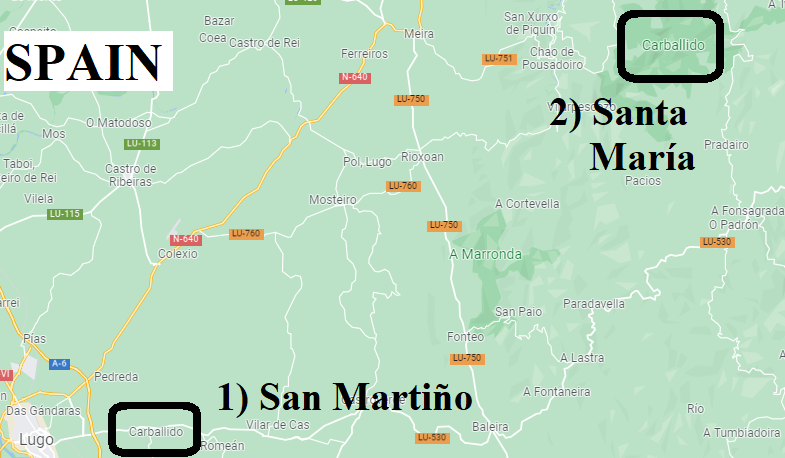
There are two tiny villages in Spain called Carballido, but they are in the same area. In fact, they are just 15 miles apart, give or take.

To distinguish the two towns with the same name, the village patron's name is attached. One is San Martiño de Carballido and the other is Santa María de Carballido. They are both in the Province of Lugo in the region of Galicia in Spain and they are both tiny. Neither village has more than 50 inhabitants. In fact, the villages are disappearing as only old people live there and their grandchildren have moved to bigger towns and cities.


The towns of Carballido in Spain lie in a region of Spain called Galicia, at the northwestern corner of the country.

In fact, a Chamorro Carbullido was attending some event in the US mainland and, in the elevator, a Spaniard said to him, "I know where your name comes from!" and told him about the little village of Carballido in Spain.


FROM VILLAGE NAME TO FAMILY NAME


Marga, pictuted above, is one of 1,752 people (since the last statistics) with the last name Carballido in Spain. Most of the people named Carballido in Spain come from Galicia, the region where the towns called Carballido are located.


As people began to choose family names for themselves, many chose the names of the towns, cities and villages they were from. We have many of them in Spanish and from them the Chamorros as well. Sigüenza, Tudela, Borja, Baza, and Benavente are names of towns in Spain.

And what does Carballido mean?

The name Carballido is related to many other names that came from the same roots, especially the name Carballo or Carvallo, which is even more popular in Spain and Latin America. The word means "a place full of oak trees."


A CHANGE OF ONE LETTER


IT'S CARBELLIDO IN THE PHILIPPINES


And then, when the Spaniards conquer the Philippines, we now see a name Carbellido, with just one letter changed from Carballido. You don't find any Carbullidos, even though Andrés was from there.

People didn't have the same fixation with EXACT SPELLING as we have today. Small differences didn't bother them. Even Juan de la Cruz sometimes wrote his name : JUAN CRUZ or JUAN DE LA CRUS. It didn't bother anyone. They knew who he was no matter the small difference in spelling.

The name LIZAMA, for example, is originally LEZAMA, a village in Spain. But on Guam people, even the Spanish priests, spelled it LIZAMA. No big deal to them. Chamorros spell it PANGELINAN, but Filipinos spell it PANGILINAN, and the PANGELINANS on the Marianas trace their ancestry to the PANGILINANS of Pampanga, the Philippines. No big deal. Some Chamorros of the past spelled it TOVEZ, and other spelled it TOVES, because in the Spanish spoken in the Marianas, S and Z sound the same.

Even today, John is spelled Jhon, Jon, Dzon, Djon and many other ways because people like variety or to be different. Exact, uniform spelling is not everyone's concern.

In the Philippines, there are today 642 people named CARBELLIDO. I wouldn't be surprised if Andrés Carbullido is from this same family many years ago, just spelled with a one-letter difference.

Friday, January 17, 2025

FAMILIA : ATAO / ATTAO


ATAO is apparently an indigenous Chamorro name and a family with roots in Tepungan, which is a part of Piti. A branch moved from Tepungan to Saipan and they spell it Attao. Priests in the old days spelled the same name in different ways, according to their own thinking, and people just went along with it. Many people couldn't read or write, anyway, in those days, so whatever way the official spelled it was just fine with them.

My wager is that Atao is an indigenous name for more than one reason. First of all, it is generally true that the non-Chamorros who settled on Guam in the late 1600s and in the early 1700s almost all settled in Hagåtña, many of them marrying Chamorro wives. It's in Hagåtña that you find the Spanish Dueñas and Camacho and the Filipino Pangelinan and Manibusan. In the rest of Guam, from Aniguak to Pågo to Inalåhan and all the rest, indigenous names dominate overwhelmingly; Babauta, Taigima', Na'mase' and all the others. In the 1758 Census we find a Pedro Atao in Hågat and a Toribio Atao in Tepungan, married to María Gupotña (also an indigenous name; gupot meaning "feast.") Thanks to Bernard Punzalan for confirming the 1758 Census information.

Sure there are people named Atao in the Philippines but so there are in Peru, as well. These are more than likely coincidences and there are probably differences in the pronunciation of Atao in these places.

Furthermore, the prefix A- and the root word tao are very Chamorro.

As far back as 1848, we find in the Spanish documents a man named Bernardino Atao, who is a Cabeza de Barangay (neighborhood leader) in the village of Asan. Asan is not far from Tepungan and people from both villages sometimes moved between them.

In the same year, but this time in Tepungan, is a man named Dionisio Atao who is the Alguacil (sheriff or bailiff) of that village. We don't know if Bernardino and Dionisio are related, but there's a good chance they are.


MARIANO ATAO

At any rate, what we can say is that all the Ataos/Attaos of Guam and Saipan today are the descendants of a man named MARIANO ATAO who was married to CEFERINA CHARGUALAF. We can assume they lived in Tepungan because all their children lived in Tepungan.

From what I can tell, from the old records, MARIANO and CEFERINA had four children; three daughters and only one son.

Since it is the son who hopefully has male heirs to continue the family name, I'll mention him first. He was PEDRO CHARGUALAF ATAO. According to the 1897 Guam Census, he was born around 1863, but these dates are sometimes unreliable and can be off a few years.


PEDRO CHARGUALAF ATAO

Pedro married María Pérez Megofña, most likely from Asan where that family comes from.

Pedro, too, had mostly daughters and only one son, Vicente. It is Vicente Megofña Atao who left Guam sometime after 1899 and settled in Saipan. There his name was usually spelled Vicente Magofña Attao, and his descendants in Saipan spell it so.

Pedro and María's daughters were Ana, María, Rosa and Consolación.

Ordinarily, daughters eventually marry and their children carry the father's name. But when a woman has a child outside of marriage, the child goes by the single mother's name.

This was the case with Ana Megofña Atao, daughter of Pedro and María. She had a son Juan in 1914 who married Josefa Chuapaco Jesús. Some think Chuapaco is the same as Champaco. It is a Chinese name and the Spaniards spelled this unusual name in several ways. Juan and Josefa had two daughters but only one son, George, carrying forward the name Atao, but he eventually moved to the States.


MARIANO AND CEFERINA'S THREE DAUGHTERS

Ana married Vicente Salas Nededog. This family settled eventually in Vicente's home village of Hågat, where his branch of Nededogs are known as familian Atao, on account of his wife Ana.

Josefa married Juan Megofña Pérez of Asan. He was the blood brother of María Pérez Megofña who married Pedro Chargualaf Atao. So a brother and sister married a sister and brother. That often happened in Chamorro society back then; two siblings marrying two siblings.

Concepción married Mariano Salas Cruz.


SAIPAN : VICENTE MAGOFÑA ATTAO

When Vicente moved from Guam to Saipan he married Natividad Cabrera San Nicolás in Saipan, the daughter of Juan San Nicolás and María Taisague Cabrera.

Their son Pedro San Nicolás Attao married Ninfa Camacho Torres. 

Their other son José San Nicolás Attao married Rosario Mendiola Cabrera. José was elected to the Saipan Congress in 1954.

Brothers Pedro and José continued the Attao line in Saipan.


Former Saipan Congressman José SN Attao and wife Rosario Cabrera
(photo courtesy of Chris Attao Concepción)


Vicente and Natividad also had daughters. Isabel married Ignacio Manahane Benavente. Maria married Alejandro Quitano Bermudes. Margarita married George Cruz Dueñas. Carmen married Cesario Taitano Concepción. Teresita never married.

Some of the Attaos in Saipan moved to Guam over the years. Right after the war, when travel between Guam and Saipan was more frequent since both were under US jurisdiction, a number of Saipan Attaos came to Guam and resided at first with their Guam Atao relatives. Some made Guam their permanent home.

Today, there are no Ataos on the Guam voter registration rolls, but there are a few Attaos registered to vote on Guam.

And just as George Atao moved to the States, some Attaos also reside today in the mainland.

Tuesday, September 10, 2024

FAMILIA : TAIJITO


The Taijito family history is pretty straightforward. The majority of Taijitos are from Asan, and I suspect that even the few Taijitos found in Hagåtña in Spanish times were originally from Asan.

Since the family is too large in number, I will just identify the males who were able to establish lines that kept the family name going.

Sometimes a female Taijito who had children out of wedlock produced children who carried forward the name Taijito, and these I will also include.


LUÍS MAAÑAO TAIJITO

Luís, from Asan, was married to Fermina Aflleje Taitano. They had two sons, Francisco and José.

Francisco married Rosalía Pérez Cruz, the daughter of Felipe and Margarita. They had a son Vicente who had moved to the US before World War II. He registered for the draft in New York City in 1940. He does not seem to have produced children and his whereabouts disappear.

José married Vicenta Santos Salas, the daughter of José and María and had several children but only one was a male who carried forward the Taijito name. He was Francisco, and he married Asunción Santos Muña, the daughter of Gregorio and Josefa. Eventually they moved to Hågat and raised their children there.

So from Luís Maañao Taijito of Asan came the Muña Taijitos based in Hågat, and their line still continues to this day.


RITA TORRES TAIJITO

Another Asan Taijito was Rita, whose parentage is unknown at this time.

Before Rita married Felipe Santos Aflleje, she had a daughter named María Taijito. María in turn had a number of children out of wedlock. At least three daughters (Vicenta, Consolación and Manuela) married and had numerous children, but carrying their fathers' surname. No sons of María seem to have fathered children to carry forward the Taijito name.

And so the Taijito name gradually vanished as a last name from its birthplace of Asan, though many Asan families obviously have Taijito blood in them.


APOLINARIA MEGOFÑA TAIJITO

Apolinaria is a Hagåtña woman in the 1897 Census, but having two very Asan names - Taijito and Megofña - I wouldn't be surprised if she originally came from Asan and then moved to the capital city.

Although married to José Aguon, Apolinaria had two children out of wedlock.

A daughter Ana Taijito married Severino Ricardo Apuron, so the entire Apuron clan are descendants of Ana, the daughter of Apolinaria.

A son Mamerto married Ana Mendiola Benavente, familian Lile'. And so now we have the Benavente Taijitos. Mamerto moved up to Machånao in the Dededo municipality before the war. They had one son Jesús.


FRANCISCO SALAS TAIJITO


I came across the interesting life of Francisco Salas Taijito, the son of José Taitano Taijito and Vicenta Salas Santos. Francisco comes from the Luís Maañao Taijito clan of Asan, though he moved to Hågat. He also went by the nickname Frank.

Frank was well-known back in the day for being chef for Guam's postwar Governors. He served them all in the 1950 and 60s, many of them American Governors appointed by the US President.

Frank wasn't just a good cook of Chamorro food. He could cook pretty much anything he could find a recipe for. Once found, the recipe stayed in his head. When he made chow mein for Governor Elvidge, who had very sophisticated tastes, Frank made his own noodles. When Governor Daniels blew in from Texas with wife and children in hand, Frank made hominy grits for breakfast. Frank made soups, salads, main courses, desserts and pastries. Each Governor had their own eating habits, and Frank easily adjusted to each one; from those partial to gourmet food to those who were satisfied with just toast and coffee in the morning.

He not only cooked for the Governor and family but also for their dinner guests, the frequency and amount of them depending on the Governor.

Frank got his start cooking for a living when PanAm hired him in 1937 to cook meals for the China Clipper seaplanes that landed in Apra Harbor before the war. He spent just two days in the Navy, the shortest stint he believed on record, and was released by the Navy to start working for PanAm. Besides cooking ground meals, Frank flew on the planes to cook in-flight meals. His plane was at Midway when the war broke out, so he wasn't on Guam for the war. Frank passed away in 1993 at the age of 85.


FRANCISCO TAIJITO WITH SAW IN HAND ON RIGHT
putting up booths for the Hågat parish fiesta in 1967
Father Donan Hickey on left


THE MEANING OF TAIJITO


We can't be too sure what Taijito means because the second part of the name, HUTO, can mean two different things. It can mean either lice or the seed of the dukduk (a kind of breadfruit) tree.

So Taijito can mean either "without lice" or "without dukduk seeds." Although the thought of lice isn't pleasant, remember that the name means WITHOUT lice, and that's a good thing.

For all we know, there could have been another meaning of huto which we don't know today.

There is another Chamorro word huto', which means "to spread," like spreading a cloth on a table. But huto' has a glota, which is not present in Taijito.

Our ancestors came up with unusual (for us) names. Just think of Taimanglo (without wind) or Taitano (without land).

Tuesday, August 6, 2024

LOST SURNAMES : CHIBOG


There used to be a family in Asan called CHIBOG.

The family goes all the way back to the 1700s. The name was also spelled Chiboc, Chibuc or Chibug. Spelling was not consistent in those days.

In 1791, in Spanish documents, there is a man named ANTONINO CHIBOG who was Teniente of the village of Asan. The Teniente was something like the assistant, or second-in-command, of the higher official who was in charge of something bigger than one village, so he had a Teniente to care for one section of his responsibility.

The document states that Antonino was the successor of an earlier Teniente named VOLFANGO CHIBOG. Volfango is the Spanish form of the German name Wolfgang (like Mozart), so this suggests to me that Volfango Chibog was born prior to 1769 which is when the Jesuit missionaries were expelled from the Marianas. Some, if not many, of the Jesuit missionaries in the mid 1700s were actually Germans, so the name Volfango was spread by them.

We know that Chibog women dominated the family in the late 1800s.

A María Chibog had married Gelacio Muña from Aniguak.

Mariano Materne also from Aniguak was a Chibog on his mother's side.

Marcela Tenorio was also a Chibog on her other's side.


BY 1897

By the 1897 Guam Census, there were only three people named Chibog on Guam.

All three were siblings, the children of Lorenzo Chibog and his wife Gabina Fegurgur. Sometimes her name is spelled Gavina.

They had two daughters and one son : Ana, María and Antonio.

Ana married Bernardo Cruz Pascual and had two daughters. The family moved to Saipan. The two daughters themselves married so the Chibog name was lost as the children took on their fathers' last names.

Neither María nor Antonio ever married and had children; so, the Chibog name was eventually lost when the two of them died, which was before the 1920 Census.


Lydia, the woman above, from San Roque in Saipan, was a Chibog. Her mother was Rosa Chibog Pascual, the daughter of Ana Fegurgur Chibog and Bernardo Cruz Pascual. They moved from Asan to Saipan in the early 1900s.

Wednesday, July 17, 2024

FAMILIA : CHARSAGUA


CHARSAGUA is an indigenous Chamorro name.

It appears in the censuses during Spanish times.

The name could mean several things, all of them more or less similar. CHAT is a prefix which means "badly, imperfectly, defectively." And SÅGUA means "port or canal." So perhaps chatsagua was used to described a way in and out of land and sea that wasn't recommended due to some geographical defect.

Although there were nine people named Charsagua in the 1897 Guam Census, it was a family destined to slowly fade away on Guam, and today it is in the US mainland that the Charsagua name continues.

JOSÉ CHARSAGUA was an old man, around 70 years old in 1897, so born around 1827, and a widower.

He was living in Hagåtña with two sons, his children from his deceased wife Apolonia García. You would think that having two sons would give his line a chance to survive. But here's what happened.


JOSÉ GARCÍA CHARSAGUA

José, the older of the two sons, married María Lizama Santos, the daughter of Ignacio and Josefa.

Court documents show that José had a nickname - Chetla.

Jose'n Chetla was involved in a road dispute in the early 1900s. He claimed that a certain trail, heavily used by the farmers traveling through the area, was on his private property. So he cut down some trees and blocked the road. The neighbors took Chetla to court, and Chetla was forced to reopen the road.

Jose'n Chetla and his wife María had half a dozen or so children, but half of them died young. Only two children lived long enough to have children, and they were both women who married. One of them was Rosa, pictured below. The other was her sister Magdalena. Having no sons, José wasn't able to pass on the Charsagua name to descendants.


MANUEL GARCÍA CHARSAGUA

But there was a second son of José and Apolonia and his name was Manuel.

His wife was Mariana Aguon. They had children, but only one lived long enough to have children. Her name was María.

María Aguon Charsagua never married but she had children. One was a boy, named José, who carried the name Charsagua from his mother. José joined the US Army and served in Korea and Vietnam. He married Dominga Rodríguez from Panama and had children; two daughters and two sons. José and his family remained in the US mainland and it is there that José sons and grandsons carry on the Charsagua name.

It is in the continental US, across several states, and no longer on Guam, where you will find people with the last name Charsagua.


JOSÉ AGUON CHARSAGUA'S GRAVE IN TEXAS
Son of María Aguon Charsagua, grandson of Manuel García Charsagua


JOSÉ CHARSAGUA'S GRANDSONS
the future of the Charsagua family name

Wednesday, April 3, 2024

FAMILIA : INDALECIO


The Indalecio clan in the Marianas probably goes back to a single individual with this last name who came to Guam sometime in the early 1800s from who knows where. 

There are no Indalecios in the 1727 nor 1758 Guam Censuses, so the first Indalecio came later. The name is Spanish, so he could have come from Spain, Latin America or the Philippines. 

But the Portuguese also have the name Indalecio, and a few Portuguese seamen did come to Guam, so we have to allow for that possibility.


SMALL FAMILY


In the 1897 Census of Guam, there are only EIGHT individuals with the last name Indalecio, and the exact relationship of about half of them, one to the other, is not entirely clear.

One Pedro Indalecio is mentioned in a document from 1856, and his signature (seen above) is even included. He could be the ancestor of these eight Indalecios in the 1897 Census (one of whom is named Pedro, probably after this older Pedro) but I have no evidence showing how he might be their ancestor.

The fact that this older Pedro Indalecio could, first of all, sign his name and with a firm hand and even with the flourish at the end shows that he was educated more than the average person on Guam at the time.

Of the eight Indalecios in the 1897 Census, there are only three men, none of them with children of their own who would carry the Indalecio name. One is older and married but without children, and the other two men are younger and still bachelors.

It is mainly the women who will have children, albeit out of wedlock, who will produce many Indalecio children, these illegitimate children keeping their single mothers' last name. We can list them as follows :

CLARA CRUZ INDALECIO

Clara was born around 1863. Apparently she never married but was the mother of

Pedro Indalecio, born around 1872. Pedro married Rufina Díaz Camacho, the daughter of Juan Camacho and María Díaz. Pedro and Rufina had more than half a dozen children, one of whom was Emeteria, who married Donald Kidd, and was the grandmother of Father Richard Kidd.

Another child, Juan, permanently moved to California in 1929; one of the early immigrants to the US mainland. He died in Alameda in 1986. He was married for a time, but late in life and never had children.

Pedro and Rufina's son José married María Mesa Camacho, the daughter of Francisco Camacho and María Mesa, and they had children, keeping the Indalecio name moving to the next generation.

Pedro had a sister María Indalecio, daughter of Clara. María had some children out of wedlock but it seems this line died out.

There was one more sister, Ana Indalecio. Ana had many more children than Pedro or María, all out of wedlock. 

Ana's son Juan Indalecio married Ignacia Rojas Mafnas, the daughter of Antonio Mafnas and Lucía Rojas, and this line continued the Indalecio name.

Another son of Ana, Vicente Indalecio, married Rosario Rojas, the daughter of Ana Santos Rojas, and they had children, too, who in turn had their own children.

Interestingly, one of Ana's grandchildren went by the family nickname "Clara," who was his great-grandmother.


MARÍA DE LA ROSA INDALECIO

All we know for now is that there was another Indalecio woman named María de la Rosa Indalecio who was the mother of a daughter out of wedlock named ROSA INDALECIO.

Rosa in turn had many children out of wedlock, all of them daughters except for one son. There are many Indalecio grandchildren from Rosa's offspring.


SAIPAN LINE


THE GOVERNOR OF THE NORTHERN MARIANAS
Arnold Indalecio Palacios
a descendant of Mariano Reyes Indalecio of Guam


In 1897 there was a Mariano Indalecio living with the other Indalecios (Maria, who married de León, Clara and her children). He seems to have moved to Saipan at the turn of the century.

According to Saipan records, his full name was Mariano Reyes Indalecio, the son of Antonio Indalecio and Ana Reyes. We do not know yet what relationship Antonio had with the other Indalecios on Guam. He does not appear in any records at the time so he was presumably dead by 1897.

In Saipan, Mariano married María Muña Palacios, the daughter of José Palacios and Ana Muña. They had children who continued the Indalecio name in Saipan. The current Governor of the CNMI is a descendant.

OTHER INDALECIOS

Many others have Indalecio blood in them, but thanks to their mothers, so they carry their father's last names.

Some of these families who married Indalecio wives a long time ago were de León, Pérez, Salas and, more recently, Quichocho.

But if you're last name is Indalecio, you're either from CLARA's line or MARÍA's line, or MARIANO's line if you're an Indalecio from Saipan.


FAMILIAN RÅNA


Even in Spanish times, Pedro Indalecio went by the nickname RÅNA, which is Spanish for frog (sapo is Spanish for toad). Other Indalecios also went by that same nickname.

The interesting thing is that there were no frogs or toads on Guam at that time. They came later. So how did Chamorros know the Spanish word for a critter that did not exist on Guam at the time? Of course it's possible they heard of it anyway, when stories are told or just from simple conversations.

Still, it's interesting (and a mystery) why someone should get that nickname.

So, some Indalecios go by Råna and sometimes by Clara. And the Quichochos who are also Indalecios often go by Råna.

Wednesday, January 31, 2024

FAMILY NICKNAMES : CAMEL


The Chamorro penchant for giving people nicknames, and it sticking to his or her children and descendants, continues to this day. In olden days, nicknames came from the Chamorro or Spanish languages, but now even English can be used to give new nicknames.

Take for example the familian Camel.

Having been a priest in Malesso' in the 1990s, I remember a family there better-known-as familian Camel, and particularly the name "Ben Camel."

Some people thought they were named after the cigarette brand Camel. One person said that a family member was known for not drinking a lot, as he was never thirsty, like a camel. Close, but not quite.

I went to a son of the deceased Ben Camel to find out the story.

Vicente Reyes Cruz from Malesso', who was very close to the Church, took members of his family on a hike one day.

Naturally some started to get thirsty and they asked Vicente if they could drink from the canteen.

Vicente told them, "Nangga nåya," "Wait a while," probably to preserve as much drinking water as possible on the hike so they wouldn't run out.

So the thirsty ones retorted, "Dalai hao, kalan hao i camel," "My goodness, you're like a camel," because camels are well-known for being able to journey through arid deserts for days on end without the need to drink water, since they are able to store water in their bodies.

So, Vicente got identified with the nickname Camel and it was passed down to the next generation in his family.


This shows us a few things about Chamorro mentality.

First, we will notice something about you. Whether it be something about your body, appearance, mannerism, behavior or speech. Or something you did or that happened to you. You fell down. You hid under a table.

Second, that one little piece of your life we will make your entire identity. That's your nickname and claim to fame for the rest of your life. And it will probably be inherited by your children.

Rest in peace, Ben Camel. U såga gi minahgong.


Monday, January 22, 2024

FAMILIA : SIGUENZA


LORENZO ("LARRY") TAITINGFONG SIGUENZA
with wife the former Rita Sablan Borja and children Rita and Otto
(courtesy of RoseMarie Siguenza)


The Siguenza family in the Marianas does not go a very long time ago. Of course, for you and me the year 1786 is a long time ago, but when other families appear earlier than that, in the 1727 and 1758 Censuses, while the Siguenzas do not, then the Siguenzas do arrive a bit later than many other families.

There was a soldier named Ignacio Siguenza on a list of soldiers serving the Spanish Government on Guam in 1786. He's one of the earliest Siguenzas documented in the Marianas. I cannot be sure if he has anything to do with the Siguenzas who came later, but there's more of a chance that he does than he does not. Who he was, where he was born and so on are questions I cannot answer for the moment. Was he Spanish, or Mexican, or Filipino, or a mixture or something else, we do not know for now.

Forty-three years later, there is another soldier named José Siguenza, who was the company drummer. For all we know, José could be Ignacio's son. Nine years later, there's a Miguel Siguenza listed as a soldier. José's brother? We cannot say anything more than that, since the documents just state first and last names and do not give us any more clues.

And we know from later records that there were a number of women named Siguenza who married, so the Siguenza name eventually got lost in the next generation.

But there were two men named Siguenza who became the patriarchs of all the Siguenzas who came later, many of them are people we know today.


LUÍS SIGUENZA

Born around 1829, Luís Siguenza married Agustina León Guerrero Pangelinan.

According to the 1897 Census, there seems to have been two sons both named José.

An older JOSÉ was married to María Quichocho Taisipic.

A second JOSÉ was married twice; the first time to Ana Tenorio Taitingfong, the daughter of José and Joaquina, and then to Maria Sablan Camacho, the daughter of Roque and Ana. One of José and Ana's sons, Felipe, was better-known as Felipe'n Bombo.

There was also a daughter named ENCARNACIÓN whom I mention because she married Pedro Royos Quichocho and many Quichochos are descended from her. One branch of these Quichochos moved to Luta (Rota).


VICENTE SIGUENZA


There was also a Vicente Siguenza from the early 1800s, whose relation to Luís Siguenza is unknown for the moment.

Vicente married Manuela Borja de los Santos.

They had the following sons :

JOAQUÍN, who first married Joaquina Pérez Cruz, the daughter of Pedro Reyes Cruz and María Cruz Pérez, then Emeteria de León Taitingfong, the daughter of Lorenzo Taitingfong and Juana de León.

From Joaquín's line come descendants like LORENZO TAITINGFONG SIGUENZA, who married Rita Sablan Borja; JOAQUÍN TAITINGFONG SIGUENZA, who married Ana Quitugua Borja and ANA TAITINGFONG SIGUENZA who, with Sharrock Brower Hannah, had a number of children.

Vicente and Manuela had at least two daughters. One was FILOMENA who married Vicente Tainatongo Castro.

The other daughter of Vicente and Manuela concerns us more because she had a number of children out of wedlock who carried the surname Siguenza, since their fathers were not known, or at least not official.

Her name was DOLORES

Allegedly with Joaquín Cruz Pérez, she had these two sons :

JESUS, who married Carmen Santos Mendiola, the daughter of Ignacio Reyes Mendiola and his wife María Fausto Santos.

And VICENTE, who married Dolores Manibusan Cruz, the daughter of Juan Ignacio Cruz and María de la Rosa Manibusan.

From another, unknown, father, Dolores had a son named JOSÉ, who married Consolación Cruz, the daughter of Juliana Cruz who was at some point married to Antonio Fejeran Mendiola.

So there are a number of people with the surname Siguenza who are all descended from Dolores Santos Siguenza who had at least three sons with "unknown" fathers.


WELL-KNOWN SIGUENZAS

Although not as numerous as many other families on Guam, the Siguenzas have produced a number of people very well-known on the island down through the years. Some of them were :


LARRY SIGUENZA


Lorenzo Taitingfong Siguenza, better known as Larry, was one of the earliest Siguenzas who became active in the island community. He was the son of Joaquín Santos Siguenza and his wife Emeteria de León Taitingfong, and so he comes from Vicente's line of Siguenzas.

His mainstay was the US Department of Agriculture before the war, working for them as an agricultural extension agent, whose job it was to promote island agriculture, especially among the youth through Boys' and Girls' Agricultural Clubs.


But that was just the beginning. Larry was involved in many civic activities before and after the war. Besides working for the Government of Guam, in various capacities such as the Department of Agriculture as Deputy Director and as the Parks chief for the Department of Land Management, Larry was involved in the Liberation Day Queen contest, the Lions Club, the Young Men's League of Guam, the Guam Civic Improvement League and the Knights of Columbus, a Catholic men's organization. He was a Boy Scout master since before the war. Larry was also involved in sports, particularly being a boxing referee and judge. He passed away in 1983.


PETE SIGUENZA


Peter Charles Siguenza, born in 1920, was the son of José Siguenza and Consolación Cruz, and thus the grandchild of Dolores Santos Siguenza, the daughter of Vicente Siguenza and Manuela Borja Santos.

Pete was fortunate enough to go to Coronado High School in Coronado, California near San Diego before the war. He was still in California when World War II broke out in 1941. He enlisted in the US Marine Corps. But his potential was noticed by his superiors and he was sent to officer's school and became the first Chamorro officer in the Marine Corps. He saw action in several famous battles in the Pacific arena.


PETE SIGUENZA (R) AND BEN BLAZ (L)
Two pioneer Chamorro Marines


He graduated from Saint Mary's College in Moraga, California and later obtained a Master's degree from the University of Southern California. He married the former Barbara Bordallo, daughter of BJ Bordallo and his wife Josefina Pangelinan Bordallo. Back on Guam, Pete Siguenza worked in various positions in the Government of Guam and for J&G Enterprises. He was also active in many civic groups and activities. He passed away in 2007.


JUDGE PETE SIGUENZA, JR


The son of Peter Charles Siguenza and his wife Barbara Bordallo, and thus a descendant of Vicente Siguenza from the 1800s, Peter Siguenza, Jr rose through the legal profession to become a trial judge in the Superior Court of Guam and then Chief Justice of the Guam Supreme Court. He graduated from Father Dueñas Memorial School and did his college and law school studies in California. He passed away in 2020.


EDDIE SIGUENZA


If you attended almost any social event on Guam in the 1970s pretty much until before he died in 2009, you saw Eddie Siguenza, the brother of Peter Charles Siguenza. More importantly, he saw you because he was a photographer by profession, one of the island's leading photographers. Chances are he took your picture. He was everywhere, camera in hand. He was often hired by government officials and corporate bosses to photograph the island's biggest affairs.


SISTER CARMEN FRANCES SIGUENZA, SSND


And the last Siguenza I will mention is one who had an air of holiness about her. She was a Notre Dame Sister, Sister Carmen Frances Siguenza, the daughter of Jesús Siguenza, the son of Dolores Santos Siguenza, and his wife Carmen Mendiola. Sister was a school teacher, so she touched the lives of hundreds of children, from elementary grades up to junior high school. She even worked in Yap as a missionary.


She always had an aura about her that was warm and accepting. In her older years, she began to suffer bad health involving a lot of pain, and had to wear a neck brace. She was never down about it, and she never complained. She stayed the same. She was constantly praying for people. People brought her many intentions, and she listed them down to remember them when she prayed. She passed away in 2015.


SIGUENZA, SPAIN


Although we don't know where the first Siguenza on Guam came from, we do know that the name is Spanish and is the name of a city in northern Spain in the Province of Guadalajara.


SPANISH SPELLING


JOSÉ PANGELINAN SIGUENZA'S SIGNATURE
in 1902


If you notice the way the name SIGUENZA is spelled in the photo of the Spanish city, there are two dots above the U. 

The two dots are needed in Spanish to make the sound GWE in SIGWENZA. Without the two dots, the GUE would sound like GUERRERO - GERERO. No GWE.

Notice that the Chamorro man José Pangelinan Siguenza spells his last name the Spanish way, with the two dots above the U.