Showing posts with label Lengguåhe/Language. Show all posts

Monday, August 3, 2026

CHAMORRO POSTCARDS FROM 1900


Attorney Michael White from Saipan sent me pics of two postcards written in Chamorro from the Northern Marianas during the German Administration in 1900.

The first one, seen above, was addressed to Froilán Mangloña in Luta. I will render it in my Chamorro orthography but you can easily follow it by reading the original :

Gi echongñan i plåsa gi me'nan i gima' u fan ma tånme flores yan man dikkiki' na trongkon håyo siha yan un gua'ot ni dångkulo para kumahulo' guato i gima'.

In English, "By the side of the square in front of the house flowers and small trees will be planted and a large staircase to go up to the house."

I like this postcard because it uses the word ECHONGÑA which is now obsolete; no one uses this word anymore which is why even good Chamorro speakers have no idea why we sing in the hymn "O Maria Nana'magof" the words TUNANAS GI ECHONGÑÅ-MO. People think it means "crooked mosquito," "echong ñåmu." But ECHONGÑA means "side."


The second postcard was addressed to Luís Igualeman which is really EGAULIMAN, a Carolinian in Saipan. It says,

I gima' gaige gi hilo' okso', gai padet kuåttro yan meggai haligi-ña lao trabia ti monhåhåyan.

In English, "The house is on top of a hill, it has four concrete (perhaps walls) and it has many posts, but it is not finished yet."

Tuesday, June 16, 2026

SINANGAN MAN ÅMKO'


TI SIÑA UN FOKSE HÅGA' GINEN I KAMUTE

You cannot squeeze blood out of a sweet potato.


This is a Chamorro variation of "you can't squeeze blood out of a turnip," or "you can't squeeze water out of a stone," and many more.

It's the same idea.

You can't get from someone what that person doesn't have to give.

Saturday, June 13, 2026

KONSUEGRA


Thanks to the Spanish language, Chamorro has a word found in very few languages around the world.

That word is CO-MOTHER-IN-LAW. In Spanish, consuegra, or in Chamorro konsuegra.

These two women, both named Terry, have children married to each other. To each other, these two ladies are KONSUEGRA. Their husbands would be konsuegro to each other. All thanks to the Spanish language, of course. But not even Italian or French has a word like this.

Suegra is the Spanish word for mother-in-law. Putting the prefix con before it means "mothers-in-law-together."


Tuesday, February 10, 2026

ONRA? PAT ONRO?


How does one say HONOR in Chamorro?

When we sing the Fanohge Chamorro, we say ONRA. "For the honor" is "Para i onra."

When we are at Mass, we say ONRO. "For yours is all the honor" is "todo i onro."

If we look at Spanish, there is a Spanish word honra, but no Spanish word honro. Honra means "honor, esteem, respect" and so on.

Påle' Román (1932) says onra means "honor," and Padre Ibáñez says the same thing in 1865.

In Chamorro, onra is also a verb. Ma onra i taotao. The person is honored.

Påle' Román says that the noun "honor" is inenra. One can turn almost any word into a noun by adding the -IN infix. The adjective "good" or "maolek" becomes the noun "goodness" or "minaolek."

So where does onro come from?

My guess is that when a word is seldom used, as "honor" is I would submit, the word is more likely to undergo transformations based on personal whim or leaning. Frequent usage sets a sort of standard you are held to. But rare usage opens one up to more freedom to modify.


Thursday, October 23, 2025

"TAIGUENNAO MOHON" OR "AMEN?"


How should we end our prayers in Chamorro?

You hear "Amen" a lot of the times but sometimes you hear "Taiguennao mohon."

A lot of people aren't even sure what "taiguennao mohon" means.

Guess what? It means "amen!"

Well, what does "amen" mean?

"Amen" was the Hebrew word used to end prayers. It means "so be it, may it be so, truly" and things like that.

When a congregation responds with an "amen" to what a priest or prayer leader says, it's the congregation's way of agreeing with the prayer just said and making that prayer said by someone else their own as well.

TAIGUENNAO means "that way."

MOHON is a word that can express desire, or a possibility that hasn't happened yet.

TAIGUENNAO MOHON means "may it be that way." Which is what "amen" means.

So both "amen" and "taiguennao mohon" mean the same, exact thing. One is based on Hebrew, and the other is Chamorro.


OTHER LANGUAGES, TOO....


"Amen" can also be said in the native language in many countries around the world.

Some Spanish speakers say "así sea" instead of "amen," because "así sea" in Spanish means "that way (así) may it be (sea)."

In Italian it's così sia. In French it's ainsi soit-il. They both mean "may it be that way" which is what "amen" means.

Many languages end their prayers with "amen" and sometimes they end it with "may it be so" in their own language.

Most times, people all over the world end their prayers with "amen" and for this main reason. It's shorter and faster to say than "may it be so."


FLEXIBILITY IN CHAMORRO


In Chamorro, people can end their prayers saying either "amen" or "taiguennao mohon."

Even in Påle' Román's prayer books, he sometimes ends the prayer with "amen" and sometimes he ends the prayer with "taiguennao mohon."

For me, "amen" goes better with something like making the sign of the cross. "Gi na'an i Tata, yan i Lahi-ña yan i Espiritu Sånto. Amen." "Amen" is a quick ending to a short prayer. For a longer prayer, I might use "taiguennao mohon."

One good thing about using "taiguennao mohon" is that it makes clear what "amen" means. That is, of course, assuming you know the Chamorro language, which a lot of Chamorros don't nowadays.

Wednesday, September 24, 2025

NA' TAOTAO TUMANO'


FIESTA SCHEDULE FROM 1977


NA' TAOTAO TUMANO' is a Chamorro term used on Guam for the communal meal served to the faithful who attend a parish fiesta or feast.

To understand the concept, one must think of the olden days when people traveled on foot or by bull cart from one village to another, many times taking many hours to reach the destination.

The feast of Saint Joseph in Inalåhan is a good example. Being such a popular saint, and patron of the men, many people from Hagåtña went down to Inalåhan for the feast (called the Patrosinio) in March. Due to the distance and the long travel time, going to the Patrosinio was a whole 2-day commitment. People had to spend the night in Inalåhan, sleeping at relatives or friends' homes.

People did the same when it came to all the southern fiestas. Even Hågat and Sumay, which were closer to Hagåtña, took some time to get to.

So the people of the village receiving these guests from other places felt obliged to feed the people when the religious services were completed. They wanted to feed the pilgrims.

A pilgrim is someone who makes a journey for a religious purpose.

The Chamorro word for "pilgrim" is taotao tumano'. The Chamorro word na' means "food."

Na' taotao tumano' means "food for the pilgrim."


TUMANO' comes from the Chamorro word for "land" or TÅNO'. People traveled by land to get from village to village, so to tumano' means to travel by land (tåno').


Nowadays, it takes less than an hour, and many times less than twenty minutes, to go from home to the church holding the fiesta, but many people still call it the na' taotao tumano'. I hope we never lose the term. It reminds us what a pilgrim is.

Wednesday, September 10, 2025

HOW TO SAY "DULCE NOMBRE"


The name of Guam's cathedral-basilica is a Spanish one. Dulce Nombre de María, which means "the Sweet Name of Mary." It's been called this since the beginning, when Sanvitores built the first Catholic church in the Marianas more or less at this present site in 1668 (it was dedicated on February 2, 1669, but construction began earlier).

Being a Spanish name, some people wonder how to pronounce it.

Well, there's more than one answer to that question, but there aren't dozens of answers to it. There are a few correct ways to say it, and many more incorrect ways to say it, depending on what language has borrowed the Spanish original.

In this video, I'll cut to the chase and start off pronouncing it the standard way of saying it as said by the majority of Spanish speakers, which is the way it was said on Guam (and still should be).

Then I will say it using two other possible pronunciations, and finally I will explain how one pronunciation is a confusing of Latin/Italian pronunciation and Spanish and should not be followed.


LISTEN....


A WRONG WAY TO SAY IT


Many years ago, someone started mixing up Spanish and Latin (or Italian).

He probably did this because there is a Latin hymn to Mary (the Salve Regina) which ends with the words "DULCIS Virgo Maria." 

Latin was the language of ancient Rome and is the historical language of the Roman Catholic Church. The Spanish word DULCE is based on the Latin word DULCIS, and they both mean the same - "sweet."

But Latin and Spanish have different rules of pronunciation. In Latin, a C before I, E, OE or AE is pronounced like a CH. So, in church Latin, DULCIS sounds like DULCHIS.

But this is not so in Spanish.  In Spanish, a C before an E or an I is NOT pronounced like a CH. It is pronounced like an S, among the majority of Spanish speakers, or in northern and central Spain, like a TH.

So that person was confusing Spanish with Latin (or Italian, which has a similar pronunciation of C before E or I). Hearing the Salve Regina week after week (it is traditionally sung in church on Saturday mornings), he got used to hearing the Latin pronunciation and started using it with a Spanish word. I have no other way of guessing why he made this switch, but it all began with him. I never heard anyone ever say DUL - CHE Nombre de María until he started saying it that way. But since he was holding a microphone, a lot of people went along with it. 

JUST LISTEN TO THE AUDIO and you'll be OK.


Tuesday, August 20, 2024

LAST WILL IN CHAMORRO


In 1927, a prominent and wealthy man decided to write his last will and testament as he was not in good health and wanted to be prepared for death. He wrote his will in Chamorro, which lets us see the kind of Chamorro being spoken in Guam in the 1920s, 28 years into Guam's slow but sure Americanization.

The man was born around 1872, and his father was a very prominent man on Guam in the mid 1800s, as his father before him had been a Spanish government official who fathered children with a Chamorro lady.

I have changed the spelling to my own spelling more familiar to people today, and I am leaving out last names because the family's current descendants may not appreciate this will becoming public knowledge. An English translation follows each paragraph and explanatory notes come at the end.

Guåho si José ____ ____, 55 åños edåt-ho yan taotao este iya Hagåtña, låhen _____ yan _____. I numeron sedulås-ho 3313. Malångo yo’ lao mamaolek ha’ todabia i hinaso-ko. Hu fa’tinas i uttimo na disposision-ho ni todo i guinaha-ho, taiguine mo’na :
I am José ____ ____, I am 55 years old and a resident here in Hagåtña, the son of _____ and _____. My cédula is number 3313. I am sickly but my mind is still well. I make my final disposal of all my assets as follows :

UNO : Guåho sottero yo’ ya tåya’ tinatte-ko pat patgon-ho ni mañaina-ho sino solamente mañe’lo yan sobrino siha.
ONE : I am single and I have no descendants or children nor parents except only siblings and nieces and nephews.

DOS : Desde ke hu tutuhon macho’cho’ asta på’go hu sodda’ este siha mo’na na propiedåt :
TWO : Ever since I began working till now I find the following properties :

(a) Un guma’ teha yan i solåt-ña ni gaige gi Calle Esperanza, barrion San Ramón, numero 1299, na hu adkiere påtte pot erensia ginen i mañaina-ho yan påtte pot finahån-ho gi mañe’lu-ho. One house with tiled roof and its plot which is on Esperanza Street, in the barrio (district) of San Ramón, number 1299, which I acquired partly through inheritance from my parents and partly from my purchase from my siblings.

(b) Un fangualu’an giya Pa’åsan hurisdiksion Hagåtña na hu adkiere lokkue’ pot erensia ginen i mañaina-ho. A farm in Pa’åsan, jurisdiction of Hagåtña, which I acquired also through inheritance from my parents

(c) Un paståhe giya Makåhna hurisdiksion Hagåtña yan trenta na guaka ni man ma påpåsto guihe. Este na tåno’ finahån-ho gi as Juan ____, as Joaquin ____ yan otros mås. A pasture in Makåhna, jurisdiction of Hagåtña, with thirty heads of cattle which are pastured there. This land is my purchase from Juan ____, Joaquin ____ and others.

(d) Guaha lokkue’ ga’-ho singko na båkan karabao yan dos na toriyon karabao na man ma sosotta gi paståhen Luís ____ giya Bubulao. Guaha lokkue’ un båkan guaka na ha popoksai si Joaquin ____; un bakiyan guaka na ha popoksai si José ____ yan tres båkan karabao, i uno ha popoksai si Juan ____, i otro ha popoksai i pastot-ho as Juan ____ ya i otro ha popoksai si Vicente ____ yan un lecheran guaka na gai patgon. I have also five female carabao and two young male carabao which are loose on the pasture on Luís ____ in Bubulao. There is also a cow being raised by Joaquin ____; a heifer being raised by José ____ and three female carabao, one being raised by Juan, the other by my herdsman Juan ____ and the other by Vicente ____ and a dairy cow with its calf (or is pregnant?).

(e) Guaha lokkue’ dos karetå-ho, i uno troso i otro råyo. I also have two carts, one with solid wheels and the other with spoked wheels.

(f) Guaha lokkue’ iyo-ko na piano. I also have a piano.

TRES : Hu deklåra na tåya’ ni uno hu didibe ya ni uno dumidibe yo’.
THIRD : I declare that I am in debt to no one at all and no one is in debt to me.

KUÅTTRO : I disposision-ho ni este siha i propiedåt-ho ni esta hu sångan taiguine mo’na :
FOURTH : The disposal of my properties already described is as follows :

(1) I gima' teha yanggen måtai yo’ para si Marikitan che’lu-ho. The tiled-roof house should I die is for my sister Marikita.

(2) I tano’ giya Pa’åsan, i paståhe giya Makåhna yan i guakas siha guihe yan i singko båka yan dos toriyon karabao ni man gaige gi paståhen Bubulao para i sobrinu-ho as Enrique ____ kon la obligasion de i kubre todo i gåsto pot guåho durånte todo i malangu-ho yan i gåston i entieru-ho yanggen måtai yo’. Pot si akåso homlo’ yo’ nu este na malangu-ho ya esta yo’ siña macho’cho’ komo åntes, obligao yo’ na hu na’na’lo gue’ ni todo i gaston-ña pot guåho. The land in Pa’åsan, the pasture in Makåhna and the cattle there and the five female and two young male carabao which are in the Bubulao pasture are for my nephew Enrique ____ with the obligation to cover all the expenses during my illness and the expenses of my funeral should I die. If I should recover from this illness and I can work as I did before, I am obliged to pay him back all his expenses for me.

(3) I tres båkan karabao, i tres båkan guaka yan un tatneron guaka ni man ma popoksai segun i esta hu sångan guine gi sanhilo’ yan i dos kareta yan i piano para i mañe’lu-ho famalao’an as Marikita, Caridad yan Consuelo. The three female carabao, the three cows and one carabao calf which are being raised in the way I have already stated above and the two carts and piano are for my sisters Marikita, Caridad and Consuelo.

(4) Hu nombra i primu-ho yan amigu-ho as José ____ para atbaseå-ho para ke, yanggen måtai yo’, guiya u dispone todo i propiedåt-ho konfotme i malago’-ho guine na testamento. I name my cousin and friend José ____ as my executor so that, should I die, he will dispose all my properties in accordance with my wishes here in this testament.

Hu deklåra na este ha’ i uniko na testamento fina’tinås-ho asta på’go na ha’åne. I declare that this is the only testament that I have written till the present.
 
Ya este na testamento hu suplika i sobrinu-ho as José ____ para u tugi’e yo’ sa’ chatsaga yo’ hu tuge’ pot i malangu-ho ya todo este siha na disposision-ho humuyong ginen i pachot-ho yan i minalago’-ho, sin hu ma su’ok pat hu ma chachalåne, ya bai hu fitma este na testamento gi me’nan i testigo siha ni i hu na’ fan ma agånge para u ha hungok i disposision-ho guine na testamento, guine giya Hagåtña på’go gi dia ocho de enero gi mit nobesientos beinte i siette na såkkan.
And this testament I requested my nephew José ____ to write for me because I am unable due to my illness to write it and all of these instructions of mine have come from me verbally and from my will, without me being pressured or influenced, and I will sign this testament before the witnesses whom I have called to hear of the instructions in this testament, here in Hagåtña on today’s date of January 8, 1927.


NOTES

(1) The testator uses some Spanish loan words which are hardly used today. Atbasea (Spanish albacea) means executor, as of a will. The sedulas (Spanish cédula) was a personal identification paper. He also uses phrases straight out of Spanish such as "kon la obligasión de" (with the obligation to).

(2) He uses the original word todabía instead of trabia (in Saipan, tarabia), meaning "still, not yet." Monsignor Calvo (born 1915) always said todabía as well.

(3) The man has a piano, a rarity among Chamorros at the time. It indicates he is a man of above-average financial means (as also evidenced by his properties and cattle) and cultural affinity with the West.

(4) This man's last will differs from older last wills in one very noticeable way - the absence of any religious language. The man was Catholic, and I am not suggesting he wasn't a practicing one, but he does not include any religious language at all, not even about his funeral, whereas older last wills were very religious in tone. They almost always began right away with a profession of the person's Catholic faith; this was often the very first line of the last will. The person went on to express how they intended to die a loyal Catholic, obedient to the Catholic faith till death, and included clear instructions that he or she be given a Catholic funeral and sometimes even made provision to pay for the exact kind of funeral services they wanted, or how many Masses they wanted to be offered for them.

(5) Place names. The man's real estate assets were all centered in what we now call the Agaña Heights area. He mentions two places : Pa'åsan and Makåhna. I have never heard of a place called Makåhna, only the mountain by that name. A mountain is hardly a place for a pasture, but maybe he means the slopes of Mount Makåhna near Agaña Heights or maybe the backside of the mountain, which isn't a steep climb.


PA'ÅSAN AND MAKÅHNA


In addition, he mentions a place called Bubulao, where he didn't own land but where one of the landowners there allowed him to pasture some of his animals, maybe for a fee or a share in the meat if and when the animal was butchered. Bubulao was prime pasture land and some prominent Hagåtña people owned land in Bubulao and raised cattle there, sometimes hundreds of heads of cattle.

Bubulao is somewhat remote. One has to drive from Malojloj inland to the foot of the mountains.


BUBULAO

Friday, December 1, 2023

THE SINGET SEWING MACHINE


Many of you know that Chamorro does not like ending words with the letters R or L. Final R or L become a T when said in Chamorro.


SPANISH

CHAMORRO

ENGLISH


COLOR


KOLOT


color


ÁNGEL


ÅNGHET


angel


This advertisement in the Guam Daily News in 1959 shows how our elders pronounced SINGER as in SINGER SEWING MACHINE.

They said SINGHET or SINGET.


Notice that "sewing machine" is MÅKINAN MAN LAKSE." Man låkse' means "to sew" and måkina is machine.

"Limited quantity" is rendered "ti meggai tetehnan" or "not many left."

"Monthly payments" is "Siña un apåse pot mes," or "You can pay by month."

Our elders had no trouble paraphrasing the English in Chamorro, rather than invent new words that are stranger than the paraphrase.


SINCE SPANISH TIMES


Apparently, there were Singer sewing machines on Guam even in the late Spanish period.

A book published in Manila in 1895 claimed that there was a Singer Sewing Company outlet in the Marianas, probably meaning Guam.

The above citation reads, in English,

The Singer Company has more than 2000 houses established in the principle population centers of the world and the Philippines agency, besides the outlets in Manila, Iloilo, Cebu and Tacloban, has agents in the principle population centers in the Archipelago and also in both the Carolines and Marianas.

Tuesday, January 3, 2023

SINANGAN I MAN ÅMKO'


I I'E' HUMUYONG TARAKITO

The I'e' fish became a Tarakito fish


This is a saying applied when a story starts when one person tells it to another person, but by the time the story reaches the 20th person, the story has grown way bigger than it really is.

The i'e' is a small fish. It's actually the name for a kind of fish when it is still in its baby stage.

When the i'e' matures and grows, it is then called tarakito.

So let's say Juan tells Manuel that he was bit by a dog.

Manuel tells Francisco and Francisco tells Lorenzo that Juan was bit by two dogs.

Lorenzo tells Ramón that Juan and his wife were bit by a pack of dogs.

Ramón tells Pedro that Juan and his wife were bit by a pack of dogs when Juan and his wife were picking mangoes from Antonio's tree without permission.

You get the idea.

The tiny fish became a big fish.

It could also be applied, I believe, to embellish a story. After all, who would be impressed if you caught a small fish? But if you single-handedly caught a marlon as big as yourself, people saw "Wow."

I i'e' humuyong tarakito.

Tuesday, August 23, 2022

YOUR AMERICAN IS SHOWING : MÅNHA TITIYAS


QUICK LESSON

In English, we say APPLE Pie. What KIND of pie? Apple.

CHOCOLATE Cake. What KIND of cake? Chocolate.

But, in Chamorro, the order is reversed. Buñuelos AGA'. What KIND of buñuelos? Aga'.

It is Pån TUBA. What KIND of pån? Tuba.

Therefore, in Chamorro, it is Titiyas MÅNHA. What KIND of titiyas? Månha.

To the Chamorro ear, saying MÅNHA TITIYAS is as unpleasant as is saying PIE APPLE or CAKE CHOCOLATE to the English ear.


FULLER LESSON


The mighty march of Americanization continues in the minds of our younger Chamorros of Guam. Swimming in an ocean of the English language, surrounded by English water from the moment one wakes up to the moment one falls asleep, and being the only language so many of our people under the age of 60 speak, it is no surprise that even when Chamorro people use a Chamorro phrase, they use it in an American way. They don't even realize it.

One glaring example of this is how widespread the phrase MÅNHA TITIYAS is.

That's an American way of using Chamorro words to describe Young Coconut Flatbread.

Chamorro flatbread is called TITIYAS, a Chamorro version of the Spanish word TORTILLA.

Now there are many kinds of titiyas. Titiyas can be made with corn (mai'es), wheat flour (arina), breadfruit (lemmai) and pretty much any carb that can be made into a flour or incorporated into flour.

But in Chamorro we put the KIND of thing it is AFTER the thing itself.

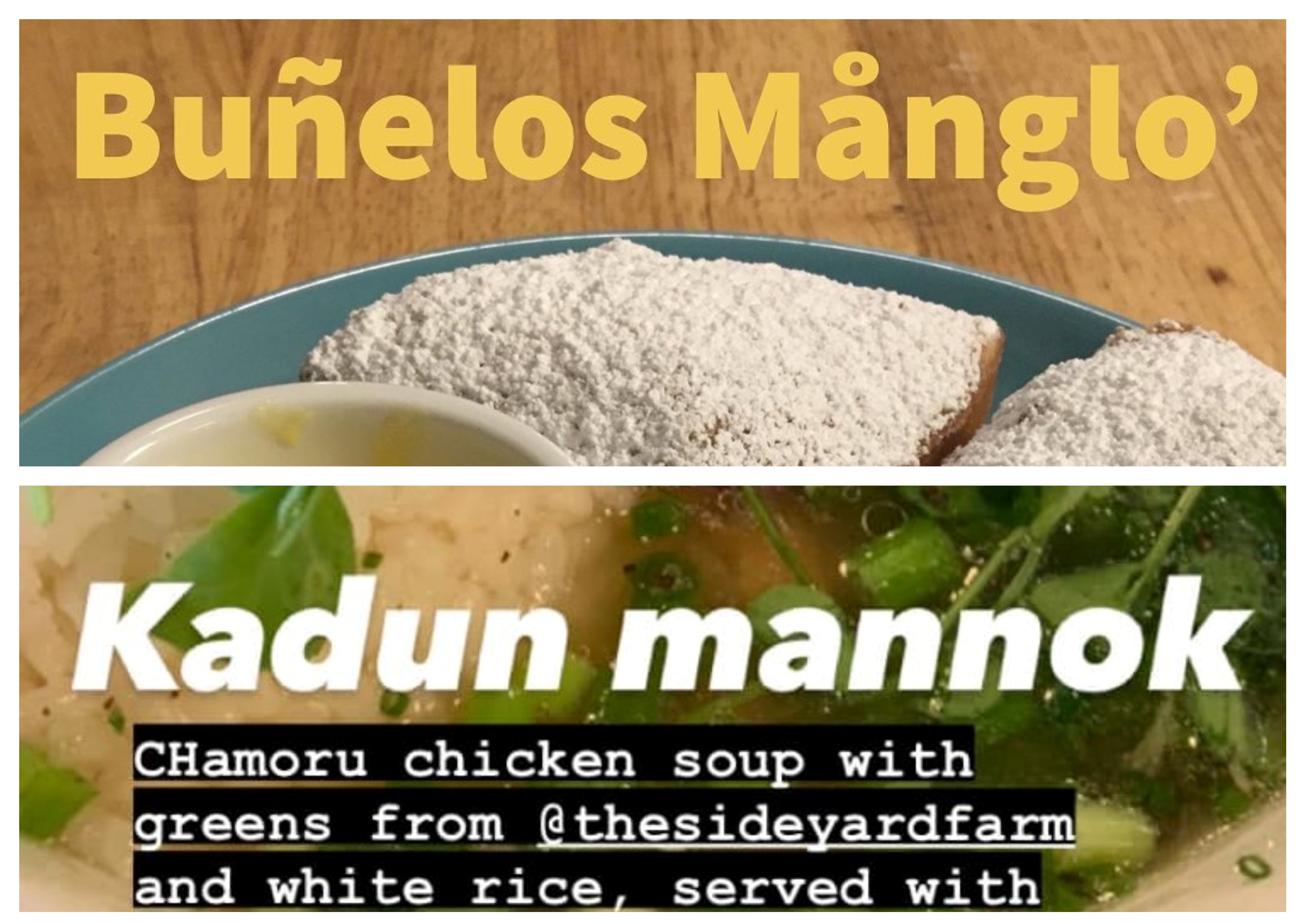
Notice in this picture we don't say MÅNGLO' BUÑUELOS (Wind Donuts). We say BUÑUELOS MÅNGLO' (Donuts Wind). What KIND of donuts is said AFTER we identify it as donuts.

We don't say MÅNNOK KÅDDO (Chicken Stew). We say KÅDDON M­ÅNNOK (Stew Chicken). What KIND of stew is mentioned AFTER we call it stew.


Notice the pattern in PÅN TUBA (Bread Coconut Toddy), NOT tuba pån (coconut toddy bread). KELAGUEN UHANG (Marinated Salad Shrimp), not uhang kelaguen (shrimp marinated salad).

In English, what KIND of thing it is comes before the name of the thing. APPLE Pie. BEEF Jerky. CHOCOLATE Cake.

But it's the other way around in Chamorro. KELAGUEN BENÅDO. PÅN TOSTA. Therefore TITIYAS MÅNHA.

Even when we use the English word "soup," it's SOUP CANDELARIA, NOT Candelaria Soup.


SO.......


Go ahead and say SPAM KELAGUEN or FLOUR TITIYAS, combining English and Chamorro.

But if you're going to use the full Chamorro name of the food, put it in the right order in the Chamorro language.

VERSIÓN ESPAÑOLA
(traducida por Manuel Rodríguez)

TITIYAS MANHA

En inglés, decimos APPLE Pie (pastel de manzana). ¿Qué TIPO de pastel? De manzana.

CHOCOLATE Cake (tarta de chocolate). ¿Qué TIPO de tarta? De chocolate.

Pero, en chamorro, el orden se invierte. Buñuelos AGA' (buñuelos de plátano). ¿Qué TIPO de buñuelos? De aga’ (de plátano).

Se dice Pån TUBA. ¿Qué TIPO de pan? De tuba (de ponche de coco) .

Por lo tanto, en chamorro, se dice Titiyas MÅNHA. ¿Qué TIPO de titiyas? De manha (de coco verde).

Para el oído chamorro, decir MÅNHA TITIYAS es tan desagradable como para el oído inglés decir PIE APPLE o CAKE CHOCOLATE.

La poderosa marcha de la angloamericanización en Guam continúa en la mente de nuestros chamorros más jóvenes. Nadar en un océano de idioma inglés, rodeado de agua inglesa desde el momento en que uno se despierta hasta el momento en que se queda dormido, y siendo el único idioma que habla mucha de nuestra gente menor de 60 años, no sorprende que incluso cuando los chamorros usan una frase chamorra, la usan a la manera angloamericana. Ni siquiera se dan cuenta.

Un ejemplo evidente de esto es cuán erróneamente extendida está la frase MÅNHA TITIYAS.

Ésa es una forma angloestadounidense de usar palabras chamorras para describir este pan plano elaborado con coco verde.

El pan plano chamorro se llama TITIYAS, una versión chamorra de la palabra española TORTILLAS.

Ahora bien, hay muchos tipos de titiyas. Las titiyas se pueden hacer con maíz (mai'es), harina de trigo (arina), fruta del pan (lemmai) y casi cualquier carbohidrato que se pueda convertir en harina o incorporar a la harina.

Pero en chamorro decimos el TIPO de cosa que es DESPUÉS de la cosa misma.

Fíjese que no decimos MÅNGLO' BUÑUELOS. Decimos BUÑUELOS MÅNGLO' (Buñuelos de Viento). El TIPO de buñuelos se dice DESPUÉS de que identifiquemos tal cosa como buñuelos.

No decimos MÅNNOK KÅDDO. Decimos KÅDDON MÅNNOK (caldo de pollo). El TIPO de caldo se menciona DESPUÉS de que lo llamemos caldo.

Observe que se dice PÅN TUBA (Pan de Tuba o de ponche de coco), NO tuba pån. Se dice KELAGUEN UHANG (Ensalada de Camarones Marinados), no uhang kelaguen.

En inglés, el TIPO de cosa se dice antes del nombre de tal cosa. APPLE Pie (pastel de manzana). BEEF Jerky (carne seca). CHOCOLATE Cake (tarta de chocolate).

Pero en chamorro se dice a la manera inversa. KELAGUEN BENÅDO (ensalada de venado). PAN TOSTA (pan tostado). Por lo tanto se dice TITIYAS MÅNHA (tortillas de coco verde).

Si usted va a usar el nombre completo de la comida en chamorro, póngalo en el orden correcto en el idioma chamorro.

Tuesday, July 5, 2022

FUNERAL RECEIPT 1925


This receipt for church funeral services was issued to prove that a member of the deceased's family shouldered that cost. It was needed in a court case in 1925 to settle a family dispute over the estate of the deceased.

For much of the Spanish period, the missionaries published a schedule of fees for many church services, and not just for spiritual services. This schedule of fees was called ARANCEL in Spanish.

Sacraments cannot be bought; it is against Church law to do so and any priest who tries to sell sacraments, blessings or blessed objects will be punished by the Church itself.

But churches and priests also had to pay bills, and a fee for a baptismal certificate, for example, meant the parish had to buy paper (rarely were blank certificates printed before-hand, another expense). A priest had to buy food and supplies and, on occasion, give monetary support to someone doing work or a service for the church. These fees met those expenses.

In those days, most people grew or caught their own food, made their own household tools or items, or traded goods for goods, that they had less reason than today to use what cash they had. That unused cash often went to their local church for Masses. American Navy officials sometimes "complained" about it.

The poor were never deprived of church services on account of their inability to pay fees. To do so was against Church rules. Fees were sometimes paid with a dozen eggs or a sack of corn meal. Many cashless people paid others in general this way.

The priest who wrote the receipt was Father Bernabé de Cáseda, a Capuchin friar from Spain. He was stationed in Inalåhan for a long time and built the church there that exists to this day. He was in Inalåhan so long that several baby boys in Inalåhan were named Bernabé after him. Bernabé is the Spanish way of saying Barnabas. Saint Barnabas was a companion of Saint Paul the Apostle.


PÅLE' BERNABÉ


In those days, no Spanish priest could be assigned to a village until he first learned enough Chamorro to be able to communicate with his people, and he had to pass a test given by Påle' Román, the Spanish priest considered the expert in the Chamorro language. In the 1920s and 30s, huge numbers of Chamorros on Guam could not speak English and spoke only Chamorro.

Let's look at the Chamorro used in the receipt :


Guåho Fr. Bernabé de Cáseda hu resibe ginen as Ignacio LG San Nicolas pot i entierron Dolores Castro Concepcion ini na limosna :
(I Friar Bernabé de Cáseda received from Ignacio LG San Nicolas for the funeral of Dolores Castro Concepcion this donation :)

Entierro Solemne yan Misa Cantada.....$14.00
(Solemn Funeral and Sung Mass.....$14.00)

Gi Noviembre na pulan pot responso....$0.75
(In the month of November for responso....$0.75)

Hu na' magåhet ini
(I certify this)

Fr. Bernabé de Cáseda

Inalåhan 22.II.1925


OK let's break it down :

1. The Fr in the receipt does not stand for "Father" but for the Spanish title "Fray" which means "Friar." Father Bernabé was a Capuchin Franciscan friar and, even though he was also a priest, his identity as a friar wasn't forgotten. Friars who were priests often titled themselves "Fray Padre," or "Friar Father."

2. You can tell the typewriter he used was probably manufactured in Spain since it had keys to type Spanish accent marks, like the dash over the E in Bernabé and over the A in Cáseda.

3. Father Bernabé uses the old word for "this" which is ini. More people used the Spanish word este.

4. Church services could be simple or solemn; recited or sung. If Mass was sung, this meant a choir had to sing at Mass and choir members had to take time out of their day to do that. So more fees were paid the more services were requested.

5. A responso is a prayer said for the dead. November is the month the Poor Souls in Purgatory are remembered in a special way, and one could request a priest to say a responso in November at the grave(s) of one's loved one(s).

6. The literal meaning of "I certify this" in the receipt is "I make this true."

7. The dating format is European, not American. First comes the day of the month (the 22nd), then the month in Roman numerals (II, or 2, which means February), then the year.


VERSIÓN ESPAÑOLA
(traducida por Manuel Rodríguez)

PADRE BERNABÉ Y UN RECIBO DE 1925

El recibo que vemos abajo, por los servicios funerarios eclesiásticos, se emitió para probar que un miembro de la familia del difunto se hizo cargo de ese costo. Fue necesario en un caso judicial en 1925 para resolver una disputa familiar sobre la herencia del difunto.

Durante gran parte de la época española, los misioneros publicaron un cronograma de tarifas para muchos servicios de la iglesia, y no solo para servicios espirituales. Este cuadro de tarifas se denominó ARANCEL.

Los sacramentos no se pueden comprar; va contra la ley de la Iglesia hacerlo y cualquier sacerdote que intente vender sacramentos, bendiciones u objetos sagrados será castigado por la propia Iglesia.

Pero las iglesias y los sacerdotes también tenían que pagar facturas, y una tarifa por un certificado de bautismo, por ejemplo, se debía a que la parroquia tenía que comprar papel. Un sacerdote tenía que comprar alimentos y suministros y, en ocasiones, dar apoyo monetario a alguien que realizaba un trabajo o un servicio para la iglesia. Estos honorarios cubrían esos gastos.

En aquel tiempo, la mayoría de las personas cultivaban o pescaban sus propios alimentos, fabricaban sus propias herramientas o artículos domésticos, o intercambiaban bienes por otros bienes, por lo que tenían menos razones que hoy para usar el dinero en efectivo que tenían. Ese efectivo no utilizado a menudo iba a su iglesia local para misas. Los oficiales de la Armada estadounidense a veces se "quejaban" al respecto.

Los pobres nunca eran privados de los servicios de la iglesia debido a su incapacidad para pagar las cuotas. Hacer eso estaba en contra de las reglas de la Iglesia. A veces, las tarifas se pagaban con una docena de huevos o un saco de harina de maíz. Muchas personas sin efectivo pagaban a otros en general de esta manera.

El sacerdote que hizo el recibo fue el Padre Bernabé de Cáseda, un fraile capuchino de España. Estuvo destinado en Inaraján durante mucho tiempo y construyó allí la iglesia de San José que existe hasta el día de hoy. Estuvo en Inaraján tanto tiempo que varios bebés varones de Inaraján recibieron el nombre de Bernabé en su honor. San Bernabé fue compañero de San Pablo Apóstol.

En aquellos días, ningún sacerdote español podía ser asignado a un pueblo hasta que primero aprendiera suficiente chamorro para poder comunicarse con su gente, y tenía que pasar una prueba dada por Påle' Román, el sacerdote español considerado el experto en el idioma chamorro. En las décadas de 1920 y 1930, una gran cantidad de chamorros en Guam no hablaban inglés y solo hablaban chamorro.

Veamos el chamorro utilizado en el recibo:

<<Guaho Fr. Bernabé de Cáseda hu resibe ginen as Ignacio LG San Nicolas pot i entierron Dolores Castro Concepcion ini na limosna :

(Yo Fray Bernabé de Cáseda recibí de parte de Ignacio LG San Nicolás por el entierro de Dolores Castro Concepción esta limosna:)

Entierro Solemne yan Misa Cantada.....$14.00

(Entierro Solemne y Misa Cantada.....$14.00)

Gi Noviembre na pulan pot responso....$0.75

(En el mes de noviembre por responso....$0.75)

Hu na' magåhet ini

(Yo certifico esto)

Fray Bernabé de Cáseda

Inalahan 22.II.1925>>

Bueno, vamos a desglosarlo:

1. El “Fr” en el recibo no significa "Padre" sino el título español "Fray" que significa "Fraile". El Padre Bernabé era un fraile franciscano capuchino y, aunque también era sacerdote, su identidad como fraile no fue olvidada. Los frailes que eran sacerdotes a menudo se titulaban "Fray Padre" o "Fraile Padre".

2. Se puede decir que la máquina de escribir que usó probablemente fue fabricada en España ya que tenía claves para escribir acentos españoles, como la tilde sobre la E en Bernabé y sobre la A en Cáseda.

3. El Padre Bernabé usa la antigua palabra para "esto" que es “ini”. Otra gente usaba la palabra de origen español “este”.

4. Los servicios de la iglesia pueden ser simples o solemnes; recitado o cantado. Si se cantaba Misa, esto significaba que un coro tenía que cantar en Misa y los miembros del coro tenían que tomarse un tiempo de su día para hacerlo. Así que se pagaban más honorarios cuantos más servicios se solicitaban.

5. Un responso es una oración que se dice por los difuntos. Noviembre es el mes en que se recuerda de manera especial a las Pobres Almas del Purgatorio, y uno podría pedirle a un sacerdote que dijera un responso en noviembre en la(s) tumba(s) de un(os) ser (es) querido(s).

6. El significado literal de "Certifico esto" en el recibo es "Hago esto verdadero".

7. El formato de fechas es europeo, no americano. Primero viene el día del mes (el 22), luego el mes en números romanos (II o 2, que significa febrero), luego el año.


Tuesday, June 14, 2022

BISHOP OLANO WRITES IN CHAMORRO


BISHOP OLANO AND SISTER MARY MARK


Bishop Miguel Ångel Olano was the Bishop of Guam from 1934 until 1945. He first arrived on Guam from his native Spain in 1919 and in time was assigned to the parish of Sumay, staying there all the way till he was made bishop.

The 1920s and 30s were a time when all Chamorros on Guam spoke Chamorro (imagine that!). For many of them, it was the only language they knew. Many couldn't speak English even if they wanted to, except for a few words like "yes" and "no."

Outsiders had to find translators, then, or better yet learn Chamorro themselves. This is what the Spanish Capuchin missionaries, as Olano was, did. A priest definitely had to learn Chamorro in those days, in order to hear confessions in Chamorro, preach in Chamorro and interact with his Chamorro flock.

Some missionaries did better in Chamorro than others. One, Påle' Román, was considered an authority in the language, many older people now deceased telling me he spoke better Chamorro than many Chamorros. Olano was also one of the better ones in Chamorro. He spoke it well, without the need to look up words in a dictionary.

One little piece of evidence showing his fluency in Chamorro is this letter he wrote in Chamorro in the year 1967. That was 22 years after he left Guam. For 22 years he had no one to speak Chamorro with, having moved to Manila in 1945 and then to Spain. On occasion, the Spanish missionaries who had lived on Guam, and were now living elsewhere, would speak Chamorro to each other now and then when they would meet up. But for the most part they had no occasion to use Chamorro, and yet they retained their knowledge of the language twenty or more years after they left Guam.


The event that occasioned this letter in Chamorro was the appointment of Sister Mary Mark Martínez as Superior of the Mercy Sisters on Guam in 1967. Olano had been very close to Sister's parents, Pedro and María Martínez, and knew Sister when she was a young girl before the war. Sister's appointment as Superior definitely swelled Olano's heart with pride and joy, first of all because of his connection with the Martínez family but secondly because the Spanish missionaries before the war tried so hard to get Catholic Sisters to come to Guam but couldn't. They found Sisters willing to come to Guam, but the US Navy stopped them from coming. Olano couldn't help but be happy and proud that, not only had Sisters finally come to Guam after the war; not only because Chamorros had become Sisters; but now because a Sister from a family he was close to had become Superior.

Writing on August 17, 1967 from San Sebastián, Spain, Olano says :

Sister Mary Mark Martínez, Superior :

Hu taitai gi Umatuna si Yu'us na hågo ma ayek para må'gas i etmånas guennao giya Guam. Este na "news" ha na' magof yo' dångkulo, sa' primet biåhe na una relihiosa taotao Guam ma ayek para este na dångkulo na puesto. Sister Mary Mark, "congratulations" nu hågo yan lokkue' todo i etmåna ni mañåsaga gi konbento. I bendision Yu'us nu hågo, ya siña mesngon, gai pasiensia, etc. Hu tungo' na i etmåna guennao man sen mesngon lokkue'. Ti hu tungo' na guaha åguaguat entre siha.

Adiós, ya todos hamyo en tayuyute i hagas Obispo.

+M.A. Olano

In English :

I read in the Umatuna si Yu'us that you were chosen to be the superior of the Sisters there in Guam. This news made me so happy, because it is the first time that a religious woman from Guam was chosen for this important office. Sister Mary Mark, congratulations to you and also to all the Sisters living in the convent. The blessing of God to you, that you may be enduring, patient, etc. I know that the Sisters there are also very forbearing. I do not know if there are any unruly ones among them.

Farewell, and all of you pray for the former Bishop.


SOME OBSERVATIONS

1. The Umatuna si Yu'us is the weekly newspaper of the Catholic Church on Guam, published by the Archdiocese (Diocese, at the time). Someone was mailing him a copy in Spain. Who and how often, I do not know.

2. Olano is mistaken in saying that Sister Mary Mark was the first Chamorro Superior of the Mercy Sisters on Guam, but he had been away for many years already and news was not as easily obtained in those days before the internet. It was actually Sister Callista Camacho who was the first Chamorro Superior of the Mercy Sisters on Guam, being appointed in 1960 and serving till 1963. Sister Mary Mark was the second Chamorro Superior, appointed in 1967.

3. It's interesting that Olano uses two English words when he could have used the Spanish/Chamorro equivalents; notisia for "news" and enorabuena for "congratulations."


VERSIÓN ESPAÑOLA
(traducida por Manuel Rodríguez)

EL OBISPO OLANO ESCRIBE EN CHAMORRO

Monseñor Miguel Ángel Olano fue obispo de Guam desde 1934 hasta 1945. Llegó por primera vez a la isla desde su España natal en 1919 y con el tiempo fue asignado a la parroquia de Sumay, permaneciendo allí hasta que fue nombrado obispo.

Las décadas de 1920 y 1930 fueron una época en la que todos los chamorros de Guam hablaban chamorro (¡imagínense eso!). Para muchos de ellos, era el único idioma que conocían. Muchos no podrían hablar inglés aunque quisieran, a excepción de algunas palabras como "sí" y "no".

Los forasteros tenían entonces que encontrar traductores, o mejor aún, aprender chamorro ellos mismos. Así lo hicieron los misioneros capuchinos españoles, como lo fue Olano. Un sacerdote definitivamente tenía que aprender chamorro durante aquellos tiempos, para poder escuchar confesiones en chamorro, predicar en chamorro e interactuar con su rebaño chamorro.

A algunos misioneros les fue mejor en chamorro que a otros. Uno, Påle' Román, era considerado una autoridad en el idioma, muchas personas mayores ya fallecidas me decían que hablaba mejor chamorro que muchos chamorros. Olano también fue uno de los mejores en idioma chamorro. Lo hablaba bien, sin necesidad de buscar palabras en un diccionario.

Una pequeña evidencia que muestra su fluidez en chamorro es esta carta que escribió en el año 1967. Eso fue 22 años después de que saliera de Guam. Durante 22 años no tuvo con quien hablar chamorro, habiéndose mudado a Manila en 1945 y luego a España. En ocasiones, los misioneros españoles que habían vivido en Guam y después vivían en otros lugares, a veces se hablaban en chamorro, cuando se reunían. Pero en su mayor parte no tuvieron ocasión de usar el chamorro y, sin embargo, conservaron su conocimiento de la lengua veinte o más años después de salir de Guam.

El evento que ocasionó esta carta en idioma chamorro fue el nombramiento de la Hermana Mary Mark Martínez como Superiora de las Hermanas de la Misericordia en Guam en 1967. Olano había estado muy cerca de los padres de la Hermana, Pedro y María Martínez, y la conoció cuando era una niña, antes de la guerra. El nombramiento de la Hermana como Superiora definitivamente infló el corazón de Olano con orgullo y alegría, en primer lugar por su conexión con la familia Martínez, pero en segundo lugar porque los misioneros españoles antes de la guerra se esforzaron mucho para que monjas católicas vinieran a Guam. Encontraron Hermanas dispuestas a venir a la isla, pero la Marina de los EE. UU. se lo impidió. Olano no pudo evitar sentirse feliz y orgulloso de que las Hermanas no solo habían llegado finalmente a Guam, después de la guerra; sino porque numerosas chamorras se habían convertido en religiosas; e incluso ahora una Hermana de una familia cercana a él se había convertido en Superiora.

Escribiendo el 17 de agosto de 1967 desde San Sebastián, España, Olano dice:

“Leí en el Umatuna si Yu'us que fuiste elegida para ser la Superiora de las Hermanas ahí en Guam. Esta noticia me alegró mucho, porque es la primera vez que una religiosa de Guam es elegida para este importante cargo. Hermana Mary Mark, felicidades para usted y también para todas las Hermanas que viven en el convento. La bendición de Dios para ustedes, para que sean perseverantes, pacientes, etc. Sé que las Hermanas ahí también son muy tolerantes. No sé si hay algunos rebeldes entre ellas.

Adiós y recen todos por el antiguo obispo”.

 ALGUNAS OBSERVACIONES

 1. El Umatuna si Yu'us es el periódico semanal de la Iglesia Católica en Guam, publicado por la Arquidiócesis (Diócesis, en ese momento). Alguien le enviaba una copia a España. Quién y con qué frecuencia, no lo sé.

 2. Olano se equivoca al decir que la Hermana Mary Mark fue la primera chamorra Superiora de las Hermanas de la Misericordia en Guam, pero Olano ya llevaba muchos años fuera y las noticias no eran tan fáciles de obtener en esos días antes de internet. En realidad, fue la Hermana Callista Camacho la primera Superiora chamorra de las Hermanas de la Misericordia en Guam, siendo nombrada en 1960 y sirviendo hasta 1963. La Hermana Mary Mark fue la segunda Superiora chamorra, nombrada en 1967.

 3. Es interesante que Olano en su carta en chamorro, use dos palabras en inglés cuando podría haber usado los equivalentes en español/chamorro; notisia para "noticia" y enorabuena para "felicidades".

Thursday, April 14, 2022

"HAPPY EASTER" IN CHAMORRO


SHORT ANSWER


FELIS PÅSGUA

or

FELIS PÅSGUAN RESUREKSION


Felis is borrowed from Spanish feliz which means "happy." You can replace felis with magof which is the indigenous, Chamorro word for "happy." Our grandparents who lived closer to Spanish times would have stuck with felis.


LONG ANSWER


This will take PATIENCE to learn and understand. Read slowly.

We moderns and we Americanized are used to greetings.

Happy Birthday. Happy Mothers Day. Happy National Chocolate Chip Day (May 15).

But greetings, at least to the extent we do so in modern times, wasn't as widespread in the old days.

Besides greeting people and saying goodbye, people didn't do a whole lot of "Happy This" or "Happy That" in the old days.

Many of the occasions Chamorros in the last three hundred years would celebrate came from their Catholic religion, which came from Spanish missionaries and which had Spanish names. Tres Reyes (Three Kings, January 6). Pentecostés (Pentecost, fifty days after Easter). La Purísima (Immaculate Conception, December 8).

One of these feasts was Easter. It celebrates the Resurrection of Jesus. It is an entirely Christian feast, first brought to the Marianas by Spanish Jesuit missionaries. So don't be surprised if the Chamorro words used for Easter are based on Spanish.

EASTER in Chamorro is called PÅSGUA. But here we run into a little trouble, which no longer remains trouble once we understand something.

Chamorro PÅSGUA comes from Spanish PASCUA which comes from Latin PASCHA. If you have a lot of exposure to the Catholic liturgy, you will see the Latin PASCHA in churchy English words like PASCHAL. We light the PASCHAL CANDLE at Easter. The season after Easter is called PASCHAL TIME (or Paschaltide). Latin PASCHA is a form of the Jewish word for the PASSOVER which is Pesach. So, due to Catholicism once being the universal religion of Europe, even English has Latin-derived words like PASCHAL.

The "problem" is that, in Spanish, PASCUA was applied to THREE major Catholic feasts : Christmas, Easter and Pentecost.

In order to be clear which Pascua was being celebrated, the Spaniards called Christmas PASCUA DE NAVIDAD.  Easter was called PASCUA DE RESURRECCIÓN (or Pascua Florida). Pentecost was called PASCUA DE PENTECOSTÉS.

Roughly translated, they mean PASCUA OF BIRTH (nativity, navidad); PASCUA OF RESURRECTION (flowery or florida, due to springtime Easter flowers); PASCUA OF PENTECOST.

Once you keep in mind that PASCUA can mean three feasts, it's no longer a "problem." If someone wishes you happy PASCUA in April, you know he or she doesn't mean Christmas, which is always in December. It's not a problem.

Look how these Christmas, Easter and Pentecost greetings in Spanish all use the word PASCUA but then specify WHICH PASCUA is being celebrated.


So the Chamorro version of Spanish PASCUA DE RESURRECCIÓN is 

PÅSGUAN RESUREKSION.


Of course, if you wanted to, you can make up your own Chamorro Easter greeting. We live in a DIY Chamorro era; Do It Yourself; make up your own version.

Magof Luma'lå'-ña Ta'lo si Jesukristo! Happy Jesus Christ's Resurrection!

But in this post I share what our grandparents and their parents knew, understood and said, and I like speaking what my grandmother spoke. And it's shorter.

FELIS PÅSGUA! (no need for Resureksion. It's April!)


VERSIÓN ESPAÑOLA
(traducida por Manuel Rodríguez)

¿CÓMO SE DICE “FELIZ PASCUA” EN CHAMORRO?

Respuesta corta: FELIS PÅSGUA o FELIS PÅSGUAN RESUREKSION

“Felis” es un préstamo del español que significa "feliz". Se puede reemplazar por “magof”, que es la palabra indígena chamorra. Nuestros abuelos, que vivieron más próximos a la época española, se habrían quedado con “feliz”.


Respuesta larga: Lo a continuación expuesto requerirá paciencia para aprender y comprender. Leamos despacio.

Los modernos y americanizados estamos acostumbrados a las felicitaciones.

Feliz Cumpleaños. Feliz Día de la Madre. Feliz Día Nacional de las Chispas de Chocolate (15 de mayo).

Pero este tipo de felicitaciones, al menos en la medida en que lo hacemos en los tiempos modernos, no estaba tan extendido antiguamente.

Además de saludar a la gente y despedirse, antes no se decía "Feliz por esto" o "Feliz por aquello".

Muchas de las celebraciones de los chamorros en los últimos trescientos años provienen de la religión católica, recibida de los misioneros españoles y que tenían denominaciones hispanas. Tres Reyes (6 de enero). Pentecostés (cincuenta días después de Pascua). La Purísima o Inmaculada Concepción (8 de diciembre).

Una de estas fiestas era la PASCUA. Cuando se celebra la Resurrección de Jesús de Nazaret. Es una fiesta enteramente cristiana, traída por primera vez a las Islas Marianas por misioneros jesuitas españoles. Así que no nos sorprendamos si las palabras chamorras que se usan para la Pascua se basan en el español.

La PASCUA en chamorro se denomina PÅSGUA. Pero aquí nos encontramos con un pequeño “problema”, que ya no lo es si entendemos algo. 

La palabra chamorra PÅSGUA proviene del español PASCUA que a su vez procede del latín PASCHA.

El "problema" es que, en español, PASCUA se aplica a TRES grandes fiestas católicas: Navidad, Resurrección y Pentecostés. 

Para tener claro cuál era la Pascua que se celebraba, los españoles llamaron a la Navidad PASCUA DE NAVIDAD. La Resurrección se llamaba PASCUA DE RESURRECCIÓN (o Pascua Florida). Pentecostés se llamó PASCUA DE PENTECOSTÉS.

Aproximadamente traducidos, significan PASCUA DEL NACIMIENTO (natividad, navidad); PASCUA DE LA RESURRECCIÓN (florida, por las flores primaverales de Pascua); PASCUA DE PENTECOSTÉS (descenso del Espíritu Santo).

Una vez que tengamos en cuenta que PASCUA puede significar tres celebraciones distintas, ya no es un "problema". Si alguien nos desea feliz PASCUA en abril, sabemos que no se refiere a Navidad, que siempre es en diciembre. No es un problema.

Esas felicitaciones de Navidad, Resurrección y Pentecostés en español usan la palabra PASCUA pero luego especifican QUÉ PASCUA se está festejando.

Así que la versión chamorra de PASCUA DE RESURRECCIÓN es

PÅSGUAN RESUREKSION.

Por supuesto, si quisiéramos, podríamos inventar nuestra propia felicitación de Pascua en chamorro más indígena. Vivimos en la era “Hazlo tú mismo”, “Inventa tu propia versión”.

Magof Luma'lå'-ña Ta'lo si Jesukristo!

¡Feliz Resurrección de Jesucristo!

Pero en esta entrada les comparto lo que sabían, entendían y decían nuestros abuelos y sus padres, y me gusta hablar lo que hablaba mi abuela. Y además es más corto.

FELIS PÅSGUA! (no hay necesidad de decir  Resureksion. ¡Es abril!)