Tuesday, April 25, 2023

THE HIKI TRADING COMPANY


THE HIKI TRADING COMPANY
Hagåtña in the early 1900s


By the 1890s, Japan started to take an increased economic interest in the Pacific, both in wanting to get things from the islands and nations of the Pacific Rim, and also to sell to them. Copra, the dried meat of coconuts, was one Pacific commodity in demand. The oil obtained from it could be used in many commercial products, and the meat used as a food product for both man and beast. 

The islands of Micronesia could supply that copra, but the Japanese could also supply the islands. Japan was closer to the islands than the US or other Western countries to sell Western products. Merchandise did make it to the Marianas from both east and west; goods could be bought in Manila and shipped to the Marianas, but ship transportation was not steady nor frequent. American and other goods did come from Hawaii and the US, but usually on whaling ships and the occasional commercial ship, but again these were not consistent nor frequent. But the Japanese could ship merchandise to the Marianas on a regular basis if the market proved successful.


The Japanese started to "open shop," as it were, in Micronesia in the 1890s. In 1899, Spain was no longer on the scene, having sold Guam to the US and the rest of Micronesia to the Germans. The Germans were initially not very pleased with the many Japanese merchants coming in and out of Micronesia, but the Americans on Guam were more accommodating. By 1899, Japanese merchant ships were already providing passenger transportation to and from Guam. By the early 1900s, the Japanese merchant presence on Guam was so strong that people claimed that the Japanese had a monopoly on trade on the island. While other races did operate stores, the Japanese were undeniably the strongest commercial force on island at the time.

One of the Japanese companies doing business on Guam in the early 1900s was the Hiki Trading Company.


Haniu was appointed Manager of the Guam branch in 1902


The full name of the company was the Nanyo Boeki Hiki Kabushiki Kaisha, which meant the Hiki South Seas Corporation, though it was called by slightly different names in English. Established in Japan in the 1890s, by the end of that decade the company had four boats that sailed around Micronesia selling various things then sailed back to Japan carrying products from the tropics.

The Hiki Company's schooners would also transport passengers up and down the Marianas. In the period 1900 to 1914 many Chamorros from Guam migrated to Saipan. The Hiki schooner was one way to get there. José Shimizu also transported passengers up and down the Marianas. Most of that migration ended in late 1914 when the Japanese took over the Northern Marianas from Germany.

Around 1900, the Guam branch of Hiki was managed by José T. Shibata, from Nagasaki. He had married a Chamorro, Vicenta Cruz Herrero. By 1902, the company had appointed a man from Tokyo, Hikoshiro Haniu, as manager of the Guam store. Haniu later married a Chamorro, Maria Deza Blaz, and was baptized a Catholic to do so, taking the Christian name José. His descendants, many of whom are better-known as the familian Desa, remain.


JOSÉ HIKOSHIRO HANIU


Tuesday, April 11, 2023

TAN ROSA AND THE ANATOMY BOOK


"ISAO!" "Sin!"

Those were the first words out of Tan Rosa, Mary's grandmother, when Mary got home.

Mary just started her nursing program at the College of Guam in the 1960s when she brought home her human anatomy book. Her professor had just passed them out to the nursing students earlier that day, and Mary had her reading assignment, to memorize the names of the different parts of the body, starting with the major bones.

In those days, many grandmothers were like a second mom, living in the household with everybody else. Since Mary's mom had a job as a cashier in a store not far away, grandma was the one who stayed home the whole day and night, supervising the cooking, cleaning and washing. When Mary got home some days, it was grandma she first met, not mom or dad.

Even Mary's mother had some misgivings about Mary going to the College of Guam. Mothers were very protective of their unwed daughters back then. Single females and males mixing together, even at school, spelled danger to them! Tan Rosa never even went to school and learned to read letters at an older age thanks to a brother teaching her. Mary's mom only went as far as the eighth grade. Before the war, a classroom education was thought unnecessary for girls after they learned to read and write.

Even the promise of financial stability as a nurse did not ease mother's mind at first. It was only when Mary's best friend, who married right out of high school but who was also studying nursing, agreed to drive Mary back and forth to the College (now the University) that Mary's mother relented. A married woman, she thought, could be trusted to make sure Mary walked the straight line.

But grandma was a different matter. With her generation, there was no talk of human reproduction or even parts of the body. When grandma saw the figures of naked humans of both sexes, albeit skeletal, grandma had a fit. She wanted to throw the books out of the house.

Mary's father had to intervene and explain what the charts and pictures were, pointing to bones in the book then showing on his own arm or shoulder what bones matched the chart.

When it came to the reproductive organs, Mary's father focused only on the uterus and explained that doctors and nurses needed to know all about the tuyan (womb) for the sake of the unborn child who might die if there is a problem. He explained that all the pattera (midwife) could do was limited to massaging, moving the baby in the right position and other such things, but that doctors could do more to save the life of a baby, with the nurse's help.

Thinking of saving babies' lives, Tan Rosa gave in.

Ironically, Mary, now a nurse of some years, assisted grandma Rosa on her death bed with her nursing skills.

Tuesday, April 4, 2023

TAN MARIA'N MAK


TAN MARIA'N MAK
María Lizama Tolentino Ignacio


She was perhaps the most influential person in Santa Rita in the 1950s and 60s. In the opinion of some, more powerful than even the village Commissioner (what is called the Mayor now).

Her name was María Tolentino Ignacio, but everyone called her Tan Maria'n Mak, after her father Máximo Tolentino, married to her mother Tomasa Lizama. She was the village nurse and midwife (pattera).

What gave her all that power and influence was her constant, direct contact with all the families in Santa Rita, right into their living rooms and bedrooms. She didn't wait in her village dispensary for the people to come to her. They did come to her, but she also went into the homes of the people. She knew everyone in the village; their particular health concerns; their habits and lifestyle; their vices and flaws.

She was a health enforcer. She got into people's faces and told them what they needed to do, whether they liked hearing it or not. But people respected her for it. They listened to her and sought her advice on many things.

She told parents, "Ennaogue' na man malålångo i famagu'on-miyo sa' man sin dodogga." ("That's why your children are sick, because they go around without footwear.")

"Na' fan o'mak åntes de u fan maigo'." ("Shower them before they sleep.")

Parents would warn their children when they saw Tan María walking or driving in their direction, telling the kids to run into the house and put on shoes or slippers.

Tan María would administer the inoculations to infants and children, and give them their anti-worm medicine. As a pattera (midwife), she assisted in many births right in the home. Whenever there was a problem birth, she baptized the newborn right then and there, and later told the village priest about it for the records.

She drove a jeep to visit the homes, and even conduct sanitary inspections. She also had an "ambulance" of sorts; not the hi-tech ones we have today but something to transport people to the hospital when needed. Her ambulance wasn't used just for emergencies; she'd drive villagers to their medical and dental appointments up north in the ambulance or at times her jeep. One day the brakes gave out on her ambulance and it was going downhill in that hillside village of Santa Rita. Her options were limited, so she jumped out of the ambulance and allowed gravity to take the ambulance into a home where no one was at the time and there it stopped. The crashed ambulance was taken away and never seen again nor replaced.

Her daughter Emilesia, now in her 80s, told me, "Guihe na tiempo, yanggen håfa ilek-ña si nanå-ho gi sengsong, ma gof osge." "At that time, whatever my mother said in the village, they really obeyed her."


HOW SHE STARTED


TAN MARIA (with X) AND OTHER VILLAGE NURSES
1950s


Tan María was always interested in sickness and healing since she was young. She had the disposition for nursing, too. Her daughter Emilesia said, "Ti måssa' si nanå-ho ha pacha i chetnot para u espia håfa." "My mother did not hesitate to touch sores to find out something." She was willing to get blood on her, handle bedpans, bandage wounds, put up with unsightly wounds and foul odors. While others shrieked in horror at these things, Tan María said, "Mientras mås hao askurosa, mås hao chetnot." "The more repelled you are, the more diseased you become." Even back then, they knew a thing or two about exposure to viruses and building immunity.

She learned from older pattera and the Navy also gave her midwife training and by-and-by she learned basic nursing skills and obtained her license to work as one. 


MORE THAN MEDICAL; MORE THAN "WORK"


TAN MARÍA WITH DAUGHTER EMILESIA


Taking care of people was more than taking care of their physical health for Tan María. She was almost like a priest or nun in the way people took all kinds of problems to her. A husband once was mistreating his wife and they called on Tan María to intervene. She went to talk to the man and he did not resist. He listened and his behavior improved.

When she assisted at the second or third birth of an unwed mother who was still connected to the father of the children, she would tell the man and woman, "Esta dos pat tres famagu'on-miyo. Håfa na ti malago' hamyo umassagua?" "You already have two or three children. Why don't you two want to get married?" and she herself would bring the matter to the village priest to get them married.

One time she was called to talk to a young lady who was pregnant for the first time. The young lady was not only not married; no one could even identify a boyfriend. The young lady refused to name who impregnated her. Tan María tried to coax it out of her, but she still refused. So Tan María finally said, "Hu tungo' håye muna' mapotge' hao. I cha'kan guma'." "I know who made you pregnant. The house rat." The startled young lady said, "Åhe' ti i cha'kan guma' na si....." "No, not the house rat but rather...." and she let the name of the man slip out. Tan María knew reverse psychology before she ever heard the name for it.

She considered herself a full-time servant of the village, 24 hours a day, and she gave up her own home to help others when needed. She had a man who became a widower move to her house and stay on the kahida (front porch). When a pregnant woman from a far away village came to her because they feared a breech baby (humuyong dågan), after she moved the baby to a normal position inside the womb, she would say, "Mungnga humånao sa' yanggen barångka i chalan siña i nene tuma'lo ha' tåtte." "Don't leave because if the road is bumpy the baby might go back again." So, the pregnant lady, even with the husband at times, would move into Tan María's house for the night.


INFLUENCE ON FUTURE NURSE

At least one young Santa Rita girl, Rosalia Tolentino (married name Perez) was inspired by Tan Maria'n Mak to become a nurse herself. She frequently talked with Tan María about being a nurse and pattera; about how hard the work was, especially since the villagers were very åguaguat (stubborn) about health issues. But, Tan María said, the work was very satisfying. She made a positive contribution to people's lives; what a great example for all of us!

Tan María passed away in 1974 from breast cancer at the age of 67.  She had been married to Luís Taitague Ignacio who passed away after her in 1982. May they rest in peace.

Photos courtesy of Emilesia Anderson and Terry Concepcion

Friday, March 31, 2023

THE GHOSTLY ALTAR BOY


Si Påle' Faustino i pale' Malesso' gi tiempon Españot ya guaha tanores-ña ni ha repåra na kada primet Bietnes gi mes, tåftaf na makmåta si Påle' Faustino lao ti ha tungo' malak måno si Påle' asta ke måtto tåtte si Påle' para i Misan chatanmak gi a las singko.
(Father Faustino was the priest of Malesso' in Spanish times and he had an altar boy who noticed that, every first Friday of the month, Father Faustino got up early but he didn't know where he went till Father came back to say the dawn Mass at five o'clock.)

Pues i tanores ha faisen si Påle', "Håfa na kada primet Bietnes gi mes humåhånao hao tåftaf para otro na lugåt åntes de un sångan i Misan a las singko?"
(So the altar boy asked Father, "Why do you go very early every first Firday of the month to another place before you say Mass at five o'clock?")

Manoppe si Påle', "Kada primet Bietnes gi mes, mumimisa yo' gi sementeyo åntes de hu sångan i Misan a las singko."
(Father replied, "Every first Friday of the month, I say Mass at the cemetery before I say the five o'clock Mass.")

Manman i tanores sa' guiya ha' na tanores pues håye na tanores guma'chuchunge si Påle' gi kåmpo sånto?
(The altar boy was surprised because he was the only altar boy, so which altar boy was accompanying Father to the graveyard?)

Pues humånao i tanores para i sementeyo gi primet Bietnes gi sigiente na mes ya umattok gi tatten i trongko yan tinanom.
(So the altar boy went to the cemetery the following first Friday of the month and hid behind the trees and shrubs.)

Katna ha' måtai i tanores sa' ha li'e' na, gigon ha tutuhon i Misa si Påle', gotpe ha' umannok un dikkike' tanores ni minagågågon tanores ya ha tanorise si Påle'. Gigon måkpo' i Misa, gotpe ha' malingo i tanores.
(The altar boy nearly died because he saw, as soon as Father began Mass, suddenly a small altar boy appeared dressed as an altar boy and served Mass for Father. As soon as Mass ended, the altar boy suddenly disappeared.)

I tanores ha faisen si Påle', "Håye ennao na tanores ni tumanorise hao gi sementeyo?"
(The altar boy asked Father, "Who was that altar boy who served your Mass at the cemetery?")

Manoppe si Påle', "I hagas tanores-ho ni eståba åntes ke hago."
(Father answered, "My former altar boy who was here before you.")

"Ya håfa uttimon-ña?"
("And what happened to him?")

"Måtai måtmos ya ma håfot gi sementeyo."
("He died drowning and was buried in the cemetery.")


VIDEO


Monday, March 27, 2023

DAMENGGON LÅSARO


You may have noticed this past Sunday, if you went to Mass, that your church covered the statues in the sanctuary (altar area). Not all Catholic churches do this, but all of them did prior to the 1960s and the custom seems to be returning to most churches in our islands.

Veiling the statues shocks us, and it is meant to.

We are two weeks away from the bitter suffering and crucifixion of the Lord when the statues are covered. The Church is wanting us to feel the loss of the Lord. He was arrested and taken away. Imprisoned, He was absent from His Mother and His disciples for that time. We, too, should feel something of their sense of loss when He was taken away.

Two Sundays before Easter was called by our mañaina (elders) DAMENGGON LÅSARO. LAZARUS SUNDAY.

Which Lazarus?

Lazarus, the friend of Jesus, who died and who was brought back to life by Jesus even after Lazarus had been buried several days in the tomb.


Well that was the last straw for the enemies of Jesus. Outdone by Jesus, His enemies resolved to put Him to death, and the ball started rolling leading to His arrest and crucifixion.

But why is this Sunday named after Lazarus? 

In the Missal (Mass prayer book) used in Spain at one time, and still is used in a few parts of Spain, took its Gospel for the Sunday before Palm Sunday from the story of Lazarus' resurrection. So, in Spain, the Sunday before Palm Sunday was called DOMINGO DE LÁZARO, and because the Catholic missionaries in the Marianas were mainly Spaniards until the late 1930s, our mañaina called it the same thing, but using the Chamorro version of the name.

Here's how the schedule looked in the old days :


DAMENGGON LÅSARO

(LAZARUS SUNDAY)

(cover statues)


Monday

Tuesday

Wednesday

Thursday

Friday

Saturday

DAMENGGON RÅMOS

(PALM SUNDAY)

Start of Holy Week

(Semåna Sånta)


Holy Monday

Holy Tuesday

Holy Wednesday

Holy Thursday

Good Friday

Holy Saturday


Statue veils come off at Vigil Mass


EASTER

SUNDAY


VERSIÓN ESPAÑOLA
(traducida por Manuel Rodríguez)

DAMENGGON LÅSARO

Es posible que notara el domingo pasado, si asistió a misa, que su parroquia cubrió las imágenes del altar. No todos los templos católicos hacen esto, pero todos lo hacían antes de la década de 1960 y la costumbre parece estar regresando a la mayoría de las iglesias en las Islas Marianas.

Estamos a dos semanas del amargo sufrimiento y crucifixión del Señor, tiempo en el que las imágenes están cubiertas. La Iglesia quiere que sintamos la pérdida del Señor. Fue arrestado y llevado. Encarcelado, estuvo ausente de Su Madre y Sus discípulos por ese tiempo. Nosotros también deberíamos sentir algo de su sentido de pérdida cuando se lo llevaron.

Dos domingos antes de Semana Santa fue llamado en chamorro por nuestros “mañaina” (ancianos) DAMENGGON LÅSARO.

¿Cuál Lázaro?

Lázaro, el amigo de Jesús, que murió y que Jesús lo devolvió a la vida incluso después de haber sido enterrado varios días en su tumba.

Bueno, ésa fue la gota que colmó el vaso para los enemigos de Jesús. Superados por Jesús, sus enemigos resolvieron darle muerte, y la bola comenzó a rodar lo cual conducía a su arresto y crucifixión.

Pero, ¿por qué este domingo lleva el nombre de Lázaro?

En el Misal (libro de oraciones de la Misa) usado en España durante un tiempo, y todavía se usa en algunas partes del país, se tomó del Evangelio, para el domingo anterior al Domingo de Ramos, la historia de la resurrección de Lázaro. Así, en España, el domingo anterior al Domingo de Ramos se llamaba DOMINGO DE LÁZARO, y como los misioneros católicos en las Islas Marianas eran mayoritariamente españoles hasta finales de los años 30, nuestros “mañaina” (ancianos) lo llamaban así, pero usando la versión chamorra del nombre: DAMENGGON LÅSARO.

Wednesday, March 22, 2023

A RUSSIAN NAMED CHARGUALAF


Julia Miller was an outgoing, cheerful person.

And she had a sense of humor.

She was born Julia San Nicolás Chargualaf, and she often told people she was Russian.

She said it with a straight face and the rest of us just looked at each other in bewilderment.

Then she would pronounce her name CHARGUALAF to match with STROGANOFF.

Then we'd burst out laughing.

She was the daughter of Pedro and Maria San Nicolás Chargualaf and was born in the Bilibik barrio of Hagåtña then lived in Talofofo after the war, until she got married.

She married Joe Miller (RIP) and she herself recently passed away. U såga gi minahgong. Rest in peace.

Thursday, March 16, 2023

ANOTHER KIND OF SURUHÅNA


In the Marianas, there are the suruhånas and suruhånos everyone speaks about.

And there are also the ones fewer people talk about.

The well-known ones are the herbal doctors who get interviewed, gain recognition and are put on special lists, such as Master Suruhåno/a.

They were, shall we say, the full-fledged suruhånas who dedicated most of their day treating clients with all sorts of ailments.

But the less-known ones never got nominated to win special titles. They were more or less known mainly in their villages, and weren't "full time" healers. They often stuck to just making common herbal remedies for ordinary illnesses such as the flu. While not regarded as full-blown suruhånas, they were the go-to people in the village when you needed åmot Chamorro (local, herbal medicine).

Here are just two examples, from people I knew in life and who gave me herbal medicine.


LUCIA CHARFAUROS ACFALLE BURKHARD


Lucia was a more-or-less homebound lady living in Malesso' when I was the priest there now and then in the 1990s.

Though homebound, due to her difficulty walking, she knew what was going on in the village, as most people in small villages do. A devout Catholic, I saw her once a month on First Fridays to give her Holy Communion. She always gave me some Mass intentions to be said at the parish.

But when she would hear that I had the flu or a cold, invariably someone would come to the konbento (priest's house) with a plastic gallon jug of åmot Chamorro and tell me, "This is from Tan Lucia."  If she heard I had the flu five times, five times a bottle of herbal medicine would be dropped off to me from her. God bless her.


ROMANA AGUON CRISÓSTOMO RAMOS


Tan Romana was from my home village of Sinajaña. She was known as a healer of children's illnesses.

I can't say for sure which specific children's illnesses she treated, because I was just 4 or 5 years old when I got the Tan Romana treatment. So I don't know what my illness was! I wasn't told; who tells a four-year-old what their illness is?

All I know is that Tan Romana came to my grandmother's house one day (or night) with her herbal concoction. I was put on someone's lap and held down, and someone used their hand to force my mouth open.

Tan Romana dipped a fresh piece of gauze into her brown, liquid medicine then squeezed the gauze till the herbal medicine poured down my throat. It was very bitter! I wanted to cough it all out, but everyone was telling me to swallow, and with hands holding me down on someone's lap and another hand firmly holding my mouth open, I complied.

I don't even remember being sick, or getting better. But I never received a Tan Romana treatment again. I didn't hold it against her, and I never developed a fear of Tan Romana. She was always a nice lady to me as I continued to see her till her death in 2001. God bless her, too.

In all the island's villages, there were women, and a few men, who weren't considered full-fledged suruhåna/o, but they did make åmot Chamorro and helped people with ordinary bouts of sickness. I'm sure many readers could add more names to this list of åmot makers.


TAN LUCIA

Tuesday, March 7, 2023

HE FOUGHT THE KAISER


VICENTE MUÑA FLORES


Imagine a young Chamorro man serving in the US Army during World War One in Europe.

But that's exactly what Vicente Muña Flores did, and it serves as a reminder that it was not totally impossible for Chamorros in the old days to leave our small islands and get a taste of the big world out there.

In fact, Flores did not join the US Army on Guam but rather in Sacramento, California; which shows that he was already in the big world away from Guam before he joined the Army.

He was in Sacramento working on a steamboat as a deck hand. His draft registration says he had previously been a mess attendant in the US Navy so maybe that's how he ended up in California. He had been born on Guam in 1891 so he was already 26 years old when he registered for the draft.


FOUGHT IN FRANCE


Flores fought in France in 1918. He was there at the Champagne-Marne campaign which was the Germans' last offensive. When the German push was repelled, the tide of the war went in the favor of the Allies. World War I was over in a few months.

Flores was honorably discharged but didn't return to Guam till 1922. Then he married Ana Blas Untalan and raised a family. He was described by both the 1930 and 1940 censuses as being a farmer. The young man who left the island to see the big world, going so far as to fight in Europe in World War One, came back to be like almost every other man on Guam; a tiller of the soil settled on his land.

But he, like few others, could sit with all those fellow Chamorros who had never left Guam and regale them with stories about France, California, the war and the high seas.


VICENTE AND WIFE ANA

Tuesday, February 21, 2023

BOY HUNTED BY JAPANESE


 AS A STUDENT AT ST. MARY'S COLLEGE
1957


If you've ever heard of a man from Saipan named JOE ELEVEN, you're in your 50s and 60s if not older.

In the past, there were two JOE TENORIOS on Saipan. The older of the two was José Camacho Tenorio, who was Saipan's richest businessman. Everyone knew him as JOE TEN.

The younger Joe Tenorio, who chose a legal career, was known as JOE ELEVEN.

Joe Eleven showed his intellectual curiosity early in life, picking up English here and there from the few people in Saipan who knew some English.

That intellectual curiosity was enough to get him in trouble with the Japanese, who were so paranoid of American victory that even a tiny knowledge of English was enough to label you a possible American spy. Even if you were just eleven years old, as Joe Eleven was in 1944.

But the Japanese came looking for the young boy, going to his family farm. He tells the story :

"When the Japanese came looking for us, we fled and went into hiding. We offered up prayers to the Sacred Heart for protection against the Japanese and for protection against the bombs that were bursting all around us. And we were protected and weren't harmed."


Just based on his natural smarts and making the most of what limited education was possible in Saipan after the war, Joe Eleven got a job teaching at Saipan's elementary school.

In this capacity, he got to know Mrs. Paul Murphy, the American principal at the Navy dependents' school in Saipan. She recognized Joe Eleven's potential and reached out to a Minnesota priest named Monsignor Bernard Mangan. He, in turn, brought the matter to the attention of the De La Salle Brothers who ran Saint Mary's College in Winona, Minnesota. They agreed to take in Joe Eleven on scholarship.

After finishing college and studying law, Joe Eleven returned to Saipan. He got married and raised a family, passing away in 1989. U såga gi minahgong. Rest in peace.

If it weren't for the Sacred Heart of Jesus, he may never have accomplished all that, all because he spoke a little English and that made the Japanese nervous about an eleven-year-old boy.


JOE ELEVEN


Thursday, February 9, 2023

ROSARY AUCTIONED TO COVER DEBT


In 1926, a woman named María owed attorney Tomás Anderson Calvo (grandfather of former Governor Paul M. Calvo), $15.72.

In today's value, that would be around $260.

No reason is ever stated in the court documents why she owed Calvo that much.

Having failed to get payment from María, Calvo sought justice from the court. María answered the summons and promised payment by a certain date. When that date came and went, and there was still no payment, the judge ordered the Commissioner of Hagåtña to search María's house for anything worthy of being auctioned, in order to obtain money to pay the debt.

The Commissioner reported that he found only one thing worthy of being auctioned. A gold rosary with red beads and a gold crucifix.

Well, that would have to do and the rosary was put up for auction. Only one person stepped forward to make a bid. He was Pancracio Rábago Palting, another lawyer, who bid $4 for the rosary, which today would mean $66. So, Palting won the rosary and the debt was now reduced by $4. I have no idea what happened to the rest of the debt.


LOST ITS BLESSING

The Catholic Church does not allow blessed items to be sold. Assuming María's rosary was blessed, her rosary lost its blessing the minute it was bought, even in auction.

Palting, if he wanted a blessed rosary, had to have it blessed again after he had bought it in auction.

This little story shows how much many Chamorros prized their rosaries. It was sometimes put in the will who in the family would inherit it.

Tuesday, January 31, 2023

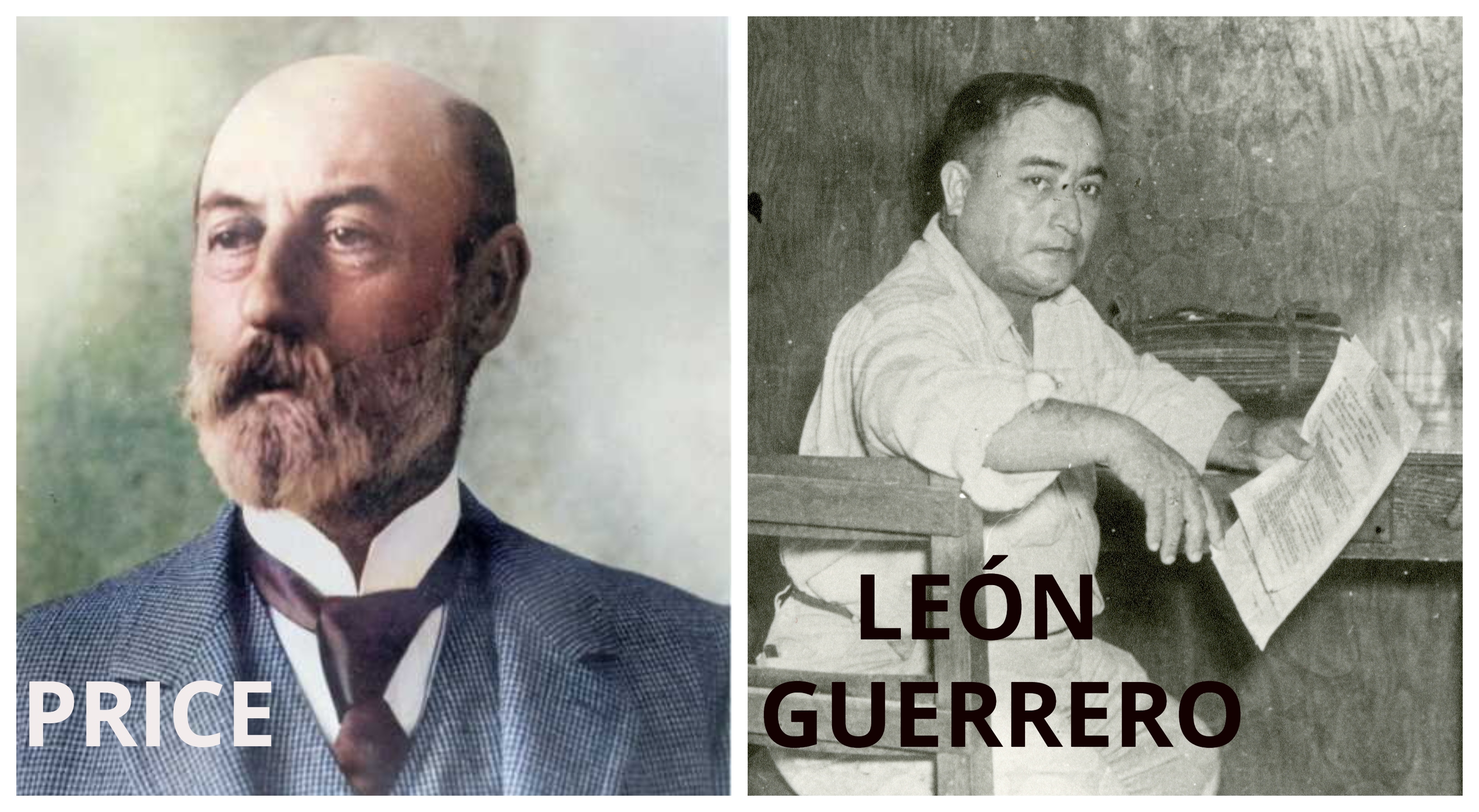
HE DEFIED PRICE


Francisco Baza León Guerrero was a fighter.

He fought for American citizenship and for democracy for Guam's people, where the people would one day vote for a representative form of government and not be ruled by Naval Governors who were the entire government rolled into one man.

A little-known story shows how León Guerrero wasn't a doormat even in his younger days.

León Guerrero, who was a chicken farmer in his youth, helping to support his widowed mother, got a job working at the US Agricultural Experiment Station in Piti. As such, León Guerrero was an employee of the US Department of Agriculture, and not of the US Navy.

In 1926, while León Guerrero was working at the Piti Station as a specialist in poultry raising, the Naval Governor, Captain Henry B. Price, walked into the Station looking for long-time Station employee Peter Nelson. All but one of the employees stood up to greet the Governor. After Price had asked his questions and gotten answers, Price turned around as if to leave, so León Guerrero and his coworker Joaquín Guerrero sat back down again.

Then, Price turned back again and commanded León Guerrero to stand once more. This León Guerrero refused to do, taking Price's command as intending to humiliate León Guerrero, who said Price already had ill feelings for him, for reasons he did not state.


CHARGED!


León Guerrero was charged in court with "Wanton Disrespect to the Governor."

Price's version of the event was that he met León Guerrero at the Station and asked for Nelson. León Guerrero told the Governor where Nelson was, but made no attempt to inform Nelson that the Governor was at the Station looking for him. Instead, León Guerrero sat down, tilting the swivel chair as far back as it could go, raising his arms and clasping his hands behind his head, looking at the Governor in what Price interpreted as a disrespectful stance.

Price told León Guerrero, "You are disrespectful." León Guerrero retorted that he was not. Price then ordered León Guerrero to stand up. He remained seated and Price was done waiting for him to stand, so Price left.

Guam's court found León Guerrero guilty as charged.


ON APPEAL


In an appeal made to a trio of appellate judges made up of a Navy officer, a Marine officer and a Chamorro judge (José Roberto), León Guerrero argued that he could not be guilty of breaking what was not a law. There was no law obliging him to rise when ordered by the Governor to do so.

Furthermore, León Guerrero could not be accused of insubordination to his superior because León Guerrero did not work for Price. He worked for the US Department of Agriculture, and not for the US Navy whose highest officer on Guam was Price.

Unsurprisingly, this court denied León Guerrero's appeal.

Still, León Guerrero did not lose his job at the Agricultural Station.


Friday, January 27, 2023

NEVER SENT TO JAPAN


On January 10, 1942, the Japanese shipped off to Prisoner of War camps in Japan all the Americans they found on Guam after they invaded the island on December 10, 1941. Around 500 people, military and civilian.

Except for TWO people.

These two Americans stayed on Guam for the entire Japanese Occupation. They were never sent, like the other Americans, to prisoner of war camps in Japan.

Who were they? And why were they exempted?

They were LOUIS FURTADO and MARY MAGDALENE CRUZ, and they had two things in common. First, they were born in Hawaii. Second, they were both of Portuguese ancestry.

Why should those two things matter?

First, Furtado claimed that the Japanese told him that he would not be imprisoned because the Japanese considered Hawaii "conquered territory." Sure, the Japanese had bombed Pearl Harbor, but they never conquered Hawaii. Who knows why they would have said so.

Second, both Furtado and Cruz, whose maiden name was Vinhaça (sometimes spelled Vinhasa), were of Portuguese ancestry. Portugal was neutral in World War II, neither an enemy nor an ally of Japan. Still, Furtado and Cruz were both born in Hawaii and had American citizenship, even though their families had come over from Portugal. So it remains a mystery why the Japanese would have let these two go free, while all other Americans were shipped off to Japan.


FURTADO


FURTADO AND PÅLE' OSCAR CALVO
Meeting again in Hawaii in 1946


Furtado, a married man with children, was sent to Guam in 1941 to work for the US Navy. When the Japanese bombed Guam on December 8, 1941, Furtado was asked by Governor McMillin to supervise the destruction of fuel on Cabras Island so as not to fall into enemy hands. He then fled into the jungle trying to avoid the Japanese. But he finally turned himself in when the island was firmly in Japanese hands. When they found out he was from Hawaii, the Japanese demanded he tell them what he knew about Pearl Harbor and American defenses in Hawaii. When he refused to, they beat him up.

He was told by the Japanese that they'd let him stay on Guam, but they kept an eye on him and punished him now and then for singing God Bless America, teaching Chamorro children to sing it and for other minor infractions. He also kept a radio, illegal under the Japanese, but got away with it till the very end. Generally, he was left unmolested, and he tried to be invisible as much as he could, farming on borrowed land. He is also credited for composing the Uncle Sam song, along with Pedro "Seboyas" Rosario.

He was ordered by the Japanese to work on the defense projects of the Japanese. He hated the idea. First, he did not want to aid the Japanese war effort. Second, he had heard that the Japanese had killed entire work crews after the job was done. So he had someone pour boiling water on him so he could claim injury and be unfit to work. He was supposed to scald only his hand, but the water scalded much of his upper body, leaving scars. He was hospitalized for ten days.

When he was caught with the radio, he fled into the jungle. That was hard on him, due to the lack of food. Luckily this was right before the American return and he finally met up with some Marines and he was brought inside American lines.


Word was sent to his wife and children, father and siblings that he had made it through the Japanese Occupation with his life intact. In due time he returned to Hawaii, and lived to the ripe old age of 96, dying in 2002 in Hawaii. Too bad I didn't know about him back then. Imagine the stories I could've heard from him.


MARY MAGDALENE CRUZ


The next Hawaii-born person left alone by the Japanese on Guam lead a quieter life than Furtado's, being the wife of Antonio Ignacio Cruz, familian Fånggo, a school teacher in Piti in 1940.

Mary Magdalene Vinhaça (sometimes spelled Vinhasa) was born in Kona, Hawaii. Her parents were of Portuguese background. 

Antonio Cruz was a teacher and somehow was in Hawaii in the late 1920s. He and Mary met and got married. Their oldest child was born in Hawaii, but they soon moved to Guam, where the rest of the children were born.

Antonio died in 1970 and Mary lived the remainder of her life in Hawaii. All of her children also moved away from Guam. Mary died in 1980 in Hawaii.

May they rest in peace.

Tuesday, January 17, 2023

RENAMING UPI


There is disagreement going on right now about renaming Upi Elementary School.

Some want to rename it after the late master ifit carver Robert S. Taitano, who, besides his significance as a cultural arts practitioner, didn't live far from the school.

But others, especially those connected to the school, want to keep the current name of the school.

Having no connection whatsoever to the school, it is not my purpose to weigh in on the matter. But I do want to clarify some statements made by some people that need it. As I didn't hear these people make these statements, and am relying on media quotes, one has to ask if they were quoted accurately.

Nonetheless, someone is reported to have said that Upi is "simply a street name that stands for Northwest Field." This is not accurate. Long before there was a small Upi Street in Yigo (not even where Upi Elementary School is), there was a district of northeastern Guam called Upi. And Upi is not in the northwest of Guam but in the northeast, nowhere near Northwest Field.


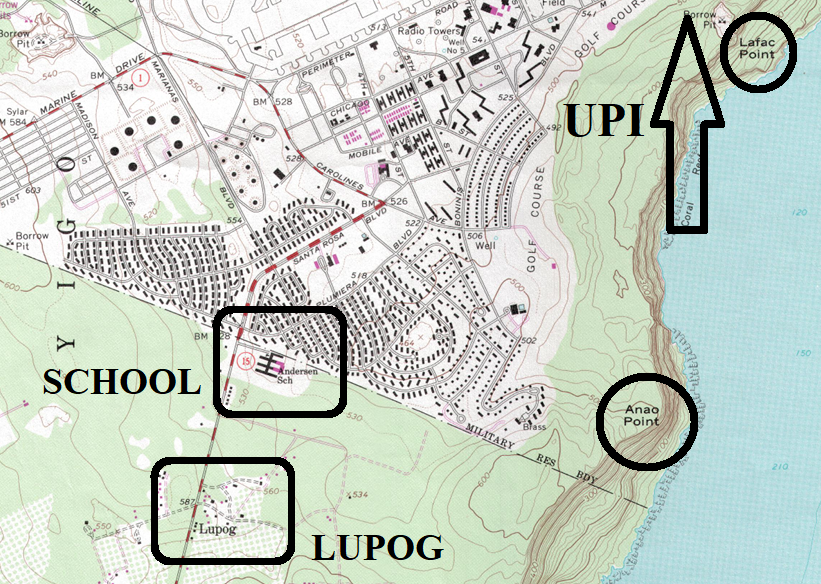
This map based on a 1902 Guam map shows the traditional location of the area called Upi. It is exactly where Andersen Air Force Base sits today.

Thus, the second alleged statement by another individual, that "Upi was actually named after a cluster of homes in the Tarague area" is also in need of clarification. Upi is an area just south of Tarague, but it is its own area, distinct from Tarague. 


AN OLD CONTROVERSY


FROM 1989


Many people associated with Upi Elementary School today want to keep the name as is, but how interesting to find out that, in 1989, the people associated with the school back then actually opposed the name Upi Elementary School.

Prior to 1989, it was Andersen Elementary School. Then the Guam Board of Education voted to change the name to Upi Elementary School. Over 600 people connected to the school opposed it, signing their names to a petition. They preferred the school be called Mount Santa Rosa Elementary School.


WHEN IT WAS STILL ANDERSEN ELEMENTARY
Late 1960s


Those opposing the name Mount Santa Rosa said that the school was not on Mount Santa Rosa, which is south of the school, though not very far.

Those opposing the name Upi Elementary School did so for a number of reasons. Some said no one knew where Upi was nor even how to pronounce it; some pronouncing it YOO-pee. Others said there was no connection between the school and some place they had never heard of.

As for the fear that Upi would be called YOOPEE by others, let it be a lesson. While it is good to anticipate possible problems, they all don't actually become problems. Almost everyone today pronounces Upi the right way, as far as I know.

The question is : is Upi Elementary School in Upi?


WHERE IS UPI?


As seen in the 1902 map, Upi is way at the northeast corner of Guam. Looking at the areas near it, one sees that Late Point is adjacent to Upi. It is definitely north of Anao Point. Upi, properly speaking, is exactly where the air fields of Andersen Air Force Base are.

Upi Elementary School is located well south of that. The school is adjacent to Anao Point.

So Upi Elementary School sits in between Upi and another area called Lupog, just north of Mount Santa Rosa. 


So a better case might be made that Upi Elementary School resides in Lupog, as the map indicates that the school is much closer to Lupog than it is to the air fields of Andersen Air Force Base, which is definitely Upi.


BUT.....

Who says a building or institution has to sit in the geographical location it is named for?

After all, there are many bakeries called Paris Bakery, and grocery stores called Manila Food Store, that are neither in Paris nor in Manila.

Buildings and institutions can be named after places, people and events that mean something to those who use the building or are part of the institution.

And, in the end perhaps, it is they, the users and participants, who ought to decide, since it is they who will have to live each day under that name.

Tuesday, January 10, 2023

I BRUHA


One rarely hears of witches in Chamorro folklore. It's all about taotaomo'na on Guam; birak in the Northern Marianas.

But, in the old days, Chamorros also feared witches, the BRUHA.

Bruha is borrowed from the Spanish word bruja, which means "witch."


FROM 1907

In 1907, an American lady living on Guam wrote about the bruha as she learned about it from Chamorro friends.

Unlike the taotaomo'na, the bruha was never seen.

But she was still able to do much harm.

She was not seen, but could be heard.

One night, a man was eating dinner all by himself when he heard "click, click, click." He knew that sound was from the bruha.

He told the bruha, "Come eat with me. I'm not afraid of you."

All of a sudden, the candle on the table where he was eating blew out. Dishes leapt from the table and smashed against the wall or the floor. The man himself was attacked by an unseen force and his face was covered in blood and his torn hair was all over the room.

The man was only able to chase away the invisible bruha by repeating, "Jesús, María, José." "Jesus, Mary and Joseph."

Tuesday, January 3, 2023

SINANGAN I MAN ÅMKO'


I I'E' HUMUYONG TARAKITO

The I'e' fish became a Tarakito fish


This is a saying applied when a story starts when one person tells it to another person, but by the time the story reaches the 20th person, the story has grown way bigger than it really is.

The i'e' is a small fish. It's actually the name for a kind of fish when it is still in its baby stage.

When the i'e' matures and grows, it is then called tarakito.

So let's say Juan tells Manuel that he was bit by a dog.

Manuel tells Francisco and Francisco tells Lorenzo that Juan was bit by two dogs.

Lorenzo tells Ramón that Juan and his wife were bit by a pack of dogs.

Ramón tells Pedro that Juan and his wife were bit by a pack of dogs when Juan and his wife were picking mangoes from Antonio's tree without permission.

You get the idea.

The tiny fish became a big fish.

It could also be applied, I believe, to embellish a story. After all, who would be impressed if you caught a small fish? But if you single-handedly caught a marlon as big as yourself, people saw "Wow."

I i'e' humuyong tarakito.