Saturday, May 14, 2011

WE USED TO PRAY IN SPANISH


Naty shares with us the Spanish prayer (said with our Chamorro pronunciation) which she learned from her father, who learned it from his.....and all the way back we go!

Santo ángel de mi guardia, de mi dulce compañía
no me desampares ni de noche, ni de día.
Con Dios me acuesto, con Dios me levanto,
con la virgen santísima y Espíritu Santo. Amen.
Virgen Encarnación,  madre del Verbo Divino
échanos santa bendición...(I can't make out the end yet)

(There is a version that ends with :
guíanos por buen camino)

Holy guardian angel, my sweet companion,
do not forsake me, neither by day nor by night.
With God I lay me down, with God I rise,
with the most holy Virgin and the Holy Spirit.  Amen.
Our Lady of the Incarnation, mother of the Divine Word,
give us holy blessing....
(guide us along good paths).

KÅNTAN CHAMORRITA

Hågo guennao, guåho guine/ ti umali'e dos matå-ta;
yanggen guåha malago'-mo / tuge' gi un pedåson kåtta.

Here I am, there you are / our two eyes won't meet;
if you want something / write it in a little letter.


As mentioned before, young Chamorro love had many obstacles (mama, grandma) to contend with.  These two sweethearts could rarely even see each other.  But absence makes the heart grow fonder.  It's not so much one asking if the other wants something; the petitioner him/herself wants something as well - to get a little note from the other.  Remember when we used to pass notes to each other in 4th grade?

I remember stories about one of my grand aunts getting love notes from her eventual husband.  She would hide the note by sewing it into the hem of her dress!  And they were far beyond the 4th grade!

FINO' I MAN ÅMKO' #2


MÅKTOS MÅRU

"Always on the go"

"Måru" is a box kite.  "Måktos" means "broken off, snapped," such as a string or a cord.  A "måktos måru" is a box kite that has been freed to fly higher and higher because the string has snapped.  It also means a person who is always on the go, going from one thing to the next.

Wednesday, May 11, 2011

TODAY'S CHAMORRO WORD : HUCHOM

bportlibrary.org

HUCHOM : close

Huchom i bentåna!  Close the window!

Ti siña ma huchom.  It cannot be closed.

Ma huchom i tenda.  The store is closed.

Måtchom.  A contraction of "ma huchom." 

Måtchom i atdao.  The sun is set (literally, "closed.")

I minatchom i atdao.  The sunset.

If we had our own version of Los Angeles' "Sunset Boulevard, " it would be "Chålan Minatchom Atdao."

Huchume.  To close to/for someone.

Bai huchume hao?  Shall I close it for you?

Huchom kåtta.  Envelope.  Literally, "what closes a letter." 

More common in the past, however, was the Spanish word for "envelope," which is "sobre."  More common today is simply the English word "envelope."

Tuesday, May 10, 2011

AFFAIRS OF THE DERRIERE


No matter how big your "dågan" is, there are too many g's in that word in the sign above.

For example, "hågan" means "daughter of."  Add an extra "g" and it becomes "haggan" or "turtle."

Just like the glota ( ' ), we can be tempted to put too many letters where they don't belong.

Monday, May 9, 2011

JUANITA - From Mexico to Guam since 1951

PLÅTICA EN ESPAÑOL CON UNA SEÑORA MEXICANA
QUE LLEVA MUCHOS AÑOS EN GUAM

Juanita was born and raised in Mexico but as a young bride moved to Guam with her husband who found work here in 1951.  She speaks about how she found the Chamorro people here in those early days.  She says there were a good number of people who still spoke Spanish in the early 50s.  As she herself didn't speak much English, these Chamorros who spoke some Spanish helped her out when she was a young mother with little babies.  Ignacia Bordallo Butler was one of her friends, who was the daughter of a Spaniard, Baltazar Bordallo from Saucelle, Salamanca.

She speaks about the kindness and goodness of the Chamorros in those days, and laments the loss of anyone's culture.  She remembers how people would invite strangers to go eat at their homes during village fiestas.  One can see some of this still alive today in the southern villages, where perhaps the hosts do not call out to passersby anymore, but who will not evict total strangers who walk into their fiestas which spill out into the narrow village streets.

Friday, May 6, 2011

I KAMYO


The kåmyo was once an indispensable item in every Chamorro kitchen.  There's nothing like freshly grated coconut; a real treat compared to the packaged kind.

TODAY'S CHAMORRO WORD : TUGE'

fanpop.com
TUGE' : to write.

Tuge' fan påpa'.  Please write it down.

Bai hu tuge'.  I'll write it.

Ma tuge' gi petta.  It is written on the door.

Månge'.  To write.

Maolek hao månge'.  You are good in writing.

Måkinan månge'.  Typewriter.

Tinige'.  Writing.

Tinige' kånnai.  Manuscript.  Written by hand.

Tinige' San Juan.  The writing of Saint John.

Fantinige'an.  Archives.  FAN+WORD+AN formula.  "Place of."  "Place of writings."

Tituge'. Writer.

Fantugian.  Place of writing.  FAN+WORD+AN formula. "Place to write."

Tugie.  To write for/to. 

Bai hu tugie hao kåtta.  I will write you a letter.

MANGO SEASON'S COMING!


We're going to Agat at the end of the month for their annual Mango Festival.

Thursday, May 5, 2011

TODAY IN HISTORY : May 5


LAST SPANISH BISHOP OF GUAM CONSECRATED
May 5, 1935

Miguel Angel Olano y Urteaga, who as a simple Capuchin priest and pastor of Sumay was known as Pale' Leon de Alzo, was consecrated a bishop on this day in the city of San Sebastian, in his native province of Guipuzcoa in Spain.  Bishop Olano first came to Guam in 1919 and was soon assigned to Sumay, the second largest municipality on Guam at the time.  His time as Bishop on Guam was not without trouble.  The American Navy wanted the Spanish priests replaced by American ones as soon as possible.  Olano himself would have been replaced in short order but World War II delayed that.  Instead, he was sent, with the American Capuchins, to Japan.  Unlike the imprisoned Americans, Olano was free to find his own lodgings because Spain was neutral in that war.  In time, he was able to go to India and then to Australia and back to Guam when it was liberated from the Japanese.  In 1945, American Bishop Baumgartner replaced Olano.  Olano then spent the next years in the Philippines and finally in Spain.  When the first Chamorro bishop, Felixberto Flores, was to be consecrated, Olano came for the historical event and asked to remain on Guam, which Flores granted.  He died of a heart attack on May 21, 1970 while swimming at Ipao Beach.  He is buried in the Agaña Cathedral, the first bishop to be buried in its sanctuary.  Bishop Olano was well-loved, especially by the people of Sumay (who were transferred to Santa Rita after the war).  Olano ordained the 2nd and 3rd Chamorro priests : Fathers Dueñas and Calvo.  He was the last Spanish bishop of Guam, but he returned to die and be buried in the island he loved.


Olano ordained Father Dueñas (on the left) and Father Calvo (on the right).  In the middle, Father Jose Manibusan, was ordained during the war in Manila and died there in 1945 due to poor health.


PARA NUESTROS AMIGOS HISPANOHABLANTES

CONSAGRACIÓN DEL ÚLTIMO OBISPO ESPAÑOL DE GUAM

Hoy día recordamos la consagración episcopal del último obispo español de Guam, el Mons. Miguel Ángel Olano Urteaga, capuchino.  Fué consagrado el día 5 de Mayo de 1935 en la Iglesia (ahora Catedral) del Buen Pastor en Donostia, pues Olano era guipuzcoano.  Sus primeros años como obispo en Guam no fueron tranquilos, que la Marina estadounidense promovió el cambio de misioneros, de españoles a norteamericanos.  Poco después del comienzo de la guerra entre Japón y los EE. UU., fué deportado a Japón, pero encontró refugio con los jesuitas españoles en aquel país.  Después, pasó a la India.  Al terminar la ocupación japonesa en Guam, volvió a la isla por vía de Australia.  En 1945, a Olano le sustituyó Baumgartner, primer obispo norteamericano en Guam.  Ahora, despojado de su grey, Olano se encontró también sin país, que en España reinaba Franco.  Olano tenía un hermano también sacerdote capuchino, Aniceto, en religión Fray Miguel de Alzo, que se refugió en Argentina después de la Guerra Civil, por ser considerado nacionalista vasco.  El Mons. Olano, pues, pasó a Filipinas, tal vez para evitar dificultades políticas en España.  Permaneció en Manila hasta el año 1960 cuando pasó a España.  Al consagrar el primer obispo chamorro en 1970, viajó a Guam para la ocasión, pidiendo al nuevo obispo permiso para quedarse en la isla.  Pocos días después, sufrió un ataque cardíaco, murió y fué sepultado en la Catedral de Agaña, Guam en el mes de Mayo de 1970.

Wednesday, May 4, 2011

FINO' I MAN ÅMKO' #1


HUMÅNAO POT ESPIA CHINATSAGÅ-ÑA

To look for your own trouble

Language is not just about precise terminology, as in "everything has a name."  "Just tell me how to say 'cat' in Chamorro."  Beyond the precise terminology, language can also express, in veiled or subtle ways, a world view, sentiments and values.  Our man åmko' often speak like this, and it is a form of speech that seems to be slipping away, even as Chamorro language advocates promote the language with neat, technologically precise methodology.

"Humånao pot espia chinatsagå-ña."  It isn't enough that bad things happen to us without our consent.  Some of us have to go chase after trouble.  If we're not in trouble, we'll look for it.

Guåha na biåhe na sen kalåktos i fino' i man åmko'!

Tuesday, May 3, 2011

AI I MAN ÅMKO'

upi.com
Fanhongge na magåhet na ma susedi este nigap!

Humålom si Vice Mayor gi Senior Citizens Center ya ha sangåne i man åmko' guihe na måtai si Bin Laden.

I amko' : Håye måtai?
Vice Mayor : Si Bin Laden.

Otro na åmko' : Taotao måno gue'?
Vice Mayor : Kao un hasso i 9-11?

I amko' : Ya ke ora i lisåyo?

ATANTÅNO'


WHAT'S HIDING BEHIND THIS WATERING HOLE?


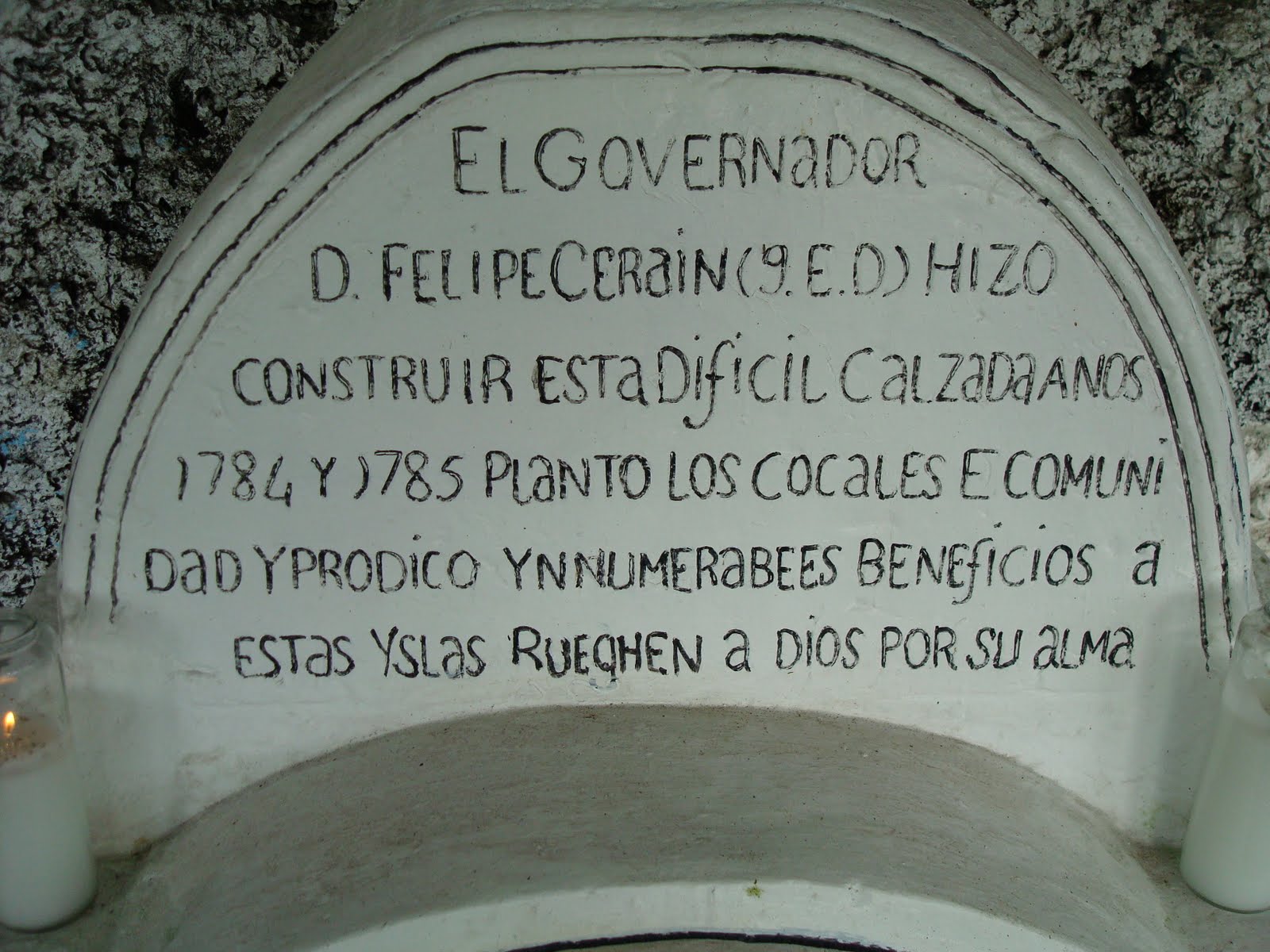
A SPANISH ROAD MARKER

We pass this everytime we go from Hågat to Hagåtña or vice versa, but it is hidden from Route 1 by the bar/eatery.  It lies just before we make the left turn from Route 1 towards Hågat, just before the main gate at Naval Station.

This area is called Atantåno', and at one time it was farming territory.  Because of its swampy terrain, it was used for rice cultivation.


The upper part of the marker commemorates the work of
former Governor Don Felipe Cerain who had the road built and
planted the coconut groves in the years 1784 and 1785.


The bottom portion relates how former Governor Don Francisco Villalobos
established the first rice plantation in this location from 1832-1834
with the participation of the Gobernadorcillos (who were Chamorro
and whose position was akin to a mayor)
Don Antonio Guerrero, Don Juan de Rivera and Don Lucas de Castro,
and the Cabezas de Barangay (neighborhood leaders).
They named the plantation
"La Cienega de la Purisima,"
The Marsh of the Immaculate (Virgin Mary).


The base of the entire marker is from the American period.  It tells us that the road was rebuilt in 1908-1909 under Governor Dorn and by Eugene L. Bisset.  Bisset was a naval officer who also bought a lot of land in the north of Guam.  His daughter later married one of the Arteros.

I KALACHUCHA


Since the latter part of March, the kalachucha has been in bloom.  Also known as plumeria and frangipani.  They make great floral leis and are a staple at Catholic May devotions.

These flowers are believed to be native to Mexico, the Caribbean and Central America, but also to Polynesia. As they are found in a very wide area, they go by different names. They are now found all over the world.

More than likely this flower was introduced to both the Philippines and the Marianas via Mexico, because the Filipinos call it kalachuchi and the Chamorros kalachucha, which are both based on the native Nahuatl name for the flower, which is cacaloxuchitl. Xochitl is Nahuatl for "flower."

GI LANGET YAN GI TANO'


There are two melodies used to sing the hymn "Gi Langet yan gi Tano'."  The first melody can be heard sung by a community of people in the Chamorro May Devotions post.  The clip above is the second melody.

I'll be posting periodically clips of traditional Chamorro hymns for the benefit of those who want to learn them.  Please remember the singer is rusty.  Sungon ha'.

LYRICS

Gi langet yan gi tano' / in na'e hao Maria (In heaven and on earth / we give you, Mary)
i flores guålo' siha / sa' Nånan-måme hao! (the flowers of our gardens / for you are our mother.)
Man måtto ham O Nåna / man magof yan man dimo; (We come oh mother / joyful and kneeling)
gi fi'on i Lahi-mo / para in nene hao. (beside your Son / in order to greet you).