Monday, February 8, 2016

EXCITED?


Are you excited?

OK then. How do you say that in Chamorro?

I was asked the other day that very question, and I must admit I was stumped.

People doing a TV ad wanted to end the commercial saying that they were offering something exciting and they wanted to say that in Chamorro.

Now, before we proceed, I think it is important for us to be very clear what we mean by "excited" or "exciting."

By "excited" or "exciting" we mean a high degree of enjoyment or positive anticipation.

So, off I went to my dictionaries and to my older Chamorro speakers whom I always consult. Even these proficient speakers of Chamorro scratched their heads and needed time to think about the question. How does one say "excitement" or "excited" in Chamorro?

Many words were suggested, but most of them only got close to the idea of excitement, but didn't hit the nail on the head.

Here are some of the words suggested to me :

MANMAN

Manman means to stand in awe or admiration at something amazing or unusual. To be manman is to be beside oneself in wonder. Now, you can be manman when you're excited. But not always. We can be excited about ordinary things which do not cause awe and wonder. For example, carrot cake always makes me excited, but does not cause me awe and wonder.

ÅNSIAS

Borrowed from a Spanish word, it is related to our English word anxious because both are based on a Latin original. Anxious/ånsias. It is true that we are often anxious when we are excited. If I am waiting in a huge crowd for the appearance of my favorite megastar, I can be both excited and anxious. Anxious that the star is taking too long to appear on stage; anxious that I may not get a good view, and so on. I would be ånsias waiting to see the dentist, but I wouldn't say I would be excited to see the dentist! So I don't think ånsias (anxious) perfectly fits the idea of excitement.

GUINAFE

This comes from the word guåfe or "fire." Guinafe means "burned" and guinaguafe means "burning." Again, being excited can be likened to burning up inside with one's emotions. But the difficulty is that guinafe can also mean literally burnt, as in a piece of meat on a grill. One can be burning up inside when one is angry, too. So, guinafe may not hit the nail on the head when it comes to excitement.

ANIMOSO

Another loan word from Spanish, animoso comes from the word ånimo, which means "spirit, energy, intent, effort." Nå'e ånimo means "give it your all, put your heart into it." Animoso usually means, therefore, "industrious, energetic." So, although excitement connotes an increase in spirit, to put it colloquially, "to be pumped up," animoso doesn't quite fit "excitement."

DIBETSION

Yet another Spanish loan word, it means "fun, entertainment, play." Again, it suggests excitement but one doesn't have to be excited when one is being entertained or when one is having some fun playing cards. Excitement suggests something stronger than simple pleasure.

And there were other such similar words that suggest excitement, or can be part of excitement, but do not work as an exact translation of "excitement."


ONE OF THE BETTER OPTIONS

Believe it or not, magof (happy) is one of the better translations I came across. And that is because, in the way we are using the word "excitement" in this post, we are talking about strong enthusiasm, delight and pleasure about something. This always means happiness. To say "I am excited to be here" always means one is happy to be there.

Enjoying the thrill of bungee jumping, one could say "Magof yo'" and mean "I am excited!"

Hearing that the show is about to begin in 10 seconds, one could say "Magof yo'" and mean "I am excited!"

Or, "Ei na minagof!" and mean "Wow, what excitement!"

Or, "Na' magof!" and mean "Exciting!"

But magof always means "happy," so Chamorro seems to lack a precise word that specifically means "excited."

But how about.....

AGODDAI

If you look at the 1932 Chamorro dictionary of Påle' Roman, he defines agoddai as "to become greatly excited," to become "enthused, impassioned."

I really like this option. I think this is the original meaning of the word agoddai.

The challenge we have today using agoddai to mean "excited" or "excitement" is that, over the years, agoddai has become associated with only one use of the word.

If someone today hears agoddai, s/he will usually think of the intense desire to pinch a baby.

Personally, I find it suspicious that our ancestors would have invented a word that only meant the intense desire to pinch a baby! It is possible they did, I won't deny that. But, to me, it seems more believable that our ancestors had a word to simple express any excitement or intense desire. Then, over time, people narrowed it down to one use of the word.

But Påle' Roman's older dictionary shows us that, at least even as late as the 1930s, Chamorros were using agoddai to express an intense desire, passion and excitement for other things, too. As in a passion for a person.

Ma agoddai yo' nu hågo. I feel passionate for you. You enthuse me.

Na' ma agoddai este! This is exciting! This is exhilarating! 

I think I found my answer. But, I would be sure to be misunderstood by the majority of people today if I used agoddai to mean general excitement about something.






Friday, February 5, 2016

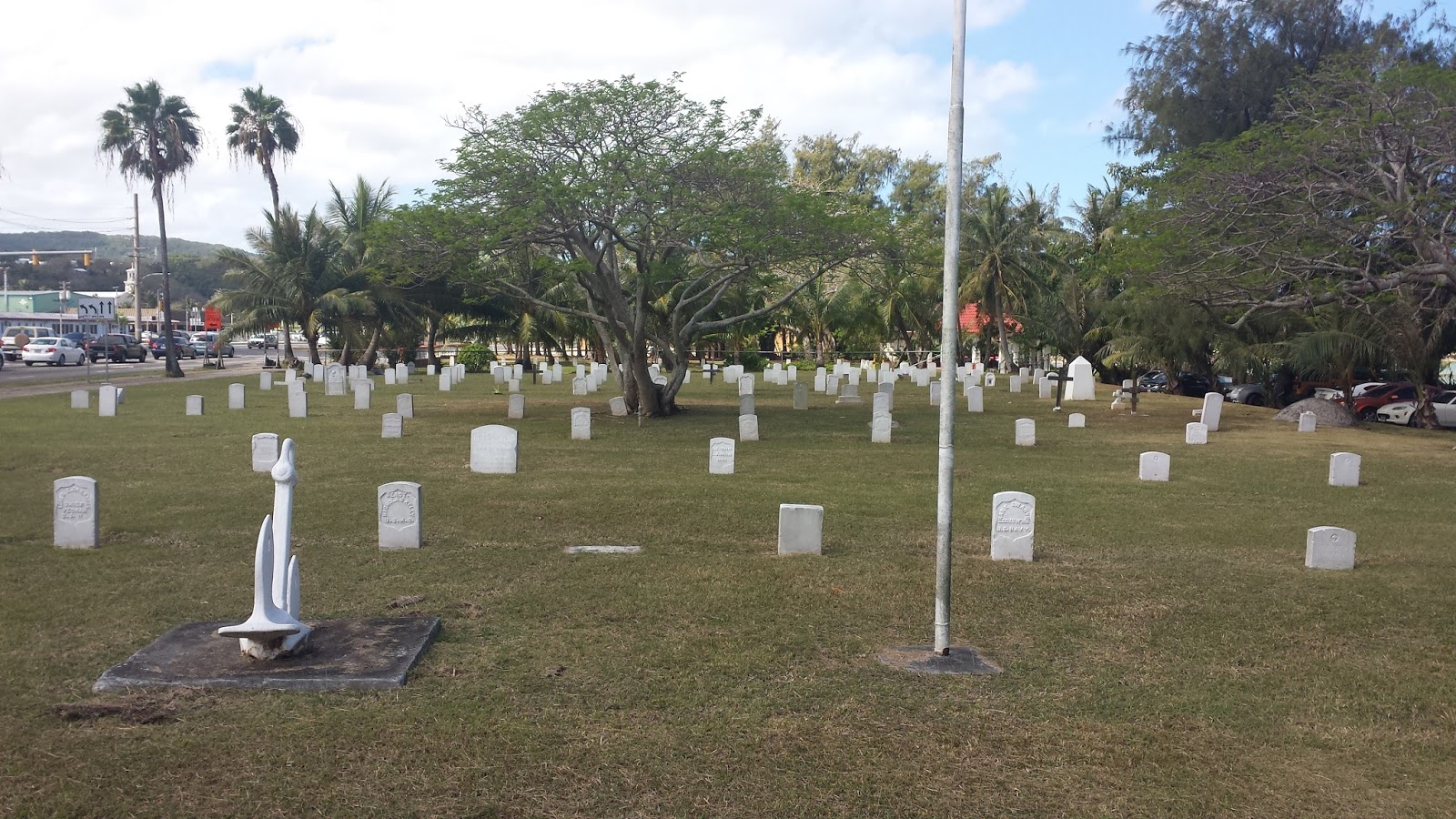
THE NAVAL CEMETERY : A FIRST


FIRST NON-CATHOLIC CEMETERY IN GUAM

Or in the Marianas, for that matter. And since westernization, to be precise. Prior to 1668, our ancestors were not Christian and were obviously buried in our islands.

But ever since Catholic Spain began to run things, only Catholic cemeteries were allowed in the Marianas, under the supervision of the local priest.

So, if you were not Catholic (and the islands always had non-Catholic residents, at least in the 1800s), where was your body laid to rest if you died in the Marianas?

The fact is that Catholic cemeteries had provisions for that possibility.

Catholic cemeteries were consecrated and a fence or a wall marked the area that was consecrated. Right outside that fence or wall was the space provided for non-Catholics, unbaptized babies, suicides and "public sinners," meaning Catholics who lived in a public way in contradiction to the religion who died without reconciling with the Church. Catholics who died unrepentant of living with a partner outside of marriage, or Catholics who joined the Freemasons, for example, would be buried here. Many of these prohibitions concerning burial in a Catholic cemetery are no longer in force, but I remember the days visiting a relative's grave which was outside the fence.

It is documented that, during Spanish times, Protestants and others were buried at Pigo but in the unconsecrated portion of the cemetery.

GOVERNOR SCHROEDER

There may be documentation stored somewhere in the US among Navy records detailing the opening of this cemetery but they aren't readily accessible, if they exist at all. Still, the first burial we know of dates back to 1902, during the tenure of the second American Naval Governor of Guam, Seaton Schroeder.

Seeing the need for a burial space for their own personnel and for the increasing number of non-Catholics on American Guam, the Naval Government chose this site for a military cemetery. At the time, this area of Hagåtña, called San Antonio, as yet had a small population. This area would have been at the outer edge of the barrio or district. But it wouldn't be long before the population grew and new houses would be built to the east of the cemetery. The beach and the road in front served as the northern and southern borders.

NOT JUST FOR AMERICAN NAVY MEN

The oldest grave is that of an American Marine private, Elwood Hopkins. But more than just active stateside military personnel are buried here. There are some spouses, children and retired military men, too. And there are also some Chamorro military men, both active and retired.


Jesus L. Guerrero, Chamorro, was in the Navy and died during World War II in 1944


Ah Shun Chang was Chinese and a member of the Auxiliary Services of the US Navy, which probably meant he was a cook or other domestic worker in the Navy.


Francisco Unpingco Rivera was a Chamorro Navy man who died in the attack at Pearl Harbor on December 7, 1941. His body was later buried on Guam.


Alessandro Veneziano was Greek Orthodox. He came to Guam as a musician in the Navy and married a Chamorro lady. His children eventually moved to the US mainland.


Gertrud Costenoble was a civilian and a German. Her husband had first moved to Saipan when it was under the Germans but he then moved to Guam.


Another German buried here was a civil servant in the Saipan government! For whatever reason (maybe medical?) he was on Guam in early 1903 and passed away.


THE CORMORAN GRAVES

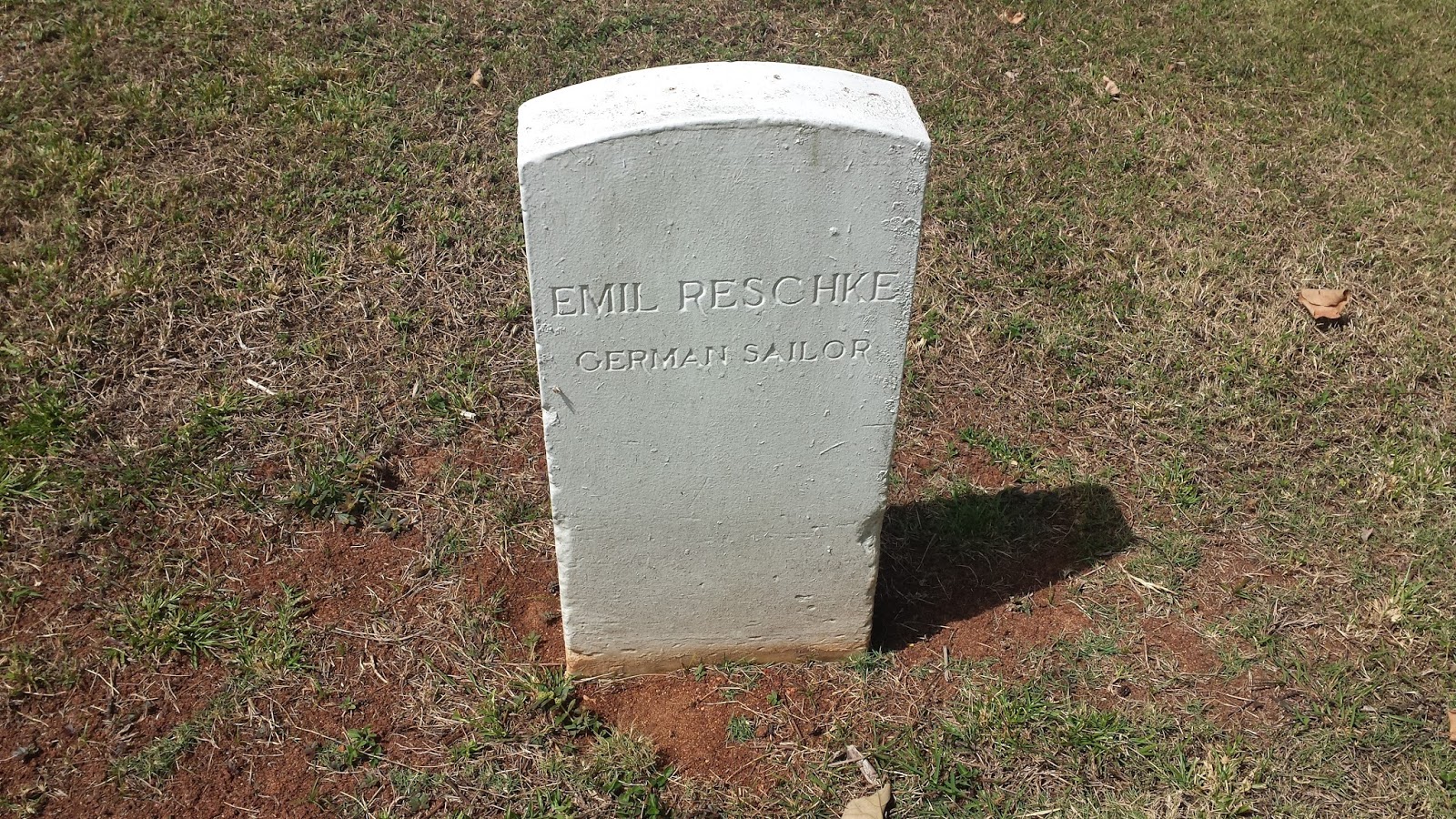
On April 7, 1917, when the U.S. declared war on Germany, a German ship, the SMS Cormoran, peacefully lay in Apra Harbor. Rather than let the ship fall into American hands, the Germans on board blew up their own ship. Seven crew members died and are buried in this cemetery.


The Cormoran marker, with the German Iron Cross and inscription in the German language.


Poor Emil Reschke of the German Navy didn't make it alive after the explosion.


One of the Cormoran deceased was not German at all but from German-controlled New Guinea. His name was Boomerum (or Bumerum).


MAY THEY ALL REST IN PEACE

Thursday, February 4, 2016

HÅYE SI SOCOCO?


In the famous song recorded by the Delgado Brothers, Ramon San, the second verse begins with :

Si Sococo segundo-ña
sa' ha dåkngas ilu-ña.
Eyo mina' må'gas gue'

Sococo was his second-in-command
because he shaved his head.
That's what made him a boss.

Now, who was this Sococo?

Was he a fictional character? Or was he a real person?

I knew from the 1897 Guam Census that there was indeed a family by the last name Sococo. We don't hear about them on Guam anymore because, as far as we can tell, no one has that last name anymore.

But, just to be sure, I called up one of the Delgado Brothers to find out.

According to him, to the best of his recollection, a man named Benavente from Dededo, composed the song Ramon San.

The "Sococo" in the song is not really Sococo. It was a nickname given to a man by the last name San Agustin.

But while we're on this topic, we might as well talk about the real Sococos.

In the village of Asan, in the 1890s during Spanish times, lived a Chinese man named Manuel Sococo. Like many Chinese settlers on Guam, his last named ended in -co (Unpingco, Limtiaco).

He was married to an Asan lady named Juliana Megofña.

They had five daughters, it seems, and no sons. But the oldest girl had a son out of wedlock so he carried the Sococo name. The boy's name was Jose.

Jose may have been the Jose who fathered children with his wife Rosa Ungacta. A son of theirs, Peter, left Guam and joined the US Navy in 1939. He had a brilliant Navy career for over 30 years as a submariner.


Peter Sococo, USN


Sococo married in the States and had three daughters.

There were a few other Sococos but, apparently, the family name disappeared in Guam in the last few decades.

***UPDATE***

According to one source, the composer named Benavente was Vicente San Agustin Benavente (familian Chedo') of Dededo and former Commissioner of that village.

Wednesday, February 3, 2016

FINO MAN AMKO' : NI HOI NI GOI


NI HOI NI GOI
Neither a hoi nor a goi

Ni hoi ni goi is said when not a word has been heard from someone.

Måtto mågi si Kiko ya ha li'e yo' lao ni hoi ni goi.

Kiko came by here and saw me but didn't say a word.

In the video above, Tan Esco talks about one of her father's brothers. She says,

Sa' i dos måtai, ah malingo gi che'lu-ña si tatå-ho i Mariano. 
Because the two who died, ah lost of my father's brothers (one) was Mariano.

Humånao ya ilek-ña bayinero, no? 
He left and became, as he said, a whaler, no?

Saonao gi batkon man aligao bayena. 
He went with the ships that searched for whales.

Eyegue ni uno ni hoi ni goi ti ma tungo' håfa uttimon-ña, no?
He was one who they heard nothing from and didn't know what happened to him, no?

Tåya' "communication."
There was no communication.


ORIGIN

It's an interesting phrase, first of all, because the Chamorros of old did not like the OI sound.

Our future-marker verb BAI comes from the Spanish word VOY which means "I go." Some older Chamorro writings maintain the BOI spelling. But no Chamorro ever says BOI. We all say BAI. Our preference is the AI sound.

Secondly, the NI in the expression "ni hoi ni goi" comes from the Spanish word "ni," which means "neither." Ni tú ni yo means "neither me nor you."

But there is no Spanish expression ni joi ni goi.

There is a Spanish expression ni pi ni pa, and it means "zero, zilch, nothing, not a thing."

~What did you learn from math class today?
~Ni pi ni pa! Not a thing!

~What did he tell you about last night?
~Ni pi ni pa!

~What do you know about tonight's schedule?
~Ni pi ni pa!

Filipinos have their own version of this expression. "Ni ha ni ho."

So it seems that the Chamorro expression is based on a Spanish model, which Chamorros heard, and which Chamorros used to create their own expression.

Usually, one person comes up with an expression, and it is copied by others who hear it and like it.

Tuesday, February 2, 2016

KÅNTA : LELU LELU LE


When Johnny Sablan started recording Chamorro music albums in 1968, I was old enough to play the records my aunties bought and listen to his songs.

One of the songs that instantly became one of my favorites is Lelu Lelu Lelu Le. I memorized the lyrics to this sweet and simple melody, and even then I could not understand what the lyrics were trying to say, although I understood some words like kafe and leche.

As I grew older I began to learn about children's songs which often have no deep meaning or message and which can sometimes simply be nonsense words so that we can just have fun singing the melody.

Today I listen to Lelu and think of the simple, innocent but fun life children had in the past. The song speaks of yummy food and fruits that kids would have readily available at their disposal. Nothing from a can except for the milk and maybe the coffee. Everything else was from the land and sea before them.

The last verse in Johnny's recording, though, was more mysterious to me. So I went to ask him about it. From Johnny himself I learned how he came to record this song.

His mother Rita had friends from Saipan who suggested Johnny record this song and provided him with the traditional lyrics. Then Johnny thought about including his own message of the youth of his time in the late 1960s who were getting involved with drugs.

He used the image of the banyan tree, the trongkon nunu a tree with many leaves, whose abundant and exposed roots are feared and respected as the abode of the spirits of our ancestors. In these roots we can "see" the faces, young and old, of our ancestors and people. He says, "If you are high on drugs, and you are asking who you are, you will find the answer to that, your name will be called, you will find yourself, if you come down off your high and just sing Lelu lelu le. The song will calm you down and you will find yourself again."


LYRICS

1. Lelu lelu lelu le, latan leche yan kafe, gi ha'åne San Jose
(Lelu lelu lelu le, a can of milk and coffee, on Saint Joseph's day)

ya hagon suni, fina'denne', ti u ma igi para mångge', lelu....
(and taro leaves, fina'denne', they can't be beat for flavor, lelu....)


2. Lelu lelu lelu le, un titiyas mamaipe, tininun ti'ao na totche
(Lelu lelu lelu le, a hot titiyas, barbequed ti'ao fish for the main dish)

yan alåguan ni ma leche, para atmåyas ni dinanche, tiinun lemmai ni ma guesgues.
(and rice porridge with coconut milk, corn porridge made just right, barbequed scrubbed breadfruit)


3. Guaha trongko gi hatdin, manmanfloflores pot fin, manmanokcha i tomåtes
(There is a tree in the garden, that is finally flowering, the tomatoes have sprouted)

manmañensen kakaguåtes, man sen meppa trongkon åtes, todo maolek mås ke åntes.
(the peanuts are full, the åtes tree is abundant, everything is better than before.)


4. Guaha trongko ni mi hagon, måtan taotao yan påtgon, sinangåne hao i na'ån-mo
(There is a tree with abundant leaves, the face of a man and child, you are told your name)

yanggen tatkilo sagå-mo, fåtto påpa' ya ta (fa)ngånta : lelu lelu lelu le.
(if your place is high, come down and let's sing : lelu lelu lelu le.)


My friend Goro from Saipan sings a verse of Lelu himself :


Monday, January 25, 2016

TODAY IN HISTORY : MABINI ARRIVES


Apolinario Mabini outside his tent at Asan


On this day 115 years ago, the US Rosecrans arrived in Apra Harbor, Guam from Manila. It carried 34 Filipino political exiles and their male servants. But among the most famous of them was Apolinario Mabini, the "Brains of the Philippine Revolution." His deportation to Guam was justified by the American authorities based on Mabini's communication, even while inside an American jail in the Philippines, with Filipino fighters continuing the fight against American rule.

Mabini returned to Manila in February, 1903 after having sworn an oath of allegiance to the U.S.

Mabini's two year stay on Guam (along with his fellow exiled countrymen) is commemorated by a historical marker at Asan Point.


Another marker is just a few feet away. From this vantage point, you can see how close the camp site was to the capital city of Hagåtña.


THE MONUMENT THAT IS NO MORE


Last year, yet another monument to Mabini was to be erected in Asan, in the center of the community and not at the seaside spot where Mabini's camp actually was.

This was not received well by a number of vocal village residents.

For half a century or more, the village residents never said a word about the two monuments at Asan Point (or the old Camp Asan). That was, in fact, where Mabini's camp was and the village itself was not located there.

But this intended monument was in the heart of the village, which is small enough that any marker or monument placed there would stand out. Planned to rest next to the mayor's office and community center, which is next to the parish church, perhaps villagers felt that this monument would be too defining a structure, coloring the Chamorro villagers with an association to a person who had no significant relationship with the village or villagers themselves over 100 years ago. Mabini happened to live a short while by a beach a mile or so distant from the community itself, and that was all, so to speak, in the eyes of the community.

My sources tell me that the monument was completed and dedicated. But Mother Nature had a quick and, at least for now, final word. A typhoon toppled a tree branch nearby and damaged the monument. Thus, only the foundation and base remain.

Saturday, January 16, 2016

SNOW IN THE MARIANAS?


Naturally there is no snow in the Marianas, just as coconut trees do not grow in Alaska.

But there have been many women named Nieves among the people of the Marianas.

"Nieves" means "snows" in Spanish. Why would Chamorro mothers name their daughters "snows?"

Because of Catholic tradition.


In Rome is a basilica which was the first church in Western Europe named after the Blessed Virgin Mary.

It is called Saint Mary Major, "major" meaning "greater," as there are many churches named after Mary in Rome, but none as grand in size as Saint Mary Major.

How this church was built explains why it is also known as Our Lady of the Snows.

In ancient Rome, a Christian couple could not have children and were thinking what to do with their wealth once they died. As they were devoted to Our Lady, they vowed to use their wealth to do something in Our Lady's honor but didn't know exactly what to do. They asked Mary for a sign.

On August 5th, snow fell on the spot where the basilica now stands. Not only is it unheard of for snow to fall anywhere in Europe in August, even in winter it doesn't snow much in Rome at all. So everyone took this as Mary's sign to build a church in that spot. And so many people called the church Our Lady of the Snows and August 5th its feast day on the church calendar.

In Spain, "snows" is "nieves." So the custom began of naming some baby girls Nieves, especially those born on August 5th.


Nieves C. Aguon
3rd name from top
1920 Guam Census


Though typically a woman's name, the Spaniards were not hesitant to name their boys, once in a while, Nieves.

Case in point, our very own Hagåtña library is named after the Filipino Nieves M. Flores, a Guam educator before the war.


The Chamorro nickname for Nieves is Ebi' or Ebe'.

Wednesday, January 13, 2016

FINO' GUAM FINO' SAIPAN


Our people, in general, like their food spicy hot.

And nature has given us the very thing to achieve that - the donne' pepper, of which there are many kinds.

When the donne' pepper is prepared (the Chamorro word fa', or "to make"), it becomes fina'denne'. Donne' that is prepared.

Usually, fina'denne' is donne'' swimming in soy sauce, or vinegar or lemon juice, often with onion slices added. People then dip their food into this sauce or spoon it over the food.

In Guam, when the donne'' is mashed (ma gulek) into a paste, usually with salt and maybe some vinegar added for flavor and preservation, it is called donne' dinanche. Dinanche means "correct."

I suppose the name came about because people had the idea that donne'' that is prepared this way is donne' that is prepared "just right" or "correctly," meaning "most pleasing to the palate."

It should be remembered that the Chamorro verb danche can also mean "to hit a target" or "hit the mark." So, donne' dinanche is to "get it just right."

Purists will say that donne' dinanche is just the donne' paste with some salt and vinegar. But many others add a wide variety of extra ingredients which differ from home to home. Some add string beans, onions, garlic, coconut crab meat, imitation crab meat, coconut milk, lemon juice, finely chopped pumpkin tips and even mayonnaise. I think the variations will continue to evolve into the future.

In the Northern Marianas, which has more Japanese influence, some add miso paste.

But the purists will say that such donne' dinanche is not dinanche!

In Saipan, no one called it donne' dinanche. Recently, a few in Saipan have started to call it so, because of Guam's influence.

Otherwise, the Chamorros of Saipan just called it donne' or fina'denne'.

But in Saipan there is another name for it : donne' chosen.

Chosen (some pronounce it Chosing) is an old Japanese way of naming Koreans. Koreans do not appreciate the name and it should not be used among them.

Guam Chamorros are unfamiliar with the term Chosen because we on Guam did not have a Korean community on our island before the war, unlike the thousands of Korean workers brought into the Saipan in the 1920s and 30s by the Japanese. Japan ruled Korea before World War II.

The Saipan Chamorros, observing the Koreans (or Chosen) and their love for the chili pepper in their food, started to call donne' paste after the Koreans.

I asked someone from Saipan what he thought of the Guam term donne' dinanche.

He chuckled and said, "Todo donne' dinanche."

"All donne' is correct."


Thursday, January 7, 2016

KONSETBA


Our islands abound in papaya. They grow wild all over the place.

But we don't see this Chamorro sweet treat much. It's called konsetba, and in English we might call it "candied papaya."


WHAT IS IT?

Konsetba are papaya slices that are :

BRINED and then COOKED IN SUGAR

The result is sweet, gummy papaya slices with some stiffness.

BRINING means soaking the papaya slices in water and åfok, which is lime (not the fruit) made from baking coral or clam shells. Brining stiffens the papaya slices so that they can survive cooking and not fall apart, and it also helps preserve the papaya. Konsetba does not have to be refrigerated, though it can be, especially if you want to take time finishing your supply.

Then sugar and some water are added to a pan and allowed to caramelize. Then the papaya slices are added and cooked in the caramel. Once done, it is now konsetba and the slices are cooled and allowed to drip any excess.

Here is a link to a recipe for konsetbaKONSETBA RECIPE


DOES KONSETBA MEAN "CONSERVE"

Why is it called  konsetba? To some, it sounds close to the English word "conserve." Is there a connection?

There is a Spanish word conservar. Indeed, it can mean "to conserve," as in, "to keep something from being lost." A synonym would be "preserve."

And foods en conserva in Spanish means preserved foods, such as canned or potted foods.

Because the brining of the candied papaya makes it harder for bacteria to breed and spoil the papaya, it was rightly called konsetba, from the Spanish en conserva.....preserved papaya.

But don't think konsetba can also be used to mean, in Chamorro, "to conserve or preserve." Konsetba, in Chamorro, only means candied papaya.


CHAMORRO WORD FOR "CONSERVE" OR "PRESERVE"


Today, and for a couple of centuries already, we have been using the Spanish word mantiene to express the idea of holding on to something, not allowing something to be lost, weakened, deteriorated and so on.

"Preserve our culture." "Mantiene i kutturå-ta."

To "conserve" as in "not to waste," there is the Chamorro term chomma', which means to reduce usage or abstain (as well as "to block, forbid, prevent").

But in the 1865 Spanish-Chamorro dictionary by Father Ibáñez, nå'na' is another word for "conserve."

This comes as a surprise to people fluent in Chamorro, because nå'na' means "to hide." But it makes sense. If you want to preserve or conserve something, you often need to hide it, or at least store it away.

Påle' Román's 1932 dictionary confirms that nå'na' did indeed mean "to save, keep, safeguard" because one often hides what one keeps safe for the future.

But since our generation has lost the other meanings of nå'na', if we said "Nå'na' i kutturå-ta" hoping to mean "Preserve our culture," fluent speakers of the modern age would interpret the statement to mean "hide our culture."

So, ironically, the indigenous term "to preserve" has not been preserved up to our times. We would generally use the word we borrowed from Spanish, "mantiene."


Tuesday, January 5, 2016

I SÅNTO ANGHET-ÑA


(The story teller preferred not to appear on the video)


BACKGROUND TO THE STORY

In 1944, the Americans by-passed Luta (Rota) while invading the other three main islands of the Marianas : Saipan, Tinian and Guam.

Luta was cut off from supply ships and food was scarce. The Japanese made the Chamorros farm for them in the fields, and American planes would sometimes fly in and attack military and Japanese targets, but Chamorros were also vulnerable to these attacks.

The story teller recounts an incident told to her by her mother about one such strike from an American plane while farming the fields of Luta when she was a baby, carried on her mother's back.

In 1945, the Japanese were given the opportunity to surrender, without an American invasion, when the war ended.


Gi liyang annai man gaige todo i taotao.
(In the cave where everyone was.)

Kada dia debe i famalao'an de u fan hånao para i gualo'
(Every day the women must go to the farm)

para u fan macho'cho' ya u fanånom para i Chapanis.
(to work and plant for the Japanese.)

Pues guåho nai "cry baby" yo' ya ti siña yo' ma po'lo
(Well I was a cry baby and I couldn't be left alone)

sa' siempre yanggen duro yo' kumåti lalålo' i Chapanis.
(because the Japanese will be angry if I keep crying.)

Pues ha kokonne' yo' si nanå-ho, ha o'ombo' yo' gi tatalo'-ña
(So my mother would take me, carrying me on her back)

ya humåhånao yo' lokkue' para i gualo'.
(and I would also go to the farm.)

Uchan yan somnak gaige yo' gi tatalo'-ña.
(Rain and shine I was on her back.)

Pues un dia annai man mamaila' i aeroplåno,
(So one day when the airplanes were coming,)

tåya' chansan-ñiha para u fan malågo ya u fan attok.
(they had no chance to run and hide.)

Pues manohge kalan eståka "or" måtai trongkon håyo ya mangeto.
(So they stood there like poles or dead trees and stayed still.)

Pot fin, mamaki i aeroplåno ya uno na båla poddong
(At last, the plane fired and one bullet fell)

gi me'nan i damagas adeng-ña si nanå-ho.
(in front of my mother's big toe.)

Ya despues ilek-ña, "Nihi ya ta fan malågo ya ta fan attok sa' siempre ha bira gue'."
(Later she said, "Let's go and run and hide because surely he will return.)

Magåhet na ha bira gue' i aeroplåno ya mamaki.
(Sure enough the plane returned and fired.)

Annai humånao i aeroplåno yan man huyong siha,
(When the plane left and the people came out)

duro ma sångan i sinienten-ñiha annai duro mamaki i aeroplåno.
(they kept expressing their feelings when the plane was shooting.)

Si nanå-ho ilek-ña, "Poddong un båla gi me'nan i damagas adeng-ña lao ti påkpak."
(My mother said, "A bullet fell in front of (her) big toe but it didn't explode.") *

Pues ilek-ñiha i famalao'an, "Ai Luisa. Ennao ha' i Sånto Anghet-ña i patgon
(Then the ladies said, "Ay Luisa. It was only the Guardian Angel of that child)

gi tatalo'-mo muna' fan såfo'," sa' todos siha magåhet man såfo',
(on your back who protected us, because they were all surely safe,)

kontodo guåho.
(including me.)

* The story teller switched back to the third person while speaking in the first person, quoting her mother.


NOTES

~ She uses another word for airplane, aeroplåno, borrowed from the Spanish. The more usual word we use is båtkon aire, both words borrowed from Spanish but according to Chamorro usage. It means "air ship."

~ She uses the original Chamorro word for the human foot, addeng, preserved by the Chamorros of the Northern Marianas. Guam Chamorros switched to using påtas, originally meant for animal feet only.

Wednesday, December 30, 2015

FAMILIA : INOS


+Governor Eloy S. Inos


The Inos family hails from Luta (Rota)

And the interesting thing about the family is that, at one time, the entire family named Inos consisted of one person! Luckily for the name, it was a male who could have children and pass down the name.

His name was Patricio Inos, and he was the son of Rita Inos. Rita had Patricio out of wedlock, so Patricio carried the surname of his unwed mother Rita. According to the hand written notes of a former Luta pastor, the biological father of Patricio was one Juan Taisacan.

Patricio married Juana Masga in 1912 and the rest is history. From these solitary roots, a family continued which produced educators, judges and civil servants, including the first Governor of the Northern Marianas who was from Luta, the late Governor Eloy Songao Inos who passed away in 2015.


INOS IS A CHAMORRO WORD


Like all Chamorro surnames, Inos actually means something.

Inos is an adjective that describes something that fits easily into something else - a hole, crack, gap, cut....any tight or restricted opening.


So, for example, in the Chamorro religious hymn, I Flechan Yu'us (The Arrow of God), it says


Guåho magåhet lånsan Longinos
kalåktos, inos flumecha hao.

I am truly the lance of Longinus,
sharp, fitting, which pierced you.


The verse is talking about the sinner being like the spear or lance of the Roman soldier Longinus at the crucifixion of Jesus; how it was sharp and fit easily into the side of Jesus' rib cage.

So a hand that is just small enough to pass through a tight squeeze is inos.

A rat which is just small enough to go in and out of a narrow break in the wall is inos.

A round peg perfectly fit to be inserted into a round opening is inos.


ENGLISH EQUIVALENT?

It's interesting because sometimes it's difficult to find one Chamorro word which is an equivalent of an English word, but, in this case, I cannot think of a single English word which is an equivalent to the Chamorro word inos.

In the hymn above, I used the word "fitting" for inos because something inos fits into a tight opening. But "fitting" is only an approximate translation.

Tuesday, December 29, 2015

ENGLISH THE CHAMORRO WAY


ODÅYE / OTDÅYE

To order for someone


We Chamorros borrow, but we usually change what we borrow!

Take, for example, the idea of ordering something.

Perhaps it's a new concept for us, since, in the past, you rarely ordered something. You either had it or it was easily accessible. Just go to the jungle and pick it. Go to the sea and fish it.

You didn't have to place an order to get it.

But, in the modern world, we place a lot of orders in order to buy things.

So, many Chamorros borrow the English word "order" even when speaking Chamorro.

"OK, bai fan order gi computer." "OK, I will order on the computer."

Of course, it would sound more like "fan oda gi kompiuta" but you get the message. Some people even spell it just as it sounds.

But, if you wanted to order for someone, how would you say that in Chamorro?

Well, in Chamorro, when an action is to be done for or at someone, we add an -e at the end of the word.

Dandan, "to play," becomes dandåne, "to play for." "Bai hu dandåne hao kantan Elvis." "I will play an Elvis song for you."

Tåyuyut, "to pray," becomes tayuyute, "to pray for." "Bai hu tayuyute hao." "I will pray for you."

But, sometimes,we need to add more than an -e to the word, to make it sound nicer to our Chamorro ears.

So, kånta, "to sing," becomes kantåye, "to sing for." "Bai hu kantåye hao." "I will sing for you."

If we go back to "order," in Chamorro, it sounds like "oda." So, "to order for" would therefore become "odåye."

And others prefer to say otdåye, keeping the R in "order" but changing the R to T, as we normally do in words where R appears. As in Carlos, which become Kåtlos, in Chamorro.

Odåye and otdåye.

To order for someone.

"Bai hu otdåye hao magagu-mo." "I will order clothes for you."

Monday, December 28, 2015

LOS GIGANTES


Parade at the Guam Fair in Hagåtña in 1932


History can be learned in many ways.

Through documents. The physical remains that survive. Stories passed down by elders.

But once in a while you learn something from photographs.

As far as I know, I have never seen anything written about this. Nor has any elder ever said anything to me about this.

But there it is.....in a photo. Undeniable evidence that it once existed on Guam.

And that is the papier maché giants that are part of festivals, carnivals and parades in Spain and other parts of Europe. Besides the skeleton that formed a frame, the giants were clothed and costumed. These playful figures often represented historic characters, mythical persons or stereotypes of the location, such as the peasant, the clergy or other social classes. Someone underneath the figure carried it, hidden below.

In Spain, they are called los gigantes (the giants). I don't know what Chamorros called them. As our elders often used Spanish terms, perhaps they themselves called them gigantes or higånte.  The G before I or E in Spanish is sounded like an H.


Gigantes in Spain


So here we see in the pic above a parade during the "Guam Fair" held in Hagåtña in 1932. Clearly walking in front of a float is a - higånte.

I assume that higåntes were once part of our local scene during a feria or carnival or during some holiday festivity, thanks to our Spanish heritage.

Higantes (as they are called there) are also found in the Philippines, where they are prominent features of specific festivals in a few places. One of the more famous ones is in Angono, Rizal.


Higantes in the Philippines


Why older people didn't speak (in my experience) about this is interesting to me, and perhaps suggests that the higånte was not so prominent a feature of pre-war Guam festivities that it made such an impression on their memory as to recall them years later. But that is just speculation. What we do know, from the pic, is that they did exist. How far back in time and to what extent is what we don't know, unless someone out there in reader land knows from their parents or grandparents.

Sunday, December 20, 2015

KÅNTA : KUTTURÅ-TA


I really like this song.


LYRICS


1. Famagu’on, atiende måno ha’ eskuelan-miyo
(Children, attend to whatever school you may be)

sa’ i lina’la’ mampos makkat gi tano’-ta.
(because life is too hard in our land.)

Ekkungok ya en fan man osge gi sainan-miyo
(Listen and obey your authorities)

gi maestra yan i maestro.
(the teacher, female and male.)


Chorus :


I kutturå-ta gof impottånte mo’na siha gi tiempo,   
(Our culture is very important in the times ahead,)
          
i lengguahi-ta mungnga ma na’ falingo.
(do not lose our language.)

Protehe todo mo’na famagu’on i tano’.
(Protect the land in the future, children.)

Ya ta sångan todo : Fanohge Chamorro!
(And we'll all say : Stand up, Chamorros!)


2. Pinasensia todos hit na klåsen taotao.
(We are all a patient kind of people.)

Direcho-ta eyo ha’ ta gågågao.
(We are only asking for our rights.)

Famagu’on na’ fitme mo’na hinenggen-miyo
(Children, make firm ahead your faith)

sa’ i kutturå-ta ta onra todo i tiempo. 
(because we honor our culture at all times.)

Saturday, December 19, 2015

GÅTBON PÅTGON


This Christmas carol is based on a carol found in a Baptist Hymnal probably in English, but which also appeared in German in a German hymanl! Thanks to Lawrence Borja for tracing this. Then it was most likely rewritten in Chamorro by Påle' Román Maria de Vera, OFM Cap.

He put it in his Lepblon Kånta, but comprised of only one verse. The second verse is found in the Saipan hymnal or Lepblon Kånta. It is possible, therefore, that Påle' Román composed only one verse, which some thought too short of a song. Even with a second verse, the song is less than a minute in duration. We don't know who composed the second verse, but it could have been someone in Saipan.

Here it is recorded by the female singers of Johnny Sablan's singing group and found in one of his albums.

The lyrics are :


Gåtbon påtgon, må'gas påtgon
(Beautiful child, great child)

dikkike' Niño Jesus.
(little Christ Child.)

Atan ham todos na in adora hao,
(Look at all of us adoring you,)

komo i magåhet na Låhen Yu'us.
(as the true Son of God.)


In tingo' todos na i finatto-mo
(We all know that your coming)

para un libre i famagu'on-mo.
(was to free your children.)

Ayo na påtgon regålon-måme
(That Child is a gift to us)

gi korason yan i anten-måme.
(in our hearts and in our souls.)


The German Version
based on a Baptist Original


Påle' Román