Tuesday, September 11, 2012

TODAY'S CHAMORRO WORD : NGINGE'

indianapublicmedia.org

NGINGE' : to smell, to sniff

Nginge' i flores.  Smell the flowers.

Hu nginge' i mannge' na fina'tinås-mo.  I smelled your delicious cooking.

Kao månnge' ma nginge'?  Is it nice to smell?

Ya-ho munginge' gue'.  I like to smell him/her (as in a baby, for example).

Nihi ta nginge' i Niño.  Let us small the image of the infant Jesus (Niño).

We smell, we don't kiss

The use of the lips (kissing), whether on the mouth or cheek, is traditionally considered sensual and is reserved for romance.  We show affection and also respect by smelling with the nose.

Nginge' is the verb form that takes on a direct object (smell the flower, smell the food, smell the baby).

"To smell" in the sense of showing respect is mannginge'.

Fannginge' gi as nåna!  Reverence mama!

Ti ngingi'on na taotao.  S/he isn't worthy of respect.  Adding -on to a verb is like adding -able in English.  Respect+able = respectable.  Nginge'+on = worthy/capable of being shown reverence. 

Austronesian Roots

As you know, Chamorro is one of hundreds of languages that have their roots in Southeast Asia (Austronesia). 

These Austronesian languages can have words that seem to be identical from Indonesia all the way to Hawaii.

In the case of the word "nose," for example, many Austronesian languages have words for "nose" that include the i+ng sounds : guieng in Chamorro; ilong in Tagalog; hidung in Indonesian.

One smells with the nose, but there is greater variety among the Austronesian languages when it comes to the word for "smell."  The closest to Chamorro nginge' is ngingi in the Tanimbili language found in the Solomon Islands.  Other than that, there is a wide divergence of words for "smell," but the ng sound appears in a lot of them.


Monday, September 10, 2012

GUAM CHAMORROS AT LOS ANGELES CATHEDRAL


Chamorros from Guam were not missing at a Celebration of Cultures Mass at the Los Angeles Cathedral.

Among those representing Guam, dressed in mestisa, was my aunt Josephine Artero McKeever, mother of Sonya Artero of KUAM fame.  My auntie Jo is first cousins with my mama.

I know some of you readers will wonder about the "Guamanian" versus "Chamorro."  Wasn't that a tempest in a teapot some time ago with the Governor's speech?  I suppose one must keep in mind the context.  The huge crowd wouldn't have known what Chamorro meant.  "Guam" had to stand out as the quickly identifiable marker.  I suppose for next time (Chamorro) could be added to the sign to educate others about our ethnic identity, not just our geographical origin.  Another question.  Were people from the Northern Marianas represented?  If so, they might refer to themselves as Chamorro/Carolinian, keeping in mind the second ethnic group in Saipan that has been there since the 1820s.

SWEET MEMORIES OF A SURUHÅNA


TAN LUCIA
SURUHÅNA


Her name was Lucia Burkhart and she was from Malesso'.

When I was a young priest, and stationed in Malesso', I would often get the flu.  Without fail, two or three times a year.  Sometimes more.

And without fail, I would get gallons of åmot Chamorro (herbal medicine) from Tan Lucia to cure me.  Sometimes someone in the parish would go ask her to make me some; sometimes she would just hear that I was sinago (with flu) and would voluntarily make it.  She never sold it.

Her medicine didn't taste all that bad.  Sometimes I'd be cured after one or two days, and still have a lot of the medicine in the fridge.

I got to see Lucia every month at her home.  By the time I knew her, she was not able to leave her house.  As a matter of fact, I think if you look at the picture above, she's sitting, maybe on a wheel chair, but nonetheless sitting, because walking was difficult for her.

Thus, she couldn't get to Mass so I brought her Holy Communion every first Friday of the month.  She lived in very humble surroundings; wooden walls and tin roofing.  Pictures of saints and statues everywhere.  The smell of Vicks.  Reminded me of my childhood.

Most of all, I was touched by Tan Lucia's graciousness, gentleness and humility.  She always gave me an envelope with Mass intentions she asked me to say.  We would talk a little.  She told me she never asked for money from people for her medicines, because "God gave her the gift" of making medicines from plants that God Himself created.

She had her physical crosses, but she still thought of relieving the sufferings of others. 

Tan Lucia's the kind of Chamorro who makes me proud of our faith and culture.  U deskånsa gi minahgong.  May she rest in peace.

Sunday, September 9, 2012

DULCE NOMBRE


The titular (patronal saint) of the Catholic church in Hagåtña since it was first founded by Blessed Diego is the Dulce Nombre de Maria, the Sweet Name of Mary.

The most familiar Chamorro hymn to Mary under this title - her Name - is O Jesus Bai In Kantåye.

The choir in this clip sings several verses into the hymn, and the words are :

Hågo pulan i hinemhom / ya man i'ina gi tano'
(You are the moon in the darkness / which shines on the earth)
kalan åtdao talo'åne / på'go ennao i inå-mo.
(As the noonday sun / such is your light.)
Nina'inan Yu'us Åtdao / as Jesus i fina'nå-mo.
(Illuminated by God the sun / Jesus whom you behold.)

Nånan Yu'us as Maria / u ma tuna i na'ån-mo.
(Mary, Mother of God / your name be praised.)

Gin in atan i tasi-ta / in hasuye i na'ån-mo
(If we look at our ocean / we remember your name)
yagin taichi i tase / taihinekkok i grasiå-mo.
(if the sea is boundless / your grace is without end.)
Yagin sahguan hånom guiya / hågo sahguan i Saina-mo.
(If the sea is the vessel of water / you are the vessel of your Lord.)

Saturday, September 8, 2012

MORE ON CHAMORRO MEDICINE


Today, the Åmot Conference (Chamorro medicine) went to an herbal farm run by Mr & Mrs Nelson in Dededo.  They call it the Åmot Taotao Tåno' Farm, or the Farm of the Medicine of the People of the Land.

Participants were able to see many differents plants and herbs and hear how they differ; even how they interact.  Some plants don't like to be placed next to certain plants, so Mrs Nelson changes their position.  Suruhånos and suruhånas were there to demonstrate how to use some of these herbs to make local medicine.  But no recordings of these were allowed.


Fermina Blas from Luta shares a little about the medicine she makes for those afflicted with coughing (lo'lo').  She uses håle' måtbas, ka'mang tåse, sibukao and flores ilang ilang.  She dries the ilang ilang flowers first because they are too fragrant when they are fresh.  Then she makes a tea out of the dried flowers. 

Friday, September 7, 2012

YOU KNOW YOU'RE CHAMORRO WHEN...


...you don't like it when people stare at you dishing food.

In some other cultures, I observe that you can stare all you want at them dishing food; it doesn't bother them.  Not us.

 
"Håfa un a'atan, ha?"

Thursday, September 6, 2012

CHAMORRO CULTURE WORKSHOP IN L.A.


I will be conducting a workshop on Chamorro culture in Torrance, CA (Los Angeles area) on November 3.  If you are in SoCal and would be intersted in coming, please use the contact info provided on this poster.  My last workshops were well-attended so the earlier you register the better.

This year, I want to present a view of where we've come from, where we're at and ask people where they want to go.

HAGAS

Hagas means "past," but can also mean "past and no longer present."  For example, one can say "i hagas guma'," "the former house, now no longer existing."

In this section of the workshop, symbolized by the pre-contact artistic rendition of our ancestors, I want to talk about the way we where before we knew about European culture.  It is our "remote past."  Hagas.  But the indigenous culture did not disappear entirely.  Traces of our hagas remain; some strong, some not as strong. 

ÅNTES

Åntes means "before" and is a Spanish word, so it's a good word to use to describe what came just before us now.  We see in this photo Chamorro women dressed in the mestisa, adopted from the colonial dress of the Philippines.  This is the generation of our great-grandparents, who lived under the Spanish flag and were the new kind of Chamorro that was created from that interplay between the hagas and the åntes.  Traces of this remain today, much of it still in strong condition, though it is weakening.

PÅ'GO

På'go means "now, today." This is a new kind of Chamorro even still.  Some traits of the past remain in them, but many of this new generation have little connection with the hagas and the åntes; raised in a multi-ethnic, multi-cultural maze we call modern Americanized Guam and the modern Marianas.  We also a huge group of Chamorros who have never even seen the Marianas.  What do they want, if anything, from the hagas and the åntes?  Where do they want to go?  College graduates jump in the air for joy.  But what lies in store for them and their cultural identity?

AT THE ÅMOT CONFERENCE


Today was the first day of a conference about traditional, Chamorro natural medicines; from plants, herbs, roots and the natural environment around us.  It is sponsored by the Håya Foundation with the assistance of the Department of Public Health and Social Services and the Non Communicable Disease Consortium.

There are participants from the Northern Marianas, and some suruhånos/suruhånas and other practitioners.

I gave a talk today about how I lost 70 pounds by switching to a more natural diet based on local produce and fish.  And brought down my cholesterol and blood pressure.

There are two more days left and more information can be obtained by emailing Zita Pangelinan at :  zpangelinan@ledgelight.com.


At the bottom right hand corner of this table is my good friend Carmen "Måmme'" Taimañao, originally from Luta but long-time Saipan resident.


The man in the mwarmwar/korona is Manny Borja (familian Tuhu) from Saipan, who recently has done a lot of published research into traditional Chamorro medicine.  Also present from Saipan (but not pictured here) was my other good friend Lino Olopai, who brings his Refaluwasch/Carolinian wisdom to the discussion.  At the table also is Rosanna Barcinas, whom I've known since childhood.  And the guy with the sinahi goes by the name of Mames ("sweet") and he really is because he generously shared with me his supply of mamå'on (betel nut).

MY GRANDMA'S DAILY CIGAR


Chamorro Women tending the Spanish Governor's Tobacco Plants
Palåsyo, Hagåtña
 

My grandmother, born in 1899, had an unusual daily habit; one that no one else in the family had.

Every day around 3pm she would go out to the laundry room.  In those days, washing machines were generally kept outside the main house.  She would unroll a large wad of newspaper wherein hid dried tobacco leaves.  She would take one, roll it up, and clip it to about a 2 inch cigar with a pair of scissors.

Then she would sit down, still outside, light it and smoke for about 5 minutes in blissful calm.  She wouldn't talk; she'd just puff and look at the sky.

She lived to be 81.

Was I surprised several years later while at UOG (she had died by then) to read the accounts of foreigners visiting Guam in the 1800s talk about how tobacco was grown on Guam and that the women, especially, were really into smoking cigars (chigålo in Chamorro, our version of the Spanish cigarro).  My grandma was continuing a Hispanic Chamorro tradition from the 1800s!

Tobacco was imported to the Marianas by the Spaniards.

Grandma used to buy her dried tobacco leaves from a lady named Nining Guzman, who owned a bar in Mongmong.  I'd go sometimes with another aunt, who drove (my grandma didn't) to buy it.  We never went at night when the bar was in operation.  We'd go in the afternoon when Nining was getting the place ready. 

When, for whatever reason, Nining didn't have tobacco, my grandma resorted to Micky Twist.


Wednesday, September 5, 2012

SINANGAN I MAN ÅMKO'

irunoninsulin.com
 
 
MEGGAI KUENTOS, MEGGAI LINACHE
DIDDIDE' KUENTOS, DIDDIDE' LINACHE
TÅYA' KUENTOS, TÅYA' LINACHE
 
(Much talk, many mistakes
A little talk, few mistakes
No talk, no mistakes)
 
Silence is golden.
 
I never regretted what I didn't say.
 
En boca cerrada no entran moscas.  (Flies don't go into a closed mouth)

ÅTBILES


Bumiabiåhe dos na taotao gi chalan annai gotpe ha' måtai i karetan-ñiha.

Ma li'e na gaige i gas gi E.

Mamaisen i uno na taotao ni matåtå'chong gi pasahero na bånda, "Håfa che'lu na ti un repåra na esta gaige i gas gi E?"

"Ai, che'lu," ilek-ña i draiba, "pine'lo-ko na kumekeilek-ña ENOUGH."

"Ya håfa kumekeilek-ña i F?"

"FILL UP."

Tuesday, September 4, 2012

FINO' GUAM, FINO' SAIPAN

manofmystery24.hubpages.com

What do we call, in Chamorro, the spirits of the ancient people of these islands?

It depends....

In Guam....we call them the taotaomo'na...the "people ahead," as in, "before us."

In Saipan....the usual word is birak.  And it doesn't apply just to the spirits of ancient Chamorros.  It can mean any ghost or spirit.  Although the word taotaomo'na is understood in Saipan, 99% of the time people there speak of the birak.

In my less frequent contact with Chamorros from Tinian and Luta, I find that those in Tinian, which is only several miles apart from Saipan, use birak more.  Those in Luta use taotaomo'na, but also birak, as well.

It's interesting that birak does not appear in some pre-war Chamorro dictionaries written on Guam, like Pale' Roman's and von Preissig's.

Very old Chamorros, a generation practically gone now, also know the word fantasma.  It is borrowed from the Spanish, and means any ghost or spirit apparition.

Our mañaina also spoke of demonic spirits, which are different.  But that's a different post.

Monday, September 3, 2012

THE LEFT HAND IS BAD


This idea that the left hand is bad is seen in many cultures.  In fact, the word "sinister," for someone or something evil, comes from the Latin word for "left."

This man from Saipan explains how he is a lefty, but was always corrected by his grandfather whenever he tried to eat with his left hand, even though his mother was a lefty and the grandfather let that go when it came to her.

One of the reasons why older people tried to stop children from using their left hands is because the left is the evil side; the right is the good side. In many Western cultures, the bad angel stands on your left shoulder and whispers temptation into your left ear. The good angels stands on your right shoulder and whispers in your right ear not to give in to temptation.

His way of getting back at his grandfather was to refuse to be the ring boy at his older sister's wedding when his grandfather asked him to take that role.


Some Words in the Video

Akaggue = left
Agapa' = right
Kånnai = hand
Bihu = grandfather (literally, "old man")
Båba = bad
Tailaye = evil
 
Masea Måno Fafayi-mo

Faye means "capable, skilled, proficient."  Masea måno fafayi-mo means "whatever you are good at," meaning "do it how it's best for you."

This also includes the idea that you use your left hand if you're a lefty.

Sunday, September 2, 2012

THEY PLANTED TRONGKON NUNU


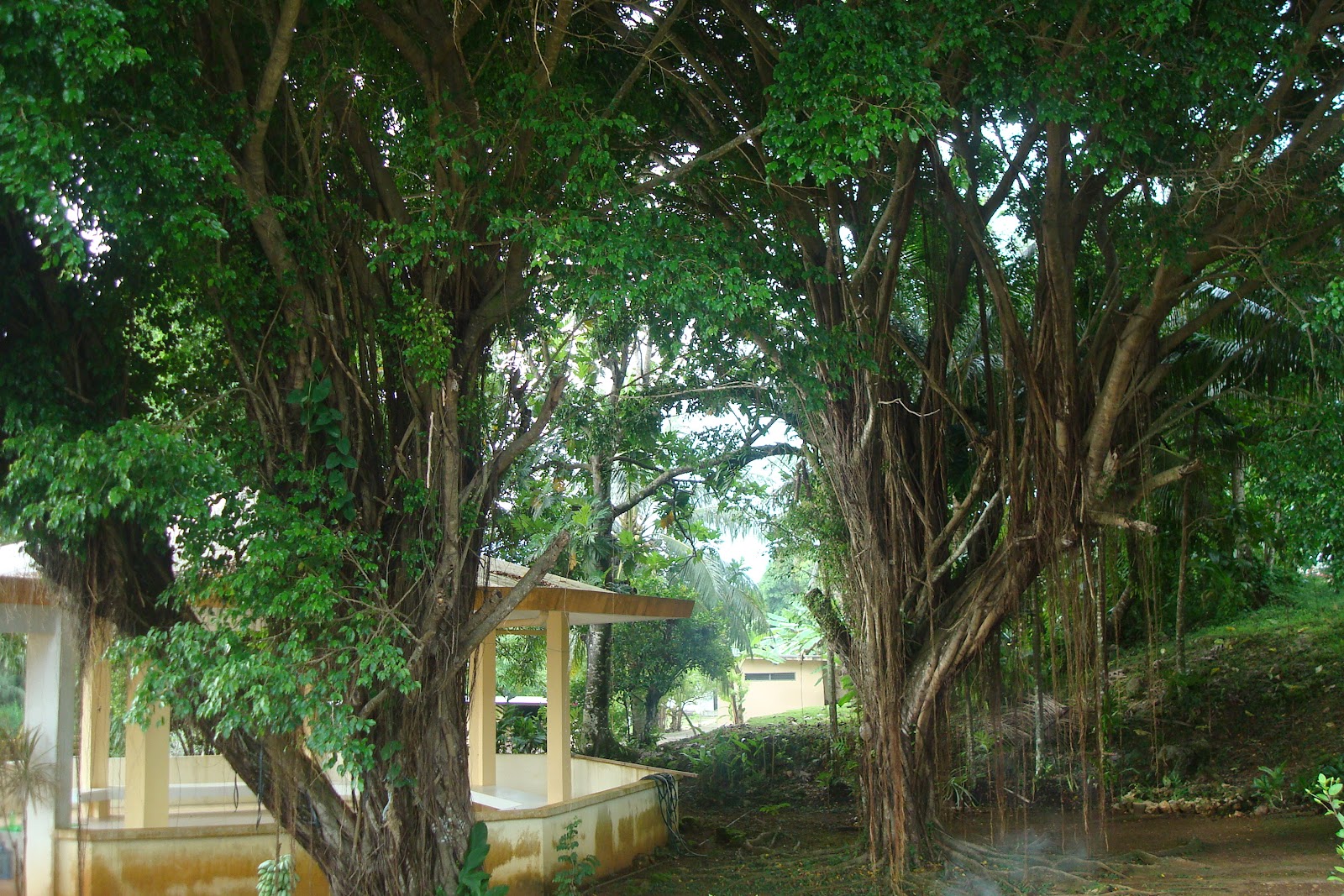
Up in Saipan, I was impressed by these two huge trongkon nunu (banyan trees), feared by many as the sagan taotaomo'na (dwelling of the spirits of the ancients).

I was surprised when I learned from an elderly Chamorro lady that these trongkon nunu were deliberately planted by the family!

I asked the lady, "Pot håfa na ma tånom?"  "Why did they plant them?"

"Sa' pot nuhong."  "For the shade."

And shady it is.  The trees are so tall and their branches so expansive that the grass below can scarcely grow since the sunlight cannot reach the soil.


And do people in the house experience anything?

The lady said, "Guaha na man finattoigue."  "It happens that they are approached."

But - the trees remain!

Saturday, September 1, 2012

FAMILY NICKNAMES : CHILENKO


In the Chamorro dictionaries, there is no word "chilenko." 

I am always suspicious that a nickname, unless obviously derived from other sources, is based on a Spanish word.

There is a lake in southern Argentina called Chelenco.  But that part of the country is so isolated that one wonders what possible connection it could have with the Marianas?

There is a Spanish word cholenco.  It means "a hybrid, a mix of two species, whether animal or vegetable."  Applied to a mixed breed dog, it means "a mongrel."

I wouldn't be surprised if chilenko comes from "i chilenko" from cholenco (hybrid).

Don't forget that our mañaina were very much exposed to and influenced by the Spanish language as we are today by English.

But it's just a guess how this branch of the Arceos got this nickname.