Sunday, January 8, 2012
LUMUT FROM LAMLAM
Lumut (moss) can be found in greater abundance in the limestone north of Guam. But the lumut in this belen above was actually harvested on top of Mount Lamlam! There is some coral rock up there, and lumut to be found.
The belen reminds me of my childhood belen. This one happens to be an outdoor one.
The family lives in Santa Rita. Mount Lamlam is just down the road.
NIÑO PERDIDO
The "Lost" Child Jesus in the Jerusalem Temple
Once again, the Spanish stand out as having a devotion to Jesus, under the mystery of His remaining three days behind in Jerusalem, without Joseph and Mary's knowledge. The devotion is present in other Catholic countries of Europe, but not to the extent it is in Spain.
There is even a town named after the Niño Perdido : Alquerías del Niño Perdido (Valencia).
He is the patron saint of Asan, which celebrated its fiesta last weekend.
Asan Church
Since the devotion is virtually unknown in the States, an American Capuchin, new to Guam, made the following mistake.
He saw the list of Mass intentions he was supposed to read out before Mass. First on the list was "Misan Ånimas," for the departed souls. Next was "Niño Perdido." He had never seen that before and thought it was the name of the Mass donor. Imagine the shock and a few giggles from the older ladies in church when the priest announced "Misan Animas, offered by Niño Perdido."
![]() |
| kulone.com |
Saturday, January 7, 2012
ADIOS PÅTGON YU'US
When we end a nobena to the Niño, it is customary to sing this song bidding farewell to Him. A similar custom exists when ending a nobena to the Blessed Mother, as well.
Lyrics
Adios Påtgon Yu'us yan Sånta Maria,
Rai i man rai siha, adios, adios, adios.
(Farewell, Son of God and Son of Mary,
King of kings, farewell.)
Ennao na ginatbo, pinentan Yu'us
muna' a'abok hit...yan si Jesus.
(That beauty, painted by God
made us friends with Jesus.)
I Lahen Maria, sa' ha guaiya yo'
chume'lo yan guåho...iyon-ña yo'.
(Because He loved me, the Son of Mary
became my brother, I am His.)
Vocabulary Lesson
Rai = King. From the Spanish rey, which in turns comes from the Latin rex.
Ginatbo = beauty. Gåtbo means beautiful. From the Spanish garbo.
Pinenta = painting. From penta, "to paint." From the Spanish pintar, "to paint."
Abok = friend. I posted this term earlier on this blog.
SPANISH ORIGINAL
Thanks to Lawrence Borja for finding this original.
GUPOT TRES REYES
Three Kings, Tres Reyes - the end of the Christmas Season (traditionally) in the Marianas and elsewhere.
As the lady in the video says to the Niño, "Esta otro såkkan ta'lo!" "Till the coming year again!"
Friday, January 6, 2012
TODAY IN HISTORY
![]() |
| flickr.com |
FIRST PUBLIC EXECUTION ON GUAM BY THE JAPANESE
January 6, 1942
January 6, 1942
On Three Kings Day (Tres Reyes), the Japanese publicly executed two Chamorro men. One was caught passing a hidden note to an American internee. Alfred Leon Guerrero Flores was visiting an American colleague from work, who was then confined at the Hagåtña Cathedral, which was used by the Japanese to house the American prisoners arrested after the fall of Guam to the Japanese. Flores was asking the American what to do with dynamite that had been left behind at work.
The second man arrested was Francisco Borja Won Pat, half-Chinese, half-Chamorro, the brother of future U.S. Congressman Antonio Borja Won Pat. Won Pat was an employee of the Pomeroy company and one side of the story is that the company managers told employees they could help themselves to the company inventory since war had broken out. The Japanese, however, considered it theft, perhaps, since they said this to others, it all belonged to Japan now.
The two men were brought to Pigo Cemetery, and a crowd of local people were ordered to attend. After having been blessed by Påle' Oscar Calvo, the two stood blindfolded in front of open graves and were shot by a firing squad of five Japanese soldiers.
Flores' mother screamed, "Adios lahi-ho; si Yu'us ga'chong-mo!" (Farewell, my son; God be your companion.)
TRES REYES
![]() |
| studioporto.com |
The Reyes family of the Marianas are really the de los Reyes family. It literally means "of the kings." In American times, most of them dropped the "de los." A few in Saipan still keep "de los Reyes." The name is in honor of the Three Kings, and many with the Reyes last name throw a feast on January 6.
In times past, this was the feast that ended the Christmas season. Some families end their Christmas nobena today.
The Other Three Kings
![]() |
pimentelguitars.com |
A Mexican singing trio
Thursday, January 5, 2012
MA SUSEDE UN DIA
![]() |
| sanderus.com.pl |
The priest of Hagåtña went in to say morning Mass. He opened drawers - caramba! Someone had stolen the paten. A paten is a metal dish used to hold the large host used by the priest, as seen in the above picture. The priest investigated, but could not discover the identity of the thief.
Two days later, on August 4, Don Ignacio Aguon came to inform the priest that Vicente Charsaga was found hanging from a tree in the district of Muyao. The stolen paten was found in the same place. Perhaps the poor man took his own life because he stole a sacred object. He was buried in the same place he was found dead.
TOP TEN VILLAGES IN 1960
1960 Village Populations
2. TAMUNING (4,232)
3. BARRIGADA (3,727)
4. AGAT (3,001)
5. AGAÑA HEIGHTS (2, 582)
6. DEDEDO (2,400)
7. YOÑA (2,139)
8. MONGMONG-TOTO-MAITE (1, 995)
9. SANTA RITA (1,786)
10. INARAJAN (1, 753)
- About half of Tamuning's population (2,049) were non-Chamorro, including 668 statesiders, 377 Hawaiians, 498 Filipinos, 506 others.
- Umatac, on the other hand, had just one non-Chamorro living there; a Filipino. I wouldn't be surprised if that was Tomasa Sinoben's husband. I used to be pastor of Humåtak.
- Yigo had just 950 residents and was second to the last in population (Umatac was last with 653 villagers). My how things have changed.
- You see why Sinajaña, to this day, has a Vice Mayor, even though it isn't one of the more populated villages today. But at one time it was #1 for many years.
Wednesday, January 4, 2012
ILEK-ÑA SI PÅLE'
Palo gi setmon para i Åño Nuebo
(Sermon excerpts for the New Year)
Ha sångan este na setmon si Påle' Lee gi 1961 na såkkan
(Preached by Father Lee in 1961)
I un åño kalan mohon sen anåkko' na tiempo. Lao yanggen tumalak tatte hao, i un åño kalan mohon un dia ha'. Meggai gi atboroton-miyo gi ma'pos na såkkan, ti man atdet på'go. Si Yu'us nina' fan låla'la' hamyo, mientras palo siha ha ågang na u fanhuyong guine na lina'la'. Palo siha na taotao, ni en sangåne "Felis Åño Nuebo" gi ma'pos na såkkan, man må'pos ha dalalak ayo siha i mangaige gi sementeyo.
Gi halom este na såkkan i para u huyong, buente guaha nai man mamadese hamyo minalångo, nina'mamahlao pat tentasion ni man fehman. Lao resibe este siha komo regålon Yu'us nu hamyo. Man nina' fattuye hamyo as Yu'us para en nina' fangåsgås para en faninayuda manhuyong mañåntos. Ti en tingo' håfa u guaha para hamyo gi halom i sesentai uno na såkkan. Lao una kosa ta tungo' na seguro : si Yu'us ha gofli'e kåda uno giya hamyo. Fañåga hihot as Jesus ya si Jesus u såga hihot giya hamyo. Yanggen gaige si Jesus hihot giya hamyo, håfa mina' para en fanchathinasso?
One year seems like such a long time. But when you look back, one year seems like just a day. Many of your troubles last year, aren't so serious today. God makes you alive, while some He has called out of this life. Some people, whom you greeted with a "Happy New Year" last year, have left to follow those who are in the cemetery.
Within this year which is beginning, perhaps there will be among you those who will suffer sickness, shame or fierce temptation. But receive these as a gift from God. God brings these to you to cleanse you, to help you become holy. You don't know what 1961 will have for you. But one thing we know for certain : that God loves each one of you. Stay close to Jesus and Jesus will stay close to you. If Jesus is close to you, what will make you worry?
SI DOÑAN TERESA
This is an example of the whimsical, nonsense kind of ditty often found in pre-war Guam. The song is interesting because it shows some residual Spanish influence (Doña) as well as more recent American influence (today/tonight). Because of the English added to it, the song could have been made up in the 1920s or 30s.
Don't expect the song to have any meaning whatsoever. It's meant to be light-hearted fun.
Eggplants and salted dried fish a bottle of beer and a half of mixed alcohol. Alapatingting today alapalapatingting tonight Marian Ramon is from Sinajaña Teresan Kapapot is from Hagåtña and Labucho' is the number one dancer.
Doña : A Spanish title of respect for a woman. Don for a man. It is always followed by the personal name, never the last name. Doña Maria, Don Pedro. Some Chamorros made it more Chamorro by adding the final -n : Doñan Teresa.
Sina' nña : Is really Sinajaña, but in the song it is shortened. Sinajaña is not really how we would spell it according to the Chamorro sounds. It would be Sinahånña. But we're used to the way it was spelled by the Spaniards many years ago.
Marian Ramon : A woman named Maria, who has some relation to a man named Ramon, probably the spouse; fewer times a father/daughter connection. We clarify which person we're talking about by connecting them to someone else, like the person's spouse or parent.
Teresan Kapapot : Kapapot would be a nickname given to the woman or her family.
Labucho' : Sometimes some people were known mainly by their nickname. There wasn't even any need to add the personal name; just saying the nickname was good enough.
Meksao : does not appear in the older dictionaries. It might be a recently coined term, coming from the English word "mix."
Don't expect the song to have any meaning whatsoever. It's meant to be light-hearted fun.
Ginen Espåña si Doñan Teresa
Ginen Sina’ nña si Marian Ramon
Ginen Hagåtña as Teresan Kapapot
Ya as Labucho' et primet bailadot.
Lunes måttes kakaguåtes
Biringhenas yan bakalao
Un boteya na setbesa
Ya un media na meksao
Alapatingting today
Alapalapatingting tonight
Ginen Sina’ nña si Marian Ramon
Ginen Hagåtña as Teresan Kapapot
Ya as Labucho' et primet bailadot.
Doña Teresa is from Spain
Marian Ramon is from Sinajaña
Teresan Kapapot is from Hagåtña
and Labucho' is the number one dancer.
Monday, Tuesday, peanuts
Interesting Words
Doña : A Spanish title of respect for a woman. Don for a man. It is always followed by the personal name, never the last name. Doña Maria, Don Pedro. Some Chamorros made it more Chamorro by adding the final -n : Doñan Teresa.
Sina' nña : Is really Sinajaña, but in the song it is shortened. Sinajaña is not really how we would spell it according to the Chamorro sounds. It would be Sinahånña. But we're used to the way it was spelled by the Spaniards many years ago.
Marian Ramon : A woman named Maria, who has some relation to a man named Ramon, probably the spouse; fewer times a father/daughter connection. We clarify which person we're talking about by connecting them to someone else, like the person's spouse or parent.
Teresan Kapapot : Kapapot would be a nickname given to the woman or her family.
Labucho' : Sometimes some people were known mainly by their nickname. There wasn't even any need to add the personal name; just saying the nickname was good enough.
Meksao : does not appear in the older dictionaries. It might be a recently coined term, coming from the English word "mix."
Tuesday, January 3, 2012
"FRIEND" IN CHAMORRO
ABBOK
Believe it or not, our ancestors knew what friendship was long before their descendants borrowed the Spanish word AMIGO, for male friend, and AMIGA, for female friend.
And so they also had an indigenous word for "friend." ABBOK.
People usually ask, "But how is that word SAID?" Here it is :
But, like many Chamorro words, abbok slowly faded away. Much older speakers know the word, and those who are well-acquainted with Chamorro hymns have seen the word. But speakers even 50 years old are often unfamiliar with the word abbok.
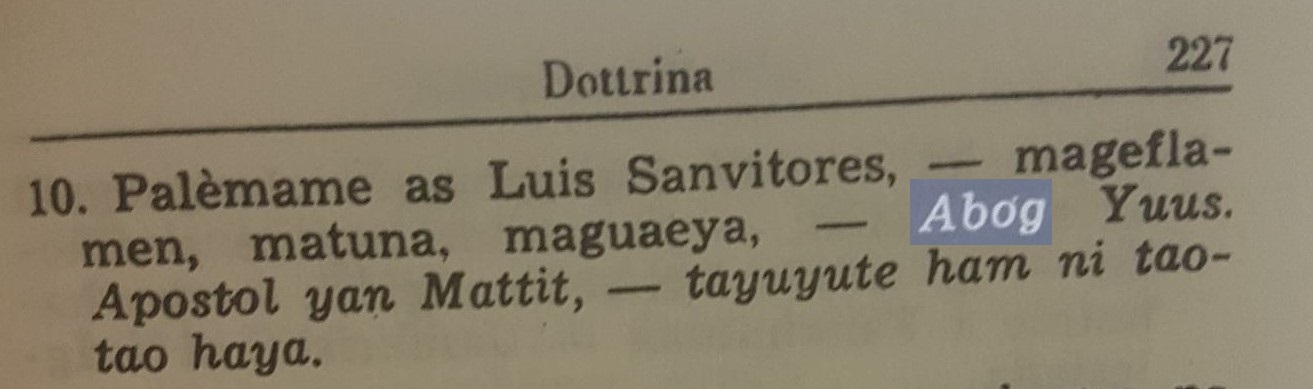
Here are some examples from our Chamorro hymns using the word abbok. In the old days, the word was spelled abog. I will spell it abbok.
MAMES GA'CHONG, MAMES ABBOK. "Sweet Companion, Sweet Friend," speaking about Jesus.
ABBOK YU'US, APOSTOT YAN MÅTTET. "Friend of God, Apostles and Martyr," speaking of Blessed Diego Luís de Sanvitores.
SEN MASÅMAI HAO ABBOK-HO. "You are very beautiful, my friend," speaking of Mary.
I have an aunt, now in her 70s, who says, whenever she wants to say she is close with somebody, "Gof umabbok ham." "We are very good friends."
AMIGO / AMIGA
Our mañaina (elders) borrowed Spanish words, even when we already had Chamorro words for the same thing. Why not? We do the same with English today. People like finding new ways of saying the same thing. We may need only one pair of shoes, but we have two or three pairs. Variety is the spice of life, even in language.
So, for the word "month," we can say Chamorro pulan or we can say Spanish mes. Our mañaina used either word. If you get injured, your injury can either be called dåño (from Spanish daño) or chetnudan (Chamorro).
So our mañaina also borrowed the Spanish word for "friend," even though they already had abbok. Since Spanish nouns have gender, either male or female, a male friend is amigo and a female friend is amiga. And this became the dominant Chamorro word for "friend." Many people prefer to spell it amigu.
CHAMORRO SONGS WITH "AMIGO / AMIGA"
Dozens of Chamorro songs use the words amigo or amiga, even in the song title. Here are just a few :
The Guam Sirenas recorded a song entitled : Mungnga Yo' Ma Fa' Amiga. It means, "Don't make me a friend." This same song can be changed to amigo if a male is singing. It means the singer wants to be more than a friend. He or she wants romance!
Here are some other song titles and their singers :
HA DINGO YO' I AMIGU-HO (My Friend Left Me) by Perry Borja
ADIOS AMIGU-HO (Farewell My Friend) by KC de León Guerrero
AMIGU-HO (My Friend) by Glen Paulino
AMIGU-HO (My Friend) Frank Bokkongo' Pangelinan
And there are more. As for abbok, I could not find a single song with the word abbok in the title. If there is one, please let me know. I am more hopeful the word abbok is used in the lyrics of a song, but at the moment I can think of none.
Many people think GA'CHONG means "friend." Not quite.
The precise meaning of ga'chong is "companion or accompaniment." Something or someone that goes along with, that is present with, that is joined to someone or something else.
Now, many times the people who accompany us (ga'chong) are also our friends (abbok, amigo, amiga). But not always.
That is why ga'chong is applied to non-persons, as well.
The food that goes with your main dish can be called its ga'chong. It accompanies the main dish. The rice or vegetables that go along with your salmon can hardly be called its friend.
Even when applied to people, ga'chong essentially means companion or partner, not friend.
So if you are worried this older woman is living by herself at home, you might ask who her ga'chong is at home, so that someone is there if she has an emergency. Suppose you find out a grandson is living with her, we would hardly call the grandson her "friend." He is her grandson and also companion at home.
If the teacher is dividing the class into pairs to partner up for some exercise or activity, she may pair you up with someone you don't get along with at all. But, like it or not, that person is your ga'chong (partner) for the activity. Not your friend; your partner.
And here's another good illustration of the true meaning of ga'chong. The placenta is a kind of organic wrap that surrounds the baby in the womb. When the baby is born, the placenta is expelled from the mother. There are two words we can use in Chamorro for the placenta. One is påres, which we took from Spanish. And the other is Chamorro : i ga'chong påtgon. The placenta goes along with the baby. This is true inside the womb, and once the baby is born there is no need for the placenta anymore so even that comes out after the baby. The placenta truly is the "companion" or "accompaniment" (ga'chong) of the baby. Even the other word, påres, comes from the Spanish word par which means "pair" or "couple," since the placenta always goes along with the baby, inside and outside the womb.
So here we can see that an organic wrap made of human tissue that supplies nutrients and oxygen to the baby, as well as remove waste, and which does many other things, can hardly be called the baby's "friend" in the ordinary sense of "friend."
BECAUSE YOUR NOBENA HASN'T ENDED YET
I present to you another carol whose lyrics are very much requested by you.
Koro : O Påtgon Belen / in na'e hao dias
sa' hågo si Jesus / yan i Mesias.
(O Child of Bethlehem / we give you greetings
because You are Jesus / and the Messiah.)
I gailanget yan tåno' / dumikkike' gue'
i tehnen i langet / lumadaffe' gue'. Koro...
(He who owns both heaven and earth / makes Himself small
He who is the strength of heaven / makes Himself weaker.)
Måtfit yan flores rosa / i dos fåsu-ña
ma guaiya ma atan / i ataddok-ña. Koro...
(Ivory and roses / are His two cheeks
they love to look / at His eyes.)
Hinilat ginefli'e / nu i taotao-ña
kumasao chumålek / gi fanagon-ña. Koro...
(Overcome with love / of His people
He cries, He laughs / in His shelter.)
Interesting words
Dias : literally means "days," as in Kuåntos dias? How many days? But here it is understood that we give the Child Jesus "Buenas Dias," or "Good Morning" greetings.
Tohne : really means a support or a brace. But here it refers to Christ as the strength of God who supports us.
Daffe' : weak, dull, lifeless
Monday, January 2, 2012
FIRST BABY OF 2012
![]() |
| guampdn.com |
....IS A DESCENDANT OF THE SPANIARD JOSE TUDELA
By a matter of a few seconds, Jenna Carly Tudela became the first baby born on Guam at 12:01 on January 1 this year, beating another baby also born at 12:01.
The Tudelas of the Marianas trace their lineage back to a Spaniard, Jose Tudela, who held various positions in the local government. He married a Chamorro, Francisca Ramirez. At the time of the American capture of Guam in 1898, the bulk of the family moved to Saipan, still under Spanish control. One son stayed on Guam, whose descendants are mainly in Talofofo. Some of the Saipan Tudelas moved to Guam in the last few decades.
FAMILY NICKNAMES : CHAROT
![]() |
| cristaldance.com |
Charol. See how shiny it is?
One branch of the Taitano clan is called Charot.
Charol is a Spanish word with several meanings. It can be either lacquer/varnish, patent leather or, in some Spanish-speaking countries, a tray. The root meaning is something that is permanently shiny or varnished. In that sense, a patent leather shoe is a zapato de charol in Spanish.
Family lore says that an ancestor of this branch of Taitanos was given a gift of shoes, zapatos de charol. Chamorros could not pronounce final L, so it became charot.
Sunday, January 1, 2012
TODAY'S CHAMORRO WORD : TUTUHON
![]() |
| spicyipindia.blogspot.com |
As we BEGIN the New Year
TUTUHON : to begin, to start
Tutuhon! Begin!
Ta tutuhon. Let's start.
Ha tutuhon kumåti. S/he started to cry.
Annai hu tutuhon bumisita Guam. When I began to visit Guam.
Ngaian ma tutuhon? When did it begin?
A ke ora para ma tutuhon? What time will it begin?
Para ma tutuhon gi oran a las dos. It will begin at two o'clock.
Ma tutuhon på'go i nuebo na såkkan. Today begins the new year.
Tinituhon. Beginning.
Desde i tinituhon i tåno'. Since the beginning of the world.
Taitutuhon. Without beginning.
Si Yu'us taitutuhon yan taihinekkok. God is without beginning and without end.
Subscribe to:
Posts (Atom)