Monday, June 27, 2016

PADRE PALOMO'S CHAMORRO CATECHISM


A catechism is a summary of church teaching, traditionally in question-and-answer format.

Blessed Diego Luís de Sanvitores taught the catechism to Chamorros in the Chamorro language, setting it to music, as our people loved to sing.

Sadly, we don't have many copies of the Chamorro writings used by the missionaries 300 years ago. But we do have a catechism in Chamorro composed by the first Chamorro priest, Padre José Palomo (Påle' Engko') written 100 or more years ago.

Palomo was born in 1836 and his parents were born around the beginning of that century, and his grandparents were born in the last decades of the 1700s. When Palomo was a teen, he would have known people born in the 1750s and would have heard the Chamorro that they spoke. So when you see Palomo's Chamorro writing, we most likely have a glimpse into the language that goes back to the mid 1700s, very close to the pre-contact language. One will see very clearly that the Chamorro spoken by Palomo was deep in the indigenous tongue, though Spanish loan words are present. Palomo's catechism uses Chamorro words that today have fell into disuse and he uses words in now-forgotten forms.

When Palomo set out to write a Chamorro catechism, he did the time-efficient thing and decided to translate a Spanish catechism into Chamorro, rather than compose one from scratch. Why reinvent the wheel!

¿ASTETE? O RIPALDA?

In Palomo's day, there were only two widespread Spanish catechisms, known by the last names of the authors : Astete and Ripalda. It was said that these two catechisms were the only truly known and used catechisms in Spain for many years that when two Spaniards met up for the first time, they would ask each other, "Astete? Or Ripalda?"

Palomo chose Astete's catechism. You can see Astete's name on the title page of the Palomo catechism at the top of this post.


A Spanish edition of Astete's catechism


EXAMPLES OF THE CHAMORRO USED IN PALOMO'S CATECHISM


Monhan. An old word, not even appearing in the latest Chamorro dictionary (2009). It is connected to the still-used word monhåyan. They both mean "completed" or "finished."

Yuhe. "That." Today we mostly say "ayo," which was also used in the past. Uhe is another form of yuhe.

Hulon. "Superior, chief, top, supreme." From the root word hulo' (top, above). Can also mean "judge." I am of the opinion that the last name Taijeron comes from the words tai (without) and hulon (superior) because the Spaniards often used an R in place of our L in words. The tai changes the hulon to hilon, just as the tai changes guma' to gima' (taigima' = homeless).

Ini. "This." Ini was gradually lost and replaced by the Spanish word este.

Ereda. "To inherit." From the Spanish word heredar, "to inherit." Ma ereda yo' ayo na tåno'. I inherited that land. Erensia (also from Spanish) means "inheritance," but inereda can also mean "inheritance."

Atochocho. "To force, coerce." Ma atochocho yo' humalom. I was forced to go in.

Chihet. "To join, adhere, get close to, unite with." Na' chihet hao as Yu'us. Get close to God.

Kaikai. "To move." Ti ha kakaikai yo'. It doesn't move me.

Iseknåne. "To judge wrongly, to damage someone by judging wrongly." Cha'-mo mamaiseknånåne ni håye. Do not judge anyone wrongly.

Kahna. "To cast spells, witchery." From the pre-contact makahna who were intermediaries with the spirits.

Guailaye. "Useful, necessary, helpful." Diddide' guailaye-ña. It has little usefulness. What remains today is the expression "Ti guailaye," or "It isn't necessary."

Pekka'. "Position, charge, responsibility, duty." I man gai pekka'. Those in charge.

Pennga. "Habit, custom, tradition."  Båba penngå-ña. He has bad habits. This was gradually replaced by the Spanish word kostumbre.

Chengle. "Detain, capture, imprison, enslave." Ma chengle yo' annai måkpo' i gera. I was detained after the war.

Mansangan. "It is said." From ma+såsångan.

Tuka'. "To poke, as with a thorn." The word "thorn" or tituka' comes from this. Tuka' can also mean "to incite, to spur to action, to begin something" as when one is poked from idleness and starts to move.

Fa'hiyunge. "To calumniate, to accuse someone falsely." Cha'-mo mamahiyunge. Don't accuse someone falsely.

Muto'. "To resolve, to obligate oneself." Minito' is "resolution, determination." Muto' yo'. I am resolved.

Alle'. "To make a mistake, commit error." Inalle' is "defect, sin, fault, mistake."

Guot. "To maintain, hold on to." Ha guot i kanai-ho. He held onto my hand.

Guahåye. "To provide." From guåha (to have, to exist) and the suffix -e (for someone).  Bai na' guahåye hao karetå-mo agupa'. I will provide you with a car tomorrow.

Eppok. "To excite, stimulate, persuade." Ha eppok yo' humånao. He persuaded me to go.

Diles. "To excel, to surpass." Cha'-mo didiles i lai. Do not go beyond the law. Mandiles hao. You shined.

Famaiche'cho'. "Force, effort." Na' famaiche'cho' i ilu-mo umestudia! Force your head to study!

Måsga. "To change for the better, to repent." Ha tutuhon mumåsga. He has started to change for the better. It is a surname in Luta.

Fa'aila'. "To accuse, to report a wrong-doing." Esta ma fa'aila' i sakke. The thief has already been reported.

Seko. "To punch, to beat with the fist." Gi Misa hu seko i haof-ho. I beat my chest at Mass.

Fegge'. "Impression, image or imprint left behind." Guåha feggen måtan taotao gi liga. There is an imprint of a man's face on the wall."

Ingen. "To detest, to abhor, to reject." Hu gof ingen i dinage. I really detest lies.


Friday, June 24, 2016

UNAI CHULU


People lived on this beach perhaps 3500 years ago!

Despite the fact that this beach was the scene of a large American invasion in 1944, greatly disturbing the physical environment, archaeologists were able to dig and search and find evidence of human settlement going as far back as 3500 years.

Unai Chulu is a beach in the northwest corner of Tinian.


The signs of human habitation at this beach, going so far back in time, show that our ancestors lived almost anywhere along the coast where dwellings could be built, even if the beach was a small one and the reef close to shore.

Tinian is a rather flat island. This beach area would have been more exposed to the elements as there are no caves and no high cliffs in this area. The people may have have depended more heavily on the sea for food than in other places in the Marianas where land resources would have been more plentiful.

Chulu is not far from a fresh water lake, which is more like marsh land, called Hagoi, which is the Chamorro word for "lake." But the water, at least now, is brackish, though ancient people could have probably strained or boiled it for drinking purposes. Otherwise, people would have collected rain water as a main source of drinking water.


This pottery sherd was found at the House of Taga, south of Chulu. But a unique and more decorated one was found at Chulu.

A unique find at Chulu was a pottery sherd which was decorated on both sides, including the inner part of the bowl or pot. On both inside and outside walls of the pot, a line of impressed circles filled with lime (åfok) can be seen. These decorated sherds are from the earliest period of human settlement in the Marianas.

Cow bones buried in the soil at Chulu point to the cattle ranches that the Spanish government maintained at Tinian in the 1800s for the benefit of Guam.


This map of the US invasion of Tinian in 1944 shows just how vulnerable Chulu Beach was at that time (White Beach 2).

As the US military always has its eye on northern Tinian for military exercises to this day, let's hope our ancestral cultural treasures do not suffer destruction any more!

Thursday, June 23, 2016

HU GOFLI'E HAO JESUS-HO


1. Hu gofli'e hao Jesus-ho, ya hu na' matuna hao :
(I love you, my Jesus, and I make you praised :)

Chorus : O Korason Jesukristo, magof hu adora hao!
(O Heart of Jesus Christ, happily I adore you!)

2. I sendålo as Longinos guiya bumabaye hit
(The soldier Longinus was he who opened for us)

ni korason Jesukristo i mina' fan såfo' hit;
(the heart of Jesus Christ who saved us;)

Lao Jesus guåho man ige' sa' hu kekelånsa hao.
(But Jesus I have surpassed him because I have pierced you.)

2. Ya ma baba sen ma baba, a'annok i korason
(And it was opened wide, the heart is visible)

gi kalaguak Jesukristo, kalan guåfe hahanon.
(in the side of Jesus Christ, a burning fire.)

Tåya' tailaye na guåho ni i ti gumuaiya hao.
(There is no sinner but me who does not love you.)


NOTE

Longinos. In tradition, this was the name (Longinus in Latin) of the Roman centurion who pierced the side of Jesus with his lance. Tradition identifies him as the same centurion in Matthew 27:54 who came to believe that Jesus was truly the Son of God. Later he was baptized and left the military. He was later martyred for the faith and is considered a saint.


Saint Longinus

Wednesday, June 22, 2016

FAMILY NICKNAMES : SAM


I ran into former Senator Benigno Manibusan Palomo and I asked him, "How did you get the nickname 'Sam?'"

He answered that it wasn't just his nickname but that of his branch of the Palomos.

He said his great-grandfather had a long white beard that reminded people of Uncle Sam's long white beard. So, he got stuck with the nickname "Sam" and it was passed on to his children and grandchildren.

Benigno's great-grandfather Palomo was Pedro de León Palomo, born around 1835.

The familiar, bearded figure of Uncle Sam that we know today didn't become prominent until the 1870s when newspaper cartoonist Thomas Nast made his depiction popular. In the 1870s, Pedro de León Palomo would have been in his late 30s, early 40s. But how would Chamorros be aware of Uncle Sam way over in the US, when Guam was under Spain?


THOMAS NAST'S "UNCLE SAM" IN 1877


The answer is easy. The American whalers who came to Guam every year, especially in the early months of the year. These whalers were the beginning of Guam's Americanization, even introducing English curse words long before the US took over Guam in 1898.

It's entirely possible that American newspapers and magazines (months old by then) were brought on island by whalers who didn't need them anymore. Some how or other, if the story be true, some Chamorros had seen pictures of Uncle Sam in the 1870s and 1880s when Uncle Sam became a popular figure in the US.

Pedro's son Ignacio Dueñas Palomo is mentioned in court documents in the early 1900s as "Ignacio'n Sam." So there we have historic evidence that the family nickname was indeed Sam, and it was a nickname before the Americans took over Guam. Ignacio'n Sam was Benigno's grandfather. He was born in 1862 or so. 


IGNACIO DUEÑAS PALOMO'S SIGNATURE IN 1912
Better known as Ignacio'n Sam


Tuesday, June 21, 2016

COMMISSIONERS IN 1960


In 1960, we had Commissioners, not Mayors.

It was just 16 years after the war and Guam just had 67,000 people in 19 municipalities or villages. Agaña was considered a city and New Agat as well. But that's another story.

Needless to say, everyone knew everyone and village Commissioners, as is still the case in many smaller villages today, were personally known to the majority of village residents.

In those days, your Commissioner wasn't Jesus S. Camacho; he was Chubado' (some say Chibado'). Not Joaquin SN Diego but rather si Gådao.

Here are the winners of the 1960 municipal elections :


The Two Biggies

The two largest villages at the time were Sinajaña and Barrigada. This is reflected in the fact that these two villages had an Assistant Commissioner, which they hold to this day (even though Sinajaña for the longest time now is nowhere near the most populated village on island).

Sinajaña : Luis Camacho Baza

Baza did not have a long term; from 1956-1964. Sinajaña Commissioners tended to have short terms in those days.

Barrigada : Jesus Sablan Camacho (Chubado')

Chibado', on the other hand, was Commissioner for twenty years (1948-1968). In those days, if you were a popular Commissioner, you tended to keep your job for as long as you were interested in running.


Luis Camacho Baza
Sinajaña


Jesus Sablan Camacho (Chubado')
Barrigada


Other long-term Commissioners re-elected in 1960 :

Inarajan : Joaquin SN Diego (Gådao) served from 1944 until 1972

Agaña Heights : Juan L. Pangelinan (Kotla) served from 1956 until 1968

Hagåtña : Juan D. Perez served from 1952 until 1962

Asan : Joaquin S. Santos served from 1956 until 1972

Piti : Vicente A. Limtiaco served from 1956 until 1972

Santa Rita : Joaquin D. Perez served from 1952 until 1968

Yoña : Jose B. Sudo served from 1952 until 1972

Mangilao : Jesus T. Pereira served from 1952 until 1968

Dededo : Vicente SA Benavente served from 1952 until 1976

Merizo : Francisco C. Chargualaf served from 1952 until 1976


Short-term Commissioners :

Tamuning : Higinio San Nicolas served from 1956 until 1964

Chalan Pago/Ordot : Francisco LG Valenzuela served from 1956 until 1964

Agat : Juan LG Leon Guerrero served from 1956 until 1962

Yigo : Jose D. Perez served from 1956 until 1964


Finally, there were three Commissioners elected for the first time in 1960 :

Mongmong/Toto/Maite : Jose C. Farfan, who served from 1960 until 1972

Umatac : Jesus S. Quinata, who served from 1960 until 1968

Talofofo : Juan C. Tenorio, who served from 1960 until 1968


And now the Assistant Commissioners :

Sinajaña : Jacinto B. Calvo

Barrigada : Jose F. Mendiola

Tamuning : Gregorio A. Calvo

Only these three villages had an Assistant Commissioner in 1960 as these were the three most populated villages at the time.

Monday, June 20, 2016

SAINAN-M­ÅME DIOS


The Our Father in Chamorro
according to Sanvitores in 1668


On this Father's Day, someone asked me, "Is tåta a true Chamorro word?"

The inquirer points out that tata is used by many Hispanics clear across the Pacific Ocean in Central and South America.

Among our own Austronesian cousins, who share many words, grammar and other features with us, the word tata is rarely the word for "father." Far more common is ama and tatay. In some Austronesian languages, tatay is the informal way of addressing a father while ama is the formal title for a father.

Given the wide variety of Austronesian words for "father," including ama, sama, tama, baba and dozens of other forms, including the occasional tata, it could be that Chamorro is one of those rare Austronesian languages where tåta is the indigenous word for "father." That Tagalog speakers and other Filipinos use tatay, sometimes as the informal word and sometimes as the actual word for "father," makes one suspect that tata and tatay are two forms of the same word. And, yes, even tata is used by some Filipinos as an informal form of "father."

In Latin America, where tata is often an informal way of addressing a father, people do not speak Austronesian languages. Yet, it shouldn't surprise us that tata is said there, and for two reasons. Firstly, tata is also used by other languages all around the world, besides Austronesia and Latin America. Tata is the informal word for "father" in different languages and dialects in Europe and in Africa, for example.

Secondly, a large number of words for "father" in the different languages across the globe are variations of the a-a form. Dada, baba, papa and tata all follow this.

So it seems that our ancestors could very well have used the word tåta for "father," just as we find it in many languages in every corner of the world.


THE FIRST VERSION OF THE "OUR FATHER"

But then I remembered this. Just to add to the mystery.

When Sanvitores came to Guam in 1668, he obviously needed to teach the people Catholic prayers in their own language. Therefore, as early as 1668, there should have been a Chamorro version of the Our Father, in the Chamorro spoken back then, which would have been free of foreign words except for a few words where the native language may have lacked them. But "father" should not be one of these words, since every one has a father! So....how did Sanvitores translate "Our Father" into Chamorro in 1668? That should clear up, without a doubt, what the certain Chamorro word for "father" is.


OUR SUPERIOR WHO ART IN HEAVEN

I'm afraid Sanvitores' rendering of "Our Father" provokes more questions than provides answers.

As you can see from the picture at the top of this post, Sanvitores' opening words of the "Our Father" are :

SAYNA MAMING DIOS

That should mean "Our Father." Instead it means "Our superior God."

Two words are easily recognizable; the Chamorro Sayna, spelled today as saina. And the Spanish Dios, meaning "God."

Saina can be applied to many people. The fundamental meaning of saina is "superior," someone higher in status than you. It has nothing to do with age. On occasion, a nephew will actually be older in age than his uncle. Still, the 15-year-old uncle is saina to his 16-year-old nephew. "Uncle" trumps age when it comes to status.

A 40-year-old priest will be called saina by an 80-year-old woman. Priesthood trumps age (in traditional Chamorro culture) when it comes to status.

The word maming is måme (ours, exclusive) if you think about it. Why then did Sanvitores add the ng? Probably because he learned his rudimentary Chamorro from a shipwrecked Filipino who lived on Guam for seventeen years before he was picked up by a passing Spanish ship and taken back to the Philippines. It is possible that this Filipino retained traits of his native Filipino language and mixed it with his newly acquired (and possibly rough) Chamorro. Sanvitores wrote this version of the Our Father in Chamorro before he even landed on Guam, Sanvitores himself wrote that he had to make corrections in these early writings in Chamorro.


NO "TÅTA?"

So the question is, "Why didn't Sanvitores use tåta when translating 'our father?'"

Even if his Filipino tutor spoke "broken Chamorro," surely the Chamorro word for "father" would be so commonly spoken in ordinary conversation that the Filipino couldn't get that one wrong!

So now we can speculate that perhaps our ancestors did not say tåta for "father," otherwise, why didn't Sanvitores use it?

Check out this other little piece of evidence :


When Sanvitores wanted to translate into Chamorro "Holy Mary, mother of God," he wrote the above words. Most of the words are easily recognizable as the following :

Santa Maria, saina palao'an ni Jesucristong Dios

Holy Mary, woman superior of Jesus Christ God

Once again, some traits more Filipino than Chamorro (at least modern Chamorro) are seen. We don't say ni to mean "of," at least, not any more. But this is exactly what is said in Filipino. And we see once again the -ng ending (in Jesucristo) which isn't done in Chamorro (at least anymore) but which is done in Filipino.

But the main thing to notice here is that Sanvitores translates "mother" as saina palao'an.

This would suggest that "father" is saina låhe, a term which is found, in fact, in the rest of Sanvitores' writing.

So, one theory could be that our ancestors did not say tåta and nåna, but rather saina låhe and saina palao'an. Tåta and nåna could have come into the language later, maybe from Filipino influence (tatay and nanay) or Latin American influence.


YES "TÅTA," BUT NOT FOR PRAYER

But here's another theory.

Perhaps our ancestors did say tåta and nåna. Then why didn't Sanvitores use those terms in his Chamorro writing?

It's possible that tåta and nåna were considered too informal, like "daddy" and "mommy." Among Tagalog speakers, one constantly hears tatay and nanay in ordinary speech. But when Filipino people pray the Our Father, they switch to the formal word ama for "father."

Perhaps this is also what happened when Sanvitores wrote his version of the Our Father and his other religious writings. In time, perhaps, the missionaries and people switched to using tåta in prayer when the religion was securely established in our islands.

Tåta is found in Chamorro word lists going back to the early 1800s and for centuries now we've been saying Tåtan-måme, and not Sainan-måme, when we say "Our Father."

Until we find more Chamorro writing of the time, which is a remote possibility, we can't be certain at all about these questions for the time being.


Friday, June 17, 2016

FÅKKAI, AGAIN


Some time ago I explained how the word fåkkai means "to distribute, pass out, disseminate, divide."

It was not a curse word. Later on it did become a fighting word, as in "I will do you harm" if someone told you, "Bai fåkkai hao!" I reasoned that perhaps the idea came from the original meaning "to divide, break apart." "I will tear you to pieces," comes to mind.

Under American influence, fåkkai received even more negative connotation because of the closeness of sound to an English curse word.

Many people, to this day, are convinced that fåkkai is and can only be a bad word, since the original meaning has been lost to these modern speakers of the language.

However, the literary evidence proves that fåkkai is far from a bad word. It was used in Catholic prayer books and now I have come across it in a Chamorro Catholic catechism.

The title on the page seen above uses the word fåkkai, spelled fakai.

If we remember that one has to divide what one will be distributing, we can see how "Mafakai i Doctrina" means "The Division of the Doctrine," meaning "the Catechism." In other words, the book has to be broken down into parts.


Finakai (I would spell it finakkai) is the noun form of fåkkai. This would make the verb "to divide" the noun "division."

Finenana na finakai means "the first division," meaning the first section, the first part.

Still, there are many people who for years have only understood the word fåkkai to be a bad word that no amount of historical evidence will ever change their minds about it!

Thursday, June 16, 2016

SÅTBE FANLIHENGAN-MÅME


1. Såtbe fanlihengan-måme, gefsaga yan guaiyayon
(Hail, our shelter, comfortable and lovable)

Bendise ham, Sainan-måme;
bendise ham, bendise ham, bendise ham, Sainan-måme, yo'ase' na Korason!
(Bless us, our Lord, merciful Heart!)

2. Såtbe inangokkon-måme gi mahatot na pasion
(Hail, our hope in the bitter passion)

3. Såtbe i binaban-måme i sume'se' hao halom
(Hail, our opening which pierced you through)

4. Iyo-mo i anten-måme yan todo i korason
(Yours are our souls and all our hearts)


NOTES

To understand this hymn, one must have some understanding of Catholic piety.

The heart of Jesus is seen as the locus of His love for us; divine, human, total and perfect love which sacrifices itself for our salvation.

In that heart we find all safety, protection, comfort (verse 1).

Because that heart was pierced by a soldier's lance, it is open (verse 3). Open so that all its loving and saving contents can spill out over us; open so that we enter in and find shelter there.

Thus the hymn speaks of the Heart of Jesus as our shelter (fanlihengan). It is a place of spiritual comfort (gefsaga). The Heart of Jesus suffered yet was not destroyed, so we too can go through life's sufferings with Jesus and emerge victorious. Thus His Heart is our hope in times of bitter passion (verse 2).

In response, we give back to Jesus our own souls and hearts (verse 4).


Wednesday, June 15, 2016

NENEN-MÅME


This picture of granddaughter Lauren helping her grandpa Antonio Manalisay with his shoes reminded me of a remark I heard once from a daughter of an elderly woman.

I was visiting a family but had never met some relatives who were also gathered there.

I started conversing with them and was learning their names when it finally came to the elderly woman, sitting in a wheel chair, visibly unable to communicate.

The daughter, in her 50s, told me her name then said, putting her arms around her mother, "Guiya på'go nenen-måme." "She is now our baby."

Her remark summarized everything I know about how our people traditionally treat our elders, specifically those elders who are now dependent on the care of family.

I say "traditionally" because care for the elderly has weakened over the past few decades. Part of that is because the traditional family model of having as many children as God gives a couple has also weakened. Huge numbers of couples practice artificial means of birth control. The days of having numerous children are over, for the most part. Couples put the blame on modern economics. But a consequence of smaller families is the dearth of hands to care for each other. Of the three children, in many cases, two live in the mainland. So it falls to one child to care for an elderly parent. In many families, there is no means to place grandma in the one senior care home we have on Guam, and no means to hire care givers who can come to the home.

Traditionally, though, families were large and extended. Even when there were no children due to sterility, the extended family came to the rescue. Sometimes a care giver was not even related by blood. It could be the godchild who came to care for the godparent.

"Our baby" may sound mildly insulting to some, as if it demeans the dignity of the aged adult. The lady who made that remark meant that she gives her aged mother all the care and attention she would give to a newborn, and with all the same pleasure and joy you see a mother give an infant when changing diapers. How often I wished I could hold my nose when a mother was changing diapers! And yet there was mom smiling and cooing with the baby, despite the sights and smells! I could tell from the tone of voice when the lady told me that her mother was now "their baby." Many older people get the physical care they need from others, but not always with the same feeling of joy and pleasure given to babies in need of care.

But the traditional Chamorro feeling towards the incapacitated elderly was just that. He or she is a baby who is loved, cherished and pampered.

"Annai eståba yo' nenen-ñiha, ma gof asiste yo' kon kariño."
("When I was their baby, they attended to me well with affection.")

"På'go, siha nenen-måme ya bai cho'gue ha' taiguennao."
("Now, they are our babies and I will do likewise.")

Chamorro Psychology 101


Tuesday, June 14, 2016

I MINAIPEN I FINO'-MO


1. Preparao yo' para i che'cho'-ho
(I was ready for my work)

un minakkat na sinisede
(a heavy incident happened)

i minaipen i fino'-mo nene
(the heat of your words baby)

esta ha gacha' yo' mågi.
(has already reached me here.)

2. Gi durånten annai macho'cho' yo'
(While I was working)

hu hungok i dilingding telefon
(I heard the ringing of the telephone)

annai hu håtsa ya hu ekkungok
(when I picked it up and listened)

ai sa' hu hungok i bos-mo!
(oh, I heard your voice!)

3. Ola mohon ya hu tungo' nene
(If only I knew baby)

håye para un minantiene
(who will hold you)

håye mohon un kinenne'
(who perhaps will take you)

ai ya guåho mohon nene.
(oh if only it were me baby.)


Monday, June 13, 2016

TA HASSO NÅYA - 1

People mean well, and using Chamorro more and more in public signs and in print is good. But there are some examples where perhaps we need to double-check our Chamorro grammar and/or usage. In the interest of improving our Chamorro usage, I'd like to offer, from time to time, instances where perhaps we can hasso nåya (think for a while) whether the Chamorro rendition is the best, or not.


Odd-Size Baggage. Nones Mineddong Maleta


We see this sign in the baggage claim area of our Guam airport.

The question is over the use of the word nones. It is pronounced no - nes.

Nones is borrowed from the Spanish word non (singular) or nones (plural). They mean "odd number or odd numbers."

1, 3, 5, 7 and 9 are números nones (odd numbers).

2, 4, 6, 8 and 10 are números pares (even numbers).

Someone at the airport wanted to say "odd-size" in Chamorro and either knew the word nones, or looked up the word "odd" in a Chamorro dictionary or asked someone how to say "odd" in Chamorro.

The trouble is that nones does not refer to anything and everything odd. It refers only to odd numbers.

In English, we can use the one word "odd" and mean different things. "Odd" can mean something strange, unusual, exceptional, rare, irregular, non-standard, abnormal, incidental...and so on!

But "odd numbers" are none of those things. Odd numbers are simply numbers that are not divisible by two.

When it comes to "odd-size luggage," it simply means luggage that goes beyond normal sizes.

So nones (odd numbers) would not be the word to use to describe over-sized luggage.

In fact, nones mineddong means "odd number size." Maybe a 33-inch long suitcase belongs here.


ALTERNATIVES

There are a number of ways we can express in Chamorro the idea of baggage that is bigger than the usual sizes.

La Dangkulo na Maleta - Bigger Baggage

Pinat Dangkulo na Maleta - Overly Large Baggage

Dispareho na Maleta - dispareho can mean "different, dissimilar, unequal"

Diferensiao na Maleta - similar to dispareho

Sasahnge na Maleta - sasahnge can mean "apart, isolated" but it can also mean "different or unusual," as in "not standard."

There are certainly more ways to express this, but one thing is clear. Nones refers to odd numbers, but not to anything and everything odd.

Friday, June 10, 2016

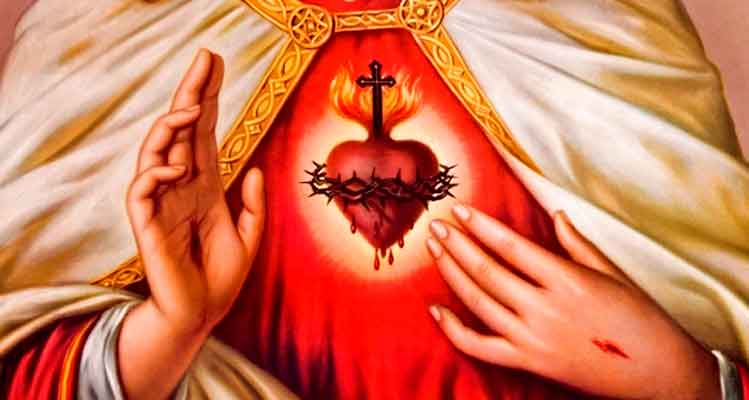
O KORASON MA GUAIYA


This Chamorro hymn to the Sacred Heart of Jesus is not so well-known, at least in Guam. I heard it sung in Saipan, though, and even there not so much.


O KORASON MA GUAIYA


O Korason ma guaiya, man dimo gi me'nå-mo;
(O beloved Heart, we kneel before You;)
in ya'ho hao Rai-måme, gi langet yan i tano'. (1)
(we call You our King, in heaven and earth.)
Asaina na iyo-mo, i saina yan i patgon;
(Lord, Yours is the parent and child;)
i guaha yan i taya', todos siha i taotao. (2)
(rich and poor, all the people.)

Hamyo i man gai pinite, fan mamaila' giya guåho;
(You who have sorrow, come to me;)
Esta guine Jesus-måme, ya man magof ham nu hågo.
(Where are here now, our Jesus, and are happy in you.)
Hamyo lokkue' famagu'on, fan la hihot guine sahyao;
(You children also, come closer here quickly;)
konne' ham, u ta fan hita, gi yini'usan na raino.
(Take us, we will be together, in the divine kingdom.)

"Guåho i maolek na Pastot, ya hamo man pineksai-ho." (3)
("I am the Good Shepherd, and you are my flock.")
Yu'us, Pastot yan Rai-måme, na' fañocho ham ni na'-mo.
(Our God, Shepherd and King, feed us with your food.)
Bo'bo' hånom i ha'of-mo, sen mames nu i man må'ho. (4)
(Your heart if a font of water, most sweet to the thirsty.)
Må'ho yo' guennao na gimen, låla'la' na matan hånom.
(I thirst for that drink, the spring of living water.)


NOTES

(1) Yå'ho : some people might interpret this to mean "to wake someone up," and it can be translated that way, but it means "to call" or "to call out," and in that way one can call out to someone to wake them up.

(2) The song refers to the rich as "those having" (i guaha) and the poor as "those lacking" (i taya').

(3) Jesus is the Shepherd, and His flock of sheep are the ones He raises, shelters, protects, provides for. Poksai means "to raise."

(4) Hå'of literally means "chest" but here it stands for the Heart, which is within the chest.


This hymn is based on the Spanish hymn O Corazón Sagrado (O Sacred Heart).


Wednesday, June 8, 2016

PURO HA' TAGÅLO


In the Philippines, there are Tagalogs, Ilocanos, Visayans, Bicolanos, Ilonggos, Kapampangans, Pangasinenses and many, many others.

Not on Guam. Or the Marianas.

Here, they are all Tagålos.

Not even Tagalog. Tagålo.

Not even Filipino. Tagålo.

For some reason, our Chamorro grandparents just put all the different Filipinos together and called them Tagålo. If they were speaking about Filipina women, it was Tagåla.

The members of the Aklan Association of Guam? Puro ha' Tagålo.

Guam Visayas & Mindanao Association? Puro ha' Tagålo.

Federation of Pangasinanses on Guam? Again, puro ha' Tagålo.

In fact, an Ilocano and a Visayan were fighting and a Chamorro stepped in and stopped the fight saying, "Why are you two fighting when you're both Tagålo?"

What's interesting is that the first Filipinos to live on Guam were mainly Kapampangans, from the Province of Pampanga. The people of Pampanga are distinct from the Tagalogs and have their own language. These Kapampangan soldiers married Chamorro wives and help make us who we are today as modern-day Chamorros. Families such as the Pangelinans, Manibusans, Crisostomos and Lizamas can all trace their Guam origins to a Filipino soldier of the Pampanga regiment.

Not Tagålo!

In time, Filipinos who were truly Tagålo (Tagalog) did come to the Marianas and marry Chamorro women, as did other Filipinos who were Ilocano and Visayan and so forth.

But, for our mañaina, they were all Tagålo.

Our elders seem to have done that with our island neighbors to the south, as well.

To them, all those islanders were gupallau.....people from Palau.

Chuukese, Yapese, Ulithians, Satawalese.....it didn't matter.

They were all gupallau....from Palau.

But that is another story.

Saturday, June 4, 2016

ASAINA BABAYE


Asaina babaye i guinaiya-mo / nu i yiniusan na kalaguak-mo.
(Lord open up your love / from your divine side.)

Guaiya yo' Jesus-ho ni tentago'-mo / ya u ta chasaga gi sanhalom-mo.
(Love me, Jesus, your servant / and let us stay together within you.)

På'go ha' ha sodda' i atadok-ho / ennao i minames na fanatok-ho.
(Only now have my eyes found / there the sweetness of my hiding place.)

Taichii gi tano' i chinatsaga / taihinekkok guennao i ginefsaga.
(Limitless on earth are troubles / endless over there is comfort.)

Ti siña yo' ñålang, ti siña yo' må'ho / sa' si Jesukristo gimen yan na'-ho.
(I cannot hunger, I cannot thirst / because Jesus Christ is my drink and food.)

Gi huisio-mo Saina håye u tacho / yagin un mahettok kalan i acho'.
(In your judgment Lord who can stand / if you become hard like rock.)

U ta hita guine sa' hamlango yo' / gaiase' nu guåho ya na' homlo' yo'.
(Let us be together here because I am sickly / have mercy on me and heal me.)


NOTES

Kalaguak. The word means either side of the upper torso below the collar bone, the left or right sides of the rib cage. When Jesus hung on the cross, a soldier named Longinus thrust a spear between the bones of the rib cage to see if Jesus were still alive. The spear pierced the heart of Jesus and out came blood and water. Jesus was already dead. This piercing of the side (of the heart) is symbolic. It shows how Jesus gave His entire self to mankind to the very last drop of blood and water from his heart. The Heart of Jesus is like an infinite storehouse of love for mankind. Because It was pierced open and can now be accessed, It becomes like a hiding place or a place of refuge for sinners. These idea run through the entire length of this hymn.

Fanatok-ho. Atok means "to hide." Fanatok means "hiding place." The Heart of Jesus is this hiding place, this place of safety for sinners.

Taihinekkok guennao i ginefsaga. In this world of trouble, in the Sacred Heart we find all comfort, spiritual and material resources and everything we need for life and happiness. Chat (defective) and gef (intensifier) added to såga (to stay, pointing to someone's status or condition) mean "poverty, trouble, suffering" or "wealth, ease, happy condition."

Gi huisio-mo. Huisio means "judgment." If the Lord had nothing but justice and no mercy; if He were hard like rock, we would surely be condemned. But because His Heart is merciful, we have hope of forgiveness.

Yagin. Older form of yanggen. Meaning "when, if."

Hamlango. Ha is a prefix that means "often" or "frequently." Hamaleffa means "forgetful." Hamalango means "sickly" and can be shortened to hamlango. We are sickly, not only in body, but also in soul.


ORIGINAL SPANISH HYMN

The Chamorro hymn borrowed the melody from a Spanish hymn composed by Father Nemesio Otaño, a Spanish Jesuit musician and composer of sacred songs.

Here is the original song, "Dueño de mi vida," or "Owner of my life." It, too, contains many of the same ideas or sentiments in the Chamorro version.


Fr. Nemesio Otaño, SJ
Composer


Påle' Román de Vera, OFM Cap
Probably wrote the Chamorro lyrics

Wednesday, June 1, 2016

CHEW ON THIS


What do you do when grandma's teeth won't let her chew her pugua' (betel nut) which she has had in her mouth every day for the last 70 years?

What do you do when the baby's still-developing mouth can't manage the herbal medicine prescribed by the local suruhåna?

You chew it for them first.

Premastication is as old as the hills. People have been doing it for as far back as we can tell, on ever continent in every race.

Even the birds do it. Mama bird making it easier for baby bird to eat the food she has found.

Besides breaking down the food mass into more manageable sizes for the baby, the salivary enzymes also start the digestive process before the food enters the child's mouth.

Saliva also contains good bacteria which helps the baby develop a robust immune system.

There are, of course, risks. There are also bad bacteria, and also diseases, which can be transferred from one mouth to the other, through saliva.


TWO DIFFERENT WORDS FOR THE SAME THING

Chamorros premasticated when someone in the family needed it done.

Our mañaina developed two different words for it, depending on who was the beneficiary.

When it was grandma, or grandpa, or someone toothless, who needed their mamå'un (pugua', pupulu amåska and åfok) pre-chewed for them, it is called ammi.

When it was a baby who needed food or herbal medicine pre-chewed for them, it was called mohmo.


AMMI - MOHMO

TINGO' I DIFERENSIA!