Tuesday, March 29, 2022

LOST SURNAMES : HOLL


There used to be a HOLL family on Guam since Spanish times, but they were descendants of a German named John Holl. In German he would have been Johann or Johannes (nickname Hans) and in Spanish Juan.

But the name HOLL would have been hard for Chamorros to pronounce the German way. Chamorro doesn't like words to end in L. Spanish hospital becomes Chamorro ospitåt. Spanish ángel becomes Chamorro ånghet.

Final L in another language becomes final T in Chamorro. HOLL has to become HOT.

But the H in Spanish spelling is silent. In order to produce the H sound, Spanish has to make it a J. Like Jose and Juan. So HOT became JOT or JAT.

Father Aniceto Ibáñez in his diary (really chronicles) tells us that a JUAN HOLL, a native of Prussia (a part of Germany) but married on Guam (the assumption here is to a Chamorro wife) presumably drowned in the sea outside of Hagåtña in 1867. He and some others were in a boat taking kamute (sweet potatoes) to a whaling ship when it capsized. His body was never found.


PRUSSIA IN THE 1800s
Before Germany was one nation


The German Juan married a Chamorro named PAULA DE CASTRO.

Apparently Juan and Paula had nothing but daughters! Here are the three daughters I have been able to find : MARIA, ANA and MAGDALENA.


MARÍA CASTRO HOLL had a son outside of marriage named Guillermo Holl. Guillermo married Caridad Quitugua, the daughter of María Quitugua.

Guillermo and Caridad had six children children; from their birth records we see that they spelled their last name Holl are HART. If you remember that Chamorros would have pronounced Holl as Hot or Håt, you can see why it could also be spelled Hart.

Of the six children, three were sons.

Of the three boys, only Pedro was married and he had two daughters. 


Two of the three daughters married, so their children would take on their fathers' last names. One of the daughters, María, married Juan Salas Cruz.


ANA CASTRO HOLL married Juan Reyes Sablan. Born on Guam, they moved to Saipan in Spanish times. Their daughter María married Antonio de la Cruz de los Reyes.

They had a son whose name changed depending on what country was governing Saipan. He was born WILHELM during German times. He would have been called GUILLERMO by Chamorros and the Spanish priests in Saipan. When the Americans took over in 1944, he switched to WILLIAM. But everyone called him by his nickname - BITLIN, believed to be a Chamorro pronunciation of Wilhelm. He was a famous educator in Saipan after the war and they named an elementary school in Chalan Kanoa after him.


WILLIAM "BITLIN" SABLAN REYES
Great Grandson of the German Juan Holl


MARIO REYES BORJA
Great great grandson of German Juan Holl

Mario, of SAKMAN fame, is the great great grandson of Juan Holl through his daughter Ana Castro Holl, her daughter Maria Holl Sablan, her daughter Magdalena Sablan Reyes, Mario's mother.


MAGDALENA CASTRO HOLL married Vicente Cruz Mendiola. Their daughter Consolación Holl Mendiola married Manuel Concepción. Their daughter Antonina, married to Blas Sholing Pérez, recently passed away.

This family spells Holl JAHT. It's how Holl would have been pronounced by Chamorros in the old days, with a Spanish J like Jose and Juan.


ANTONINA CONCEPCIÓN PÉREZ
Great Granddaughter of the German Juan Holl


If Juan Holl had never drowned taking kamute to a whaling ship, presumably he would have lived many more years and possibly have had sons, and we might today know all kinds of HOLLS in Guam, Saipan and who knows where else.

Tuesday, March 22, 2022

A FORGOTTEN CUSTOM


OLD PHOTO OF SAN FRANCISCO DE BORJA CHURCH
Songsong, Luta


A very Chamorro thing to do in the old days was to COMPOSE SONGS for just about any special occasion.

When a dignitary arrived on island, they composed a song to sing in his or her honor when getting off the ship or plane.

When someone celebrated a milestone or an anniversary, someone put words to music to tell the story.

When a new building, school or church was begun or finished, they wrote a song for everybody to sing to celebrate the project.

Here is Ray Barcinas singing something he learned from his mañaina (elders) in Luta (Rota) about the start of the building of the new church there after the war.


Ray was born a long, long time after the church in Luta was built. But here he is telling a bit of the story, how the plans were done in 1951; how the Chief Commissioner (who would be called a Mayor now), Tomás Camacho Mendiola, who held that position from 1947 to 1952, led the project; how the community was called together to make the plans a reality. The song bridges the long gap between the building of the church and Ray's own life many decades later.

The words Ray sings are :

Mit nobesientos singkuentai uno munhåyan i plåno
(1951 the plans were done)

para u ma håtsa i nuebo na guma'yu'os-ta.
(to build our new church.)

Chief Commissioner Tomás yan i man ga'chong-ña.
(Chief Commissioner Tomás and his team)

Ha kombida i taotao songsong, ayo suena mås.
(He invited the people of the village, as was fitting.)


TOMÁS CAMACHO MENDIOLA
Chief Commissioner of Luta 1947-1952


The song also helps us not forget the Chief Commissioner of Luta at the time, Tomás Camacho Mendiola. Those of us not from Luta or too young to have known him may never even hear his name, except that this song keeps his name alive.

In 1935, the US Secretary of War paid a visit to Guam. Our people composed a song to welcome him, and sang it in Chamorro, a language the American official didn't understand.

When the Northern Marianas was made into its own diocese in 1984, on the occasion of Bishop Tomás Camacho's ordination as bishop and elevation of Chalan Kanoa's church to a cathedral, Juan Sánchez of Saipan composed two dozen verses in Chamorro telling the tale.

It goes to show, the instinct of our people in those days was to write a song, even if they used familiar melodies, to memorialize the event.

Sadly, we don't do that much at all today. Once in a blue moon I've seen it done at celebrations. But sadder still, fewer people today could compose such a song in Chamorro, for an audience that increasingly doesn't understand their native language.

Tuesday, March 15, 2022

FQ SÁNCHEZ OF HUMÅTAK


FRANCISCO QUINATA SÁNCHEZ
1899-1954


Many people, even in the old days, were content with simply keeping the law, doing their daily duties and staying out of trouble. But there were always some who wanted to do more; to bring the community together and accomplish things for the benefit of all.

In Humåtak before the war, one of those few was Francisco Quinata Sánchez. He personified the civic spirit, especially when it came to the children. He was Humåtak's school teacher, but he was more than that. He was a kabayero, a term describing a man who is noble, esteemed and respected.

Here's why he rose to that level among his community.


FAMILY

Francisco was born in Humåtak in 1899, the son of Antonio Sánchez and Emilia Quinata. Antonio was a simple farmer, as almost every man was in those days. But Francisco took a different path early in life. By the age of 16, in the year 1915, he began teaching school in Humåtak. In those days, a child may only reach the fourth or fifth grade then quit, so it was not unusual to hire a smart 16-year-old to teach the little ones.

His younger brothers, Joaquín and Ignacio, did the same. They started teaching in their teens, as well.


TEACHER


HUMÅTAK SCHOOLHOUSE


Humåtak is one of our smaller villages and in the 1920s the village had roughly 350 residents. Numbers were low enough that a one-room schoolhouse was all that was needed, and often just one teacher, Sánchez himself, who held the title of Principal and Teacher.

School was not just where students learned to read, write and add. It was where government tried to form the island's society by training the children who would soon become the island's working population. Everything from hygiene to agricultural improvements was touched, and Sánchez was the main player. Sánchez was an avid supporter of volleyball and his school scored prizes in island-wide competitions.


VOLLEYBALL IN HUMÅTAK


It's very likely that Sånchez got some teacher training in Hagåtña, though I haven't found anything describing the details. Many teachers still went to night school to enhance their own knowledge. Sánchez also wrote articles for the government newsletter about Humåtak's activities, school and otherwise. Humåtak won a good share of prizes in education, sports and civic activities because of Sánchez.


MAGELLAN DAY


MAGELLAN DAY 1926


Humåtak in the old days was very proud that tradition held that Magellan anchored here when he "discovered" Guam and the Chamorros discovered him!

So Magellan Day, as it was called then, in March, was always a major event in Humåtak. It was a time, other than the agricultural fair and the patronal feast of San Dionisio in October, when the village hosted large crowds of people from all over the island. It was a time for Humåtak to beam with pride, and Sánchez made sure every Magellan Day was better than the last. Humåtak was so identified with Magellan that the village school which Sánchez headed was officially called Magellan School.

As there was no real road between Hågat and Humåtak back then, many people took a boat, the USS Penguin, from Piti to Humåtak. Sánchez lead the Humåtak people in greeting the boats as they came in. The school children took a leading part in the festivities, especially in singing and giving speeches, so Sánchez was behind all those arrangements.

Someone said that Sánchez should be considered the Grandfather of Guam Tourism because he was one of the first people to promote Guam tourism, albeit local. He made sure the Magellan Day celebrations and Humåtak's agricultural fair were huge affairs that drew Hagåtña and Sumay people down to Humåtak. It is believed he, really, was the originator of the annual Magellan celebration.


LANDING AT HUMÅTAK
for Magellan commemoration in the 1920s


Sánchez was involved in the formation of the Guam Teachers Association in 1920 and he must have convinced the Association to adopt as one of its goals the erection of a monument in Humåtak to Magellan. The Association raised the money and the Monument was finished in 1926.  Sánchez is credited with a lot of this work, including the design of the monument. A lot of the yearly fanfare on Magellan Day happened at this Monument.


Sánchez did a lot of the planning and execution of Magellan celebrations. The students and young people of the village had an active role in these events, from singing to acting to speaking, as the nicely-dressed young man pictured above was doing at the Monument. Sánchez was behind all of these plans.

They say Sánchez penned this song that the Humåtak children and people sang as the boats left the bay when the celebrations were done for the day.

Goodbye, friends, you are leaving today.
Goodbye, friends, you are going far away.
But you are coming back again on next Magellan's Day,
to dear old Humåtak by the sea.

In our dear old southern home,
situated right by the sea,
where Magellan landed when he crossed the silent sea,
in our dear old Humåtak by the sea.


AMERICAN CITIZENSHIP CAMPAIGN


In 1936, Guam's political leaders decided to send a delegation to Washington, DC to lobby for US citizenship and other changes on Guam. The Naval Government of Guam refused to finance the cost of such a trip. So, the people of Guam began to raise funds on their own. Sánchez was one of them.

He got his school children to go out every Saturday evening and Sunday morning from house to house, asking for donations. The Guam Recorder mentioned this and added this message of thanks :

The amount of contributions
will appear for you to see;
sixty dollars was collected
by Umatac on the sea.
Many thanks we are extending
to all the citizenry
for aiding the delegation.
Praise be Umatac by the sea!

Pedro "Doc" Sanchez recalls seeing a dozen or so Humåtak school children, lead by Sánchez, singing in the streets of Hagåtña asking for donations for the delegation's trip to Washington. The children held open some sheets and people from their homes would throw nickels, dimes and quarters.


OUTDOOR LIBRARY


In 1933, Sánchez put into action an idea to have a small concrete structure built on the side of the main road passing through the village where he could stack books where people could come and read. There was no librarian. People could read the book and leave it on the shelf when they had to go. 

Although different roofing was placed over the concrete book shelf,  some of them woven material and sometimes tin, the books were still vulnerable to the weather; rain, wind and sun. 

Besides books and reading material, the village put trophies and awards in the structure won by the village. It was fitting that "Umatac Pride" was written on the structure. Behind the outdoor library was Magellan School, which was replaced by a new and larger school after the war further down the road.

The Humåtak people provided the muscles and donated supplies, except for the cement. Books were donated by the Navy. 

During the Japanese Occupation, all the books were removed by the Japanese. After the war, new books were donated, often by the military, till the library fell into disuse.

It's fitting that, in the middle of the structure, Sánchez designed a heart. It was a labor of love for his community.


Besides all of this, Sánchez was elected a Congressman in the old, advisory Guam Congress, representing Humåtak.


DEATH AND RECOGNITION


FQ SÁNCHEZ ELEMENTARY SCHOOL


Sánchez passed away in 1954 at the young age of 55. At around the same time, a brand new, concrete school was being built in Humätak, one of the first post-war permanent and typhoon-resistant schools built.

Members of the Guam Legislature thought it was opportune to name the new school after the village's long-time and beloved educator and civic leader. The Legislature passed a resolution asking the island's education board to do so. The board ignored the request and, when a second resolution was passed to press the point, the board said they could honor Sánchez with a plaque or statue.

The board was out of touch with the sentiments of the general public, which wanted to do more. The Legislature passed a bill, then Governor Elvidge signed it into law, mandating the school be named after Sánchez. It was the first Guam public school named for a Chamorro educator. The first Guam public school named after a Chamorro was before the war, when the Naval Government named the public school in San Antonio district in Hagåtña after Padre Palomo.


SÁNCHEZ WITH WIFE AMPARO AND DAUGHTER ANGELINA
Photo courtesy of Joe Quinata, GPT


There are plans in the making to repair and reuse FQ Sánchez School as a charter school, museum, senior citizen center, mayor's office and to include a coffee shop. The Government of Guam has put aside $3.5 million for this project. Senator Joe S. San Agustin introduced the funding bill.

Tuesday, March 8, 2022

BURT PUGH : HAGÅTÑA'S HOMELESS MAN


 BURT AND BABY


One of the late Burt Pugh's dubious distinctions is being one of Guam's first homeless people. It's a sad story, but I thought it would be a positive lesson to share how Guam responded to Burt's passing away in 1976; a real testament to the island's values of the time.

Burt, born Bartholomew M. Pugh, Jr., was obviously not always homeless. He came to Guam in 1947 with the Army Air Corps. He left island to do some sailing all over the Western Pacific. Done with that, he opened a heavy equipment business and machine shop on Guam. He even ran as an independent candidate for Senator in 1960 and received 303 votes, not enough to win a seat. His slogan was, "A vote for Pugh, is a vote for you!"

Court battles with the Federal Government over the ownership of some equipment cost him his money, and his spirit. He just wasn't the same after that. He more or less gave up, but not entirely. But he was short on money for the rest of his life. He was arrested several times for small-time thefts, DUI and the like and served short sentences.

He had a house to live in as late as 1972, because he reported to police that it was burglarized.

In April of 1973, the wooden house in Hagåtña where Burt and some other men were living burned down, as the grassy area behind Ada's Market where the house stood caught on fire. It was a very bad dry season and large grass fires had broken out in several places, especially in the southern hills, threatening homes there.

Apparently that's when Burt became homeless, saying he lost everything in the house fire except the clothes he was wearing. He found some people to take him in, then they threatened him at gun point. So he left.

He moved to the Paseo de Susana and slept on the bleachers, storing his things underneath. "The good Lord asks no rent," Burt said. It was 1974. He had a stray dog for companionship named Baby.

He kept the bleacher area clean, and then he would go all over Hagåtña, Sinajaña and Tamuning on foot collecting discarded copper, glass and bottles. He made $4 a day selling them to Island Equipment Company and the soda pop people. He was hoping when he turned 62 and qualified for a pension that he could now afford, with some government help, to rent a place.

He was frequently seen in various places around the capital city, asking people for spare change at Town House, the Julale Shopping Center and the Guam Legislature.

He was at the Guam Legislature sometimes to testify on bills! His favorite topics were public utilities - power and telephones - things he didn't have.

When Typhoon Pamela (May 1976) wrecked the Paseo and its bleachers, Burt moved to live under the Spanish Bridge (Tollai Åcho').

But homelessness was not the only problem Burt faced. He had turned to the bottle very heavily. Vodka was his drink of choice. It was just a matter of time before booze did him in.

He landed at Guam Memorial Hospital in October of 1976. He escaped the hospital once, and was found in hospital gown and no pants walking the street. He died at GMH on December 22, 1976 of gastro-intestinal bleeding and cirrhosis of the liver. He was just 64.

Burt's death left some things unresolved. First was how would his hospital bill be paid. Second was who would bury him. A daughter lived in the States, but would she come and take care of Burt's funeral?


AN ISLAND RESPONDS


BURT'S BURIAL AT TIGUAG
Attended by Madeleine Bordallo (left), Father Mel McCormack and others


For almost two months, Burt's body lay in the morgue unclaimed.

There had been, in fact, no daughter. But Burt had a brother in the States, but he could do nothing for his deceased sibling.

Then Pete Ada of Ada's Mortuary stepped in. Bearing most of the expenses himself, he arranged for Burt's remains to be given a proper burial. Burt was placed in a casket, then a hearse took the casket to Tiguag Public Cemetery (now Vicente A. Limtiaco Memorial Cemetery).

Attending the burial were 18 people, some who knew Burt but others who didn't. They only heard about Burt and his burial from the newspaper the day before. The newspaper worried that the only people who would be at his burial would be reporters who had written stories about Hagåtña's homeless man.

It wasn't to be so. Capuchin Father Mel McCormack, who knew Burt since Burt first came to the island, lead the religious prayers at the grave site. 

Madeleine Bordallo, First Lady at the time, also attended and laid a floral arrangement on Burt's casket before it was lowered. She knew Burt from his constant presence around Hagåtña and the Legislature. "He always said 'Hi Madeleine.' when he saw me," she said.

A public school teacher, Opal Jaquette, who didn't even know Burt, sang "Sunrise Tomorrow." And someone else, a man who wished to remain anonymous, gave flowers. Two flower shops, Floral Boutique and Eileen Kershaw, also donated floral tributes.

Father Mel said, "Burt never harmed anyone, so please see that no harm comes to him now."

And so that is how our island in 1977 took care of a homeless man who passed away. He was alone, but not really. I wonder, though, what happened to Baby.


THE ADA'S HEARSE PASSES BURT'S HOME - THE PASEO
before heading up to Tiguag

Tuesday, March 1, 2022

AN UNKNOWN SENATOR


So tell me what you know about ALFRED CHING.

Nothing? I'm not surprised. Some much older people surely remember the name, and even though I'm just entering man åmko' status, I remember hearing the name before but couldn't tell you either who he was.

But he was Guam's FIRST SENATOR NOT BORN ON GUAM.

We're not talking about the old Guam Congress under the US Navy administration, where someone like Tomás Calvo served, who was born in Manila. We're talking about the popularly-elected Guam Legislature that was created by the Organic Act in 1950.


BORN IN HAWAII

Alfred Kwai Doon Ching was born in Hawaii in 1919.

He was of Chinese background, his father having born in Guangdong (Canton) and his mother having been born in Hawaii but of Chinese parents.

Ching got involved in the construction business after finishing high school. He moved to Guam in the early 1950s and continued in that line of work; building houses and other things, selling building supplies, and developing real estate.


GUAM BUSINESSMAN


He got involved civically, too, becoming President of the Guam Lions Club and serving on the Territorial Planning Commission.


ELECTED IN 1958

Ching decided to give politics a try for the first time in 1958.

In those days, the only way to get elected on Guam was to run as a Popular Party candidate. So he added his name to a list of 28 candidates. There was no primary election in those days. The party had a convention in September and the convention voted for the party's final list of 21 candidates. Ching won enough votes to make it among the 21.

In the 1956 election, the Popular Party won all 21 seats in the Legislature and the Territorials won zero. It looked like it would be a repeat performance in 1958 and, sure enough, the Popular Party won all 21 seats again, with Ching coming in last (or next-to-last according to the Hawaii newspapers).

Though coming in at the bottom, he was still elected and an equal to the other 20 winners once sworn in. As a Senator (called Congressman in those days), he was quite vocal and was often in the news. He had his fiery arguments with other Senators, even though they were all of the same party. he was known as a stickler for correct spelling and clear wording in the bills being debated, often calling the attention of the Legislature to typos.


DROPPED FROM LIST, RETURN TO HAWAII

In the 1960 Popular Party convention, Ching did not make it to the official list of 21 senatorial candidates. He was beat out by another candidate by one vote for the 21st slot. So Ching was unable to run in 1960 as a Popular Party candidate.

After some years, he decided to return to Hawaii where he continued in private business and passed away in 1997.

He and his wife did have children and one that I know of went to Father Dueñas Memorial School. So I wonder if the children are still with us and have been back to the island any time lately?

Tuesday, February 22, 2022

HINENGGEN CHAMORRO : DOGS AND OCTOPUS


MÅTGAN SIEMPRE I PILU-ÑA I GA'LÅGO YANGGEN CHUMOCHO GÅMSON

If a dog eats octopus, its hair will fall off.


I've heard this al my life.

But is it true?

According to many websites, run by veterinarians or canine experts, dogs can eat cooked octopus in moderate amounts now and then with no risk to their health. Eating raw octopus or octopus in large amounts and with frequency could be hazardous to dogs (germs, worms, mercury and many other factors involved).

As for the dog's hair falling off, only one internet source that I came across treats the question and the vet's answer is "no." It won't happen.

Maybe it's just a Guam/Marianas thing. 

If someone has a personal experience seeing a dog eat octopus and lose its hair, please share the story in the comments.

Still, don't feed your dog octopus. If you do, there will be less kelaguen gåmson for humans.

True or not about the dog losing its hair, I decided to write a little poem about it :


Gåmson senan-måme, pues in yite' nai i sepbla;
Kinanno' palo ni ga'lågo yan palo ni kulepbla.
Lao dumåkngas i ga'lågo, patås-ña yan ilu-ña,
sa' an ha kånno' nai i gamson, siempre måtgan i pilu-ña.


Octopus was our dinner, then we threw out the leftovers;
some was eaten by the dog, and some by the snake.
But the dog became bald, his paws and his head,
because when he eats the octopus, his hair will surely fall.


"But how do you say it, Påle? How do you say it?"

Here's the audio, complete with sing-song intonation :


NOTE


PODDONG is the Chamorro word for "fall" or "drop" and can be applied to just about any fall.

MÅTGAN means more like "falling off," like when a fruit falls off a tree when ripe, or the handle of a suitcase when it's old. So, when something is attached to something else and falls off, måtgan is the better word to use, and a dog's hair is attached to its body. But when the entire dog falls into a pit, then poddong is the word.

Monday, February 14, 2022

PARA HÅFA SI YU'US


It being Valentines Day, I composed this poem celebrating the love between spouses which most times creates new life, we the children! So blessed is this union that it is a Sacrament of the Church.

The Bible also has romantic imagery. Listen to these words from the Song of Songs in the Old Testament : Listen! My beloved! Look! Here he comes, leaping across the mountains, bounding over the hills. My beloved is like a gazelle or a young stag.

I got my inspiration for my poem from the idea that eyes are useless if they do not behold anything beautiful, which for us believers is everywhere, for everything created speaks of the divine artist, our Creator.


Para håfa si Yu’us
(Why did God)
Na ha nå’e yo’ ni dos matå-ho
(give me my two eyes)
Yanggen ti siña hu li’e’
(if I cannot see)
kada dia i bonitå-mo?
(your beauty every day?)

Para håfa na ha nå’e yo’
(Why did He give me)
Ni dos talanga-ho
(my two ears)
Yanggen ti siña hu hungok
(if I cannot hear)
I suåbe na kuentos-mo?
(your gentle voice?)

Para håfa na ha nå’e yo’
(Why did He give me)
Ni gui'eng-ho
(my nose)
Yanggen ti siña hu nginge’
(if I cannot smell)
I mames na paopao-mo?
(your sweet fragrance?)

Para håfa na ha nå’e yo’
(Why did He give me)
Ni dos kanai-ho
(my two hands)
Yanggen ti siña hu go’te
(if I cannot hold)
I manñaña’ na kanai-mo?
(your tender hands?)

Para håfa na ha nå’e yo’
(Why did He give me)
Ni dos adeng-ho
(my two feet)
Yanggen ti siña yo’ malågo
(if I cannot run)
Guato gi fi’on-mo?
(there by your side?)
 
Para håfa na ha nå’e yo’
(Why did He give me)
Nu este i labios-ho
(these my lips)
Yanggen ti siña hu chiko
(if I cannot kiss)
I guaiyayon na fåsu-mo?
(your lovable face?)

Para håfa na ha nå’e yo’
(Why did He give me)
Ni todo i lina’lå'-ho
(my whole life)
Yanggen ti siña hu na’ danña’
(if I cannot unite it)
Yan entero lina’lå’-mo?
(to your entire life?)

The English translation is not always exact, because the outcome wouldn't be graceful. But the English is essentially what the Chamorro is saying.

Since many of you tell me you need to know how the Chamorro words sound, here's the audio :


AUDIO


Tuesday, February 8, 2022

KÅNTAN GUMA'YU'US : GOF MÅ'GAS HAO


When I was a priest in Saipan from 1991 to 1994, Chamorro was my main language of daily communication. It was there that I got into a Chamorro-translating phase, putting at least a dozen church hymns into Chamorro, mostly from Spanish hymns. A few I taught to my choir and one or two songs caught on, at least for a while.

But somehow the thought came to me translate an English Protestant hymn, How Great Thou Art, into Chamorro. It is said that How Great Thou Art is the second best-known English hymn, after Amazing Grace. I think in the Marianas How Great Thou Art is not that well-known.

But, the music moves me, and the lyrics are not in opposition to Catholic teaching, and I would be translating it freely anyway, meaning changing things up a little, mostly in order to match the musical notation. In the end, I inserted a line about the Blessed Mother, so the hymn became Catholic!

For the Chamorro title, I rendered "How great thou art," which is four syllables, as "Gof må'gas hao," also four syllables, which literally means, "You are very great."

Gof Må'gas Hao is the one hymn I've translated that is still sung here and there. From my one parish in Saipan, it spread to other Saipan parishes and then to Guam. I just heard it sung the other day by a choir in Santa Rita.

Here is one of Guam's top vocalists, Ruby Aquiningoc Santos, singing two verses of the song which, in Chamorro, is Gof Må'gas Hao (You are Very Great). She is assisted by Lawrence Perez Borja.


LYRICS

Saina Yu’us hågo muna’ fan huyong
(Oh Lord God you created)
I tano’ yan todo i guinahå-ña.
(the earth and all that it contains.)
I atdao yan i pilan yan puti’on
(The sun, the moon and stars)
Muna’ annok i metgot kanai-mo.
(show forth your mighty hand.)

Refrain

Pues i anti-ho kumantåye hao :
(So sings my soul to you : )
Gof må’gas hao! Gof må’gas hao!
(You are very great! You are very great!)

Hu li’e’ i flores siha gi tano’
(I see the flowers on the earth)
I ekso’ yan i taddong na tåse.
(the hills and the deep sea.)
Hu tuna hao pot todo i che’cho’-mo
(I praise you for all your works)
Hu guaiya hao, sa’ un gof guaiya yo’.
(I love you, for you have truly loved me.)

Ya un deside para un fa’tinas
(And you decided to make)
Hame ni taotao i imahen-mo.
(Us, the people, your image.)
Un pega ham para u pulan maolek
(You placed us to watch over well)
Todo i nina’huyong-mo siha.
(All your creation.)                                                                      

Ya annai poddong i taotao-mo siha
(And when your people fell)
Ya man abak gi chachalan-ñiha,
(and lost their way,)
Un na’ hånao i mames na Lahi-mo
(You sent your sweet Son)
Para u såtba ham ni man isao.
(to save us sinners.)

Puede ha’ mo’n i langet bai hanaogue
(Would that to heaven I shall go)
Ya guihe bai hu sen adora hao.
(and there will truly adore you.)
Gi fi’on i Bithen Sånta Maria
(Alongside the Blessed Virgin Mary)
Bai hu kånta : Saina, gof må’gas hao!
(I will sing : Lord, you are very great!)

Wednesday, February 2, 2022

DATING IN THE 1950S


My conversation with this elderly widow took an unexpected turn when she began telling me how her late husband began courting her. The lady is not one to say much about her married life, which lasted for fifty years plus till his death, so I was surprised she wanted to tell me these stories.

What she shared can be seen in Chamorro life long before her; the strictness and the rules of courtship. But in the late 1950s, early 1960s when she was of dating age, life had changed on Guam in other ways. There were more venues to take a girl out than before the war. There was much more access to automobiles.

But the dating rules of old Guam were still in force as in her grandmother's day, as she relates :

"My late husband told me he first saw me at a parish dance when I was 15 and he was 16. He knew better than to come up and talk to me, since I was still young and he knew my parents were strict. But he said he took one look at me and said, 'That's my girl. I will marry her one day.'

When I was already 16, my father allowed me to work a few hours after school at a nearby store. My father knew the owners, an elderly couple, and they assured my father they would keep an eye on who was trying to talk to me.

My husband would come every week and buy a case of 7-Up just to be able to see me and exchange a few words, always with a big smile. He didn't have to say much. I saw it in his eyes. I pretended not to notice and treated him like everybody else. The store owners, especially the wife, probably could tell this man liked me, but so did a few other men but nothing ever happened and she never brought up the topic. But every week he came and bought a case of 7-Up.

Finally when I began my senior year at George Washington, my husband came to my house and asked to speak to my dad. Being a year older than me, my husband was already graduated and found a good job with the Navy and, even though he only had a high school diploma, his supervisor at the Navy liked him and put him in an apprentice program. It wasn't an official program, more like the supervisor told an experienced worker to take my husband under his wings and teach him everything.

I guess my husband felt more confident that way and he asked my dad if he could visit me at my home. He also told my dad that if my dad needed any help around the house or at the ranch, he would help. He told my dad that he had a good job and that I was already a senior so it's time to look at the future.

I think my dad liked my husband's confidence and said, "OK, you can visit here but only on these days and at these times." And when my husband did come to visit, there were my mom and dad sitting with us, and me on one side of the såla (living room) and my husband on the other side. Of course we could not talk about everything we wanted to but we did talk about his family, his work and his hopes for the future so I did get to know more about him.

Finally my dad allowed my husband to take me on dates but only on Saturday night so there would be no interference with my homework. We would go to the movies. We had the Johnston, Universal, Gaiety and even the Drive In theaters. He taught me how to bowl at the Guam Bowling Center. A favorite of mine was going to Dairy Queen in East Agaña. Every time we went I tried a different thing. When he was low on money we'd just go to the beach. And he had to be low on money sometimes because every time he took me out, there were never less than four of us; me, him and two others in my family. If not my brothers and sisters then even a cousin. And he had to pay for all of us! He would tell me, "It cost me my life savings to win your hand in marriage!"

But that's how my parents felt safe letting me go on a date. And my parents were smart enough to always have one of my sisters go, not just a brother, because brothers are easily bribed. The guy just has to give him a few dollars and tell him to go away for a while and he will. But my two sisters would never do that, so either both sisters go with me, or one sister then one of my brothers.

My birthday is in January so in January of my senior year, I turned 18. According to American law, I was now free to do what I want, but try doing that when you're still living with your Chamorro parents. At the same time, I didn't want to go with the modern ways. I saw that the old kostumbre (customs) were good and protected me.

But my husband came to my dad in February asking permission to take me to the senior prom just him and me, since I was already 18. He promised to take me from my home straight to the dance, where my aunt would be because she worked at George Washington and would be at the prom. Then when the prom was over straight back to my house. So my dad said "yes" under those conditions.

Well, on the way to the prom, my husband's car had a flat tire. It really did! And he did not have a spare. Luckily, he pulled over near a friend's house who just happened to have a spare tire lying around the house in Chalan Pago. So we made it to the prom, but almost an hour late. My husband explained to my auntie what happened and even showed her his dirty hands and dust on his clothes, but my auntie was not happy.

When my husband dropped me home, my dad did not know what happened because there was no way for my auntie to call him. But the next day I was expecting my father to be angry at me. The whole day I was thinking the phone will ring and it will be my auntie with all the news. But my father said nothing the whole day, and the next and the next.

Little did I know that my auntie didn't tell my dad first. She told my husband's parents first! It just so happened that the next day was Sunday, and my auntie and my husband's family were from the same village and went to the same Mass. So she told my husband's parents what happened.

Long story short, my father never said anything to me because my own husband's parents grounded him for one month. They said he brought shame to his family, so they punished him. For one month he could not see me or communicate with me for any reason. Somehow his father talked to my father about the whole thing, and my father was satisfied. A week or so later, my mother talked to me privately. When I told her that the whole truth of the matter was my husband's car did have a flat tire and nothing happened between me and him, she said, "I believe you," and said nothing more about the topic.

Later on I found out that my husband convinced his father, and later on my father, that our story was true, because my husband showed his dad his flat tire and the friend from Chalan Pago also swore that my husband came to him to borrow a spare tire.

Oh the good old days! So strict! But I think life was better in those days."

Wednesday, January 26, 2022

FILIPINO CANDIDATE, CHAMORRO AD


In 1970, the vast majority of Guam voters were Chamorro. Many of those Chamorro voters were elderly, born when schools went as far as the fourth or fifth grade in many cases. So, quite a number of senior voters spoke little to no English in the 1970s.

Even if many voters spoke English, their primary language was still Chamorro and to speak Chamorro to many voters was more effective than to speak to them in English.

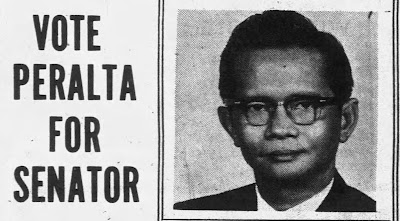
So when Juanito Peralta, a Filipino, ran for the Guam Legislature in 1970, he thought it a good idea to put some campaign ads in the newspaper in the Chamorro language. Not only did he have an uphill battle winning because he was not Chamorro, he also ran as a Republican, a new party on Guam that had not won a single seat in the Legislature yet.

Peralta had a Chamorro wife who perhaps assisted him in writing the Chamorro ad, or perhaps a Chamorro supporter penned it for him. The spelling is quite rough, so I'll put it in my own way of spelling Chamorro.


HÅFA ADAI MAN ATUNGO'-HO yan todos hamyo taotao Guam.
(Greetings to all my acquaintances and to all of you people of Guam.)

Guåho si Juanito T. Peralta, asaguan Rita Flores Guerrero, ginen Bånik yan Charot na familia.
(I am Juanito T. Peralta, the husband of Rita Flores Guerrero, from the Bånik and Charot families.)

Numero diesisais yo' gi agapa' na bånda gi baloto.
(I am number 16 on the right side of the ballot.)

Pot fabot na' saonao yo' gi bentiuno na kandidåto para en bota.
(Please include me among the twenty-one candidates you will vote for.)

Malago' yo' bai anunsia na yanggen suette ya humålom yo' gi konggreso
(I would like to say that if I am lucky and am admitted into the Legislature)

bai protehe mås i mamopble yan bai hu setbe maolek para i interes-miyo
(I will protect the poor more and serve well your interests)

yan i fina'maolek i tano'-ta.
(and the improvement of our land.)

I fuetsa gaige giya hamyo. Hamyo i ma'gas, guåho i setbiente. Ennao i hinengge-ko.
(The power is with you. You are the boss, I am the servant. That is my belief.)


NOTES

Notice that uses his wife's full maiden name, including her maternal and paternal surnames and even the Chamorro nicknames for her families. This is a way to connect with all the voters who might be related or who these families well. A candidate can win by one vote, so every vote counts.

He doesn't say he is on the Republican side of the ballot. In 1970, the island was still very Democrat. The Democrats won all 21 seats in the Legislature two elections in a row before 1970. The word "Republican" would instantly turn off a number of voters and, as every vote counts, it's safer to just say "right side of the ballot."

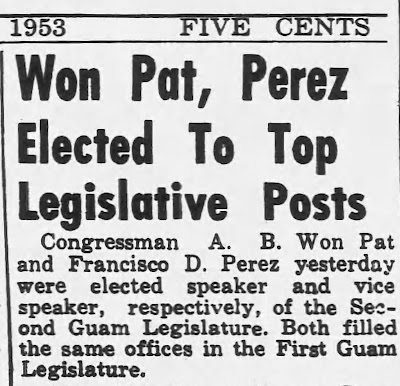
He calls the Legislature Konggreso or "Congress." This was the way older Chamorros called the Legislature. It goes back to the pre-war Guam Congress established by some Naval Governors, which was purely advisory and lacked real power. Even when, in 1950, Guam got a Legislature with the power to pass laws, older Chamorros kept calling it the Konggreso and the members Konggresista. Even in English, members of the Legislature were called Congressmen/women till 1970. Old habits die hard.


Seen above, it's 1953, Guam has a Legislature, not a Congress, but the new Speaker is called CONGRESSMAN A.B Won Pat, not Senator A.B. Won Pat.


DEMOCRAT SUPER MAJORITY

Peralta did not win, but neither did fourteen of his fellow Republicans.

The Democrats swept the 11th Guam Legislature in 1970 with a super majority of fifteen seats, against six Republican winners.


Thursday, January 13, 2022

SAIPAN SISTER, BUT ONLY SPANISH


SISTER JULIANA DE LA CRUZ, MMB


I once knew a Chamorro sister who wouldn't speak Chamorro to me. She would only speak Spanish.

In 1992, I flew to Spain to research in our Capuchin archives in Pamplona, Spain where many documents are stored concerning Guam, mainly about the Church from the 1900s to 1941. 

After a week of research in Pamplona, my next visit was to Bérriz, a small town not too far away from Pamplona. If I had a car, I could have driven from Pamplona to Berriz in two hours. But I didn't have a car and took the train, instead, which meant it took me pretty much the whole day to get to Bérriz (by changing trains at least 2 or 3 times).

My goal at Bérriz was to meet some older Spanish Mercedarian Sisters who had once served on Saipan since the 1930s. But little did I know that there was a Chamorro Mercedarian Sister there as well!


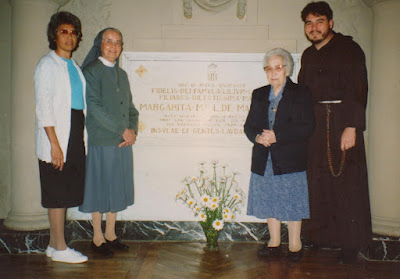
SISTERS HELEN (Palau), JULIANA (Saipan), BEATRIZ (Spain) and ME (Guam)
At tomb of Mercedarian Foundress Bd Margarita Maturana, Spain, 1992


Her name was Sister Juliana Roberto de la Cruz, of the familian Bisco from Saipan. She was born in 1912, so she was 80 years old when I met her. Her parents, Vicente San Pedro de la Cruz and María Sablan Roberto, were both born on Guam but moved to Saipan where they met and married in 1904.

She was in the first group of Saipan women who joined the Mercedarian Sisters after the war. She ministered for many, many years away from Saipan so I had never seen her before. Even the Chamorro Mercedarians from Saipan who never worked on Guam I knew from meeting them in Saipan, but Sister Juliana had long left Saipan by then.

I finally met this surprise (for me) Chamorro sister all the way in Spain in the parlor. I do not remember now if my first words to her were in Chamorro or Spanish; knowing me I would have let her begin the dialogue and choose the language.

Naturally I would have wanted to explain to her who I was and what my connection to Saipan was. I distinctly remember trying to say all this in Chamorro, and she understood, because when she answered, her comments followed up on what I was saying, but she said it all in Spanish.

But when she spoke in Spanish, it was said with a very identifiable Chamorro tone and pronunciation. I kept hearing Spanish words, but the "music" was Chamorro. So I kept going back to Chamorro when it was my turn to speak. But, her complete reliance on Spanish (she didn't say a word to me in Chamorro) made its impression on me. Eventually I switched to Spanish, as well, and Spain was bereft of hearing Chamorro that day.

Sister Juliana seemed very interested in what I had to say; I knew her family in Saipan. We talked about how they were, what the latest news was in Saipan, a little bit about her and a little bit about me. It was the one and only time I ever met her, and the impression remains with me to this day. This urge to speak Chamorro far, far away from home, with a Chamorro woman fifty years older than me, but who would only speak Spanish to me. How often would I get to experience that!


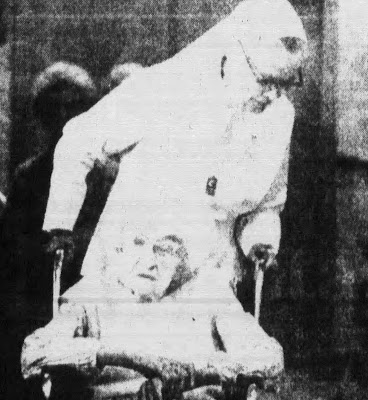
SISTER JULIANA WORKING IN THE RETIREMENT HOME
Kansas City, Missouri in 1985


Sister Juliana had joined a Spanish community of Sisters. When she joined them, all the Sisters were Spanish-speaking and only one, I believe, Sister Beatriz (previously Angélica), spoke some English. They recruited new Sisters from all over Micronesia; Palau, Chuuk, Ponape as well as Saipan. English was unknown to them, so Spanish was the dominant language in the Micronesia community until some years later when enough time had passed to allow more of them to learn English.

But Sister Juliana eventually left Micronesia and began serving in the US. One of her last assignments was assisting the elderly in a Mercedarian facility in Kansas City, Missouri. Then she retired to the Mercedarians' motherhouse in Bérriz, Spain.

All those years away from the Marianas meant that Sister Juliana stopped speaking a whole lot of Chamorro, and got accustomed to speaking Spanish more and more, the language of most of the Sisters. She must have continued to communicate in Chamorro with her family, who did not know Spanish. But, for whatever reason, we only conversed in Spanish.

In a way, Sister Juliana reminds me of the countless Chamorro men who left the Marianas forever on the whaling ships in the 1800s, and ended up living a new life wearing new clothes, eating new food and speaking other languages because they had few people, sometimes no one, to speak Chamorro with.

Hearing Sister speak Spanish with a Chamorro accent also took me back in time to the 1800s when quite a number of Chamorros spoke excellent Spanish. We know this because many government documents written in the Marianas in perfect, high-level Spanish were penned by Chamorro clerks and officials. But I assume many (most?) spoke it with a Chamorro accent.

Not many years after I met her, Sister Juliana went to her eternal reward and is buried in Spain. In 1668, Spain came to the Marianas as Sanvitores started the Catholic mission, and one of his fruits 300 years later, Sister Juliana, went from the Marianas to Spain and her remains are still there. U såga gi minahgong. Descanse en Paz. Rest in Peace.


VERSIÓN EN ESPAÑOL
(traducida por Manuel Rodríguez)  


LA HERMANA JULIANA DE SAIPÁN, ISLAS MARIANAS

Una vez conocí a una hermana chamorra que no me hablaba en chamorro. Ella solo me hablaba en español.

En 1992, viajé a España para investigar en nuestros archivos capuchinos en Pamplona, donde se almacenan muchos documentos relativos a Guam, principalmente sobre la Iglesia desde 1900 hasta 1941.

Después de una semana de investigación en Pamplona, mi siguiente visita fue a Bérriz, un pequeño pueblo no muy lejos de Pamplona. Si tuviera un coche, podría haber conducido desde Pamplona a Bérriz en dos horas. Pero yo no tenía coche y cogí el tren, por lo que tardé casi todo el día en llegar a mi destino.

Mi objetivo en Bérriz era conocer a algunas hermanas mercedarias españolas mayores que alguna vez habían servido en Saipán desde la década de 1930. ¡Pero no sabía que allí también había una hermana mercedaria chamorra!

Su nombre era Sor Juliana Roberto de la Cruz, de la familia Bisco de Saipán. Había nacido en 1912, así que tenía 80 años cuando la conocí. Sus padres, Vicente San Pedro de la Cruz y María Sablan Roberto, nacieron en Guam pero se mudaron a Saipán donde se conocieron y se casaron en 1904.

Juliana estaba en el primer grupo de mujeres de Saipán que se unieron a las hermanas mercedarias después de la segunda guerra mundial. Ella ministró durante muchos años, lejos de Saipán, así que nunca la había visto antes. Incluso las mercedarias chamorras de Saipán que nunca trabajaron en Guam, las conocí por haberlas visto en Saipán, pero Hermana Juliana ya hacía mucho tiempo que se había ido de la isla.

Finalmente conocí a esta (para mí) sorprendente hermana chamorra en España. No recuerdo ahora si mis primeras palabras con ella fueron en chamorro o en español; Conociéndome, le habría dejado comenzar el diálogo y elegir el idioma.

Naturalmente, hubiera querido explicarle quién era yo y cuál era mi conexión con Saipán. Recuerdo claramente tratar de decirle todo eso en chamorro, y ella me entendía, porque cuando me contestaba, sus comentarios seguían a lo que yo estaba diciendo, pero lo decía todo en español.

Cuando hablaba en español, lo decía con un tono y una pronunciación chamorros muy identificables. Yo continuaba escuchando palabras en español, pero la "musicalidad" era chamorra. Así que seguí en chamorro cuando me tocó hablar. Sin embargo, su completa confianza en el español (no me dijo una palabra en chamorro) me impresionó. Eventualmente también cambié al español, y ese día España no pudo escuchar una conversación en chamorro.

Hermana Juliana parecía muy interesada en lo que tenía que decirme; Conocí a su familia en Saipán. Hablamos de cómo estaban, cuáles eran las últimas noticias en Saipán, un poco de ella y un poco de mí. Fue la primera y única vez que la vi, y la impresión permanece conmigo hasta el día de hoy. Esas ganas de hablar chamorro lejos, muy lejos de casa, con una mujer chamorra cincuenta años mayor que yo, pero que sólo me hablaba en español. ¡¿Con qué frecuencia llegaría a experimentar eso?!

Hermana Juliana se había unido a una comunidad española de hermanas. Cuando se unió a ellas, todas hablaban en español y solo una, creo, Hermana Beatriz (anteriormente Angélica), hablaba algo de inglés. Reclutaron nuevas hermanas de diferentes partes de Micronesia: Palaos, Chuuk, Ponapé y Saipán. El inglés era desconocido para ellas en aquella época, por lo que el español fue el idioma dominante en la comunidad de Micronesia hasta algunos años más tarde, cuando pasó suficiente tiempo para que aprendieran inglés.

Pero Hermana Juliana eventualmente dejó Micronesia y comenzó a servir en los Estados Unidos. Una de sus últimas asignaciones fue ayudar a los ancianos en una instalación mercedaria en Kansas City, Missouri. Luego se retiró a la casa matriz de las mercedarias en Bérriz, España.

Todos esos años lejos de las Islas Marianas hicieron que Hermana Juliana dejara de hablar mucho el chamorro y se acostumbrara a hablar cada vez más el español, el idioma de la mayoría de las hermanas. Debió seguir comunicándose en chamorro con su familia, que no sabía español. Pero, por alguna razón, nosotros solo conversamos en español.

En cierto modo, Hermana Juliana me recuerda a los innumerables hombres chamorros que dejaron para siempre las Islas Marianas en los barcos balleneros durante el siglo XIX y terminaron viviendo una nueva vida, vistiendo ropa nueva, degustando comida diferente y hablando otros idiomas porque tenían poca gente, a veces nadie, con quien hablar chamorro.

Escuchar a la hermana hablar español con acento chamorro también me llevó atrás en el tiempo a 1800 cuando muchos chamorros hablaban un español excelente. Sabemos esto porque muchos documentos gubernamentales escritos en las Islas Marianas en perfecto español de elevado nivel, fueron escritos por empleados y funcionarios chamorros. Pero supongo que muchos, tal vez la mayoría, lo hablaban con acento chamorro.

No muchos años después de que la conocí, Hermana Juliana fue a su eterna recompensa y está enterrada en España. En 1668, España había llegado a las Islas Marianas cuando San Vitores inició la misión católica, y uno de sus frutos 300 años después, Hermana Juliana, pasó de las Islas Marianas a España y sus restos aún están allí. Descanse en Paz.