Tuesday, October 31, 2023

SEEING A SPIRIT


If you ever go into the jungle and see a spirit, here's a guide what to say, provided to us by Pedro, who was taught by his grandmother :


Sesso de humånao si Pedro gi halom tåno' manaliligao åmot pat håyo pat masea håfa, ya ti ma'å'ñao si Pedro achok ha' guiya ha' na maisa humånao.
(Pedro often went into the jungle looking for medicine or wood or whatever may be, and Pedro wasn't afraid even when he went by himself.)

Finaisen gue' as Kiko', i amigu-ña, "Kao tåya' na ma'å'ñao hao na siña hao manli'e' espiritu gi halom tåno'?"
(His friend Kiko' asked him, "Aren't you ever afraid that you might see a spirit in the jungle?")

Manoppe si Pedro, "Tåya', sa' ha fanå'gue yo' si nanå-ho biha håfa para bai ålok an siakåso na guaha håfa hu li'e'."
(Pedro answered, "Never, because my grandmother taught me what to say if I ever see something.")

Mamaisen si Kiko', "Håfa?"
("What?" Kiko' asked.)

Manoppe si Pedro, "Siempre bai ålok, 'Yanggen anite hao, pues hånao tåtte para sasalåguan!'
(Pedro replied, "I'll say, 'If you're a demon, then go back to hell!')

'Yanggen ånimas hao, bai tayuyute hao lao hånao tåtte para Putgatorio!'
('If you're a Poor Soul, I will pray for you, but go back to Purgatory!')

'Yanggen taotao hao, pues hånao tåtte para i gimå'-mo!'"
('If you're human, then go back to your house!')

Pues mamaisen si Kiko', "Lao håfa para un ålok yanggen ginen i langet na espiritu?"
(Then Kiko' asked, "But what will you say if it's a spirit from heaven?")

Ha hasso nåya si Pedro sa' tåya' håfa ilek-ña si nanå-ña biha pot ennao. Pues manoppe si Pedro, "Yanggen ginen i langet na espiritu, siempre bai ålok, 'Ayuda yo' sumodda' håfa hu aliligao!"
(Pedro thought a while because his grandmother said nothing about that. Then Pedro answered, "If it's a heavenly spirit, I'll say, 'Help me find what I'm looking for!'")

Tuesday, October 24, 2023

SHOES, SLIPPERS AND NOTHING


SHOESTRING SET
Socially elite Chamorro ladies with Americans in the 1910s


An American lady, the sister of the island's Governor at the time, Olga Dorn, wrote an article describing life as she saw it when she visited the island in 1909.

She described three classes of Chamorro women, all based on footwear!

The three classes, in her words, were the Shoestring Set, the Slipper Society and the Barefoot Brigade.

SHOESTRING SET. These were women of the socially elite class. Many of them had Spanish or other European blood. Their fathers occupied positions in the American government or in commerce. These ladies were very eager to adopt American fashions. They always wore shoes and stockings. These were the women often invited to American social events.


SCHOOLGIRLS 
Some with shoes, some without


SLIPPER SOCIETY. These were a much larger group of Chamorro women who clung to the fashion of their mothers and grandmothers. Many of them also had Spanish or some European blood in them, but their preference was for the fashions of old. They mainly wore the mestiza dress and heelless, flat slippers with no stockings. These women were almost never invited to American social events. Among the Chamorros themselves, many of these women were considered elite and prestigious, but they occupied a different world than the Americans.

BAREFOOT BRIGADE. These women were of the poorer class who generally went around without any footwear at all. 

Today, everybody wears something on their feet. Usually.

Tuesday, October 17, 2023

NO MORE PLANE RIDES


Monsignor Zoilo LG Camacho was known for a few things.

Building round churches, for one. Like San Vicente in Barrigada and Santa Barbara in Dededo.

Farming. A good portion of almost every day was spent growing fruits and vegetables. Even I received a nice watermelon from him one time.

But what not a whole lot of people knew about him was his loathing of air travel. Monsignor avoided flying on a plane if he could. If it meant not attending some event off-island, so be it. He would not board the plane.


On July 14, 1960, Father (he was not Monsignor, yet) Zoilo was flying from Okinawa to Manila on a Northwest Orient plane. His intention was to proceed from Manila to India to visit his sister, a missionary nun, whom he had not seen in 22 years.

At 320AM in the dead of night, the pilot reported that one of his engines had "run away." This means the engine was getting extra fuel from an unintended source (often a fuel or oil leak), making the engine run faster. The lack of lubrication for a faster-running engine means the engine could catch fire, and if it doesn't catch fire it will most likely break anyway.

The pilot said he could do nothing about the runaway engine, so only time would tell. An hour after reporting the runaway engine, the engine caught on fire. Dawn had not come yet and it was still dark, but the pilot decided the best thing to do was land in the sea. He was near Polillo Island, around 85 miles from Manila.


The plane landed in the sea just as safely as it could. Everyone got wet, lost their footwear and luggage, but there were no serious injuries or loss of life except for one passenger. American amphibious planes based in the Philippines rescued the crew and passengers. The survivors had calmly gotten into four or five life rafts after deplaning. There was only one other passenger from Guam, a businessman named Alfred Minot.


BRIDGET MACARAEG
(photo from the Macaraeg family)


Father Zoilo was taken to the San Juan de Dios Hospital in Manila for 24-hour observation, even though he had sustained no injuries. There he met a Guam resident, Mrs Bridget Macaraeg, wife of physician Dr Godofredo Macaraeg, who was in the Philippines for a visit. She reported that, besides losing his shoes, Father Zoilo had lost his eye glasses (as well as everything else he had on board).

Father Zoilo told Mrs Macaraeg that the pilot made all the necessary announcements and the passengers put on their life vests. Some people on the descending plane asked Fr Zoilo to hear their confessions, and he did. I wonder where?

The plane hit the water with just a strong jolt. Then it was a matter of life or death to exit the plane, now filling with smoke from the burning engine slowly going out from the ocean water. One female passenger, in a panic, clung to the plane but Father Zoilo managed to get her into a life raft.

The one passenger who died, an elderly woman, reportedly died of a heart attack. Her body was recovered.

The plane sank in less than ten minutes. The rescue operations took four hours to complete. Fortunately, the sun was up by then.

Despite the crash landing, Father Zoilo did proceed, by plane, to Hong Kong then India to meet his sister. Then back to Guam, all by plane.

But, after that, Monsignor Zoilo avoided flying on a plane as much as possible.

Thursday, October 12, 2023

WHY NINE NIGHTS?


Most Chamorro Catholics will start praying a rosary as a family, with friends and others joining, the day someone in the family passes away. It lasts for nine days or nights.

Why nine?

The devotion is Catholic and so the answer is to be found in the Catholic religion, and not in the Chamorro culture itself.


NINE DAYS OF PRAYER


WHEN THE HOLY SPIRIT CAME
on the 10th day


When Jesus returned to Heaven, body and soul, on Ascension Thursday, He told the Apostles to return to the Upper Room and pray for the coming of the Holy Spirit. The Holy Spirit would come and remain with the Church, with the Apostles and with every believer until Jesus comes back again at the end of the world. The Holy Spirit would be the friend, the advocate, the consoler, the enlightener, the guide of the Church till the end of the world.

So the Holy Spirit would be a great grace, and Jesus told the Apostles to pray for the coming of that great grace, that great favor, the Holy Spirit.

So from Thursday, when they started praying, till the following day Friday, is one day. Count nine days of prayer and that takes you to Saturday. And the great grace, the great favor, came the following day, Pentecost Sunday. The Holy Spirit came down upon all the Apostles, the Blessed Mother and others on the 10th day. So, the favor asked for 9 days came on the 10th.

A period of NINE DAYS is called a NOVENA. It comes from the Latin word for NINE, which is NOVEM. The month of NOVEMBER used to be the NINTH month on the Roman calendar.

We pray novenas to some saints. In these novenas, we ask that saint to pray to God for us to grant us a favor, a grace, which we hope to receive at the end of the novena, just as the Apostles prayed for nine days and after that received the great grace of the Holy Spirit.


CANDY TAMAN'S ROSARY SCHEDULE
The 1st night not there because it started before this could be put in the newspaper


When we pray for the dead, we are asking God to have mercy on them, shorten their time in Purgatory and to take them to heaven as soon as possible. That is the request, the great favor or grace wanted.

And, like the Apostles and Mary, we pray for NINE DAYS (or nights) asking for this great favor and grace. It is a NOVENA (series of nine) of ROSARIES for the deceased. Jesus told us that God hears our prayers, so we believe and so we do!

Tuesday, October 3, 2023

SALAKLULA'


SALAKLULA' (or INARAJAN POOL)
YT : Cris Paul Adventures


It's one of Guam's more famous seaside scenes. Locals love it just as much as tourists.

Everyone knows it as Inarajan Pool, but the area's Chamorro name is SALAKLULA'. There's a glota at the end, so be sure to voice it.


I'm sure people have been swimming in it for centuries, but it didn't get the island-wide attention it now has until the 1960s. Keep in mind that Guam didn't have a "beach" mentality in the old days as we do now. Certainly people went to the beach and swam, but not with as much importance as we do now. The sea was mainly a source of food, there wasn't a culture of "recreation" back then and "sports" meant cockfighting in the old days.

People say that Inarajan Pool is NATURAL, but that is not totally true. Man has left his fingerprints on it for a while now.


1966


The first mention of Inarajan Pool in Guam's newspaper after the war was in 1966 when the Inarajan Social Improvement Club took it upon themselves to turn Salaklula' into a public swimming pool.

By 1966, the naturally-formed pool was BLASTED to open up more spaces and deepen the pool. Next, Ken Jones and the J&G people sent a crane down to DREDGE the blasted pool and remove the debris left over from the blasting. They would also cement the edges around the pool to smooth them out.

And, after that, the pool has had a life of its own; some highs and some lows. Besides the thousands who have had loads of fun swimming there, over the years it has taken a beating from typhoons, became a dumping ground for people's trash, polluted and almost ignored because of it (with government warnings to avoid it). As recent as 2015 a man had a heart attack while in the pool and drowned as he went under the water.


But, problems get solved; the government funds improvements and the pool remains a popular place. People swim, jump into the pool and BBQ in the picnic pavilions. The government has built ample parking, toilets and showers.


THE MEANING OF SALAKLULA'

A few elderly people in Inalåhan tell me that SALAK was a children's mispronunciation of SÅDDOK which means "river." When kids told their parents they were going to swim in the pool, they'd say SALAK instead of SÅDDOK (even though a pool is not a river).

This differs from Påle' Román who says in his 1932 Chamorro dictionary that SALAK is connected with a word that means to line up two-by-two. What that has to do with the pool is beyond me. Maybe nothing.

They also say that LULA' means "to harvest suni (taro)." So their interpretation is that SALAKLULA' means "river for harvesting suni." Påle' Román does say that lula' means "to harvest suni." I'm not just 100% sure about the salak part.


WHAT ABOUT "SALUKLULA?


Just to confuse us even more, SALAKLULA' has also been called SALUKLULA by others, and it makes a tempting alternative because there is a word SALUK (or SALOK).

SALUK means a "gorge, pass, gully, ravine, channel or canal."

One can see how the pool can be considered almost any one of those in a broad sense; basically a drop in the terrain surrounded by walls of earth.

As enticing as this alternative might be for others, I have a few reasons for hesitating.

1. As far as I know, no name for the Inarajan Pool area shows up on any map at all that I have seen (starting in the 1800s) until the 1968 Geological Survey map, where the name is SALAGLULA, as in earlier in this blog post.

2. SALUGLULA starts to appear in the Guam Daily News in the late 1960s. But so does SALAGLULA. So BOTH names run concurrently all through the media from the 1960s until the 2010s. Since the 2010s, the media uses SALAKLULA' a bit more. So it's hard to argue which name is correct when both names appear more or less in equal numbers in print.


The Year 2000


3. OLDER VILLAGERS, unrelated and not with me at the same time, told me quite clearly that the name is SALAKLULA'.


MISTAKEN SIGN


Parks & Rec is trying to promote the Chamorro name for Inarajan Pool, but they need to correct the sign.

SAULAGLULA means "to whip Lula." Saolak (to whip).

The name is SALAKLULA', not Saulaglula.

Tuesday, September 26, 2023

WHEN PÅLE' FELL ASLEEP IN CONFESSION


Humålom gi konfesionårio si Rita ya ha sangåne si Påle' na mañåkke gue' la'uya.
(Rita went into the confessional and told the priest that she had stolen a pot.)

Ayo ha' na momento, malingo maigo'-ña si Påle' ya ha tutuhon maigo'. Pot i tåya' håfa ilelek-ña si Påle', må'pos ha' si Rita ya humålom otro na palao'an gi konfesionårio.
(At that very moment, Father fell asleep. Because the priest wasn't saying anything, Rita left and another woman came into the confessional.)

Gigon dumimo i nuebo na palao'an, gotpe ha' makmåta si Påle' ya ilek-ña, "Ya håfa ta'lo pot i la'uya ni un såkke."
(As soon as the new woman knelt down, Father suddenly awoke and said, "And tell me more about the pot you stole.")

Manoppe i palao'an, "Tåya' na mañåkke yo' la'uya Påle'! Fana'an mamaigo' hao gi durånten i konfesion!"
(The woman replied, "I have never stolen a pot, Father! I think you're sleeping during confession!")

Ilek-ña si Påle', "Pues empas hit! Sa' guaha na mamaigo' hao gi durånten setmon-ho!"
(The priest said, "Then we're even! Because sometimes you sleep during my sermon!")


Tuesday, September 19, 2023

KÅNTA : KUMPLEAÑOS-HO


Sung by Alfred Saures


LYRICS


På’go i ha’ånen kumpleaños-ho
(Today is my birthday)
Siempre bai hu magof
(I surely will be happy)
Lao sen ti månnge’ nene
(But baby it's surely not pleasant)
Sa’ taigue hao gi fi’on-ho.
(because you're not by my side.)

I regålo malago’-ho
(The gift that I want)
Nai i chiku-mo yan hågo.
(which is you and your kiss.)
En lugåt hu ågang hao ya ilek-ho
(Instead I called you and said)
Biba Kumpleåños para guåho.
(Happy Birthday to myself.)

Humånao yo’ na maisa para i gima’
(I went home by myself)
Ya hu songgiye un danges ya hu desea.
(and I lit a candle and made a wish.)
Hu baba un dikkike’ na pakete
(I opened a small package)
Ni hu fahånen maisa yo’
(which I bought for myself)
Ya ilek-ho Biba Kumpleåños para guåho.
(and said Happy Birthday to myself.)


ALFRED SAURES

Wednesday, September 13, 2023

I CHALÅN-TA : PICK-A-NAIL ROAD


You won't find a street sign calling it PICK-A-NAIL ROAD.

You won't find a street sign calling it anything. No street sign survived the last typhoon.

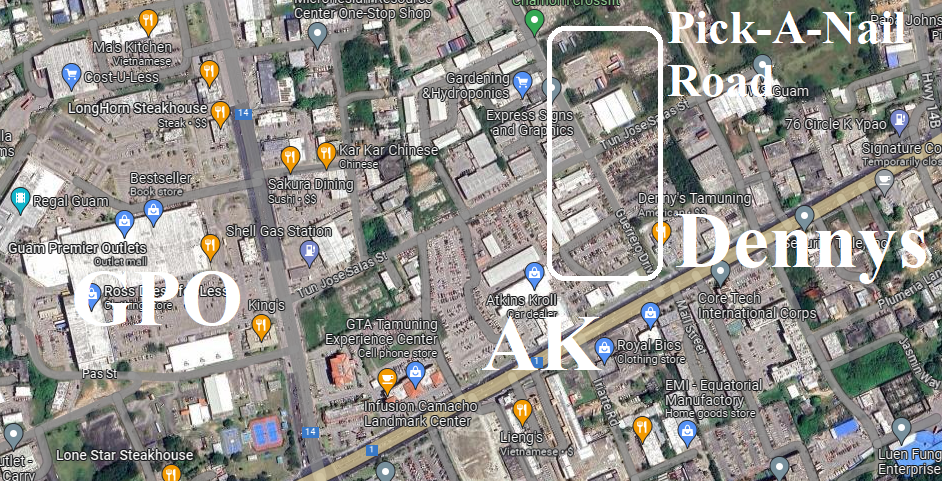
And although officially it is GUERRERO ROAD (some say DRIVE), a lot of people still call it by its old name : PICK-A-NAIL ROAD (some say STREET).

How did this street get such an unusual name?


A MESSY, INDUSTRIAL PLACE


As you can see from the satellite map of Pick-A-Nail Road, it lies in the middle of heavily built-up, commercial Tamuning.

That particular area of Tamuning has always been the site of warehouses, industrial and mechanical supply stores, dredging companies, automobile services, roofing companies....you get the idea.

So the road back in the day was a bit messy, with nails, screws, bolts....you name it.....strewn about.

Joe Murphy, a columnist for the Guam Daily News (and later the Pacific Daily News), wrote in 1968 that someone decided to name the street himself and put up a sign saying PICK UP A NAIL STREET.


In other words, the street was so cluttered you could go and pick up a nail there anytime. Or maybe, help clean up the street by picking up a nail!

Sometime in the 1990s the street was officially named GUERRERO ROAD (or DRIVE). But a lot of people still call it by its old name.

Modern maps even put both names down, the old and the new.


OLD AND NEW NAMES TOGETHER


For those who may not be familiar at all with Pick-A-Nail Road, just remember that it lies in between AK and Denny's on Marine Corps Drive.


So, is Pick-A-Nail Road still so messy? Nope. I guess the Guerrero name has some magic to it, because, as the recent pic shows, the street isn't more messy than your typical Guam street in a commercial area. The street is so clean now, you can't even pick up a nail there anymore.


NOT A NAIL IN SIGHT

Wednesday, September 6, 2023

THE MEETING PLACE


INN ON THE BAY
Hågat


I was having breakfast one morning with two Santa Rita ladies at a neighborhood restaurant in Hågat, at the intersection of Route 1 and the road that leads up to Santa Rita.

One of the ladies said to me in Chamorro, "Påle', have you ever noticed that there are fewer families in Santa Rita with Filipino fathers compared to Hågat?"

I knew that just up the road from where we were was the old Camp Roxas, built right after the war when hundreds of Filipino workers, a great many from Iloilo, were recruited to work for the many military projects that built up Guam into an important Naval base. Many of these workers stayed on working for the military, and quite a number married Chamorro wives. 

I also knew that Hågat had a good number of families with Filipino dads. Some of their children were my classmates in high school, or whom I knew in other ways. One of my Hågat classmates whose dad was Filipino became well-known as the bet collector (the Cristo) at the local gayera (cockfight, sabong in Filipino).

The lady went on to explain, "But in Santa Rita, you can count on just a few fingers the Filipinos who married Santa Rita girls. Langas, Calip, Claveria, Grecia.....and Viernes but he came by way of Hawaii."


She looked over her left shoulder which faced the window, and said, "You know where Inn on the Bay is? In the old days there was a store there with a pool table. The store was called Para Luchan and was owned by the Bordallos. The Camp Roxas men would go there and hang out in that area, and the Hågat girls would also go there and socialize with the Camp Roxas workers. But the Santa Rita girls couldn't go there. Our parents were so strict. That's why less Santa Rita girls married Filipino men. It was harder for them to meet. That's why there are fewer Santa Rita women married to Camp Roxas men."


Tuesday, August 29, 2023

ÅNTES YAN PÅ'GO


WHEN ATKINS KROLL WAS IN ANIGUÅK


Atkins Kroll, most known as a car dealership, used to be in Aniguåk up until October 1969 when the company moved to its present building in Tamuning which it built that year.

The company found its Aniguåk location, which it took up after the war, to be too confined and the building too outdated for the growing business it was enjoying in the late 1960s. Rather than improve the Aniguåk location, the company decided to start from scratch at a new location in Tamuning.

While AK has been Guam's Toyota dealer for many decades now, it was selling General Motors cars in the 1950s and 60s on Guam.


Tuesday, August 22, 2023

INDIAN MISSIONARIES ON GUAM


MALABAR CHRISTIANS FROM 1500s


The first recorded Indian in the Marianas was a Christian named Lorenzo, who was shipwrecked off the southern coast of Saipan in 1638 aboard the Spanish galleon Concepción. He stayed in the Marianas after surviving the shipwreck. When Sanvitores and his missionaries came in 1668, Lorenzo was there to render assistance, being an interpreter for the missionaries (having lived thirty years already with the Chamorros).

Sanvitores sent Lorenzo to help with the Christianization of Anatahan, where he was killed by Chamorro opponents to the mission in 1669, the FIRST of the Christian martyrs of the Marianas.

A very early missionary account of Sanvitores (written by Jesuit Francisco García in 1683, just eleven years after Sanvitores' death) clearly states that Lorenzo was a Malabar; it wasn't his "last name," which many people all over the world still did not use, yet. Other early books (e.g. Morales) are also clear that Lorenzo was from the Malabar Coast, which is in India.

The Malabars were from the southwest coast of India (now Kerala) who had become Christians through the preaching of Saint Thomas the Apostle, who is said to have reached India in the year 52AD. They are thus also called "Saint Thomas Christians." From those ancient times till now, the Malabar or Saint Thomas Christians have remained Christians. The blood of one of them wetted the soil of Anatahan in 1669.


ENTER ANOTHER MALABAR

Three hundred and thirty-three years later, yet another Malabar Christian came to the Marianas; specifically Guam.

His name was Father Thomas Vengayil, from the Syro-Malabar Diocese of Palai (a city in Kerala, India).


Father Vengayil heard about Guam through a classmate in London, where he was studying economics, who had lived on Guam, by the name of John Gillam. Father wrote to Bishop Flores offering his services, and Flores accepted, bringing Father to Guam in 1971. He served in various places such as Niño Perdido parish in Asan, Santa Teresita parish in Mangilao and Santa Barbara parish in Dededo where he was pastor in both places for a time.


FATHER VENGAYIL BAPTIZING IN DEDEDO


Due to his interest in economics and social issues, Father Vengayil also headed the Campaign for Human Development on Guam, a social advocacy agency of the Catholic Church.

He left Guam to serve in other dioceses sometime in the 1980s.


MOST RECENT INDIANS


Since Fr Vengayil left Guam, there have been a few Indian Capuchin priests who have helped on Guam for very brief periods, usually one to three months.

But in 2021, two Indian Capuchins came to Guam to assist for a longer time.


Fathers Claud Mascarenhas and Silvano Fernandes come from Karnataka in India, a different state from that of Kerala, where Father Vengayil and Lorenzo Malabar came from.

Nonetheless, Fathers Claud and Silvano are the latest Catholic Indian priests to come to Guam, specifically to minister at Saint Fidelis Friary.


CHAMORRO MISSIONARY TO INDIA


SISTER EANSWIDA CAMACHO on LEFT in INDIA


But the story gets better.

Not only have Indian Catholics ministered on Guam; in the 1950s and 60s, a Chamorro Sister ministered in India!

Maria LG Camacho (familian Zoilo) wanted to be a Catholic Sister when she was a young woman. But there were no Sisters on Guam before the war. So she went to Manila to join the Franciscan Missionaries of Mary. She was given the religious name of Sister Eanswida.

She was sent to college and then to Stella Maris College in Chennai, India (Madras in the old days). There she founded the Social Welfare Center and did so much to develop the Social Welfare program of the school that, to this day, there is an Endowment Fund named in her honor.

Feeling her work as a missionary was over, and wanting to return to Guam to be with her aging parents, Sister Eanswida changed Orders and became a Mercy Sister upon returning to Guam. She also got a new religious name, Sister Thecla.

She died on Guam in January of 2017 at the age of 99 years. Had she lived till September, she would have reached her 100th birthday.

Monday, August 14, 2023

FAMILIA : DIEGO


There is only one Diego clan on Guam and its håle' (roots) are in Inalåhan.

But they are almost certainly descended from a Filipino soldier of the Pampanga Company whose name was AGUSTÍN DIEGO. He is the only adult person with the surname Diego on Guam in the 1758 Census. He does not appear in the earlier 1727 Census. Pampanga is a province in the Philippines with its own language, different from Tagalog.

DIEGO is the Spanish form of the Latin name DIDACUS. The name can also come from a variation of the name James, which in Latin is Jacobus, which turns into Santiago (Sant + Iago).

Spanish personal, or first, names sometimes became family names or surnames. Think of Pablo (Paul), Blas (Blaise) or the famous Ferdinand Marcos (Mark).

Agustín married Juana Cabangis. Two Cabangis soldiers, also of the Pampanga Company, are in the 1727 Census so Juana could be the daughter of one of them. One of those soldiers married a Chamorro woman, so Juana could already be the beginning of the Chamorro link in the family. Agustín and family lived in the capital city, Hagåtña, but some Spanish, Mexican and Filipino soldiers were sent to the villages to serve as officials. This is probably how one of the Diegos went to Inalåhan.

By 1758, Agustín Diego had two sons but more could have come later. At any rate the Diegos start appearing in Inalåhan by the 1800s. 

As far back as 1847, there was an Eduardo Diego who was the warden or alguacil of Inalåhan.

By 1878, or 31 years later, a new figure by the name of José Meyao Diego appears in the records in various civic capacities in Inalåhan, sometimes as warden and other times as Justice of the Peace.

It is this José Meyao Diego, married to Francisca Chargualaf, who is the founder of the clan that continues to this day.


JOSÉ MEYAO DIEGO 
and FRANCISCA CHARGUALAF


José's middle name, which was his mother's maiden name, has been spelled in various ways : Miyao and Mellao are just some examples. It doesn't seem to be a Spanish name. It is probably an indigenous Chamorro name, as there are records of Inalåhan people with the name during Spanish times. If it is Chamorro, it could come from the prefix MI, which means "abundant," with the root word YAO or IYAO unknown. It could also be that MEYAO has nothing at all to do with MI (abundant). It remains a mystery.

José was born around 1837. Without an actual baptismal certificate, it's hard to be exact about his date of birth. People were always guessing their ages in those days, and would have different answers every so often.

José and Francisca had numerous children. They had four sons, but only one of the four produced enough male heirs to keep the Diego name going. One son never married. Another son had no children, though married, and another married son had one daughter.

ROMUALDO CHARGUALAF DIEGO married Dolores León Guerrero San Nicolás, the daughter of Gerónimo San Nicolás and Antonia León Guerrero. It is Romualdo who produced enough male heirs to keep the Diego name going. His sons were Joaquín, Enemesio, Juan, Vicente, Jesús and José.

JOAQUIN CHARGUALAF DIEGO married Victorina Meno Mantanoña. Apparently they had no children.

JUAN JOSÉ CHARGUALAF DIEGO married Ignacia León Guerrero, the daughter of Vicenta León Guerrero and an unknown father. They had a daughter Catalina, who later married.

VICENTE CHARGUALAF DIEGO never married.

Then there were José and Francisca's daughters, who were :

MARÍA CHARGUALAF DIEGO who married Francisco Castro.

CLARA CHARGUALAF DIEGO married Joaquín Crisóstomo, the son of Ana Crisóstomo and an unknown father.

VICENTA CHARGUALAF DIEGO married Lucas Taitague Naputi, the son of Mariano Naputi and Antonia Taitague.


JOAQUÍN SAN NICOLÁS DIEGO
"GÅDAO"
Former Commissioner (Mayor) of Inalåhan
Grandson of JOSÉ MEYAO DIEGO


ROMUALDO CHARGUALAF DIEGO
Former Commissioner of Inalåhan before the war
Son of JOSÉ MEYAO DIEGO


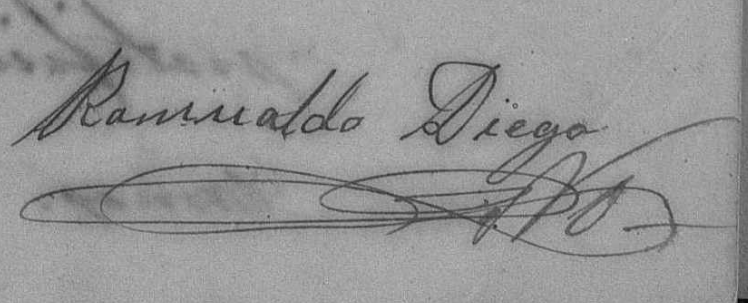
ROMUALDO DIEGO
signature in 1904


160 YEARS AND 6 GENERATIONS OF DIEGOS


ROMUALDO CHARGUALAF DIEGO, born 1863, father of

VICENTE SAN NICOLÁS DIEGO, born 1908, father of

FRANK PAULINO DIEGO, born 1938, father of

FRANK TAITAGUE DIEGO, born 1969, father of

GAVIN DIEGO, born 1987, father of

FRANCIS PAUL DIEGO, born 2023

Tuesday, August 8, 2023

PÅLE' S ONE GOOD EAR


Humålom si Ana gi konfesionårio.
(Ana went into the confessional.)

Mampos takpapa' i bos-ña si Ana ya chatta hohongga i håfa ha konfesatñañaihon.
(She was speaking too low and one could barely hear what she was confessing.)

Ilek-ña si Påle' annai monhåyan si Ana kumonfesat, "Iha, hånao pot fabot para i otro bånda ya bai hungok hao gi maolek na talanga-ho."
(When Ana finished confessing, the priest said, "My daughter, please go to the other side and let me hear you with my good ear.")


Wednesday, August 2, 2023

DR TORRES OF SAIPAN


DR JOSÉ DÍAZ TORRES


It's interesting how, even in the days when formal, higher schooling was not possible in our islands, ambitious young people found a way to work themselves into a skilled profession.

Take the case of José Díaz Torres, who was born on Saipan on June 1, 1895 during Spanish times.

He was the son of Félix Atoigue Torres and Vicenta de León Guerrero Díaz. He married Asunción Martínez Ada, one of the familian Bodik clan which spans both Saipan and Guam. She is sometimes called Ascensión.


HIS WIFE ASUNCIÓN ADA TORRES


During German times, he came to the notice of the German officials as being a bright young man, and he went with one of the German governors for a short time to Yap and Ponape. He also visited Nauru and New Guinea during the German period. In 1914, just before the Japanese took over the Northern Marianas from the Germans, he became a medical assistant.

Then the Japanese gave him formal medical classes for just a year. What he lacked in longer years of book study he made up for by assisting Japanese doctors in their practice, even during surgeries. The people of Saipan considered José a doctor and called him so.

When the Americans attacked Saipan in 1944, Dr. Torres offered his services to the Americans as soon as he was able to, to tend to the wounded and anyone else needing attention, even when mortar fire was whizzing by him. The US military later gave Dr Torres a commendation for his contribution. Many nights Dr Torres got no sleep as many people awakened him with medical emergencies. He never turned anyone away.

In 1962, the Trust Territory Government built a new hospital in Saipan, costing (in 1962 values) $700,000. They named it in honor of Dr. Torres.


DR TORRES HOSPITAL
In construction 1962


He retired in 1972 at the age of 77, but in the first weeks of his retirement, he still woke up and got dressed in his white medical uniform. His wife had to ask government officials to remind her husband that he was retired. She wanted him to avoid overdoing it in his older years.

But Dr Torres lived a healthy lifestyle. He didn't smoke, barely drank any alcohol and was partial to local, home grown foods like taro and yams. He learned to speak German with the Germans, Japanese with the Japanese and English with the Americans.

Dr Torres died in 1976 in his "own" hospital, meaning the hospital named after him. He lived till he was 80, just two and half months shy of his 81st birthday.

In November of 1986, the Northern Marianas Commonwealth Government completed the construction of a new hospital for Saipan, calling it the Commonwealth Health Center. It did not carry over Dr Torres' name for the new hospital. So I hope this blog post helps to keep the memory of Dr Torres alive.

Many of the buildings that make up the present Northern Marianas College at its main campus in As Terlaje, Saipan were once the buildings of Dr Torres Hospital. Some believe that there are haunted areas of the College buildings because they used to house the dead who passed away at the old hospital.


Youtube : ChatRoger Cadua

NORTHERN MARIANAS COLLEGE
the former Dr Torres Hospital

Friday, May 19, 2023

KÅNTAN SANTA RITA


IMAGE OF SANTA RITA
in Santa Rita Church, Guam


Saint Rita of Cascia (the town in Italy where she lived in the 1400s) is the patron saint of the village of Santa Rita in Guam.

Her feast day is May 22 and the public celebration of that feast is usually held on the weekend closest to that date.

The Chamorro hymn to Santa Rita speaks about her life, so unless you know some details about her life you may not understand the hymn.

1. THE BEES

When Santa Rita was born, bees gathered around her mouth, even entering and leaving, laying honey on her lips without harming the little baby. A man who observed this, who had a wounded arm, tried to gather the bees and his wound was healed instantly. The bees were taken as a good omen that the baby would grow into someone important. Later, long after Santa Rita died, white bees would gather in the walls of her monastery up until her feast day.


2. HER HUSBAND AND SONS

Saint Rita had always wanted to be a nun, but her parents pressured her to marry a man she didn't love. He was a womanizer and an abuser. She consented and suffered much on his account. Her husband was murdered and later her only two children, sons, died. But, in all three cases, Santa Rita helped the three repent of their sins before their deaths. Now independent, she finally entered the Augustinian monastery and became a nun.

3. HER WOUND


Wanting to share in the sufferings of Jesus, Santa Rita asked to feel in her body the pains the Lord endured. Jesus allowed her to receive a wound on her forehead and the marks of the Crown of Thorns. This wound began to stink horribly and all the other nuns had to avoid being near her. But on the day she died the wound was replaced by a mark in the shape of a rose and colored like ruby. It now gave off a beautiful fragrance.

Santa Rita is the patroness of impossible cases and of abused women.


Fina’tinas Santa Rita meggai siha na milågro;
tayuyute ham Santa Rita todos i mangilisyåno.
(Saint Rita made many miracles;
pray for us, Saint Rita, for all Christians.)

Linangitan minamisan i masåmai na na’ån-mo / ninatungo nu anghet na sinantos na na’ån-mo / sa u maolek yan tagåhlo i hinanao-mo gi tano’…
(Your beautiful name is a heavenly sweetness, the holiness of your name was made known by an angel, because your journey on earth would be good and exalted...)

Annai på’go ma takpånge i pachot-mo nai man annok / i abehas låhyan siha / si Yuus ma na’ fan måtto / ya ma tungo magin ayo i minames i bidå-mo...
(When you were baptized a swarm of bees appeared on your mouth, sent there by God and because of that we know the sweetness of your life...)

I man silok na mañaina achok ha ti malago / ma naassagua hao guihe yan i ti ya-mo na taotao / lao un sungon i finakai si Yuus långet nu hågo…
(Your overbearing parents, even though you didn't want to, made you marry a man you didn't love, but you endured what the God of heaven marked out for you...)

Annai måtai i asagua na pinino’ nu i taotao / ya man måtai i dos lokkue na lahi-mo na man gåtbo / un hasuye gi anti-mo na un gunos hao gi tåno’...
(When your husband died, killed by someone, and your two handsome sons also died, you thought in your soul to separate yourself from the world...)

Umetmåna agustina ya un setbe i Saina-mo / korason ånte mumagof mesngon kalåmya såntos / un gofli’e’ i guinaiyan i anti-mo un nahåspok...
(You became an Augustinian nun and served your Lord, your heart and soul rejoiced, perseveringly you became holy, you loved the love of your soul and became satisfied...)

Si Yuus ha nadinilok i hai-mo nu i laktos / ya sumåga mandochon i dilok-ña giya hågo / O gai tituka’ na sånta ma asi’e’ i taotao-mo...
(God pierced your forehead with a thorn and its gash remained fixed in you. O saint with a thorn forgive your people...)