Thursday, February 9, 2023

ROSARY AUCTIONED TO COVER DEBT


In 1926, a woman named María owed attorney Tomás Anderson Calvo (grandfather of former Governor Paul M. Calvo), $15.72.

In today's value, that would be around $260.

No reason is ever stated in the court documents why she owed Calvo that much.

Having failed to get payment from María, Calvo sought justice from the court. María answered the summons and promised payment by a certain date. When that date came and went, and there was still no payment, the judge ordered the Commissioner of Hagåtña to search María's house for anything worthy of being auctioned, in order to obtain money to pay the debt.

The Commissioner reported that he found only one thing worthy of being auctioned. A gold rosary with red beads and a gold crucifix.

Well, that would have to do and the rosary was put up for auction. Only one person stepped forward to make a bid. He was Pancracio Rábago Palting, another lawyer, who bid $4 for the rosary, which today would mean $66. So, Palting won the rosary and the debt was now reduced by $4. I have no idea what happened to the rest of the debt.


LOST ITS BLESSING

The Catholic Church does not allow blessed items to be sold. Assuming María's rosary was blessed, her rosary lost its blessing the minute it was bought, even in auction.

Palting, if he wanted a blessed rosary, had to have it blessed again after he had bought it in auction.

This little story shows how much many Chamorros prized their rosaries. It was sometimes put in the will who in the family would inherit it.

Tuesday, January 31, 2023

HE DEFIED PRICE


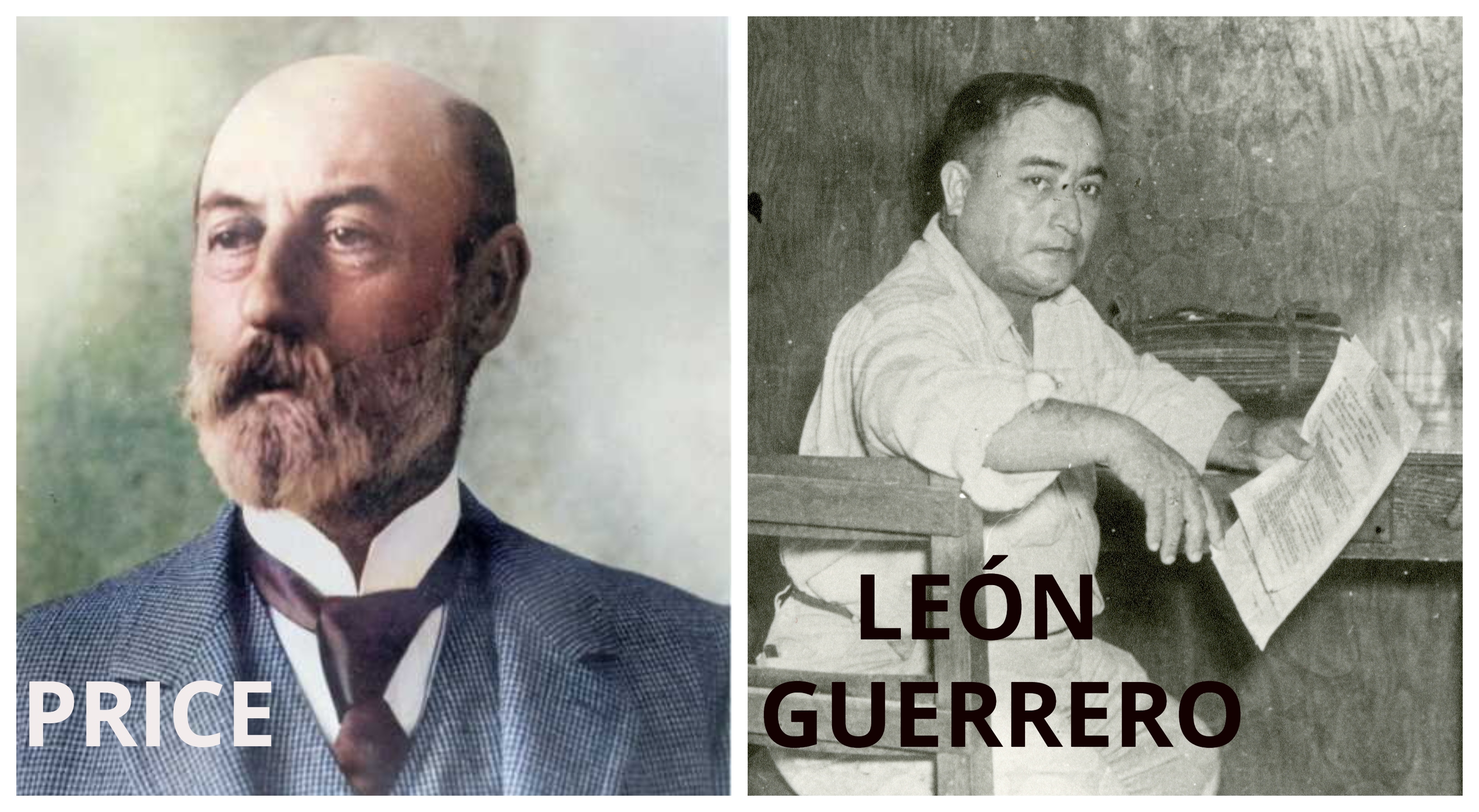
Francisco Baza León Guerrero was a fighter.

He fought for American citizenship and for democracy for Guam's people, where the people would one day vote for a representative form of government and not be ruled by Naval Governors who were the entire government rolled into one man.

A little-known story shows how León Guerrero wasn't a doormat even in his younger days.

León Guerrero, who was a chicken farmer in his youth, helping to support his widowed mother, got a job working at the US Agricultural Experiment Station in Piti. As such, León Guerrero was an employee of the US Department of Agriculture, and not of the US Navy.

In 1926, while León Guerrero was working at the Piti Station as a specialist in poultry raising, the Naval Governor, Captain Henry B. Price, walked into the Station looking for long-time Station employee Peter Nelson. All but one of the employees stood up to greet the Governor. After Price had asked his questions and gotten answers, Price turned around as if to leave, so León Guerrero and his coworker Joaquín Guerrero sat back down again.

Then, Price turned back again and commanded León Guerrero to stand once more. This León Guerrero refused to do, taking Price's command as intending to humiliate León Guerrero, who said Price already had ill feelings for him, for reasons he did not state.


CHARGED!


León Guerrero was charged in court with "Wanton Disrespect to the Governor."

Price's version of the event was that he met León Guerrero at the Station and asked for Nelson. León Guerrero told the Governor where Nelson was, but made no attempt to inform Nelson that the Governor was at the Station looking for him. Instead, León Guerrero sat down, tilting the swivel chair as far back as it could go, raising his arms and clasping his hands behind his head, looking at the Governor in what Price interpreted as a disrespectful stance.

Price told León Guerrero, "You are disrespectful." León Guerrero retorted that he was not. Price then ordered León Guerrero to stand up. He remained seated and Price was done waiting for him to stand, so Price left.

Guam's court found León Guerrero guilty as charged.


ON APPEAL


In an appeal made to a trio of appellate judges made up of a Navy officer, a Marine officer and a Chamorro judge (José Roberto), León Guerrero argued that he could not be guilty of breaking what was not a law. There was no law obliging him to rise when ordered by the Governor to do so.

Furthermore, León Guerrero could not be accused of insubordination to his superior because León Guerrero did not work for Price. He worked for the US Department of Agriculture, and not for the US Navy whose highest officer on Guam was Price.

Unsurprisingly, this court denied León Guerrero's appeal.

Still, León Guerrero did not lose his job at the Agricultural Station.


Friday, January 27, 2023

NEVER SENT TO JAPAN


On January 10, 1942, the Japanese shipped off to Prisoner of War camps in Japan all the Americans they found on Guam after they invaded the island on December 10, 1941. Around 500 people, military and civilian.

Except for TWO people.

These two Americans stayed on Guam for the entire Japanese Occupation. They were never sent, like the other Americans, to prisoner of war camps in Japan.

Who were they? And why were they exempted?

They were LOUIS FURTADO and MARY MAGDALENE CRUZ, and they had two things in common. First, they were born in Hawaii. Second, they were both of Portuguese ancestry.

Why should those two things matter?

First, Furtado claimed that the Japanese told him that he would not be imprisoned because the Japanese considered Hawaii "conquered territory." Sure, the Japanese had bombed Pearl Harbor, but they never conquered Hawaii. Who knows why they would have said so.

Second, both Furtado and Cruz, whose maiden name was Vinhaça (sometimes spelled Vinhasa), were of Portuguese ancestry. Portugal was neutral in World War II, neither an enemy nor an ally of Japan. Still, Furtado and Cruz were both born in Hawaii and had American citizenship, even though their families had come over from Portugal. So it remains a mystery why the Japanese would have let these two go free, while all other Americans were shipped off to Japan.


FURTADO


FURTADO AND PÅLE' OSCAR CALVO
Meeting again in Hawaii in 1946


Furtado, a married man with children, was sent to Guam in 1941 to work for the US Navy. When the Japanese bombed Guam on December 8, 1941, Furtado was asked by Governor McMillin to supervise the destruction of fuel on Cabras Island so as not to fall into enemy hands. He then fled into the jungle trying to avoid the Japanese. But he finally turned himself in when the island was firmly in Japanese hands. When they found out he was from Hawaii, the Japanese demanded he tell them what he knew about Pearl Harbor and American defenses in Hawaii. When he refused to, they beat him up.

He was told by the Japanese that they'd let him stay on Guam, but they kept an eye on him and punished him now and then for singing God Bless America, teaching Chamorro children to sing it and for other minor infractions. He also kept a radio, illegal under the Japanese, but got away with it till the very end. Generally, he was left unmolested, and he tried to be invisible as much as he could, farming on borrowed land. He is also credited for composing the Uncle Sam song, along with Pedro "Seboyas" Rosario.

He was ordered by the Japanese to work on the defense projects of the Japanese. He hated the idea. First, he did not want to aid the Japanese war effort. Second, he had heard that the Japanese had killed entire work crews after the job was done. So he had someone pour boiling water on him so he could claim injury and be unfit to work. He was supposed to scald only his hand, but the water scalded much of his upper body, leaving scars. He was hospitalized for ten days.

When he was caught with the radio, he fled into the jungle. That was hard on him, due to the lack of food. Luckily this was right before the American return and he finally met up with some Marines and he was brought inside American lines.


Word was sent to his wife and children, father and siblings that he had made it through the Japanese Occupation with his life intact. In due time he returned to Hawaii, and lived to the ripe old age of 96, dying in 2002 in Hawaii. Too bad I didn't know about him back then. Imagine the stories I could've heard from him.


MARY MAGDALENE CRUZ


The next Hawaii-born person left alone by the Japanese on Guam lead a quieter life than Furtado's, being the wife of Antonio Ignacio Cruz, familian Fånggo, a school teacher in Piti in 1940.

Mary Magdalene Vinhaça (sometimes spelled Vinhasa) was born in Kona, Hawaii. Her parents were of Portuguese background. 

Antonio Cruz was a teacher and somehow was in Hawaii in the late 1920s. He and Mary met and got married. Their oldest child was born in Hawaii, but they soon moved to Guam, where the rest of the children were born.

Antonio died in 1970 and Mary lived the remainder of her life in Hawaii. All of her children also moved away from Guam. Mary died in 1980 in Hawaii.

May they rest in peace.

Tuesday, January 17, 2023

RENAMING UPI


There is disagreement going on right now about renaming Upi Elementary School.

Some want to rename it after the late master ifit carver Robert S. Taitano, who, besides his significance as a cultural arts practitioner, didn't live far from the school.

But others, especially those connected to the school, want to keep the current name of the school.

Having no connection whatsoever to the school, it is not my purpose to weigh in on the matter. But I do want to clarify some statements made by some people that need it. As I didn't hear these people make these statements, and am relying on media quotes, one has to ask if they were quoted accurately.

Nonetheless, someone is reported to have said that Upi is "simply a street name that stands for Northwest Field." This is not accurate. Long before there was a small Upi Street in Yigo (not even where Upi Elementary School is), there was a district of northeastern Guam called Upi. And Upi is not in the northwest of Guam but in the northeast, nowhere near Northwest Field.


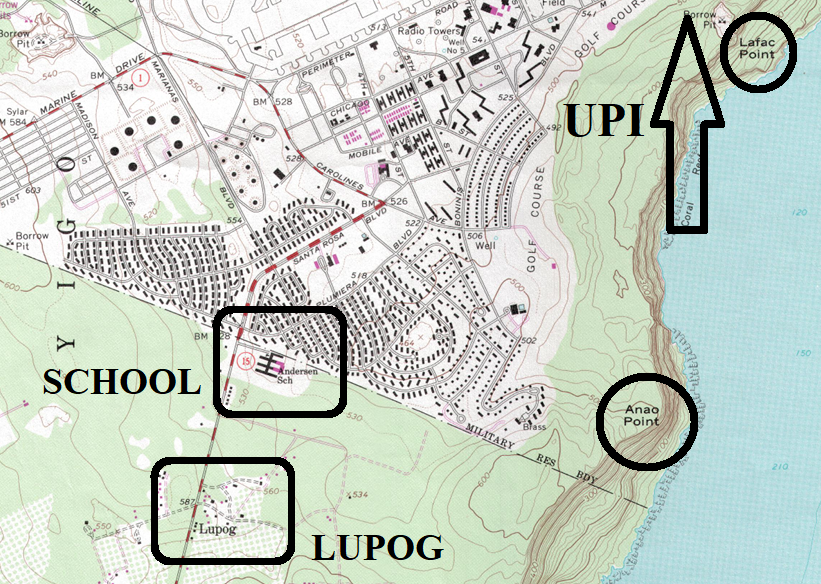
This map based on a 1902 Guam map shows the traditional location of the area called Upi. It is exactly where Andersen Air Force Base sits today.

Thus, the second alleged statement by another individual, that "Upi was actually named after a cluster of homes in the Tarague area" is also in need of clarification. Upi is an area just south of Tarague, but it is its own area, distinct from Tarague. 


AN OLD CONTROVERSY


FROM 1989


Many people associated with Upi Elementary School today want to keep the name as is, but how interesting to find out that, in 1989, the people associated with the school back then actually opposed the name Upi Elementary School.

Prior to 1989, it was Andersen Elementary School. Then the Guam Board of Education voted to change the name to Upi Elementary School. Over 600 people connected to the school opposed it, signing their names to a petition. They preferred the school be called Mount Santa Rosa Elementary School.


WHEN IT WAS STILL ANDERSEN ELEMENTARY
Late 1960s


Those opposing the name Mount Santa Rosa said that the school was not on Mount Santa Rosa, which is south of the school, though not very far.

Those opposing the name Upi Elementary School did so for a number of reasons. Some said no one knew where Upi was nor even how to pronounce it; some pronouncing it YOO-pee. Others said there was no connection between the school and some place they had never heard of.

As for the fear that Upi would be called YOOPEE by others, let it be a lesson. While it is good to anticipate possible problems, they all don't actually become problems. Almost everyone today pronounces Upi the right way, as far as I know.

The question is : is Upi Elementary School in Upi?


WHERE IS UPI?


As seen in the 1902 map, Upi is way at the northeast corner of Guam. Looking at the areas near it, one sees that Late Point is adjacent to Upi. It is definitely north of Anao Point. Upi, properly speaking, is exactly where the air fields of Andersen Air Force Base are.

Upi Elementary School is located well south of that. The school is adjacent to Anao Point.

So Upi Elementary School sits in between Upi and another area called Lupog, just north of Mount Santa Rosa. 


So a better case might be made that Upi Elementary School resides in Lupog, as the map indicates that the school is much closer to Lupog than it is to the air fields of Andersen Air Force Base, which is definitely Upi.


BUT.....

Who says a building or institution has to sit in the geographical location it is named for?

After all, there are many bakeries called Paris Bakery, and grocery stores called Manila Food Store, that are neither in Paris nor in Manila.

Buildings and institutions can be named after places, people and events that mean something to those who use the building or are part of the institution.

And, in the end perhaps, it is they, the users and participants, who ought to decide, since it is they who will have to live each day under that name.

Tuesday, January 10, 2023

I BRUHA


One rarely hears of witches in Chamorro folklore. It's all about taotaomo'na on Guam; birak in the Northern Marianas.

But, in the old days, Chamorros also feared witches, the BRUHA.

Bruha is borrowed from the Spanish word bruja, which means "witch."


FROM 1907

In 1907, an American lady living on Guam wrote about the bruha as she learned about it from Chamorro friends.

Unlike the taotaomo'na, the bruha was never seen.

But she was still able to do much harm.

She was not seen, but could be heard.

One night, a man was eating dinner all by himself when he heard "click, click, click." He knew that sound was from the bruha.

He told the bruha, "Come eat with me. I'm not afraid of you."

All of a sudden, the candle on the table where he was eating blew out. Dishes leapt from the table and smashed against the wall or the floor. The man himself was attacked by an unseen force and his face was covered in blood and his torn hair was all over the room.

The man was only able to chase away the invisible bruha by repeating, "Jesús, María, José." "Jesus, Mary and Joseph."

Tuesday, January 3, 2023

SINANGAN I MAN ÅMKO'


I I'E' HUMUYONG TARAKITO

The I'e' fish became a Tarakito fish


This is a saying applied when a story starts when one person tells it to another person, but by the time the story reaches the 20th person, the story has grown way bigger than it really is.

The i'e' is a small fish. It's actually the name for a kind of fish when it is still in its baby stage.

When the i'e' matures and grows, it is then called tarakito.

So let's say Juan tells Manuel that he was bit by a dog.

Manuel tells Francisco and Francisco tells Lorenzo that Juan was bit by two dogs.

Lorenzo tells Ramón that Juan and his wife were bit by a pack of dogs.

Ramón tells Pedro that Juan and his wife were bit by a pack of dogs when Juan and his wife were picking mangoes from Antonio's tree without permission.

You get the idea.

The tiny fish became a big fish.

It could also be applied, I believe, to embellish a story. After all, who would be impressed if you caught a small fish? But if you single-handedly caught a marlon as big as yourself, people saw "Wow."

I i'e' humuyong tarakito.

Wednesday, December 28, 2022

THE MOON OR MANILA?


Ma faisen si Juan gi eskuela, "Kao hihot-ña i pilan kontra Guam pat hihot-ña Manila?"
(Juan was asked in school, "Is the moon closer to Guam or is Manila closer?")

Ilek-ña si Juan, "I pilan."
(Juan said, "The moon.")

Ilek-ña i ma'estra, "Bai faisen hao ta'lo."
(The teacher said, "I will ask you again.")

Pues ilek-ña si Juan, "Ya pareho ha' bai oppe hao."
(Then Juan said, "And I'll tell you the same thing.")

Mamaisen i ma'estra, "Kao hihot-ña i pilan pat Manila?"
(The teacher asked, "Is the moon closer or Manila?")

Manoppe si Juan, "Esta hu sangåne hao na hihot-ña i pilan."
(Juan replied, "I already told you that the moon is closer.")

Mamaisen i ma'estra, "Håfa taimano?"
(The teacher asked, "How is that?")

Manoppe si Juan, "Gaige yo' Guam ya hu lili'e' ha' i pilan lao ti hu lili'e' Manila."
(Juan replied, "I'm on Guam and I can see the moon but I can't see Manila.")

Wednesday, December 21, 2022

ESCAPE TO SAIPAN?


JK SHIMIZU'S SCHOONER
Mariana Maru


We all know that Guam and the Northern Marianas form two separate governments. Still, both are under the American flag and observe all applicable US Federal laws.

But think about the advantages some people could have had when the two island governments were under separate flags; Guam under the US and the Northern Marianas under Japan.

When that was the case, between 1914 and 1941, the Japanese in Saipan did not have to honor American requests from Guam, and vice-versa, when it came to judicial proceedings.

In 1926, a complaint was filed in Guam's court against a man named Ignacio for illegally possessing a house which rightfully belonged to another.

When he received the summons to appear in court, Ignacio seems to have had other plans : sail to Saipan on JK Shimizu's schooner, the Mariana Maru. There, in Saipan under the Japanese, Ignacio may be able to avoid going to the American court on Guam and face punitive measures.

The plaintiff in the case reported this plan of Ignacio's possible escape to the Court. The Court, in turn, asked the Governor to prevent the schooner from taking Ignacio to Saipan.


REQUEST TO PREVENT DEPARTURE


Instead, the Governor solved the whole situation by allowing Ignacio to sail to Saipan, but in the nature of being DEPORTED.

That was a brilliant stroke of legal manoeuvre. Instead of fleeing, Ignacio was being deported. If he was deported, he could not expect to ever come back. Whatever house he was illegally possessing on Guam was now vacant, and the legal owner could move back in.


ORDER TO DEPORT

Wednesday, December 14, 2022

JAPANESE SMELLS THE MADOYA


JOSEFINA LEÓN GUERRERO MARTÍNEZ


Josefina LG Martínez, a young mother in her 20s, was peacefully frying bananas in her home in Sinajaña one day in 1955. It was 1:30 in the afternoon and she was all alone in the house.

Out of the blue, the frightful appearance of an almost-naked, bearded man startled her when he pushed open the kitchen door.

His beard went down to his chest and his hair down to his shoulders. He held a gun and a saber hung from a rope around his waist. It had to have been a Japanese straggler.

The Japanese motioned with his fingers for her to keep silent, and nudged his gun against her ribs.

Thankfully, the menacing man only grabbed some bananas, both the ripe and also the fried bananas (madoya), saying "beru, beru." which must have been "taberu," Japanese for "to eat." Then he dashed back into the jungle near the house. On his way out he dropped two madoya!


MADOYA


Josefina contacted the police, however, and the Police Chief tasked Juan Unpingco Aguon and José Salas Bukikosa, two police officers who had previously been members of the Guam Combat Patrol that hunted Japanese runaway soldiers after the war, to track down this latest straggler.

But he was never to be seen again. His bones probably lie somewhere in the dense vegetation of the island.


Tuesday, December 6, 2022

FAMILY NICKNAMES : LINCOLN


Jesús Villagómez Santos (1905-1968) had a very pronounced limp, and it wasn't temporary.

It was such a noticeable limp that people would talk about his LIMPING openly.

But people started to play around with the English word "limping" and changed it to LINCOLN.

So, Jesús became known as JESÚS LINCOLN.

"Lincoln," of course, when said, sounds like LINGKON.

To show he took no offense and was a good sport about it, when Jesús and his wife Rosario had their first baby boy, they named him ABRAHAM. In all seriousness, this child could truly be called, in Chamorro fashion, Abraham Lincoln.


JESÚS VILLAGÓMEZ SANTOS
better known as Jesús Lincoln


Jesús was from that branch of Santoses who already had a family nickname, BÅLI TRES. So we see how new nicknames can be applied to individuals and then their children and grandchildren could go by a new nickname.


TWO THINGS

Jesús Lincoln's nickname shows two things about Chamorro culture.

1. We single-out a prominent physical trait or condition of people and it becomes their nickname.

We're not the only culture that does that. Think of all the men nicknamed SLIM or LEFTY in the US.

But God help you if you stand out in any way in the Marianas. Chances are it will become your nickname.

2. We play around with English.

We know the English word and how to say it. But we like to play around with it. "Might as well" becomes MINUS WHALE. "Toilet paper" becomes PAPER TOILET.  LIMPING became LINCOLN for Tun Jesús. And the list goes on.


Tuesday, November 29, 2022

DON'T MESS WITH ROSA


ROSA GUMATAOTAO TENORIO
1888 ~ 1969


Alfonso was a píkaro (naughty) man in his early 20s. He had been caught more than once sneaking into people's homes.

But one night in 1925 he tried once too much.

He made the mistake of sneaking into the house of JUAN NAUTA TENORIO and his wife, the former ROSA GUMATAOTAO.

Rosa was the mother of three young daughters by 1925 : Amanda, aged 18; Rita, aged 16 and Encarnación, aged 15. There were also two young sons, José and Juan, both not even teenagers yet.

But Rosa was no woman to mess with.

It was ten o'clock that night and everyone was in bed, but not necessarily sleeping. Rosa and daughter Encarnación were lying in the såla or living room, evidently on the guåfak or woven floor mat. The two other daughters, Amanda and Rita, were lying on an actual bed in the apusento or inner room/bedroom. The door was shut, but not locked, as was often the case on Guam in those days.

In walked Alfonso, without so much as knocking or calling out, and he quickly blew out the one lamp resting on the table in the såla. 

Immediately, Encarnación called out to whoever this man was, asking why he put out the light. Realizing he was discovered, Alfonso made a run for the door, but Rosa was no slow poke. She caught up to Alfonso just as he got to the door and she grabbed his shirt, holding him back and preventing him from escaping through the door.


Rosa asked, "Why are you here? Are you asking for the hand of any of my daughters?" Denying that he was, he tried to pull free. But Rosa testified in court, "But being of superior strength, I got a piece of iron rod and hit him by the head with it, and then got a piece of rope and tied him to a post in my house, in order to be identified by the authorities. I sent my daughter Amanda to wake up Jesús Matanane Cruz, better known as Ibang, to look for a policeman, which Matanane went away and and came back with a patrolman..." While all this was going on, one of the daughters had lit the lamp again.

Grabbed his shirt; hit him with an iron rod and tied him to a post with rope. Not bad for a Chamorro matron, with no help from a man. Don't underestimate the capabilities of a protective Chamorro mother.

In fairness to Alfonso, he later straightened out, got married and raised a family. Every saint has a past, and every sinner has a future.


A PERSONAL NOTE

I was only seven years old when Rosa passed away, but I knew her daughters Amanda and Rita, who lived close to Saint Jude Church in Sinajaña and went to Mass every day, all dressed for church in mourner's black until their own deaths, which was the old custom.

Had I known this story back in the 1970s and 80s when I knew the two sisters, I would have asked them, "Sangåne yo' pot si Alfonso!" "Tell me about Alfonso!" I would have loved to know what they remembered of this story.

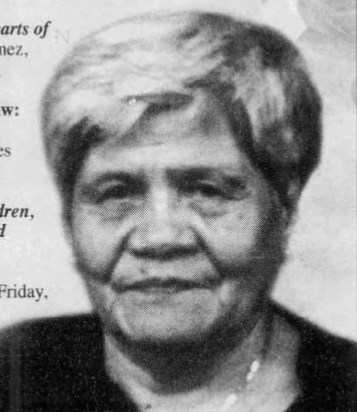
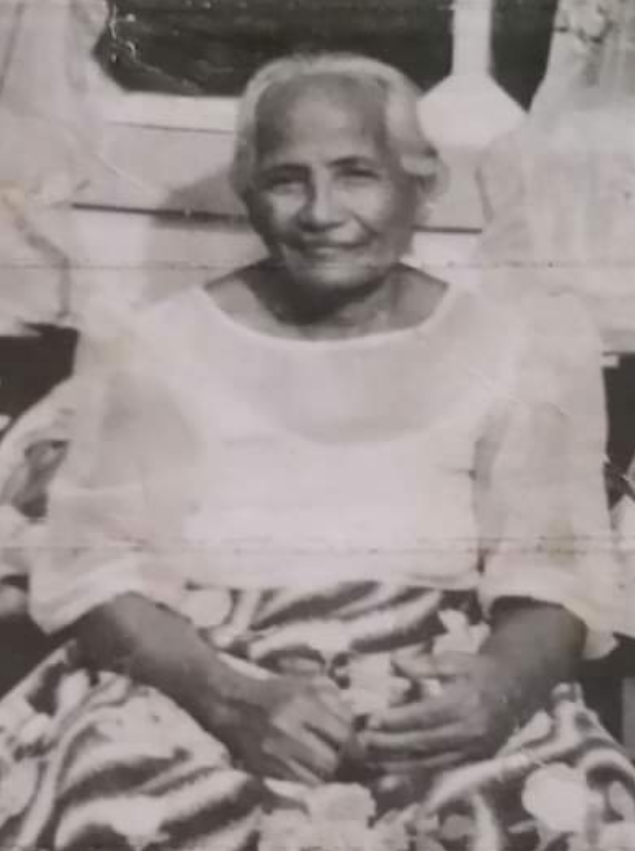
Thanks to my fellow Sinajañan and friend Patricia Tuncap Andrews, great granddaughter of Rosa, for Tan Rosa's photo and to Carmela Cruz, another great granddaughter, for the photo of Encarnación.


THE THREE SISTERS

Wednesday, November 16, 2022

GUAM'S FIRST NURSERY


INFANT OF PRAGUE CATHOLIC NURSERY & KINDERGARTEN
Tå'i, Mangilao

Nurseries, pre-schools, kindergartens and day care centers abound on Guam today, a reflection of modern times when both parents work, or perhaps there is only a mom and she works, so someone needs to care for the little ones during working hours.

In the old days, most families were huge and multi-generational. There were more than enough grandmothers, single aunts, nieces and older sisters to care for the young.

But in 1952, the Mercy Sisters opened Guam's first nursery, where parents could drop off their pre-school children and the Sisters would care for them and begin to educate them.


CHRISTMAS PLAY AT INFANT OF PRAGUE


The Mercy Sisters had moved into their new convent in Tå'i, on church land next to Father Dueñas Memorial School and Seminary, in 1951. In 1952, Sister Redempta Thomas, a stateside Sister and Mercy superior for Guam, decided to open a nursery on land just down the hill from the Mercy convent. A nursery would provide the Sisters with extra income to meet their financial obligations for a rapidly increasing community. Not all the Sisters were inclined to teach in schools; some worked better with pre-school children. Guam was also changing. More parents by then were living in nuclear family houses, without the extended family around to help watch the children, so a nursery was helpful to the parents who could use that help. An early start in their child's education wasn't a bad idea, either.

A permanent concrete building was completed in 1959 which still remains, but it has been added to and improved more than once over the years.


LIFE AT TÅ'I NURSERY IN THE EARLY YEARS


Religion, of course, played a big role in the daily program at the nursery. Basic prayers were taught, as were religious songs, and many of them were in Chamorro. A number of parents were attracted to sending their children to Infant of Prague for this reason; to learn prayers and hymns and also in Chamorro. Religion was reinforced with devotional acts, like May Crownings, and through religious plays.

The children never went hungry. If a child wasn't given a lunch pail from home, the Sisters had an endless supply of Ichiban (ramen) noodles. Some of the Sisters who baked also treated the children with their cakes and other pastries.

So well-cared for were the children that even when parents forgot to pick up their child at the end of the day, they didn't panic when they remembered or got a call from the nursery. Their child was in good hands with the Sisters. One auntie was asked to take the child to the nursery and so she dropped him off, not realizing that the day was a public holiday and there was no school. The convent was just up the hill and a Sister called the parents to come fetch the child.

Many more nurseries and day care centers have popped up all over Guam now, but Infant of Prague is the first. Many of Guam's leaders in every type of career and profession got their first taste of school at Infant of Prague. The nursery is still going strong; full of children, with the Sisters and lay teachers continuing the mission of caring for the children, spiritually and in every other way.


WHO IS THE INFANT OF PRAGUE?


The Infant of Prague is a statue of the child Jesus which is venerated in the city of Prague in the Czech Republic. It has many claims of miraculous episodes in its history. The devotion was very popular in America in the 1950s when the nursery on Guam was established.

Thursday, November 3, 2022

ÅNTES YAN PÅ'GO


The road up to San Ramón Hill, forty-one years apart.

In 1981, the road was decorated for the arrival of Pope John Paul II on February 22, 1981 - the first and only Pope, so far, to visit Guam. He actually spent the night, too, right at the Bishop's House which can be seen in the 1981 photo, at the top of the hill, dead center.

Take away those papal visit decorations, though, and the area was very simple. No curbs along the road up the hill, no new Judicial Center, no office building in the back, no bus stop. Even the vegetation looks sparser. The Latte Stone Park was just that; just latte stones and no picnic cabanas as we have now at the renamed Angel Santos Memorial Park. The wooden telephone poles are now concrete.

The area to the left in the photo, under the hill where the Archbishop's house is, is the barrio of San Ramón.

The area to the right in the photo, what is now Angel Santos Memorial, or Latte Stone, Park, is the beginning of the barrio of Togae (also spelled Togai or Toggai).

Wednesday, October 26, 2022

KÅNTAN GUMA'YU'US : O GAI LISÅYO


This short hymn about the Holy Rosary is almost not a hymn on account of its brevity - just three strophes long with no refrain.

Secondly, the hymn is more than just about the Rosary. Like many of the old hymns, it is catechetical - it teaches Catholic doctrine. And this hymn teaches about the Communion of Saints.

But, first, the hymn :


LYRICS

O gai Lisåyo, Bithen Maria,
(O Virgin Mary, Lady of the Rosary)
mames na Nånan i taotao siha.
(sweet mother of the people.)
Oppan gi tano' : Åbe Maria!
(It resounds on earth : Ave Maria!)
Åbe bula hao gråsia.
(Ave full of grace.)

O gai Lisåyo, Bithen Maria,
(O Virgin Mary, Lady of the Rosary)
mames na Nånan i anghet siha.
(sweet mother of the angels.)
Oppan gi langet: Åbe Maria!
(It resounds in heaven : Ave Maria!)
Åbe bula hao gråsia.
(Ave full of grace.)

O gai Lisåyo, Bithen Maria,
(O Virgin Mary, Lady of the Rosary)
mames na Nånan i ånte siha.
(sweet mother of the Souls in Purgatory.)
Oppan gi guafe : Åbe Maria!
(It resounds in the fire of Purgatory : Ave Maria!)
Åbe bula hao gråsia.
(Ave full of grace.)


EARTH - HEAVEN - FIRE

As you can see, the hymn speaks about PEOPLE on EARTH; ANGELS in HEAVEN and SOULS in the FIRE (of Purgatory).

These are the three communities that make up the Church. These three communities are on EARTH, in HEAVEN and in PURGATORY.

We also call them the CHURCH MILITANT, the CHURCH SUFFERING and the CHURCH TRIUMPHANT.


First of all, there is you and me. We're still here on earth, struggling hard, with the help of God's grace found in prayer and Sacraments, to abide by the Lord's teachings even though the world goes by its own rules, and we face hardships of every kind. It is a real battle, spiritually. So the Church fighting the spiritual battle is called the Church Militant.


After we have died and left the battle field of the earth, most of us will go through Purgatory where we will purified of all that is in us that isn't worthy of heaven - our imperfections, the harm we did while on earth that we haven't repaired, the penances never done and so on. This delay of heaven is of immense suffering to the soul in Purgatory, who longs for heaven but cannot enter it for a while. The Church enduring the pains of Purgatory therefore is called the Church Suffering.


And on that blessed day that our souls, now made spotless for heaven, enter the full vision of God, we will rejoice in God's presence, with the saints and angels. The Church that enjoys the perfect joy of heaven is called the Church Triumphant.

All three communities that make up the Church are spiritually united with each other. Death does not separate us on earth from the Souls in Purgatory, who need our prayers, and the Saints in Heaven, who pray for us. This is what we call the Communion of Saints.

Our Lady is Queen and Mother of all three parts that make up the Church. She is with the Church Triumphant in heaven, praying for us the Church Militant on earth and also for the Church Suffering in Purgatory.


GERMAN ORIGINAL

Lawrence Borja has found a German hymn on which the Chamorro one is based.

Not only is the melody the same, the subject of the hymn is the same, i.e. Our Lady of the Rosary. The German title is Rosenkranzkönigin, which means "Queen of the Rosary." The composer was the German priest Michael Haller. Påle' Román used Haller's hymns quite a bit when writing Chamorro versions of hymns.


Thursday, October 20, 2022

WHEN YOUR COMPADRE TAKES YOU TO COURT


When the biological father chooses a godfather for his child to be baptized, the two fathers become compadres, also called kompaire. Com (together, with) and padre (father).  Co-fathers. One biological, the other spiritual.

This arrangement creates a bond that lasts for life. Compadres come to each other's aid whenever needed.

In the village of Inalåhan in 1924, Isidoro Chargualaf Taimanglo received a bakiya (a heifer or young female cow) as payment for services rendered to a Japanese settler in the village named Antonio Kamo.

Taimanglo kept the bakiya at a place outside the village but eventually brought it into town to tame the animal and, while it was in the village, Manuel Dueñas Flores claimed the  bakiya as his own.

Taimanglo took the matter to court. Flores, meanwhile, stated that Kamo had given away two bakiya, one to Taimanglo and the second one to Flores. The bakiya Flores took was his, not Taimanglo's. Taimanglo denied Flores' version of the story.

But when the day came for the case to be heard in court, Pancracio Palting, Taimanglo's lawyer, told the judge that Taimanglo wanted to withdraw his complaint, as he and Flores were compadres. He proposed that both Taimanglo and Flores divide the bakiya between them when slaughtered, and share the court costs fifty-fifty.

Flores accepted the proposal and the case was dismissed. All because the two opponents were compadres.


VERSIÓN ESPAÑOLA
(traducida por Manuel Rodríguez)


KOMPAIRE

Cuando un padre biológico elige a un padrino para bautizar a su hijo, ambos se convierten en compadres, también llamados “kompaire” en chamorro. Kom (junto, con) y paire (padre). Co-padres. Uno biológico, el otro espiritual.

Este arreglo crea un vínculo que dura toda la vida. Los compadres acuden en ayuda mutua cuando es necesario.

En el pueblo de Inaraján en 1924, Isidoro Chargualaf Taimanglo recibió una “bakiya” (una novilla o vaca joven) como pago por los servicios prestados en el pueblo a un japonés llamado Antonio Kamo.

Isidoro Taimanglo mantuvo la “bakiya” fuera del pueblo, pero después decidió llevarla y domesticarla y, mientras estaba en el pueblo, Manuel Dueñas Flores reclamó la “bakiya” como suya.

Isidoro Taimanglo llevó el asunto a los tribunales. Manuel Flores, por su parte, afirmó que Antonio Kamo había regalado dos “bakiya”, una a Isidoro Taimanglo y la otra a Manuel Flores. La “bakiya” que tomó Manuel Flores era suya, no de Isidoro Taimanglo. Pero Isidoro Taimanglo negó la versión de Manuel Flores.

Cuando llegó el día de la audiencia del caso, Pancracio Palting, abogado de Isidoro Taimanglo, le dijo al juez que Isidoro Taimanglo quería retirar su denuncia, ya que él y Manuel Flores eran compadres. Propuso que tanto Isidoro Taimanglo como Manuel Flores dividieran la “bakiya” entre ellos cuando la sacrificaran, y que compartieran los costos de los tribunales al cincuenta por ciento.

Manuel Flores aceptó la propuesta y el caso fue sobreseído. Todo porque los dos opositores eran compadres.