Thursday, October 20, 2022

WHEN YOUR COMPADRE TAKES YOU TO COURT


When the biological father chooses a godfather for his child to be baptized, the two fathers become compadres, also called kompaire. Com (together, with) and padre (father).  Co-fathers. One biological, the other spiritual.

This arrangement creates a bond that lasts for life. Compadres come to each other's aid whenever needed.

In the village of Inalåhan in 1924, Isidoro Chargualaf Taimanglo received a bakiya (a heifer or young female cow) as payment for services rendered to a Japanese settler in the village named Antonio Kamo.

Taimanglo kept the bakiya at a place outside the village but eventually brought it into town to tame the animal and, while it was in the village, Manuel Dueñas Flores claimed the  bakiya as his own.

Taimanglo took the matter to court. Flores, meanwhile, stated that Kamo had given away two bakiya, one to Taimanglo and the second one to Flores. The bakiya Flores took was his, not Taimanglo's. Taimanglo denied Flores' version of the story.

But when the day came for the case to be heard in court, Pancracio Palting, Taimanglo's lawyer, told the judge that Taimanglo wanted to withdraw his complaint, as he and Flores were compadres. He proposed that both Taimanglo and Flores divide the bakiya between them when slaughtered, and share the court costs fifty-fifty.

Flores accepted the proposal and the case was dismissed. All because the two opponents were compadres.


VERSIÓN ESPAÑOLA
(traducida por Manuel Rodríguez)


KOMPAIRE

Cuando un padre biológico elige a un padrino para bautizar a su hijo, ambos se convierten en compadres, también llamados “kompaire” en chamorro. Kom (junto, con) y paire (padre). Co-padres. Uno biológico, el otro espiritual.

Este arreglo crea un vínculo que dura toda la vida. Los compadres acuden en ayuda mutua cuando es necesario.

En el pueblo de Inaraján en 1924, Isidoro Chargualaf Taimanglo recibió una “bakiya” (una novilla o vaca joven) como pago por los servicios prestados en el pueblo a un japonés llamado Antonio Kamo.

Isidoro Taimanglo mantuvo la “bakiya” fuera del pueblo, pero después decidió llevarla y domesticarla y, mientras estaba en el pueblo, Manuel Dueñas Flores reclamó la “bakiya” como suya.

Isidoro Taimanglo llevó el asunto a los tribunales. Manuel Flores, por su parte, afirmó que Antonio Kamo había regalado dos “bakiya”, una a Isidoro Taimanglo y la otra a Manuel Flores. La “bakiya” que tomó Manuel Flores era suya, no de Isidoro Taimanglo. Pero Isidoro Taimanglo negó la versión de Manuel Flores.

Cuando llegó el día de la audiencia del caso, Pancracio Palting, abogado de Isidoro Taimanglo, le dijo al juez que Isidoro Taimanglo quería retirar su denuncia, ya que él y Manuel Flores eran compadres. Propuso que tanto Isidoro Taimanglo como Manuel Flores dividieran la “bakiya” entre ellos cuando la sacrificaran, y que compartieran los costos de los tribunales al cincuenta por ciento.

Manuel Flores aceptó la propuesta y el caso fue sobreseído. Todo porque los dos opositores eran compadres.

Wednesday, October 5, 2022

SAMOAN VILLAGE IN SAIPAN


SITE OF SAMOAN VILLAGE IN SAIPAN
1909 to 1915


In 1909, both Saipan and Samoa belonged to Germany.

Among the various differences between the two places owned by a common colonial power, the Chamorros and Carolinians of Saipan accepted German rule without a whimper, but not all the Samoan chiefs did.

A Samoan resistance movement against the Germans called Mau a Pule concerned the Germans so much that they exiled 10 chiefs involved in the movement to Saipan in 1909. The German ship SMS Jaguar took them, and their wives and children, some 72 in all, to Saipan in April of that year. A German colonial journal said that deportation was a severe punishment for the Samoans, since they were so attached to their native land.


SAMOAN CHIEFS HEADED FOR SAIPAN


The Samoans at first lived in a government building near the landing pier in Garapan but this was just temporary. The Germans always had in mind to keep the Samoans in their own separate community. Considered "rabble rousers," the Germans may have wanted to keep them apart to prevent them influencing the Chamorros and Carolinians, though those fears would have amounted to nothing, given the docility of the Chamorros and Carolinians. Still, the Samoans sent to Saipan were not regular settlers; they were political prisoners, having had no prior contact with Chamorros or Carolinians, so a separate place for them was decided.

It was hard, at first, to convince the Samoans to live in their own settlement, according to the German colonial journal, but the German officials took the Samoan leaders to scout areas and it was decided to build in this area just south of Tanapag. Tanapag was a small community of a few hundred people, and the Samoan camp would be two and a half miles away from Garapan, the capital, with its much larger population.


The area was situated just south of a stream called Saddok as Agaton. The German journals say that the water was clean and drinkable, but eventually water was fed through bamboo pipes from a spring called Bo'bo' Agaton.

The ocean was right at their doorstep and the area had breadfruit and coconut trees.  Each family was given the same amount of land to grow their own foods, and the taro patch was common to all. The Samoans also traded food with the Tanapag villagers. 

The houses were built with prison labor, since the Samoan deportees were political, not criminal, prisoners. Each chief had his own dwelling. A Protestant pastor came with them, and he also his own quarters as well as a prayer house where he conducted daily services. There were a few Catholics in the group, but they could go to the Catholic church in Garapan.


CHIEF LAUAKI NAMULAU'ULU MAMOE
One of the leading chiefs who lived in Saipan


In October 1914, Japan took over the Northern Marianas from the Germans on account of World War I. It took a while to get things moving, but the Samoans finally got their chance to leave Saipan and return to Samoa in June of 1915.

One of the chiefs, I'iga Pisa, didn't wait for that but, instead, sneaked away in a canoe to Guam where he spent a few years, then returned to Samoa.

Four Samoan chiefs had died in Saipan before the group could return to Samoa. That left five chiefs who boarded the ship to go back to Samoa, minus I'iga Pisa in Guam. But one of them, Lauaki, died during the voyage before the group arrived in Samoa, so only four chiefs made it back on that trip. Pisa returned his own way later.

The bones of the four chiefs who died on Saipan, and others among the Samoans who also died in Saipan, were brought back to Samoa.


Tuesday, September 27, 2022

MOTHER'S MILK


I met a man attending a funeral and, to make conversation, I asked him if he knew the deceased man. This is how the conversation went.

~ Kao un tungo' i difunto?
(Did you know the deceased?)

~ Hu tungo' håye gue' sa' man besino ham gi annai man dikkike' ham. Lao achok ha' ti gos amigu-ho gue', menestet na bai hu fåtto gi entieriu-ña pot otro na rason.
(I knew who he was because we were neighbors when we were small. But although he was not a close friend, it was important that I come to his funeral for another reason.)

~ Ya håfa ennao?
(And what is that?)

~ Gi annai sais åños yo', man hugåndo ham ni famagu'on gi tatten guma' ya ha danche i matå-ho un pedåson kriståt annai ma panak un boteya ya måffak. På'go mafañågo i difunto pues humånao si nanå-ho para as nanå-ña i difunto para u fan ayao leche ginen i sisu-ña si nanå-ña ya ma åmte i matå-ho ni lechen i nana. Pues hu didibe i difunto meggagai sa' an ti mafañågo gue' ti u gai leche si nanå-ña guihe na tiempo.
(When I was six years old, we kids were playing behind the house and a piece of glass hit my eye when they hit a bottle and it broke apart. The deceased was just born so my mother went to his mother to borrow milk from his mother's breast to treat my eye with the mother's breast milk. So I owe the deceased a lot because if he had not been born his mother wouldn't have had breast milk at that time.)

Some blog readers always ask to hear how the Chamorro sounds :


BREAST MILK AS MEDICINE


Science tells us what Chamorro mothers knew all along.

Breast milk has a lot of health benefits, even for the mother! But not only is breast milk good for the baby to drink and put inside the body, the anti-bacterial properties of mother's milk can be used to treat external problems such as skin rashes and pink eye.

Different cultures use breast milk for all sorts of conditions. Chamorros in the past used it to treat eye ailments.

Tuesday, September 20, 2022

PREGNANT IN PRISON


In the 1920s, María was arrested and taken to court. The crime? Adultery.

She was found guilty and sentenced to serve time in Hagåtña's civil jail.

There was one other factor involved. María was pregnant. Probably by the man with whom she had an adulterous affair.

How could María take care of an infant while serving time? She had no relatives living in Hagåtña either.

When her time came, María gave birth in the Naval Hospital. The doctor entrusted the newborn, a baby boy, to a man named José and his wife Dolores.

Although the court records don't say it, we know from census records that José and Dolores were childless at the time. Childless couples often adopted children from single mothers who were in difficult situations. But how did the doctor know José or Dolores?

Court documents do say there were no relatives available. Census records show that María's parents were deceased by the 1920 Census. Her siblings, if she had any, may have also passed by then.

At any rate, María agreed that José and Dolores take care of her son and, not only that, that they be legally appointed custodians of the boy.


A SURPRISING TWIST

The old Chamorro belief was that a barren couple, by adopting children, would be rewarded by God with biological children of their own making.

José and Dolores did have one son, born five years after they adopted the imprisoned woman's boy. And this one biological son of theirs gave José and Dolores SIXTEEN grandchildren.

Wednesday, September 14, 2022

DOLOROSA MEDLEY


The Sorrowful Mother is a big part of traditional Chamorro devotion. Chamorro women, especially mothers, strongly identify with the Virgin Mary's sorrows.

In Chamorro, she is known as i Dolorosa, the "Sorrowful One." Many Chamorro women were also called Dolores in past times. Both these names, Dolorosa and Dolores, come from the Spanish word for pain, which is dolor.

The Dolorosa has her own section in the traditional Chamorro hymn book (Lepblon Kånta) on Guam. Her feast day is September 15 and the parishioners of Santa Rita have been praying her novena and singing many of her hymns.


Here's the English translation just of the verses they sang in the video.

SEN MAHÅLANG SI MARIA (Mary was Very Sorrowful)

Sen mahålang si Maria, annai taigue i Saina-ta.
(Mary was very sorrowful when our Lord was absent.)
Mañe’lu-ho pinitiye i maså’pet i Nanå-ta.
(Brethren, feel sorrow for the sufferings of our Mother.)

Kololo’-ña nina’ låmen annai måtai gi fi’on-ña.
(She was wounded worse when He died by her side.)
Ma atåne gi kilu’us i yini’us na patgon-ña.
(Her divine child was nailed to the cross.)
Sen pinite si Maria sa’ ma puno’ i Saina-ta.
(Mary was greatly pained because our Lord was killed.)

SAOSAO NÅNA (Wipe Mother)

Saosao Nåna i lago’-mo,
(Wipe your tears, Mother,)
guåho muna’tånges hao.
(I made you weep.)
Lao mañotsot yo’ magåhet
(But I am truly sorry)
sa’ hu na’ pinite hao.
(because I hurt you.)

O Bithen mipinite hasuye i tinago’
(O Virgin full of sorrow remember the command)
Nina’i-ña nu hågo na un adahe yo’.
(Given to you to care for me.)
Mañotsot i anti-ho, hu setbe hao Nanå-ho
(My soul repents, I will serve you, my Mother)
Hu ago’ i bidå-ho ya un gofli’e yo’.
(I change my ways and you will love me.)

NÅNAN PINITE (Mother of Sorrows)

Nånan pinite, nånan ma guaiya
(Mother of sorrows, beloved mother)
Po’lo ya guåho hu sångan a’gang
(Let me declare loudly)
I masa’pet-mo piniten nåna
(Your sufferings, a mother's sorrows)
Nu i Lahi-mo ni i ma klåba.
(for your Son who is crucified.)

Ya i Katbårio nai ma sen anña’
(And Calvary was where He was truly struck)
Ma na’ taidahok i tataotao-ña
(His body was stripped of clothing)
Ya ma atåne addeng kanai-ña
(and His feet and hands nailed)
Gi trongkon håyo kalan gue’ gå’ga’.
(to the tree as if He were an animal.)

MA KANA' GI KILU'US (He was Hung on the Cross)

Umågang i Saina-ta ilek-ña “Må’ho yo’.”
(Our Lord cried out saying, "I am thirsty.")
I taihanom na Nåna yinengyong takhalom.
(The waterless Mother was shaken deep within.)
Mamichao gi matå-ña dos lågo’ dångkulo.
(Two large tears burst from here eyes)
Ya ayo ha atu’e i må’ho na påtgon.
(And that is what she offered her thirsty child.)

Ma kana' gi kilu'us. Maså'pet fehman gue'.
(He was hung on the cross. He suffered intensely.)


Friday, September 9, 2022

QUEEN ELIZABETH ON GUAM


THE QUEEN WITH GOVERNOR RICKY BORDALLO
and First Lady Madeleine Bordallo with Prince Philip


As the world mourns the passing of a Queen almost all of us have known all our lives, let us recall the time that Queen Elizabeth made a short visit to Guam on May 4, 1975.

She has been all over the world, but not to every single country or place. She never visited some countries, close to Guam, who are huge compared to our small corner of the world. But she came to us, even if it was for just an hour.

Word first reached Guam in March of 1975 that the Queen would make a stop on Guam as part of her Asian tour, with Hong Kong (still under British rule) and Japan on the schedule.

She was originally supposed to stay two days on Guam, but the presence of thousands of Vietnamese refugees changed her mind. She didn't want the island to divert attention from the needs of all those refugees.

An advance team from London came out to Guam not only to look over security, but also to explain the rules of dealing with the British monarch.


BRITISH SUBJECTS WELCOME HER AT THE AIRPORT


The Queen's plane landed at Guam International Airport at 1:13PM on Sunday, May 4, 1975. The royal couple (husband Prince Philip accompanied the Queen) then went in separate limousines to Government House. The Governor, Ricky Bordallo, and the Queen in one car, and Prince Philip and First Lady Madeleine Bordallo in another car.

They went from the airport to Hagåtña by way of Maite, avoiding Marine Corps Drive.

At Government House, the Queen enjoyed the view of the island. Some refreshments were served, gifts were exchanged and the conversation kept light and social. This was not a formal, state visit. But, royal protocol was observed in dress and food. Military and a few other officials were present, but otherwise the affair was kept to minimal attendance. There were thirty members of her entourage from London to begin with!


Then it was time for the Queen to return to her plane and continue her journey. Her Guam visit lasted about an hour.

Madeleine Bordallo remembers a bet that the Queen never made with Prince Philip which she would have won. Flying over Guam, they saw gray canvases all over one area. Prince Philip said they were the canvas tops of military vehicles. The Queen told Madeleine this and Madeleine replied, "Oh no, ma'am, those are canvass tents for the refugees." And the Queen said, "I would have won that bet."

Guam residents who were British subjects, of course, were very happy to welcome their Queen. They took out a full-page ad in the newspaper to greet her. I hope someone showed the Queen a copy of the PDN!


I was never a British subject, but my grandfather was, when the British ruled Ireland (there are six Irish counties they still occupy).

My grandfather, it is said, ran off to America to escape British rule. Still, my dad took me to the hillside across Government House with a hundred or so other people to see the British Queen's limo drive by.

Tuesday, September 6, 2022

FEW OBESE


GRANDMA WALKING BAREFOOT FOR MILES TO THE RANCH
before the war


In the 1990s, an older woman shared with me this description of prewar life on Guam.


Ai, åntes de gera, håssan yommok. 
(Oh, before the war, there were few overweight people.)

Håfa na ti meggagai na taotao man yommok åntes de gera?
(Where weren't there many overweight people before the war?)

Ke sa' megai-ña na in kanno' håfa in tanom gi gualo' pat in kenne' gi tasi. Nahong ha' para in fan lå'la' lao diddide' golosina na klåse. Ayo ha' i in nesesita. Titiyas, atule, guihan, chåda'. I mannok, hame in pepeksai. I hineksa' yan kåtne mås para an Damenggo pat gupot.
(Well because we mainly ate what we grew on the farm and caught in the sea. It was enough for us to live, but very few delicacies. Just what we needed. Flat bread, corn porridge, fish, eggs. The chicken we raised ourselves. Rice and meat were more for Sundays or parties.)

Yanggen para in fanmamåhan gi tienda, ni bes en kuåndo ha' na in che'gue, para arina yan laterías; satmon, leche, latan kåtne. Lao megai-ña na in kanno' håfa in tatanom gi gualo'.
(When we were to buy from a store, which we did only once in a while, it was for flour and canned goods; salmon, milk, canned meat. But we mainly are what we planted on the farm.)

Pues, fuera de ennao, man macho'cho' ham duro guihe na tiempo. Desde ke man makmåta ham asta ke man maigo' ham. Ya ti ma nanangga asta ke sumottera pat sumottero hao para un tutuhon macho'cho'. Yanggen esta hao siña mamokkat, siempre u guaha para tareå-mo. Makkat i lina'la' åntes de gera.
(Then, more than that, we worked hard in those days. From the time we woke up till we slept. And they didn't wait for you to be a teenager for you to start working. If you could walk, you would have your task. Life before the war was hard.)

Mañåga ham Hagåtña lao gaige i gualo'-måme giya Lu'ayao pues debe de in fanmamokkat desde Hagåtña para ayo na lugåt katna ha' kada dia. Guaha karetan guaka lao ti todo siña man hulat man ma udai guihe. Para håfa ham ni "diet" sa' esta nahong i diårio na cho'cho' para bai in fan dalalai.
(We lived in Hagåtña but our farm was in Lu'ayao, so we had to walk from Hagåtña to that place almost every day. There was a bull cart but not everyone could fit to ride on it. We didn't need to 'diet' because daily work was enough to keep us thin.)

Åntes de gera, i yemmok kumekeilek-ña na riko hao. Kololo'-ña i asaguan i riko na taotao. Pot i ti ha nesesita macho'cho' i riko na palao'an. Sumåsåga ha' gi halom guma' ya guaha muchachå-ña para todo i che'cho' halom guma'.  Tåya' na mamokkat para i gualo' yan guaha karetan asaguå-ña yanggen para u paseo. Yan, pot i riko, meggai finahån-ña na nengkanno' ginen i tienda ni na' yommok.
(Before the war, to be fat meant you are rich. Especially the wives of rich men. Because the rich woman didn't need to work. She stayed indoors and had a servant to do the housework. She never walked to the farm and she had her husband's cart to go around in. And, because she was rich, she had a lot of store-bought food which was fattening.)

Tuesday, August 30, 2022

LAUNDRY WOMAN'S PAY


LABANDERA


In 1923, a woman named JOSEFA and her two adult daughters IGNACIA and SOLEDAD washed laundry for a living.

A washerwoman, or laundry woman, in Chamorro is a LABANDERA.

A court case gives us an idea how much they made every month doing this work. 

Their three clients, and how much they paid each month, were :

JULIANA SALAR PÉREZ, the wife of Juan Díaz Torres - $7.00

CONCEPCIÓN TORRES CALVO, the wife of Jacques Schnabel - $6.00

PEDRO LIZAMA CEPEDA (Kókora) - $5.00

That made a total income of $18.00 per month. In today's value, that would be $312. That doesn't sound like a lot of money, and that was the income of three people, not just one, but people in those days also didn't need cash as much as they did after the war. Many things came free of charge from mother nature if you were able to farm and fish. If they made that income all twelve months of the year, it would make an annual income of $3744 in today's value.

Keep in mind that's income from just three clients. Imagine if they took on more.

This information also shows how much money the clients had. All three came from the "respectable" class of people, and the two ladies came from the upper tier of Chamorro society. Juliana's husband had occupied government positions and Concepción's father was a Manila college graduate and Island Attorney for Guam.

Pedro'n Kókora's monthly bill of $5 would be $86 in today's value. No small expense.

A good number of Chamorro women made a living as labandera, especially for American military officers, besides the affluent civilians.

The court case makes it clear that all the earnings of the three women went to the purchase of iron roofing for a new house being built by the husband/father. The iron roofing was bought from the store of JK Shimizu.


VERSIÓN ESPAÑOLA
(traducida por Manuel Rodríguez)

EL SALARIO DE  UNA LAVANDERA

En 1923, una mujer llamada JOSEFA y sus dos hijas adultas IGNACIA y SOLEDAD lavaban ropa para ganarse la vida.

Lavandera, en chamorro se dice “LABANDERA”.

Un caso judicial nos da una idea de cuánto ganaban cada mes haciendo este trabajo.

Sus tres clientes, y cuánto pagaban éstos cada mes, eran:

JULIANA SALAR PÉREZ, la esposa de Juan Díaz Torres - 7.00 dólares

CONCEPCIÓN TORRES CALVO, la esposa de Jacques Schnabel - 6.00 dólares

PEDRO LIZAMA CEPEDA (Kókora) - 5.00 dólares

Eso sumaba un ingreso total de 18.00 dólares por mes. En el valor de hoy, sería 312 dólares. No parece mucho dinero, y ése era el ingreso de tres personas, no solo de una, pero la gente en aquellos tiempos tampoco necesitaba tanto dinero en efectivo como después de la segunda guerra mundial. Muchas cosas venían gratis de la madre naturaleza, si podía uno cultivar y pescar. Si tuvieran ese ingreso los doce meses del año, generaría un ingreso anual de 3744 dólares en valor actual.

Tengan en cuenta que son ingresos de solo tres clientes. Imagínense si aceptaran más.

Esta información también muestra cuánto dinero tenían los clientes. Los tres procedían de la clase "respetable" de personas, y las dos damas procedían del nivel superior de la sociedad chamorra. El esposo de Juliana había ocupado puestos gubernamentales y el padre de Concepción se había graduado en la Universidad de Santo Tomás en Manila y era el fiscal de la isla de Guam.

La factura mensual de Pedro'n Kókora de 5 dólares sería 86 dólares en el valor de hoy. No es un gasto pequeño.

Un buen número de mujeres chamorras se ganaban la vida como “labandera”, especialmente para los oficiales militares estadounidenses, además de los civiles adinerados.

El caso judicial aclara que todas las ganancias de las tres mujeres se destinaron a la compra de techos de hierro para una nueva casa que estaba construyendo su esposo y padre. El techo de hierro se compró en la tienda de JK Shimizu.


Tuesday, August 23, 2022

YOUR AMERICAN IS SHOWING : MÅNHA TITIYAS


QUICK LESSON

In English, we say APPLE Pie. What KIND of pie? Apple.

CHOCOLATE Cake. What KIND of cake? Chocolate.

But, in Chamorro, the order is reversed. Buñuelos AGA'. What KIND of buñuelos? Aga'.

It is Pån TUBA. What KIND of pån? Tuba.

Therefore, in Chamorro, it is Titiyas MÅNHA. What KIND of titiyas? Månha.

To the Chamorro ear, saying MÅNHA TITIYAS is as unpleasant as is saying PIE APPLE or CAKE CHOCOLATE to the English ear.


FULLER LESSON


The mighty march of Americanization continues in the minds of our younger Chamorros of Guam. Swimming in an ocean of the English language, surrounded by English water from the moment one wakes up to the moment one falls asleep, and being the only language so many of our people under the age of 60 speak, it is no surprise that even when Chamorro people use a Chamorro phrase, they use it in an American way. They don't even realize it.

One glaring example of this is how widespread the phrase MÅNHA TITIYAS is.

That's an American way of using Chamorro words to describe Young Coconut Flatbread.

Chamorro flatbread is called TITIYAS, a Chamorro version of the Spanish word TORTILLA.

Now there are many kinds of titiyas. Titiyas can be made with corn (mai'es), wheat flour (arina), breadfruit (lemmai) and pretty much any carb that can be made into a flour or incorporated into flour.

But in Chamorro we put the KIND of thing it is AFTER the thing itself.

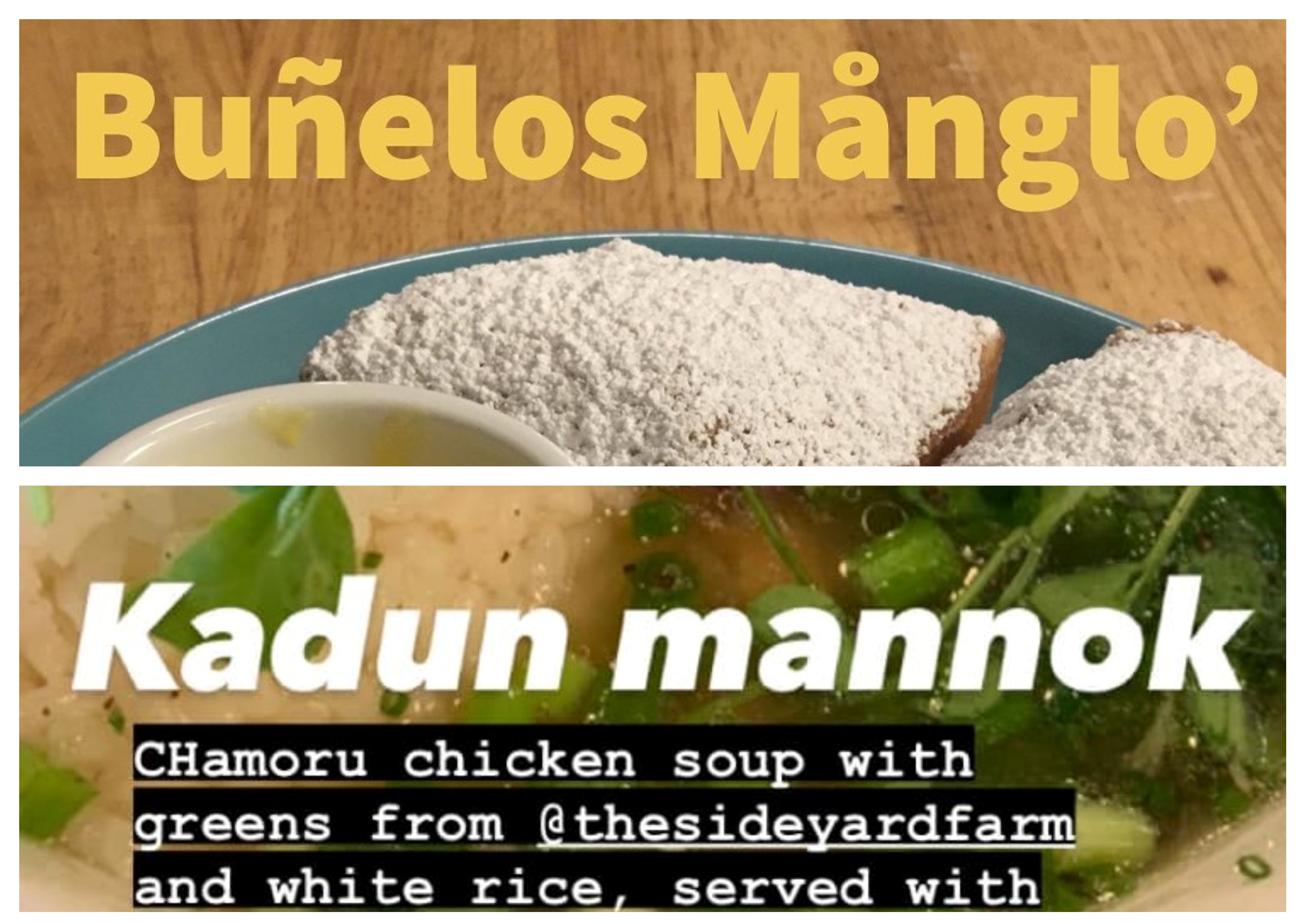
Notice in this picture we don't say MÅNGLO' BUÑUELOS (Wind Donuts). We say BUÑUELOS MÅNGLO' (Donuts Wind). What KIND of donuts is said AFTER we identify it as donuts.

We don't say MÅNNOK KÅDDO (Chicken Stew). We say KÅDDON M­ÅNNOK (Stew Chicken). What KIND of stew is mentioned AFTER we call it stew.


Notice the pattern in PÅN TUBA (Bread Coconut Toddy), NOT tuba pån (coconut toddy bread). KELAGUEN UHANG (Marinated Salad Shrimp), not uhang kelaguen (shrimp marinated salad).

In English, what KIND of thing it is comes before the name of the thing. APPLE Pie. BEEF Jerky. CHOCOLATE Cake.

But it's the other way around in Chamorro. KELAGUEN BENÅDO. PÅN TOSTA. Therefore TITIYAS MÅNHA.

Even when we use the English word "soup," it's SOUP CANDELARIA, NOT Candelaria Soup.


SO.......


Go ahead and say SPAM KELAGUEN or FLOUR TITIYAS, combining English and Chamorro.

But if you're going to use the full Chamorro name of the food, put it in the right order in the Chamorro language.

VERSIÓN ESPAÑOLA
(traducida por Manuel Rodríguez)

TITIYAS MANHA

En inglés, decimos APPLE Pie (pastel de manzana). ¿Qué TIPO de pastel? De manzana.

CHOCOLATE Cake (tarta de chocolate). ¿Qué TIPO de tarta? De chocolate.

Pero, en chamorro, el orden se invierte. Buñuelos AGA' (buñuelos de plátano). ¿Qué TIPO de buñuelos? De aga’ (de plátano).

Se dice Pån TUBA. ¿Qué TIPO de pan? De tuba (de ponche de coco) .

Por lo tanto, en chamorro, se dice Titiyas MÅNHA. ¿Qué TIPO de titiyas? De manha (de coco verde).

Para el oído chamorro, decir MÅNHA TITIYAS es tan desagradable como para el oído inglés decir PIE APPLE o CAKE CHOCOLATE.

La poderosa marcha de la angloamericanización en Guam continúa en la mente de nuestros chamorros más jóvenes. Nadar en un océano de idioma inglés, rodeado de agua inglesa desde el momento en que uno se despierta hasta el momento en que se queda dormido, y siendo el único idioma que habla mucha de nuestra gente menor de 60 años, no sorprende que incluso cuando los chamorros usan una frase chamorra, la usan a la manera angloamericana. Ni siquiera se dan cuenta.

Un ejemplo evidente de esto es cuán erróneamente extendida está la frase MÅNHA TITIYAS.

Ésa es una forma angloestadounidense de usar palabras chamorras para describir este pan plano elaborado con coco verde.

El pan plano chamorro se llama TITIYAS, una versión chamorra de la palabra española TORTILLAS.

Ahora bien, hay muchos tipos de titiyas. Las titiyas se pueden hacer con maíz (mai'es), harina de trigo (arina), fruta del pan (lemmai) y casi cualquier carbohidrato que se pueda convertir en harina o incorporar a la harina.

Pero en chamorro decimos el TIPO de cosa que es DESPUÉS de la cosa misma.

Fíjese que no decimos MÅNGLO' BUÑUELOS. Decimos BUÑUELOS MÅNGLO' (Buñuelos de Viento). El TIPO de buñuelos se dice DESPUÉS de que identifiquemos tal cosa como buñuelos.

No decimos MÅNNOK KÅDDO. Decimos KÅDDON MÅNNOK (caldo de pollo). El TIPO de caldo se menciona DESPUÉS de que lo llamemos caldo.

Observe que se dice PÅN TUBA (Pan de Tuba o de ponche de coco), NO tuba pån. Se dice KELAGUEN UHANG (Ensalada de Camarones Marinados), no uhang kelaguen.

En inglés, el TIPO de cosa se dice antes del nombre de tal cosa. APPLE Pie (pastel de manzana). BEEF Jerky (carne seca). CHOCOLATE Cake (tarta de chocolate).

Pero en chamorro se dice a la manera inversa. KELAGUEN BENÅDO (ensalada de venado). PAN TOSTA (pan tostado). Por lo tanto se dice TITIYAS MÅNHA (tortillas de coco verde).

Si usted va a usar el nombre completo de la comida en chamorro, póngalo en el orden correcto en el idioma chamorro.

Tuesday, August 16, 2022

SAIPAN CAROLINIANS IN CHINA?


CAROLINIAN CANOES


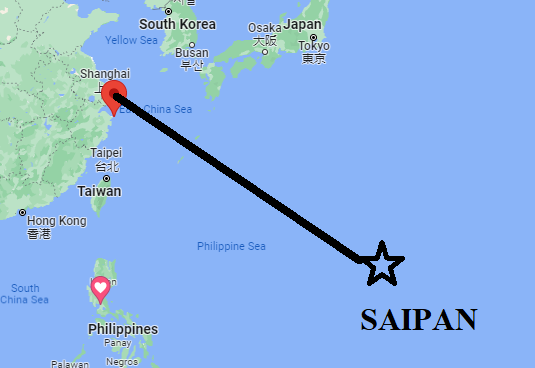
Sometime in 1909, Chinese fishermen discovered a canoe, with three unknown sailors from a different land, off Zhoushan Island in China, very close to Shanghai. What the Chinese did know was that these three foreign sailors were hungry, thirsty and weak. Had they not been discovered, they would probably had perished.

The Chinese fishermen took the three castaways to the civil authorities, but no one could speak to them as they had no common language.

The three lost sailors were described as being dark with frizzy hair. They wore huge earrings made of coral and shell, and necklaces made of the same material. The oldest of the three, who had a beard, also had tattoos. The only possession they had were two boxes of simple fishing material such as twines and hooks. Wearing only enough to cover their private parts, some of the people who found them gave them shirts and trousers.

Finally, after two days, someone considered that the three men might be from New Guinea, controlled at the time by the Germans. So, off they went to the German Consulate. The Germans still couldn't communicate with the three to verify where they were from, but someone was inspired to take out a map of the Pacific and show the map to the lost men. The castaways most likely wouldn't have had use for a map, probably never having used maps before nor being able to read. But when one of the Germans said out the name "Saipan" the three fishermen got all excited. They made unmistakable signs that they were from the island just mentioned.

If the three lost men were from Saipan and being described as they were, especially wearing large earrings and necklaces, then undoubtedly they were Carolinians from Saipan and not Chamorros. We add to these points the fact that Carolinians were still seafaring people at the time, while Chamorros no longer sailed the high seas in the same way. A Chamorro lost in China might be able to say "Saipan" or some words in Spanish or even English, even before a map was put in front of him.

I do not know if the three castaways ever made it back to Saipan, although that was the German government's intention.

But this story reminds us that Chamorro and Carolinian sailors could have unintentionally made it to Japan, Korea, China, Taiwan and many other places and we just don't know about it. Zhoushan Island is a long, long way from Saipan, as you can see on the map.


Tuesday, August 9, 2022

FAMILIA : MEGOFÑA/MAGOFÑA


MEGOFÑA and MAGOFÑA are one and the same name.

People in the old days were not that concerned about "proper" spelling or being consistent with spelling either. That's a modern-day anxiety.

Chamorro names and words were written by Spaniards, not by Chamorros until much later.

Not being their native language, and hearing sounds unlike the sounds they were used to, the Spaniards spelled Chamorro names and words in a variety of ways, and almost never consistent.


E FOR A

So, for example, the name we all now spell TERLAJE was also spelled TEDLAJE, TARLAJE, TARLAGE, TADLAJE in the old Spanish documents.

None of these differences bothered anybody in those days. The Chamorros knew how the name sounded. TAT plus LÅHE. TAT is short for TÅYA'. So Terlaje is really Tatlåhe, meaning "no man" or "no son."

The Spaniards often put an E where the Chamorros said an A. TER or TED instead of TAT. We see this also in TEDPAHOGO and TEDTAOTAO.

And we also see it in MEGOFÑA and MAGOFÑA. The name was spelled both ways. Even the same man named Megofña sometimes spelled it Magofña.

Some people think MAGOFÑA is just the Saipan way to spell it, but records show that even on Guam in the old days it was also spelled MAGOFÑA.

Just to give you a headache, sometimes the name was spelled MIGOFÑA. Only in modern times has it been standardized to MEGOFÑA for Guam and MAGOFÑA for Saipan.


As you can see, the name was even spelled MAGOFÑA on Guam at times. This is a document involving a Magofña who was living in Hagåtña (Agaña) in the early 1900s.


"HAPPY"

The meaning is pretty clear. The name comes from the word magof which means "happy." 

Magof-ña can mean "his or her being happy" or "he or she is happier."

They are a happy sort of people!


ASAN

The Guam Megofña name is mostly associated with Asan, although there were fewer Megofñas in Tepungan, which later moved down the road in American times and became Piti. But in the 1897 Guam Census, for example, more than half the families named Megofña on Guam lived in Asan. A few lived in Tepungan and one, a widow, lived in Sumay as she had married a Sumay man.

MARIANO MEGOFÑA of Asan married a Rita Pérez.

Their son VICENTE PÉREZ MEGOFÑA married twice. His first wife was Rita Bae Guerrero and his second wife was Carmen Chargualaf, the daughter of Josefa Chargualaf.

Mariano and Rita also had two daughters; Ramona married Gerónimo Maañao and Ana married Juan Manibusan Salas (the great grandparents of Judi Won Pat).

FRANCISCO MEGOFÑA also of Asan married María Terlaje.

Their son JOAQUÍN TERLAJE MEGOFÑA married Rosalía Pérez de la Cruz, the daughter of Felipe and Margarita.

In TEPUNGAN (part of Piti), 

JUAN MEGOFÑA married Josefa Atao.

Their son JOSÉ ATAO MEGOFÑA married María Flores, the daughter of María Flores.

Their daughter María had a daughter Rita out of wedlock in 1913.

There is also a good number of Megofñas on Guam who are the descendants of a man whose hometown I am unsure of, as he is absent in the 1897 Guam Census. Perhaps he was not living on Guam in 1897, or maybe he was accidentally overlooked. Either way, I cannot find his native place. His name was

ANASTASIO MEGOFÑA, son of María Megofña. He married Ana del Rosario Acosta, the daughter of Justo and Antonia. Some in this family lived in Hagåtña and some in Sinajaña before the war.

This is not a complete list, as there were women Megofñas who may have had children outside of marriage who would have continued the Megofña name.


SAIPAN

The Saipan Magofñas are all descendants of a man from Asan named

JOSÉ MAGOFÑA who was married to Gabina Fegurgur, Gabina was previously married to Lorenzo Chibog who had died.

José and Gabina had these sons :

VENANCIO FEGURGUR MAGOFÑA who married María de la Cruz Babauta.

VICENTE FEGURGUR MAGOFÑA who married Vicenta Santos Blas.

PEDRO FEGURGUR MAGOFÑA who married Rosa de la Cruz Quitugua.

LUÍS FEGURGUR MAGOFÑA who married Concepción (or Circuncisión) Lizama

All the Magofñas in the Northern Marianas are descendants of José and Gabina of Guam.

Some of the Magofñas of Saipan during Japanese times lived for a while in Luta and even Palau, and some of their children were born in those islands.


VICENTE FEGURGUR MAGOFÑA and wife VICENTA SANTOS BLAS
were both born on Guam but moved to Saipan when they were children with their parents

Tuesday, August 2, 2022

WAR STORIES : WATER HOSE


SEEING A WATER HOSE WOULD NEVER BE THE SAME AGAIN


Experiences of a young Chamorro girl during the Japanese Occupation.


Ma aresta si tatå-ho ni Chapanis sa' ma sospecha na guaha ha nåna'na' ginen i Chapanis ni man ma pribi.
(My father was arrested by the Japanese because they suspected he was hiding something from them which was prohibited.)

Gi magåhet, mannå'na' bateria si tatå-ho ni siña ma na' setbe para i redio, lao tåya' na ma gacha'.
(In reality, my father was hiding a battery which could be used for a radio, but he was never caught.)

Lao nahong ha' i ma sospecha ha' na guaha ha nåna'na' pues ma aresta.
(But it was enough to be merely suspected of hiding something so he was arrested.)

Ma konne' si tatå-ho para i ofisinan i Chapanis ya hu dalalaki siha lao ti ma tungo'.
(They took my father to the Japanese office and I followed them but they didn't know.)

Annai man hålom si tatå-ho yan i Chapanis gi ofisina, kahulo' yo' gi trongko para bai hu li'e'.
(When my father and the Japanese entered the office, I climbed a tree to look.)

Siña hu li'e' håfa ma susesede sa' lokka' i trongko ya siña hu li'e' gi bentåna.
(I could see what was going on because the tree was tall and I could see through the window.)

Ti hu tungo' håfa ma fafaisen si tatå-ho sa' ti siña hu hungok lao hu li'e' na ma patmåmåda si tatå-ho kada biråda.
(I didn't know what they were asking my father because I couldn't hear but I saw that they were slapping my father time after time.)

Despues, ma konne' si tatå-ho para i san hiyong ya, achok ha' ma kollat i lugåt, lokka' i trongko annai eståba yo' ya siña hu li'e'.
(Later they took my dad outside, and even though the place was fenced, the tree was tall where I was and I could see.)

Ma kana' i dos kanai-ña si tatå-ho gi un trongko ya esta i dos patås-ña ti ha papacha i edda'.
(They tied my dad's two hands to a tree and his feet were off the ground.)

Ma afuetsas un tilipas hånom gi halom pachot-ña ya ma na' bula i tiyån-ña ni hanom.
(They forced a water hose into his mouth and filled his stomach with water.)

Annai esta ma chuchuda' i hanom gi pachot-ña, ma na' påra i hanom ya ma tutuhon ma dommo' i tiyån-ña si tatå-ho asta ke muta' gue' todo hånom.
(When the water was already spilling from his mouth, they shut off the water and began to punch my dad's stomach until he was vomiting water.)

Ma'å'ñao yo' na siña måtai si tatå-ho lao en fin ma na' tunok gue'. Ti siña esta si tatå-ho tumohge ya umåsson ha' gi hilo' odda'.
(I was afraid my dad would die but finally they took him down. My dad couldn't stand and he just lay on the ground.)

Despues ma ågang si tiu-ho yan i primu-ho siha para u ma konne' si tatå-ho tåtte gi gima'.
(Later they called my uncle and my cousins to take my father back home.)

Despues nai hu tungo' na ma faisen si tatå-ho mångge si Tweed, ya ti ma hongge na ti ha tungo'.
(Later on I found out they were asking my dad where Tweed was, and they didn't believe that he didn't know.)

Lao annai esta annok na magåhet na ti ha tungo' sa' ma kastiga fehmaman lao tåya' ha sångan, ma hongge en fin na ti ha tungo'.
(But when it became clear that he really didn't know because they punished him so fiercely but he didn't say anything, they finally believed he didn't know.)

Lao desde ayo asta på'go ti siña hu sungon lumi'e' na guaha taotao gumigimen hånom ginen i tilipas, ya kontodo i famagu'on-ho yan i nietu-ho siha hu na' famåra siha mangimen hånom ginen i tilipas yanggen hu li'e'.
(But from that time till now I can't stand to see someone drink water from a hose, and even my children and grandchildren I stop them when I see them drinking water from a hose.)


NOTES

Tweed - was an American Navy radioman who fled from the Japanese and was taken cared of by many Chamorros. He was a thorn in the side of the Japanese the whole time and was rescued by an American ship when the US came back to retake Guam.

Tilipas literally means "intestines" and when rubber hoses came to Guam during American times, Guam Chamorros called hoses tilipas. In the Northern Marianas, the Chamorros there used the Japanese word hos for "hose."

Påtas - originally meant feet of animals (or of furniture) and addeng meant human feet. Guam Chamorros began using påtas even for human feet, but in the Northern Marianas the original meaning of both påtas and addeng remain.

Tuesday, July 26, 2022

ONE DAY IN TANAPAG


TALISAI NUTS


I was early for a Mass in Tanapag in Saipan so I decided to park by the beach as the sun began its descent.

Out of my rear view mirror, I saw a huge utility truck pull up behind me. I lowered my window and, since I didn't want to assume the driver spoke Chamorro, I asked in English, "Do you need me to move my car? Are you doing work here?" He said, "No, no, you're good." I could tell from the accent he was not from another country but was someone local. He went over to a couple of ladies sitting nearby and sat down.

The scenery looked inviting so I got out of my car almost immediately after the man sat down with the ladies and I heard him tell them, in Chamorro, "Mamaisen este kao para bai facho'cho' guine," "This guy asked if I'm going to do some work here."

I walked out further from my car, which was partially hiding me from them, and now they could see I was a priest, and I smiled at them and said, "Adahe sa' siña ha' yo' fumino' Chamorro!" "Be careful because I can speak Chamorro!" And they laughed and we started a conversation.

The ladies had gotten to the beach first and were eyeing the tall talisai tree. The nuts looked ripe for the picking. By the grace of God, the man was just knocking off from work and drove his utility truck, the one with the buckets to lift workers up to the top of utility poles, to the beach. The ladies saw an opportunity. Let's climb on the truck and reach the nuts with our pole.

One of the ladies got up and used a pole to knock down the nuts. The others collected the fallen nuts, and cut them open.

"Estague' kandin-måme åntes!" "This was our candy before!" they kept saying.

People would either eat the seeds of the nuts "as is" or cook them in sugar in a pan. The taste of the talisai is like almonds, and one of the English names for it is "sea almonds" because the trees often grow on the shore.


Talisai (scientific name, terminalia catappa) has many health benefits, both the nut and the leaves. It is one of the plants used in the old days for medicinal reasons. The wood of the tree is also used and the tree itself is desirable for the abundant shade it provides.


There are places called Talisay, both on Guam and in the Philippines. The talisai more than likely was brought to the Marianas from the Philippines, since our name for it is the same as the Filipino.


A LESSON

Coming upon these friendly people in Tanapag purely by happenstance taught me a nice lesson of island life. To enjoy the talisai staring right in front of you, free of charge, a gift from God, so unappreciated by modern generations; to speak our language, laugh and be cheerful, and to be made a part of the gang instantly, hearing them say, "Let the priest try," several times. This is the kind of spirit we once had everywhere in our islands, unseen now in many parts, but which can still be found in the quiet, breezy shore of Tanapag if you manage to slow down and just park at the beach waiting to see what might happen.


Tuesday, July 19, 2022

WASHING IN THE TOILET


The man who told me this is long gone, so I can't go back to him and verify the story. But when he told me this anecdote twenty or more years ago, he seemed very serious.

He said he was a teenager when the Japanese occupied Guam. He was old enough to earn a few sen (Japanese coins) as a kind of errand boy or runner.

One day, he said, he was told by a Japanese civilian official to run to so-and-so's house and deliver a written message to a Japanese living at that house, which belonged to a Chamorro family but had been taken over by the Japanese. The Chamorro family preferred to live at their ranch to feed themselves and avoid the Japanese, anyway. 

The boy gave the message and waited for the Japanese man to write down his response for the boy to take back.

While the boy stood there waiting, his eyes moved to the open door of the restroom. There he saw a Japanese soldier kneel in front of the toilet and wash his face! That soldier got up, and was replaced by yet another Japanese soldier kneeling down and washing his face in the toilet.

Later the boy found out that Japanese toilets were very different from American ones. Either the Japanese soldier didn't know what this ceramic seat filled with water was used for, or he didn't care.

Wartime creates some very interesting stories.


Monday, July 11, 2022

O SÅNTOS NA ESPIRITU


Perhaps it was 1992 or 1993 when I was stationed in Saipan. I walked into the sanctuary at Kristo Rai Church in Garapan to start the 6AM Mass and was startled when the singers began the entrance hymn because I hadn't even reached the altar yet when I thought they were singing to me!

The line they sang went, "Pot kuentos Påle' ina ham...." "Through Father's words enlighten us...."

What were they referring to?

So I asked them to tell me the whole verse. It ended up being a prayer to the Holy Spirit to teach the people through the priest's words. More about that later, but here is the audio and lyrics, with English translation.


O Såntos na Espiritu, i kandet Tåta, må'gas Yu'us.
(O Holy Spirit, light of the Father, great God.)

Pot kuentos Påle' ina ham, doktrinan Yu'us fanå'gue ham.
(Through the words of the priest enlighten us, teach us the doctrine of God.)


ORIGIN

This little verse was introduced to Saipan by the German Capuchin missionaries who were in the Northern Marianas from 1906 to 1919. It appears in a little hymnal they published in 1915. It's possible that the melody is borrowed from a German hymn.

It's such a short verse that it was probably composed to be sung outside of Mass (which was said in Latin). It would have been an appropriate verse to sing right before catechism or before the priest preached a sermon. In the old days, sermons were not preached just during Mass. Sermons were preached as a stand-alone event, or as part of a devotion, such as a novena or the Stations of the Cross.

In fact, an old custom, not done all the time, was to put a dove above the pulpit where the priest preached. The idea was, as long as the priest was teaching the doctrine of the Church, he was teaching what the Holy Spirit ensured was God's truth. You can see in the picture at the top of this post a dove above the pulpit.