Tuesday, March 30, 2021

AMERICA'S SIBERIA?


Guam has been ruled mainly by two foreign powers, Spain and the United States. Both nations have used Guam as a place of exile. Just as the French had Devil's Island and the Russians had Siberia, there was also Guam.

Guam's remoteness was an asset to Spain and the US when they wanted to make trouble makers "disappear." Send them to Guam! And, in the case of Spain, send them to the Marianas!

Spanish political agitators, and Filipino criminals and revolutionaries were sent here by Spain, and the US also used Guam to house Filipino rebels such as Mabini and many more.

But, in 1919, an American senator came up with another reason to use Guam as a place of exile. Guam, he said, should be an island prison for radical American Communists wanting to overthrow the government.


THE 1917 RUSSIAN REVOLUTION


In 1917, the Bolshevik faction of Russian Communists took over the Russian government through force of arms. The Soviet Union was born. It was the first nation to be ruled by Communists.

In 1919, an American Communist party was founded and still exists today. Many Americans feared them, and the loss of democratic and religious freedom.

Although the Bill of Rights protected Americans and their right to hold  whatever political ideas they wanted, it was against the law to aim for the violent overthrow of the government and this is where the anti-Communists searched for targets.


But, besides putting these Communists in jail, exile was also an option. Exile got trouble makers out of the way, so they could make less trouble.

Senator Duncan Fletcher, a Democrat from Florida, introduced a bill in the US Senate to make Guam a place of exile for American Communist radicals.

Guam was far away and the entire island was ruled by a Naval commander. The island was tropical, with no concern for winter heating, and mother nature gave up her gifts of fish and fruits without effort. After a month of good behavior, a Communist prisoner may even be allowed to roam the island freely, and still cause no harm to the United States.

Some went so far as to say that, since the Communists believed they could create a perfect human society, they could first do it on Guam and, if they succeeded, then maybe others would believe them, as well.


AND THE CHAMORROS?


None of the proponents of this idea seemed to have cared at all that they didn't ask an important group of people what they thought of the idea; the people of Guam who had lived here for thousands of years.

When they even mentioned the existence of Chamorros (or Guamese, Guamians or Guamites), they said "Too bad." Someone has to pay the price for isolating the reds, let Guam be the sacrificial goat. "I have more interest in the people of the United States," said one American Senator, "than in the people of Guam."

Some would argue that sentiment is still rife in Washington, DC. For that politician just quoted, the United States was one thing, and Guam was something else.

But others, to be fair, asked, "Why pick on Guam? And the Chamorros?" The Chamorros of Guam were too nice, they said, to be troubled, corrupted or harassed by such unseemly people as Communists.

Fletcher's bill went nowhere and the Chamorros of Guam needn't be bothered by red Americans. They had enough to deal with with red, white and blue Americans.


"SEND THEM TO GUAM!"
Florida Senator Duncan O. Fletcher


VERSIÓN ESPAÑOLA
(traducida por Manuel Rodríguez)

¡ENVIADLOS A GUAM!

Guam ha sido gobernado principalmente por dos potencias, España y Estados Unidos. Ambas naciones han utilizado a Guam como lugar de exilio. Así como los franceses tenían la Isla del Diablo y los rusos tenían Siberia, España y EE.UU. tenían a Guam.

La lejanía de Guam fue una ventaja para España y Estados Unidos cuando querían hacer que los alborotadores "desaparecieran". ¡Enviadlos a Guam! gritaban los americanos. Y, en el caso de España, ¡A las Marianas con ellos!

Los agitadores políticos españoles y los criminales y revolucionarios filipinos fueron enviados aquí por España. Y Estados Unidos también usó Guam para albergar a rebeldes filipinos como Mabini y muchos más.

Pero, en 1919, a un senador estadounidense se le ocurrió otra idea para usar Guam como lugar de exilio. Guam, dijo, debería ser una prisión para los comunistas estadounidenses radicales que deseaban derrocar al gobierno democrático.

En 1917, la facción bolchevique de comunistas rusos se hizo cargo del gobierno ruso por la fuerza de las armas. Nació la Unión Soviética. Fue la primera nación gobernada por comunistas.

En 1919, se fundó un partido comunista estadounidense y todavía existe hoy. Muchos estadounidenses les temían a ellos y a la pérdida de libertad democrática y religiosa.

Aunque la Declaración de Derechos protegía a los estadounidenses y su derecho a sostener cualquier idea política, era contra la ley apuntar al derrocamiento violento del gobierno y aquí es donde los anticomunistas buscaban soluciones.

Pero, además de encarcelar a estos comunistas, el exilio también era una opción. El exilio eliminaba a los alborotadores para que no causaran problemas.

El senador Duncan Fletcher, en la foto, un demócrata de Florida, presentó un proyecto de ley en el Senado de los Estados Unidos para hacer de Guam un lugar de exilio para los radicales comunistas estadounidenses.

Guam estaba lejos y toda la isla estaba gobernada por un comandante naval. La isla era tropical, no había que preocuparse por cómo calentarse en invierno, y la madre naturaleza proporcionaba pescado y frutas en abundancia sin tener que esforzarse. Después de un mes de buen comportamiento, a un prisionero comunista se le podía permitir vagar libremente por la isla sin causar daño a los Estados Unidos.

Algunos llegaron a decir que, dado que los comunistas creían que podían crear una sociedad humana perfecta, primero podían hacerlo en Guam y, si tenían éxito, quizás otros también les seguirían.

A ninguno de los proponentes de esta idea parecía importarle en absoluto que pensaba la gente de Guam que había vivido aquí durante miles de años.

Cuando incluso mencionaron la existencia de chamorros o guameños, dijeron "Lástima". Alguien tiene que pagar el precio por aislar a los rojos, habrá que sacrificar a Guam. "Tengo más interés en la gente de los Estados Unidos", dijo un senador estadounidense, "que en la gente de Guam".

Algunos dirían que ese sentimiento todavía abunda en Washington, DC. Para ese político que acabo de citar, Estados Unidos era una cosa y Guam era otra.

Pero otros, para ser justos, preguntaron: "¿Por qué meterse con Guam? ¿Y los chamorros?" Los chamorros de Guam eran demasiado amables, decían, para ser molestados, corrompidos o acosados por personas tan indecorosas como los comunistas.

Afortunadamente, el proyecto de ley de Fletcher nunca fue aprobado.

Monday, March 15, 2021

"LONESOME STRANGER" OF TALOFOFO


Here is a slice of old village life that mental health professionals and others may reprove, but it happened and may even happen today.

I recently heard for the first time about what someone called the "Lonesome Stranger" of Talofofo.

That's all the writer said, so I had to do some digging. I went straight to the source; lifelong Talofofo residents.

There was once a man living in Talofofo who kept to himself. He was described as a hermit. Everyone in the village knew to leave him alone because that's what he wanted, and the man himself heightened the chance of remaining alone by living by himself most of his life, and by venturing out only in the early morning hours or after sunset. As daily Mass in the 1950s and 60s was as early as 5AM, people going to daily Mass would sometimes see him walking about. Naturally he preferred walking around at night when the sun was down.

He had family, a large one, in fact, but they respected his desire to be on his own. For a while he lived in a separate structure in the back of a brother's house. Later he lived on his own; in a cave or at Ipan along the shore. Family members always kept an eye on him, bringing him food, clothing and supplies. He could have always worn the new clothes the family gave him, but he preferred the tattered clothes he had already until he had to switch to the new ones. When he passed away, the family took care of his funeral.

But for many years, especially for Talofofo kids in the 1950s and 60s, the "Lonesome Stranger" was something of a mythical figure. Parents told their children not to be out of the house at night because the man might snatch them, which of course never happened. The "Lonesome Stranger" never scared anyone; kids were just scared of him. His ragged clothes and peculiarities just looked frightful to them.

There is talk that the man lost his mind during the war when bullets were fired right over his head, whizzing by within inches of killing him. After that experience, he was never the same, so it is said.

Stories grow less and less accurate as they spread. That's because the next story teller adds his own inventions to make the story more interesting. People outside of Talofofo called him the "Lonesome Stranger." But the truth was he was no stranger at all; his large clan lived in Talofofo. Stories circulated that the "Lonesome Stranger" appeared on the road so suddenly that drivers were thrown off by the fright.  Saying that makes the story is more interesting than just a man walking the village streets minding his own business.

One man, not from Talofofo, claimed he was driving around in the early hours of the morning in the 1970s when he came upon the stop at the top of the hill overlooking Talofofo Bay. On his approach, he saw no one, but after he continued driving he looked in his rear view mirror and saw a man sitting on the guard rail. He turned back to check, and there was no one. But when he drove off again, there the man was again in his rear view mirror. He said it could have been the "Lonesome Stranger" who legend says died in that spot. But the real "Lonesome Stranger" was alive and well, and didn't pass away for another forty years.


TALOFOFO


The "Lonesome Stranger" was harmless, but parents used his idiosyncrasies to scare the children into good behavior.

He would go around the village with a sack, collecting bottles and cans. Your trash might go missing, too, as he would go through your garbage can waiting by the road side for pick up and bring them back to his hide-away to sort them. 

Kids might have called him names or thrown rocks at him, but villagers tell me this wouldn't have been often and if adults had been around the kids would have been scolded. Generally, he was left alone. If he saw someone coming his way, he'd make a detour if possible. If you passed him, he wouldn't look at you.

Several villages in the 1950s, 60s and 70s had their own version of the "Lonesome Stranger." In all cases, they did no harm and no harm was done to them, except for the occasional tease from children (as children can be till taught better). Children at first have that kind of reaction to the odd or different. The older the children got, they lost their fear of these special people and saw them as fellow human beings who just had their own way, and then blended into the scene.

Rest in peace, "Lonesome Stranger."


Monday, March 8, 2021

CHAMORRO EXPRESSIONS : NAPPA'


YANGGEN NAPPA' UN TÅNME,
SIEMPRE NAPPA' DOKKO'

If you plant nappa',
nappa' will sprout.


The other day I was sharing with an older man how this young man in his twenties is still a child in thinking and behavior. His whole day is spent on computer games, and his evenings are spent playing music and drinking with friends. No thought is given to furthering his education or finding a job to develop skills, earn a living and contribute to society.

But, his father is the same way. If it weren't for the fact that the father is very talented in one thing that brings in money without much effort on his part, since he's so good in it, the family would be penniless.

The older man replied to me with the above proverb. If you plant nappa', you get nappa'. Nappa' will grow.

The son was "planted" by the father (and mother). As the father, so the son. The Bible says, "You reap what you sow." The apple doesn't fall far the tree, and many other sayings like that from all over the world, in their own manner of speaking.


NAPPA'


Nappa' is the Chinese cabbage.

But the word nappa' is borrowed from Japanese nappa, which refers to the leaves of vegetables in general, especially those used for food.

The fact that Chamorros use a Japanese word for it, when Japanese influence in the Marianas did not start till around 1900, suggests that the cabbage is not old in the Marianas. Safford (1905) states that cabbage didn't grow on Guam, but does say that Japanese merchants were bringing in plant seeds from Japan by the time he was on Guam (1899-1900). So, more than likely, nappa' began to be grown in the Marianas thanks to Japanese infuence in the 1900s and so even the name is taken from Japanese.

So, at least from the early 1900s, nappa' has been grown in the Marianas and the saying came about. If you plant nappa', nappa' will sprout. Train a child a certain way, he or she will grow up that way.

Monday, March 1, 2021

CHAMORRO MOONSHINE PROS AND CONS


MAKING ÅGUAYENTE OR AGI
Early 1800s Guam


As someone once told me, "Almost anything can be made booze, if it has sugar."

So our ancestors learned the art of making åguayente (from Spanish aguardiente or "burning water"), also known as agi.

Corn, tuba, sugar cane, among other things, could all be used to make it. 

But alcohol can be dangerous, especially since not all alcohol are created the same. Methanol is a bad one, when it comes to human consumption. It can kill you.

People didn't have the ability in those days to use laboratory methods to analyze moonshine. People only guessed from actually drinking it what proof it had. If it was too strong, or if methanol was produced sometimes by natural microbes that got in, the agi could be deadly.

And so one elderly man told me that his grandfather died that way. His grandfather was a great agi drinker and maker. He made it clandestinely before the war and a little after the war. But one time, his last time, he made it too strong. Perhaps he was used to it being that strong after all those years. But he died some hours after drinking.

"Sinengge i san halom-ña," the grandson told me. "His insides were burned up."

There were no autopsies performed in the late 1940s when the grandfather died so there's no telling what he truly died from. But he had the telltale signs of methanol poisoning. Beginning with headache, dizziness, confusion, abdominal pain  and leading to, hours later, loss of movement and vision and finally death.

Methanol poisoning from homemade liquor happens frequently all over Asia.

And yet.....


According to the same older man whose grandfather died, probably of agi toxicity, when gasoline became hard to find in the final days of the Japanese Occupation, the Japanese sometimes used local åguayente, if it were higher in alcohol content, to fuel their trucks, if you care to believe him.

One man's poison was another man's propellant.


VERSIÓN ESPAÑOLA
(traducida por Manuel Rodríguez)

PROS Y CONTRAS DEL DESTILADO CHAMORRO

Como alguien me dijo una vez, "Casi de cualquier cosa se puede hacer alcohol, si tiene azúcar".

Así que nuestros antepasados aprendieron el arte de hacer åguayente (del español “aguardiente” o “agua ardiente”), también conocido como agi.

El maíz, la tuba de coco, la caña de azúcar, entre otros productos, podían usarse para elaborarla.

Pero el alcohol puede ser peligroso, especialmente porque no todos los alcoholes son iguales. El metanol es malo en lo que respecta al consumo humano. Puede matarte.

En los tiempos de antes, la gente no tenía la capacidad de utilizar métodos de laboratorio para analizar el destilado. Solo lo reconocían probándolo. Si era demasiado fuerte, o si el metanol era producido por microbios naturales, el agi podía ser mortal.

Así es que, un anciano me contó que su abuelo había muerto en esas circunstancias. Su abuelo era un gran bebedor y productor de agi. La hacía clandestinamente antes de la guerra y también un tiempo después. Pero la última vez, la hizo demasiado fuerte. Quizás estaba acostumbrado a que fuera tan fuerte después de todos esos años. Pero murió unas horas después de beber.

"Sinengge i san halom-ña", me dijo el nieto. "Sus entrañas estaban quemadas".

No se realizaban autopsias a fines de la década de 1940 cuando murió el abuelo, por lo que no se sabe de qué murió exactamente. Pero tenía los signos reveladores de intoxicación por metanol. Comenzando con dolor de cabeza, mareos, confusión, dolor abdominal y llevándolo, horas más tarde, a la pérdida de movimiento y visión y finalmente a la muerte.

La intoxicación por metanol de licor casero ocurre con frecuencia en toda Asia.

Según el mismo anciano cuyo abuelo murió probablemente por toxicidad del agi, cuando la gasolina era escasa durante la ocupación japonesa de Guam, siempre que tuviese un alto contenido en alcohol, se usaba åguayente local para repostar los camiones.

El veneno de un hombre era el propulsor de otro.


Monday, February 22, 2021

GUAM HUB FOR MISSING ULITHIANS


THE SIX ULITHI SAILORS LOST AND FOUND


What was supposed to be a two or three day journey, five hours each way, from Ulithi to Fais, only fifty miles away, ended up being a frightful 53-day lost at sea ordeal, 37 days of them without food.

And Guam served as the hub for the rescue efforts to get the lost sailors back home.

On April 11, 1963, six sailors set sail in a 36-foot traditional outrigger canoe from Fassarai, one of the atolls in Ulithi in Yap State. Their destination was Fais, another atoll some fifty miles to the east. People grew tobacco in Fais and the six sailors leaving Fassarai wanted to trade for tobacco.

The group was lead by Pedro Yamalmai, 34 years old. Three others were from Fassarai : Luis Yoloreg, 45; Pablo Hasgur, 60 and, the oldest in the group, Marcher Yayulfar, 65. There was also Joseph Yormar, aged 62, from another Ulithi atoll called Mogmog. Finally there was Johanes Yguy, aged 42, from Satawal which is not part of Ulithi but it is in Yap State and the two languages and cultures of Ulithi and Satawal have similarities

After ten days at sea and not sighting Fais, they realized they had miss the small atoll and turned back. After some time retracing their route, they saw Fais in the distance, but strong currents overpowered them and pushed the canoe past Fais and towards the west. They tried to sail for Palau, or some other island within the Trust Territory, but when they didn't see any land for days, and with their food and water running low, they decided to head west for the Philippines.


It took them over a month to find the Philippines, some 850 miles from Ulithi, and by day 16 they had no food or water left. They had brought on a lot, but they didn't expect to need two months' worth of supplies for what should have been several days at sea. They still had 37 days to go before finding land. They must have been able to collect some rain water, and eaten some fish straight from the ocean.

Finally, their canoe arrived at Samar, one of the large Philippine islands. They were all in decent shape. No one's life was in peril.

It was not the first time, by the way, that people from western Micronesia ended up on Samar's coast. Mother Nature plays a role, with the trade winds and ocean currents naturally guiding vessels westward from Micronesia. Leyte and Mindanao can also be landing spots for Micronesian canoes lost at sea. This has been going on for hundreds, if not thousands, of years. 


GUAM'S ROLE


Guam entered the rescue scene right away.

Given our geographic location and availability of government and military resources, search planes from Guam went out for 10 days looking for the lost canoe, but with no luck.

When the Ulithi sailors made landfall in Samar, the US Embassy in Manila was contacted. The American officials knew the next step : send them first to Guam.

Imagine these six island sailors who began their voyage in a traditional canoe ended it by flying on a Pan Am jet plane from Manila to Guam. But that's what they did, landing on Guam on June 7, 1963.


Joseph Yormar was the only one who needed medical attention, having injured a foot. He went straight to Naval Hospital. The others went back to Ulithi after a few days on Guam.


ONE THING MISSING


ULITHI CANOE AT GUAM NAVAL STATION


Although the six sailors made it to Guam, their canoe didn't.

That canoe weighed a ton. That's 2000 pounds.

So it wasn't something that could just go on the next flight.

It took a while, perhaps longer than the Ulithians wanted, but the Trust Territory Government and the Commander of Naval Forces Marianas put their heads together and got the canoe to Guam by March of 1964, on board a US Coast Guard cutter. From Guam the canoe was sent to Ulithi.

The canoe was vital to the livelihood of the Ulithian sailors. Without it, they could not go from place to place to trade goods.

Monday, February 15, 2021

RAMÓN REYES IN HONOLULU


OLD HONOLULU IN THE 1800s


Just as there is no one way to be Chamorro today, Chamorros had differences among themselves 200 years ago.

These differences can be seen among the Chamorro young men who left the island, most of them permanently, starting in the 1820s, to join the whaling ships that stopped at Apra Harbor. Others also joined merchant ships. 

There's a difference right there. There were many young Chamorro men who would never be interested in leaving island; and there were many others who couldn't wait to leave.

When these Chamorro seamen eventually settled permanently in their chosen lands, they all followed different paths. Some were unable to read or write, and so they could only hold low-paying jobs, while others were more prosperous, a few becoming property owners, businessmen or clerks. Some got married, some never did. Some even ended up in prison.

Today I want to look at one Chamorro seaman whose story is not typical. He wasn't the only one of his kind, but his path in life was not the usual one for the Chamorro settler abroad in that era. He got into retail business, and did some business on the side it seems. Officially he identified himself as a "salesman." But the little we know about him, from newspapers and government documents, shows us a glimpse of a man who was frequently in court for financial and legal issues.  When he couldn't pay back loans, he  lost some assets to pay them back.


FINANCIAL ISSUES 1884


I can't say more, because we don't have the documents to tell us the full story. But RAMÓN REYES, better known as RAYMOND REYES in Hawaii, where he settled in 1870, was not the usual Chamorro immigrant who did manual labor or farming as many of them did in Hawaii, or California or wherever else they settled.

REYES made some money. He lost some, too. But he certainly was, as we say, "in the game." He was known in the Honolulu community, and appeared quite a lot in the newspaper and in court.

Take a look at this piece of evidence. Imagine you're a young Chamorro man and you left Guam around 1870, and just thirteen years later you have made enough money and acquired a home to throw a luau party in Honolulu interesting enough to make it in a local newspaper.


1883

This was not a simple meal. Even the road, and not just the house, was decorated and illuminated. There was not just food, but also dancing and musicians. This meant money. Reyes was very unlike most of his Chamorro countrymen in Hawaii and elsewhere; hidden and unnoticed.

How did Reyes make his money? As he called himself in many records, he was a salesman, and it's clear that he was a salesman for the JT Waterhouse Store in Honolulu as early as 1880, just ten years after coming to Hawaii. Waterhouse was an importer and merchant. By 1895, a newspaper called Reyes the "head salesman." 

The fact that Reyes was a salesman for a commercial business in Hawaii in the 1880s tells us a few things. First, that he had command of enough English to be a salesman, dealing with customers and suppliers in that melting pot of Hawaii. In later censuses, Reyes states he can read, write and speak English, and that he could also speak Hawaiian.  And from what you can see from the language of the newspaper notices he posted, his level of English qualified him to be a salesman or clerk, and to do his own business dealings on the side. 

All of this puts Reyes in a category different from many of his fellow Chamorro immigrants. The fact that Reyes was a salesman for Waterhouse just ten years after coming to Hawaii makes me wonder if he had picked up enough English on Guam (as some did), speaking to British and American whalers or learning from the English-speaking settlers on Guam, or if he was just a fast learner once he left Guam.


REYES WORKED FOR JT WATERHOUSE STORE IN THE 1880s
People were casual about spelling and names in those days


Here's a newspaper notice from 1889 showing that Reyes owned a house and lot which he put up for sale. Knowing his future financial difficulties, I wonder if he had to sell these to cover debts. Maybe not. But the fact that Reyes owned a house and lot, and wasn't just renting, again puts him at a different level from many of his fellow Chamorro immigrants who were living in rented bachelor pads and boarding houses.


A MARRIAGE, THEN DIVORCE

At some point, Reyes married a Hawaiian woman named Kapeka. The marriage ended in 1884 when Reyes filed for divorce on the grounds of his wife's adultery. The divorce was granted. There was certainly a daughter born of this marriage named Esther, born in 1882. There seems to have also been a son, but I can't track him down.


THE MACHADOS

And then, in 1888, Reyes' life became intertwined with the lives of five fatherless minors, the children of the deceased Andre Machado, a Portuguese settler in Hawaii. Machado had married a woman named Kulea from the Marshall Islands, according to the 1900 Census. Kulea was still living when Machado died, but the case was brought to court which determined that an administrator of the deceased father's estate be appointed. Reyes was not the first administrator appointed but he was given the position in 1888. He was now responsible for managing the Machado's assets in the interest of the minor children who would, upon reaching adulthood, inherit their share.

The oldest of the five children, Maria, also known as Mary, was not a minor when Reyes became administrator. She turned 18 that same year Reyes became administrator. It was also the same year Reyes married the same Maria Machado. Perhaps that's why Reyes became administrator of the Machado estate. Reyes' children from his first wife Kapeka, did not live with him.

Many Chamorros in Hawaii married Portuguese women, and Chamorros in California married Mexican women, because of the Marianas' Spanish heritage of 200 years.

Maria stuck by Reyes through the ups and downs of their life together till he died in 1909.  They had several children. The oldest, a daughter named Annie, married Fred Owen. The youngest, another daughter name Rosalie (in some documents Rosaline), married Thomas Beckley and then Joseph Keanu. So their descendants all have the Chamorro blood of Ramón Reyes.


ancestry.com


ANNIE MACHADO REYES
daughter of the Chamorro Ramón Reyes


The one son, Valentine Reyes, seems to never have married or have children. He seems to have spent quite a bit of time as a seaman and we lose all trace of him in the end.


Financial Troubles up to the End


HE READ HIS OWN DEATH NOTICE


The story of Reyes reading his own death notice in 1895 in a Honolulu newspaper is not only humorous; it also shows how well he was known in the community because the newspaper that erroneously reported his death wrote not only that he had died, but also included the circumstances of his death, all of it mistaken. The newspaper said Reyes was "Spanish" and well-liked by the kama'aina (people of the land). In reality, Reyes hadn't died and lived for another fourteen years.


AN EARLY US CITIZEN


Doubtless Reyes heard that his native island of Guam had been taken by the US in 1898. But was he now, by virtue of being a Guam native, a US citizen? It seemed so to the Hawaii judge, but to be safe Reyes went through the normal naturalization process and was made a naturalized US citizen in 1900.

His people on Guam wouldn't acquire that till 1950.

What a life Reyes had! He was born in 1839. He came to Hawaii around 1870 but before that he could have been on a whaling ship or living elsewhere, for all we know.

He made good for himself as a salesman for a store in Honolulu, but had his share of life's troubles.

He laid down his earthly burdens and passed away in 1909 according to the death certificate. He was buried at the King Street Catholic Cemetery. Rest in peace.

Tuesday, February 9, 2021

TELEFON HALAIHAI


We don't hear it too often nowadays, but in the past an expression used now and then was TELEFON HALAIHAI.

It meant "word of mouth," news that spreads from person to person, not what can be read in the newspaper or heard on radio or TV. And today, by phone or internet.

Since people use telephones to communicate one-on-one, the word TELEFON was used.

HALAIHAI refers to the vines that grow especially on beaches. In English, they're known as Morning Glories.

Just as the halaihai is connected by these vines and just as they spread all over, news that is spread all over by people communicating with each when they connect is called the telefon halaihai.


THE HALAIHAI SPREADS OVER THE BEACH
and the
TELEFON HALAIHAI SPREADS THE NEWS


The English counterpart to the halaihai is the GRAPEVINE.

There is the famous song "I Heard it through the Grapevine" sung by Gladys Knight and the Pips, Marvin Gaye and others.

The expression "grapevine," like telefon halaihai, means news that is spread by word of mouth.

The origin of the expression comes from the observation that telephone wires reminded people of grapevines.


DID YOU KNOW?

There's an area of Saipan called Halaihai. If you go to the famous Lourdes shrine in As Teo, just keep heading east.


HALAIHAI, SAIPAN

Monday, February 1, 2021

THE TRINCHERA MASSACRE


For some Chamorros, the heart-breaking brutality of war hit them right in the face in the first two hours of Japanese rule on Guam.

Six members of the Limtiaco family by blood lost their lives all at the same time, killed by the Japanese on the very first day of Japanese rule, and all they were doing was fleeing to the relative safety of the ranch lands of Yigo. Many families lost one member in wartime, but imagine six.

Three more people connected to the Limtiacos by marriage perished in the very same incident.

It's a wonder the Limtiaco clan doesn't talk much about this tragedy. Perhaps it's best not to bring up this painful memory.

Five other people, not related or connected to the Limtiacos but who were from the same village, were murdered in the very same massacre. Seventeen civilians were attacked, fourteen died, two were wounded but survived and one escaped without injury.


ESCAPING PITI AND ASAN

From the moment the Japanese began the aerial bombardment of Guam on December 8, continuing on the 9th, the people living in municipal communities fled to the rural parts of the island. They believed they would be safer from bullets and bombs that way. Half the island lived in Hagåtña and most of them fled to their ranch lands in central and northern Guam. People in the south generally fled for their ranch lands or mountain valleys. 

Hagåtña's streets were congested with every sort of vehicle transporting people out of the city. Even the priests used their cars to load people up all day and night on the 8th and 9th to get them to safety. People with cars didn't help just their own families, many transported whoever they found in need.

A branch of the Limtiaco family had been in the auto business for many years already. Santiago Aflague Limtiaco of Asan was one of the earliest civilians to buy a car on Guam, purchasing one in 1916 from Atkins Kroll. He turned it into a business, hiring himself out to whoever needed transportation. His brothers followed suit, many of them being identified in censuses as chauffeurs or garage owners. The Limtiacos began in Asan, but in time some of them moved to Piti, besides the few in the family who moved to Hagåtña and Sumay.

So the Limtiacos were also occupied those first two days of the war shuttling people from Piti and Asan to the ranch lands of the north, using the family and family business cars. Time was critical, so they drove all hours of the day and night.


WRONG PLACE, WRONG TIME

Sadly, the last group of Limtiacos in Piti and Asan began their ill-fated trip north right at the same time the Japanese were landing their troops at Apotguan Beach, better known nowadays as Dungca's Beach. Seventeen people from Piti and Asan, two-thirds of them Limtiacos by blood or connected by marriage to the Limtiacos, piled into a jitney owned by the Limtiacos and headed for Hagåtña with Yigo as their final destination. The other third of the passengers were from two other families in Piti.

There are conflicting stories about who was the driver. Tony Palomo wrote in a newspaper story that Juan Limtiaco Blas was the driver. But Gregorio Aflague San Nicolas' daughter Daidai, who was 8 years old at the time, says her father, who was married to a Limtiaco, was the driver. Daidai also says that the jitney belonged to her grandfather, Santiago Aflague Limtiaco.

Once past Hagåtña, the plan was to take the road that followed the shore into Trinchera, now known as East Agaña. The next place would be Apotguan, and from there the road went north to Yigo.  The problem was the Japanese were going to be on the exact, same road at the exact, same time! And the Japanese were not going to bother to check IDs before shooting. They were in attack mode. Shoot anything that moves.


INTENDED ROUTE
of the Limtiacos on December 10


Couldn't the Limtiacos have known they were heading towards danger? No, they couldn't.

The Japanese landing around 4AM that morning was done without bombs or artillery. There was no one to shoot at. The American Marines and Navy men were not there, and neither were any local defense force. The Japanese had zero opposition when they landed at Apotguan. Only the light of flares shot into the sky to provide some illumination for the Japanese wading ashore alerted the Americans that something was going on in Apotguan. But this information was not made public; it was sent to the Governor. It was all happening "in the moment." There was no way to tell the people, most of whom had deserted the city by that time anyway. There was no radio station on Guam, broadcasting the latest local news.

So when the Limtiaco jitney made it past Hagåtña and were in Trinchera on the quiet road heading north, they had no idea that 400 trigger-happy Japanese soldiers were moving in their direction. As we all know from driving through East Agaña, Marine Corps Drive is hemmed in on one side by the bay and on the other side by steep cliffs. There is not much of an escape route.


SHOOT FIRST, ASK QUESTIONS LATER

Out of the blue, the Japanese opened fire when they heard or faintly saw an approaching vehicle. Juan Limtiaco Blas, yelled, "I've been hit!" The tires of the car were punctured with bullets, making a hasty U turn impossible, with the driver hit and eventually dead.

Gregorio Aflague San Nicolás, around 32 years old, was able to jump out as soon as he heard the gun fire. Without getting hit at all, he dashed for the cliffs and, with the adrenalin running, scaled the steep walls of the cliff till he reached the top, around the place where Jerry Calvo's home is at the Calvo Compound in Maite. He was the only one to escape without harm. He hid in the Maite area for two days before learning it was safe to come out, eating corn he found growing in the location. According to his daughter, who was 8 years old at the time, the family began saying the rosary for the dead when he didn't turn up in those 2 days or so.


Everyone else were either shot or stabbed by bayonet or both. The oldest was Nicolasa Camacho Santos Sablan, aged 51 or so. She was from the Tibutsio clan of Piti and married a Sablan. She was holding a statue of San Vicente Ferrer on her lap as she rode on the jitney. The youngest to die were around 14 years old; Joaquín Limtiaco San Nicolás and Rosa Barcinas Yamanaka.

The massacre was tinged with a note of bitter irony. The only victims who were not Limtiacos by blood or connected to the Limtiacos by marriage were half-Japanese, half-Chamorro residents of Piti brought along by the Limtiacos; the Matsumiya siblings and Rosa Yamanaka. The Japanese had killed their own; individuals who would have been treated a cut above the others during Japanese Rule by the very Japanese who killed them.


THREE WOUNDED SURVIVED

Vicente Aflague Limtiaco, the leader of the group, was bayoneted but didn't die. The same for Joaquín Santos Sablan, who was seriously injured but not dead. Magdalena Limtiaco San Nicolás, Vicente's sister, was stabbed eight times by Japanese bayonets, from her head to her torso. She played dead, restraining her breathing, when Japanese soldiers inspected the bodies.

The three survivors were perhaps helped by the fact that the Japanese didn't have the freedom to linger. Their mission was to take over Hagåtña, the capital city, so off they went, leaving the three wounded wherever they were lying.

By 6AM, only two hours after landing ashore, the Japanese were in control of Hagåtña, as Governor McMillin signed the letter of surrender. Local Japanese residents were quickly identified to help with interpreting and telling various people what the Japanese wanted done. Some of the half-Japanese, half-Chamorro sons of these Japanese residents were also called to lend a hand with Japanese organizing efforts.

As the victims in Trinchera lay on one of the main roads in and out of Hagåtña, it was only a matter of time when automobiles would pass once the fighting was over. A half-Japanese Chamorro, Joaquín Torres Shimizu, sent on an errand by the Japanese that he couldn't get out of, drove by and promised Magdalena to alert people to come help her and the survivors. 

Then a truck passed by. In it was a Japanese soldier who, according to Magdalena's daughter, was ready to kill the three survivors, but the driver, a half-Japanese, half-Chamorro named Félix Flores Sakai, convinced the soldier not to do it. This truck took the three survivors to the hospital where they were treated. Unfortunately, Joaquín Santos Sablan did not last long, dying some days later as a result of his injuries sustained in the attack. His death was merely postponed for a period after the massacre and he truly died at the hands of the Japanese.

Gregorio Aflague San Nicolás, who escaped with his life in the massacre, eventually did die during the Japanese Occupation, in 1943, according to some.  His daughter told me that he was already sick from exposure to the sun and rain, and the Japanese came to their ranch in Yigo looking for him and beat him up so that he died as a result. So, in the end, only two people in the group attacked by the Japanese in Trinchera lived beyond the war to tell the story, Vicente Aflague Limtiaco and his sister Magdalena Limtiaco San Nicolás, except that, like most who went through the war, bitter memories were best left unspoken rather than retold. No book was written by them nor interviews published. Stories were told only at select times to select people.

Vicente would have to deal with some physical effects for the rest of his life, on account of the multiple stabs he suffered from the bayonet. That didn't stop him from serving the Piti community as Commissioner (today's Mayor) for sixteen years (1957-1973). The public cemetery at Tiguac is named after him. Magdalena passed away in 1976; Vicente in 1984.

I wonder what Vicente and Magdalena felt, and what images flashed in their minds, when they would journey on Marine Corps Drive in Trinchera (East Agaña) where, in an instant, bullets and bayonets tried to take away their lives, and did take away the lives of loved ones. Physical scars heal, but the emotional ones may have hurt all the way till their deaths.


THE TWO LONG-LASTING SURVIVORS
Brother and sister Vicente Aflague Limtiaco and Magdalena Limtiaco San Nicolás


WAR CRIME?

Had it been feasible to identify the actual Japanese soldiers who shot or bayoneted the Chamorros at Trinchera, it's possible they could have been tried for war crimes. But many Japanese soldiers who committed atrocities could never have been brought to justice, not only because many could not be identified, but also because many never lived long enough to face trial. Few Japanese surrendered at the end of war; most died in battle, even committing suicide rather than be captured.

The Japanese soldiers at Trinchera killed unarmed, non-combatant civilians, among them teenagers and a woman in her fifties. Those Japanese soldiers were not responding to enemy shooting. They were the first and the only ones to shoot. Even if they argued that they could not know, in the darkness of the early morning hours, that the approaching jitney was filled with harmless civilians, they cannot argue that once they started bayoneting their victims they didn't know.

Burying the Chamorro war dead was not high on the list of priorities for the Japanese. Local people, including the priests, had to take the initiative to get clearance from the Japanese to bury the dead, including the victims at Trinchera. Digging graves for the rapidly decaying bodies was exhausting work. Father Calvo, soaked with perspiration, told Bishop Olano he had to leave the burying to some other priests already helping. I cannot find any reliable source telling us where the bodies were buried, but my sense is that they were buried right in that area. Normal burial customs (at the cemetery) were disrupted in those destabilizing first days of war. Even Gregorio's daughter Daidai thinks her relatives were buried just in that area.

One source, probably relying on Dorothea SN Furukawa, Magdalena Limtiaco San Nicolás' daughter, says the massacre happened in the general area of the Mobil Station in East Agaña (Trinchera). Daidai Taitano, daughter of Gregorio San Nicolás, says her father climbed the cliff below Jerry Calvo's Maite home. So these two bits of information help us get closer to pinpointing the area of the massacre and the probable burial spot.


GENERAL LOCATION OF MASSACRE AND PROBABLE BURIAL


For many years we have been honoring, and rightly so, the memory of innocent victims in the massacres at Tinta and Faha in Malesso', and more recently at Chagui'an and Fena. Perhaps a memorial can be erected at Trinchera Beach to honor the memory of the seventeen unarmed civilians attacked by the Japanese on the first day of Japanese Rule.

Even the Japanese themselves, with the encouragement of Father Oscar Luján Calvo, built a memorial to the Chamorros who died in the Japanese bombardment and invasion of Guam. The monument disappeared during the destruction that accompanied the American invasion of 1944. Gregorio's daughter Daidai says there was some marker put in Trinchera after the war to commemorate the massacre but that, over time, the marker was worn down, probably from the natural elements, and disappeared.


WHO WERE THEY

I will give the names of the seventeen in two different ways, depending on what information is desired. First, just a list of names in alphabetical order, with their ages :

DIED

Blas, Ana Limtiaco (19)
Blas, Juan Limtiaco (22) - the driver
Limtiaco, Rosa Aflague (35)
Matsumiya, Jesús Mendiola (25)
Matsumiya, José Mendiola (23)
Matsumiya, Josefina Mendiola (24)
Matsumiya, Tomás Mendiola (19)
Sablan, Joaquín Santos (15) - died some time after the massacre but due to his wounds
Sablan, Nicolasa Camacho Santos (51)
Sablan, Vicente Santos (23)
San Nicolás, Joaquín Limtiaco (14)
San Nicolás, José Limtiaco (15)
San Nicolás, María Limtiaco (19)
Yamanaka, Rosa Barcinas (14)

SURVIVED BUT WOUNDED

Limtiaco, Vicente Aflague (27) - head of the group
San Nicolás, Magdalena Aflague Limtiaco (29)

ESCAPED UNINJURED

San Nicolás, Gregorio Aflague (32) 


THE LIMTIACO FAMILY CONNECTIONS

Half of the seventeen people in the Trinchera Massacre were Limtiacos by blood and another four were connected to the Limtiacos through marriage.

SIBLINGS

Three were siblings :

Vicente Aflague Limtiaco, the coordinator of the trip to Yigo that ended in massacre.
Magdalena Aflague Limtiaco, married to Antonio Flores San Nicolás.
Rosa Aflague Limtiaco, who never married.

CHILDREN, NIECES AND NEPHEWS

Magdalena's two children :

María Limtiaco San Nicolás
Joaquín Limtiaco San Nicolás

Then there were nieces and nephews, children of Limtiaco siblings who were not traveling with the group that morning :

The children of Joaquina Aflague Limtiaco, married to José Blas :

Juan Limtiaco Blas
Ana Limtiaco Blas

The son of María Aflague Limtiaco, married to Vicente Flores San Nicolás :

José Limtiaco San Nicolás

IN-LAWS

The Sablans were the in-laws of Vicente Limtiaco, who had married Martina Santos Sablan. Nicolasa was Martina's mother, so Vicente's mother-in-law, and Vicente and Joaquín Sablan were Martina's brothers, and thus Vicente's brothers-in-law.

Gregorio Aflague San Nicolás was married to the Limtiacos' niece, Matilde, daughter of their brother Santiago Aflague Limtiaco and his wife Ana Flores San Nicolás. Gregorio was thus, Chamorro-style, their nephew-in-law.


RESIDENCE

The Limtiacos, as I mentioned, started in Asan but some family members moved elsewhere, including Piti just a mile away. The two villages being neighbors, there was some fluidity in movement between relatives in both places. For example, there are some Limtiacos who lived in Piti who are included in the memorial to the war dead from Asan. But, according to the 1940 Guam Census, just a year before the war, here are the residences of the seventeen people involved in the Trinchera Massacre :

PITI (14 people)

Vicente Aflague Limtiaco, Magdalena Limtiaco San Nicolás, José Limtiaco San Nicolás, María Limtiaco San Nicolás, Joaquín Limtiaco San Nicolás, Gregorio Aflague San Nicolás, Nicolasa Santos Sablan, Joaquín Santos Sablan, Vicente Santos Sablan, José Mendiola Matsumiya, Jesús Mendiola Matsumiya, Tomás Mendiola Matsumiya, Josefina Mendiola Matsumiya and Rosa Barcinas Yamanaka.

ASAN (3 people)

Rosa Aflague Limtiaco, Juan Limtiaco Blas, Ana Limtiaco Blas

Tuesday, January 26, 2021

BÅTBAS UHANG


So I learned a new Chamorro word today and I wanted to share it with you.

In English it's called the shrimp's antennae. Even then I'm sure people come up with their own word(s) for it, even calling it a "thingy" if we ever have to talk about it at all!

But I was so happy to hear an older man call it the BÅTBAS UHANG. The shrimp's beard!

Sure enough, I found the expression in some older Chamorro dictionaries.

But what pleases me is how our elders looked at something and came up with words that describe the thing just as it is, as they saw it. We find it in many other words and phrases we use for things that other languages see differently. Just one example would be "sleeping water" for a water puddle.

The word BÅTBAS (beard) is used in combination with other words, too, for other things. But I'll save those for future blog posts.

By the way, we aren't the only ones who describe shrimp antennae using facial hair.

In Filipino it is called the SHRIMP'S MUSTACHE. Bigote ng hipon.

Both bigote (used in both Filipino and Chamorro) and båtbas (barba) are borrowed from Spanish.

Monday, January 18, 2021

PUTI ÑÅLANG, PUTI HÅSPOK


Humålom si Pedro gi sagan chumocho ya ha sodda' i amigu-ña as Kiko'
(Pedro went into the restaurant and found his friend Kiko')

na esta monhåyan chumocho sa' tåya' esta nengkanno' gi na'yan siha.
(who was done eating as there was no more food on the dishes.)

"Håfa Kiko' na un lalasa i tiyån-mo?" mamaisen si Pedro.
("Hey Kiko' why are you rubbing your tummy?" asked Pedro.)

Man oppe si Kiko', "Ai amigo, puti håspok!"
(Kiko' answered, "Man buddy it hurts to be full!")

Ilek-ña si Pedro, "Pues guåho puti sa' ñålang yo'!"
(Pedro said, "Well I'm in pain 'cause I'm hungry!")

Ilek-ña si Kiko', "Puti-ña håspok!"
(Kiko' said, "It hurts worse to be full!")

Ineppe gue' as Pedro, "Lache hao amigo. Sa' masea puti an håspok, lao sige adumiddide' mumågong.
(Pedro answered him, "You're wrong buddy. Because even if you hurt to be full, little by little

Lao an ñålang hao, mås luma'atdet puti-ña para mo'na!"
(it keeps getting better. But when you're hungry, it gets worse as time goes on!")


Wednesday, January 13, 2021

NO MORE CHAMORROS?


When I was a kid I would hear, now and then, that there aren't any real Chamorros left.

Many years later, I met people from the south of Guam. And later, people from Luta. And eventually started doing their family trees.

And then I laughed at what I had heard earlier. No real Chamorros left.

Take for example my friend Maria Espinosa Quinata from Malesso' and for many year now living in Santa Rita. That's her in the picture above.

When I did her family tree just on her father's side, all her family names on that side are indigenous with the exception of two.

Since Malesso's baptismal records go all the way back to 1835, I was able to trace Maria's family tree that far back.

Here are all the names on her father's side going back to the 1830s :

EGUIGUAN
NAMASI
TAIJERON
CHARGUALAF
NASAYOF
BABAUTA

Those are the indigenous Chamorro names. The only two names that are not Chamorro are

ESPINOSA
SAN NICOLAS

Half of the Chamorro names are based on words so old we don't use them anymore and so we're not sure what they mean.

Namasi is easy to see, because we still use the word na'mase', which means "pitiful." Chargualaf is really chatgualaf, which means "to hunt by moonlight badly." Thanks to a Spanish writer in the late 1600s, we know that an obsolete Chamorro word for "flag, emblem, symbol" is babao, so Babauta is babao-ta, "our flag, emblem or symbol."

If you understand how Spaniards spelled Chamorro names the way their ears heard it, you can understand how Terlaje is really tatlahe, meaning "no son" or "no man." That got me thinking that Taijeron is really taihilon. Hulon is an old Chamorro word for "leader, ruler, judge." The tai changes hulon to hilon. So, "no leader, no ruler." The Spaniards often put an R where an L ought to be. Think of Inalåhan and Malesso' (Inarajan and Merizo).

But Eguiguan and Nasayof remain doubtful, or even unknown. Not only have the words died out; even the family names have died out.

As for Espinosa, that is a well-known Spanish family name, and has been in Guam since the early 1700s. But we don't know what specific country the founder of the Espinosa clan on Guam came from.

As for San Nicolás, that name was given now and then by some Spanish priests to illegitimate babies, in honor of the Augustinian saint who was the patron of those priests. So, San Nicolás is Spanish but it doesn't mean the baby's father was Spanish. The baby's biological father could have been Chamorro, but the baby was given a saint's name in Spanish.

So, when I look at Maria, she has all the features of the Chamorro as described by many European visitors 200 years ago. Strong and big boned. All that Eguiguan, Nasayof, Chargualaf, Namasi and Babauta blood. And her mother's side Tedpahogo and Gofigan, more indigenous names.


THE SOUTH AND LUTA


We have to keep in mind the history of people's movement and settlement in the 1700s.

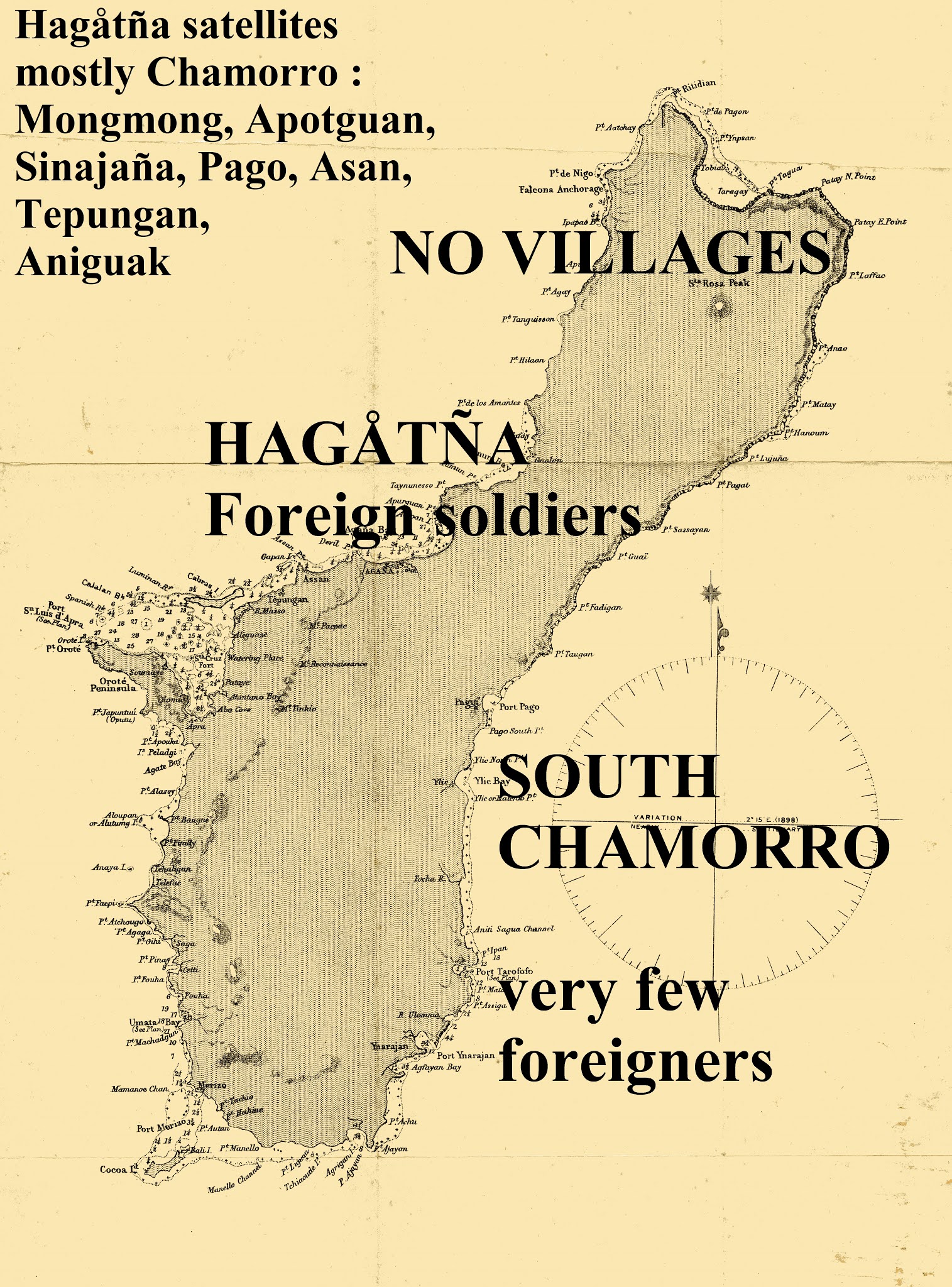
The foreign soldiers (Mexican, Filipino, the Spanish officers) lived in Hagåtña. This is where we find the Cruzes, Santoses, Pangelinans, Mendiolas and Camachos; a mix of those three ethnicities, from Mexico, the Philippines and Spain. Soldiers from abroad who didn't bring wives with them married Chamorro women, and the children of foreign soldiers took on Chamorro blood, language and culture.

The outlying satellite villages of Hagåtña (Aniguak, Asan, Tepungan, Apotguan, Mongmong, Sinajaña and Pago) were mostly Chamorro. There we find names like Ungacta, Materne, Gumataotao, Angoco, Terlaje, Maañao, Megofña, Taimanglo, Quidachay, Tedtaotao, Quichocho, Atoigue.

The southern villages were likewise mostly Chamorro with few foreigners. There we find names like Topasña, Aquiningoc, Nededog, Aguon, Afaisen, Naputi and Mantanoña.

Luta, as well, had few foreigners so the Ayuyu, Hocog, Songsong and Taisacan are strong there.

Although Maria most likely has Mexican, Spanish and Filipino additions, she is neither Mexican, Spanish or Filipino, just as a Filipino with a Chinese grandmother is not Chinese, just as a Spaniard with a French great grandmother is not French. People have additional strains of blood, but their predominant racial profile remains, and their ethnic identity is more than a matter of mathematics.

After all, Barack Obama's mother was Caucasian, but he is considered America's First Black President.


VERSIÓN ESPAÑOLA
(traducida por Manuel Rodríguez)

¿NO MÁS CHAMORROS?

Cuando yo era niño a veces escuchaba que ya no había chamorros auténticos.

Muchos años después, conocí a gente del sur de Guam y luego, gente de Rota que comenzaron a hacer sus árboles genealógicos.

Así que me reí de lo que había escuchado en el pasado: que ya no quedaba ningún chamorro real.

Tomemos por ejemplo a mi amiga María Espinosa Quinata, originaria de Merizo que desde hace muchos años vive en Santa Rita. La podemos ver en la imagen de arriba.

Cuando hice su árbol genealógico solo por el lado de su padre, todos los apellidos de ese lado son indígenas, con la excepción de dos.

Dado que los registros bautismales de Merizo se remontan a 1835, pude rastrear el árbol genealógico de María hasta tan atrás.

Aquí están todos los apellidos del lado de su padre que se remontan a la década de 1830:

EGUIGUAN
NAMASI
TAIJERON
CHARGUALAF
NASAYOF
BABAUTA

Ésos son apellidos indígenas chamorros. Los dos únicos apellidos que no son indígenas son

ESPINOSA
SAN NICOLÁS

La mitad de esos apellidos indígenas se basan en palabras tan antiguas que ya no las usamos, por lo que no estamos seguros de lo que significan.

“Namasi” es fácil de comprender, porque todavía usamos la palabra na'mase ', que significa "lamentable". “Chargualaf” es realmente chatgualaf, que significa "cazar mal a la luz de la luna". Gracias a un escritor español de finales del siglo XVII, sabemos que una palabra chamorra obsoleta para "bandera, emblema, símbolo" es babao, por lo que “Babauta” es babao-ta, "nuestra bandera, emblema o símbolo".

Si entendemos cómo los españoles deletreaban los apellidos chamorros en la forma en que los escuchaban sus oídos, podemos comprender cómo “Terlaje” es realmente tatlahe, que significa "ningún hijo" o "ningún hombre". Eso me hizo pensar que “Taijeron” es realmente taihilon. Hulon es una antigua palabra chamorra para "jefe, líder, gobernante, juez". El tai cambia de hulon a hilon, “ningún jefe”. Los españoles a menudo ponen una R donde debería estar una L. Pensemos en Inalåhan y Malesso' (Inaraján y Merizo).

Pero Eguiguan y Nasayof siguen siendo dudosos, o incluso desconocidos. No solo se han extinguido las palabras; incluso los apellidos han desaparecido.

En cuanto a Espinosa, es un apellido español muy conocido y ha estado en Guam desde principios del siglo XVIII. Pero no sabemos de qué país específico vino el fundador del clan Espinosa en Guam.

En cuanto a San Nicolás, ese apellido fue dado a veces por algunos sacerdotes españoles a los hijos naturales, en honor al santo agustino que era el patrón de esos sacerdotes. Entonces, San Nicolás es un apellido español, pero eso no significa que el padre del bebé fuera español. El padre biológico del bebé podría haber sido chamorro, pero el bebé recibió el nombre de un santo en español.

Entonces, cuando observo a María, tiene todas las características del indígena chamorro tal y como lo describieron muchos visitantes europeos hace 200 años. Fuerte y de huesos grandes. Toda esa sangre de Eguiguan, Nasayof, Chargualaf, Namasi y Babauta. Y del lado de su madre, Tedpahogo y Gofigan, que son más apellidos indígenas.

Debemos tener en cuenta la historia del movimiento y asentamiento de personas en el siglo XVIII.

Los soldados extranjeros (mexicanos, filipinos, oficiales españoles) vivían en Agaña. Aquí es donde encontramos a los Cruz, Santos, Pangelinan, Mendiola y Camacho; una mezcla de esas tres etnias, de México, Filipinas y España. Los soldados del exterior que no traían esposas se casaron con mujeres chamorras y los hijos de los soldados extranjeros adquirieron la sangre, la lengua y la cultura chamorras.

Los pueblos satélites periféricos de Agaña (Aniguak, Asam Tepungan, Apotguan, Mongmong, Sinajaña y Pago) eran en su mayoría de población indígena chamorra. Allí encontramos apellidos como Ungacta, Materne, Gumataotao, Angoco, Terlaje, Maañao, Megofña, Taimanglo, Quidachay, Tedtaotao, Quichocho, Atoigue.

Los pueblos del sur de Guam también eran en su mayoría indígenas chamorros con pocos extranjeros. Allí encontramos apellidos como Topasña, Aquiningoc, Nededog, Aguon, Afaisen, Naputi y Mantanoña.

Rota también tenía pocos extranjeros, por lo que los Ayuyu, Hocog, Songsong y Taisacan son comunes allí.

Aunque lo más probable es que María tenga adiciones mexicanas, españolas y filipinas, no es mexicana, española o filipina, al igual que un filipino con una abuela china no es chino, al igual que un español con una bisabuela francesa no es francés. Las personas tienen cepas de sangre adicionales, pero su perfil racial predominante permanece y su identidad étnica es más que una cuestión de matemáticas.