Saturday, October 12, 2013

FUNERALS ARE FOR....


...finding out who your relatives are.

Sometimes very close relatives!  Ahem.

Grandma says one day,

"Fan minagago hamyo!  På'go gi alas nuebe guaha bela gi gima'yu'us ya debi de en fan man asiste sa' parientes-miyo i matai."
"Put on clothes!  Today at nine o'clock there's a wake at the church and you have to attend because the deceased is your relative."

Says one child, "Haftaimano?"  "How?"

Grandma says, "Tåtan-miyo i matai!  Famatkilo ya na' fan listo hamyo!"
"He's your father.  Keep quiet and get ready!"

The child asks, "Lao håfa para in che'gue gi gima'yu'us?"
"But what are we going to do at church?"

Says grandma, "Fan matå'chong ha' ya mungnga manguentos solo man kuinentuse hamyo!"
"Just sit down and do not talk unless you are spoken to!"

"Ai adei nåna," says the child, "håfa na solo an esta måtai na in tingo' na tåtan-måme?"
"Oh my gosh grandma, why is it only when there's a death that we know who our father is?"

"Ti siña ma kuentuse esta!"
"He can't be spoken to already!"

As one person said in English, "At a funeral you hear the unheard."

Illegitimate births were considered very shameful in traditional Chamorro culture.  One never ever asked who one's father was.  Asking that could get you a slap or a spanking.

But the moment a father or grandparent died, sometimes the truth would come out and the children were sent to the rosary or funeral. 

Sometimes the illegitimate child/children were acknowledged and brought into the circle of mourners.

Other times, the illegitimate child/children were not acknowledged and sat there quietly, while people spoke about their presence under the breath.

It would be considered brazen for the illegitimate child to dress as a mourner without the permission of the legitimate children or widow.

Wednesday, October 9, 2013

ÅFOK HIMA

http://beachcomberonsaipan.blogspot.com/2007/12/ingredients.html


I heard recently about an old custom of making åfok, the slaked lime that is added to pugua' (betel nut) and pupulu (pepper leaf), from hima, the giant clam shell.

Like the limestone obtained from coral rock, the hima is baked in a hotno (oven) to a high degree.  When it is fully baked and cools, one just has to touch it and the shell falls apart like powder.

But you still had to sift (ma kula) the powder in a kolladot (wire strainer) to remove dirt, grass and other impurities.  Then you had åfok.  You added water, according to one's taste, to make it a paste if you wanted.  I was told that åfok hima was rather strong.


ÅFOK
(apog or apug in various Philippine languages)

Tuesday, October 8, 2013

CHAMORRO NICKNAMES : HUDAS


In our culture, be careful what and how you do, say and dress.  Because all is fair game when it comes to getting stuck with a nickname.

Our people were putting on plays a whole lot more back in the days before TV and the internet.  One church decided to put on a play during Lent about the betrayal of Jesus.  A lady tells me the story.

Guaha un taotao ni ma ayek na para guiya si Hudas.
(There was a man chosen for him to be Judas.)

Despues, annai esta monhåyan i play, humåhnanao ha' ma ågang gue' Hudas.
(Later, when the play was over, they kept calling him Judas.)

Åños yan åños despues, gigon ma li'e na mamamaila', ilek-ñiñiha i taotao, "Ei!  Atan sa' estague' si Hudas!"
(Years and years later, as soon as they that he is coming, the people were saying, "Hey!  Look because here is Judas!")

Yan magåhet, ti inestototba i taotao na ma å'ågang gue' Hudas.
(And it's true, that he wasn't disturbed that he was being called Judas.)

Lao annai sige mandångkulo i famagu'on-ña, ti yan-ñiha i famagu'on-ña na u ma ågang si tatan-ñiha Hudas.
(But when his children grew up, his children didn't like their father to be called Judas.)

Pues ha sangåne i parientes-ña yan atungo'-ña siha, "Båsta yo' ma ågang Hudas, sa' man pininite i famagu'on-ho."
(So he told his relatives and acquaintances, "Stop calling me Judas, because my children are hurt.")

Pues magåhet na mamåra i taotao ma ågang gue' Hudas gi me'nå-ña pat gi me'nan i pupbliko, lao entre hame ha' hunggan sige de in agang gue' Hudas!
(So it's true that the people stopped calling him Judas in front of him or in public, but among ourselves, yes, we kept calling him Judas!)

This remind me of the time, in my own parish, I had a religious play and chose a teenager to play the part of Jesus as he had nice, long hair already.  For years he was called "Jesus" by his peers.

Saturday, October 5, 2013

A CHAMORRO IN A HAWAII NURSING HOME


A brief stop in Hawaii gave me the opportunity to visit an elderly Chamorro lady from Saipan who is trying to recover enough strength in her Hawaii nursing home to get back home.

My half-hour visit opened my eyes to see how she and her family are not quite the same as other clients in the nursing home.

The lady is just one of three clients in the room.  In fact, she is the minority.  One out of three.  But she is the dominant flavor of the entire room.  It shows on her part of the wall.  Religious iconography cover every available inch.

But it's also because she has three adult children at her side.  They do not have shifts, since the home does not allow 24 hour visitation.  So, all three of her children are basically there the whole day and into the night, up till visiting hours end.  The other two clients, though residents of Hawaii, do not have any children, much less three, visiting all day.  One, unfortunately, gets no visits.  The other gets a visitor periodically.  Of the three Chamorro children, two live in Saipan and so have made the journey and taken extended leave from work to surround their mother with three children.  Not only does this provide the mother with a larger circle of family, it lightens the load on the children, who have three pairs of shoulders to share the weight.

The four of them pray in Chamorro and sing Chamorro hymns all throughout the day and night.  This does not disturb the other two clients.  In fact, one of them, the one who gets no visits, enjoys them.  Though not Catholic, she is Christian and appreciates the prayers and hymns.  Before I ended my visit, the Chamorro family asked me to bless this neighbor.  She was happy to be blessed.

The lady from Saipan is old enough to have learned Japanese in her youth when Saipan was under the Japanese.  Hawaii has many residents of Japanese ancestry.  The lady from Saipan told me that she would talk more with some of the clients in Japanese, except that many of them are not capable of conversing much.

Lastly, the children of this elderly lady made sure she had Chamorro food to supplement what she was being fed by the home.  I don't know whether they had the blessing of the nursing home or not, but there was saibok lemmai (breadfruit cooked in coconut milk) and I was given a Tupperware bowl of it to take with me, even though I would be boarding a plane in several hours!

The stark differences between this Chamorro lady and her children and the rest of the clients were very noticeable from the start.  Family, constant physical presence, food and the unashamed expression of religious faith were all strongly noted.

A sickly Chamorro woman was being nursed in Hawaii, but to a great extent in a very Chamorro way.

Friday, September 27, 2013

PRE-WAR CHARITY


Before the war, Bishop Olaiz organized the Saint Vincent de Paul Society for the relief of the very poor.  All over the world, local chapters of the Saint Vincent de Paul Society did the same, so the Bishop decided to start one for Guam.

It was headed by such prominent Guam business and civic leaders as Antonio Suarez, Vicente Calvo, Judge Manibusan, Jose M. Torres, Pedro Martinez and James Underwood, all seen in the photo above with Bishop Olaiz in the center and Påle' Blas on the right.

The group photo of the Society was taken in front of their own hall, built adjacent to the Agaña Cathedral around 1930.

The Society chipped in money and collected donations from the general public and gave these funds to the most needy families.

FORGOTTEN CHAMORRO : KÅTSA


Who can forget Margaret Dumont, the actress, always bedecked with the most elegant jewelry.

In Chamorro, we call that kåtsa.

It means to dress elegantly, with fine jewelry, or the smartest fashion for the men.

In the old days, "dressing up" made one stand out, and standing out in a Chamorro context always invites teasing.

A guy dressed to the nines walks into a store.

Says one, "Håfa?  Ginen mamano hao mågi?  Sa' ma kåtsa si pendeho!"

"So?  Where are you coming from?  Because the rascal is all dressed up!"

Again, this word is borrowed from the Spanish calza, a fashion term but it doesn't mean to be "dressed up."  We borrowed it, but gave it our own meaning.

Thursday, September 26, 2013

FALSE FRIENDS : LIBIÅNO


LIBIÅNO

In Chamorro, when something is easy to do, we say it is libiåno.

Libiåno ma sodda'.  Easy to find.

Libiåno ma kånta.  Easy to sing.

Although the word is Spanish in origin, we have given it a meaning that has strayed a bit from the original Spanish meaning.

In Spanish, liviano means "light" in weight.  They got it from the same Latin root that gives us the English word levity, or lightness (in weight or spirits).

But even in Spanish, different locales have given it secondary meanings, like "frivolous," "fickle" and even "lewd."

So our Chamorro ancestors also gave the word a new shade of meaning.

Something light in weight is easy to handle.  So libiåno came to mean "easy" in every way.

But it's a false friend in Spanish because you can't go to Spain or Mexico and ask that something be done the libiåno way.  They'll think you mean light in weight, not easy to do,

Wednesday, September 25, 2013

20 SIGNS YOU'RE NOW A "LOCAL STATESIDER"


My stateside dad has been living on Guam continuously since 1959 and is definitely "local statesider."  It got me wondering what are the tell-tale signs that a statesider has become local.

1. Understands that the 35mph signs are just reminders how we used to drive in 1974.

2. Goes to the Talofofo fiesta, even though he or she's not Catholic.

3. Figures out immediately how two people are related.

4. Skips straight to the Assistant Manager, whom s/he knows, rather than speak to the Customer Service Representative.

5. Isn't bothered by geckos anymore; believes they're good because "they eat the bad bugs."

6. Prepares all morning to spend the day at the beach, and once there looks for the most shade.

7. Goes to Kentucky Fried Chicken for the kelaguen.

8. Finds him/herself secretly tuning into the Chamorro radio station while driving alone.

9. Still doesn't speak Chamorro, but adds "nai" at the end of English sentences.

10. When waiting at a red light, doesn't dare look over to the next driver.

11. Knows the name of his/her mayor.

12. Can never go to any store without saying "hi" to at least one person.

13. Knows that "Abe Maria Purisima" is the end of any rosary.

14. Drives down south, passes a carabao without even looking at it.

15. Is single with no family, but still has to visit someone at GMH.

16. Actually has reasons NOT to vote for some senatorial candidates.

17. Bush cuts in zori.

18. Looks for the soy sauce, tabasco or tooth pick in any restaurant of any cuisine.

19. Walks through Micronesia Mall and says to self, "So many statesiders now on Guam!"

20. Has a second fridge; outside the house.

Monday, September 23, 2013

TODAY'S CHAMORRO WORD : MÅSMAI


MÅSMAI : drenched, soaked

More people are familiar with the word fotgon.  But fotgon means wet; måsmai goes further.  It means someone or something is totally soaked.

Måsmai masahalom.  Soaked in one's sweat.

Måsmai håga' chininå-ña si Jose.  Jose's shirt is soaked in blood.

Måsmai yo' gi ichan.  I was soaked in the rain.


The word måsmai is a contraction of ma sumaiSumai means to submerge in water or liquid.

SPANISH HYMN IN SAIPAN


September 24 is the feast of Our Lady of Mercy.  Up in Saipan, since 1928, the Mercedarian Missionaries of Berriz (Spain) have been ministering and brought this hymn to that island.

It is not sung anymore by the people, but we still have the music and lyrics.

The lyrics can be found here :

http://soltorres.udl.cat/bitstream/handle/10459/561/LLG-1-0356.pdf?sequence=1

 
En Español

Llegaron a Saipan (Islas Marianas) las Misioneras Mercedarias de Bérriz (Vizcaya) en el año 1928.  Enseñaron  a unas alumnas este Himno a la Orden Mercedaria pero, lamentablemente, ya no se canta este himno en aquella isla.  Conservamos las letras y la solfa y, para complacer la solicitud de un amable lector, he puesto aquí esta grabación del himno.

Friday, September 20, 2013

COMMON MISTAKES IN CHAMORRO PRAYERS


Nowadays there is a bit of an attempt to keep praying in Chamorro alive, but, as younger Chamorros who are less proficient in the language take leadership in this, they may not be aware of some of the more common mistakes being made when praying in Chamorro.

Here is, I hope, a simple guide to help us watch out for these.

TATAN-MÅME (Our Father)

Mistake : Asi'e i tano', komo gi langet

Correct : Asi gi tano', komo gi langet

Explanation : The English is, "On earth, as it is in heaven."  When the missionaries translated this into Chamorro, their rendering was "as it is on earth, as in heaven."  They used the Spanish word así, which means "like this" or "like that."  The stress is on the second syllable; aSI.

If you say, "Asi'e i tano'" you are saying, "Forgive the world," which is not what the Our Father says.  What makes even less sense is the rest of the sentence, "as it is in heaven."  "Forgive the world, as it is in heaven."  God doesn't forgive anyone in heaven.  That's how they got to heaven; they were forgiven first while on earth.

So, once again, the English is, "Thy will be done, on earth, as it is in heaven."  We're talking about God's will being done on earth as God's will is done in heaven.  No talk about forgiveness here.

"U ma fa'tinas i pinto'-mo, asi gi tano', komo gi langet."

"May your will be done, like on earth, as in heaven," would be a more literal translation of the Chamorro.

Older Chamorros, more accustomed to Spanish, would have understood the word así.  But modern Chamorros, cut off as it were from their Spanish influences, don't recognize the word así and confuse it with asi'e.

SI YU'US UN GINEGGUE MARIA (Hail Mary)

Mistake : Si Yu'us u gaige giya hågo

Correct : Si Yu'us gaige giya hågo

Explanation : In the Hail Mary, in English, we say, "The Lord is with you."  It's a declarative statement.  It declares something existing.  The Lord IS with Mary.  Not will be; not we hope will be; but rather IS.

The Chamorro word u is a future marker.  It means "will be" or "hopefully will be."

Siempre u ma cho'gue agupa'.  It will surely be done tomorrow.

Puede u ma cho'gue agupa'.  Hopefully it will be done tomorrow.

When we say, "Si Yu'us u gaige giya hågo," we are saying, "May the Lord be with you," or, "The Lord will be with you." 

This is not only linguistically inaccurate, it is also theologically off.  The whole point Gabriel was making was that Mary was "full of grace,"  connected with God in a way radically different from the rest of Adam's race, who were cut off from God by Adam's sin.

Mistake : U ma tuna hao entre todo i famalao'an

Correct : Ma tuna hao entre todo i famalao'an

Explanation : Same mistake; the improper use of u.  "U ma tuna hao" means "You will be praised/blessed" or "May you be praised/blessed."  But this is erroneous.  Gabriel was making a declarative statement.  Mary IS praised/blessed among all women.

Mistake : Ya u ma tuna i finañagu-mo as Jesus.

Correct : Ya ma tuna i finañagu-mo as Jesus.

Explanation : Same thing.  Jesus will not BE praised/blessed (u ma tuna) but is in fact praised/blessed (ma tuna).

Possible Source of the Confusion

In the Glory Be, we say "U ma tuna i Tata, yan i Lahi-ña, yan i Espiritu Santo."

There we do use the u, because in this particular prayer we are wishing glory to God.  Of course God is already glorified, whether we glorify Him or not.  God doesn't need anyone to glorify Him; He is glorious in Himself whether anybody knows it or not.

But in our worship and adoration of Him, we desire to give Him our glory.  That's where the u comes in.  U expresses something that will happen in the future, or which we wish will happen in the future, even if the future means in the next few seconds.

ABE MARIA PURISIMA

In this short prayer (ejaculation) which is unique among Spanish-speaking and Spanish-influenced places, we say :

Abe Maria Purisima, sin pekådo konsebida.  (Hail Mary most pure, conceived without sin.)

Mistake : Sen pekådo konsebida.

Correct : Sin pekådo konsebida.

Explanation : This prayer is actually in Spanish, pronounced the Chamorro way.  The original Spanish is "sin pecado concebida."  "Conceived without sin."

Sin is Spanish and Chamorro for "without."

Sen is Chamorro for "very much."

If we say, "Sen pekådo," we are saying, "Very much sin."  Not something we want to say about the Mother of God.

Thursday, September 19, 2013

DEER HUNTERS IN 1872


Guam's deer, or benådo, were brought to the island by Governor Mariano Tobias in the early 1770s.

They became so rampant that they damaged crops, including the governor's own garden behind his Palacio.

In 1872, we see a list of deer hunters on Guam.  They were :

Juan del ESPIRITU SANTO
 
Pedro PEREZ
 
Tomas IRIARTE
 
Andres DELGADO
 
Mariano de CASTRO
 
Alberto GARCIA
 
Antonio NAMAULEG

Wednesday, September 18, 2013

KATESISMO #10

29. Kuånto siha na Yu'us guaha?

Tåya' mås na un Yu'us ha' na maisa.

30. Kuånto siha na Petsona guaha gi as Yu'us?

Gi as Yu'us guaha tres na Petsona : I Tata, i Iho yan i Espiritu Santo.

31. Kao guaha håye guine gi tres na Petsona mås åmko' pat mås na'siña ke i palo?

Tåya'; I tres na Petsonan Yu'us hagas ha' man gaige desde åntes de todo i tiempo, ya siha man chagaisiña, man chamaulek ya man chakabales.

32. Håf ta fa'nana'an este na misterion un Yu'us gi tres na Petsona?

I misterion un Yu'us gi tres na Petsona ta fa'nana'an i misterion i Santisima Trinidåt.
 
 
NOTES

Maisa : alone, by itself

Iho : Spanish, but used by older Chamorros along with låhe for "son"

Cha : prefix meaning "equally"

Gai : to have

Fa'na'an : Fa' (to make), nå'an (name); "to call"

Tuesday, September 17, 2013

FINO' GUAM, FINO' SAIPAN


In Saipan and Guam, we basically eat the same food and call them the same names, but sometimes the names are totally different.  If you ask for that food in Saipan using the Guam name, they may not know what you are talking about, and the same holds true for Guam if you use the Saipan name.

In both islands, we all eat bananas, breadfruit, taro and other starches cooked in coconut milk.  But on Guam we call it gollai åppan.  In Saipan, it is called saibok.

Gollai means "vegetable," related to the Tagalog word gulay

Åppan means "to evaporate, extract liquid, dry."

Saibok means "to cook in coconut milk."

It's interesting that almost all the Chamorro families in Saipan come from Guam families that moved up there between 100 and 150 years ago.  That's not a long time span, and there's only 120 miles that separate us, but little differences in language have evolved nonetheless.

Monday, September 16, 2013

FAMILY NICKNAMES : KOTLA


KOTLA

A huge branch of the Pangelinan family is better-known-as the Kotla family.

Where Chamorro families got their nicknames is often a mystery.  Sometimes the origin is easy to figure out, especially when the nickname comes from the name of an ancestor such as the Siket (Castro) family, named for their ancestor Ezequiel (Siket) or the Nåndo family (Peredo), whose ancestor was Fernando.

Other times, the family has preserved a family story, such as the Charot (Taitano) clan which has the lore that their ancestor was given a pair of shoes known as charol in Spanish.

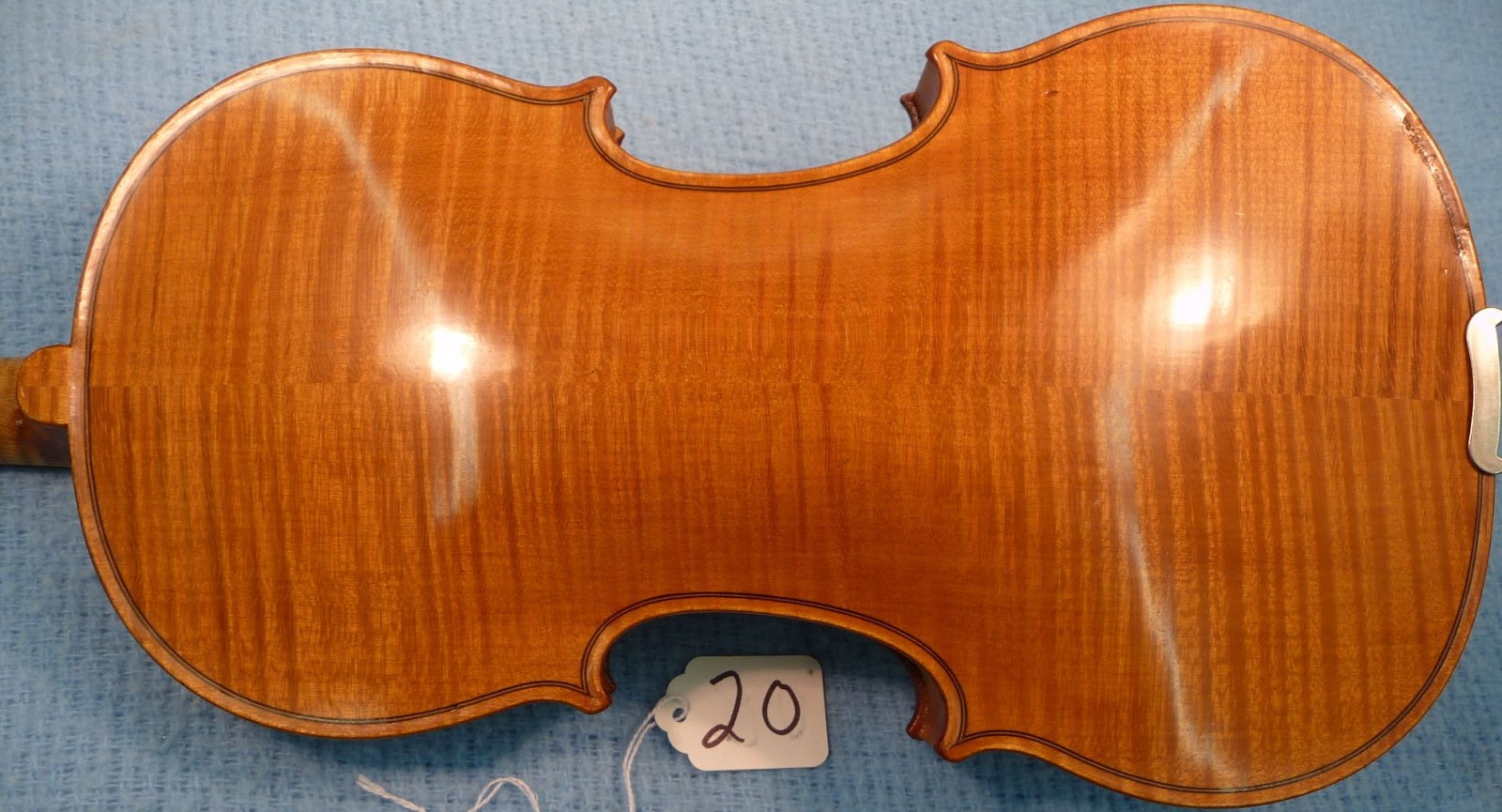
As for Kotla, if we looked for a Spanish origin, it is possibly derived from an old Spanish term corlar, which means to apply a gold varnish on something, like the beautiful violin in the picture above.

Spanish corlar becomes Chamorro kotla, because Chamorros change an L or an R to a T when it's the final sound in a syllable. Another example of this would be ÅTTAT, which comes from Spanish altar. Notice that the L and the R are the final sounds of their syllables, and Chamorro changes them into a final T.

Juan Flores Pangelinan is the first documented person we know who was called Kotla. Why? I have no idea, and, as far as the family is concerned, there are a few theories but no one can guarantee their theory.

But since kotla means "to varnish," could it be that Juan worked in varnishing? Or perhaps he varnished something so well that people nicknamed him kotla. Chamorros loved to tease, and would tease you for something that stood out about you, even if it were a one-time event. Juan was a big landowner; he owned a lot of property in the Hågat and Sumay areas and their surroundings. The land records are still existing, in large part. He owned that land because he worked that land, growing, harvesting and selling.  People in those days made a lot of things by hand (there was no Home Depot). This includes the tools they used for farming, carpentry and so on. Varnishing would have been a part of that work.

But, the truth is, we have no solid evidence how the nickname came about. We only know what it means, if indeed Kotla comes from corlar.


SIGNATURE OF JUAN KOTLA IN 1898
He didn't need to add his first name Juan. His flourish at the end of his surname was enough identification.